Have you ever wondered about this confusion in writing? Many people feel confused about atleast and at least. It appears in emails, essays, and social media posts often. This writing mistake happens in everyday English very easily. This issue is common in professional documents and everyday English usage. Many writers overlook the correct spelling, which leads to confusion.
The phrase looks like a single word but is not. Both forms look similar, but only one is correct. This small difference affects clarity communication in writing. atleast is a common spelling mistake and should be avoided. Using the wrong form impacts clarity communication and makes writing look less professional. It is often seen in social media posts where rules are ignored.
Always write it as two words: at least. This simple rule improves grammar and makes English clear and professional. Choosing the correct option helps in a minimum amount or number situation. It helps sentences sound natural and easy to understand. Following the simple rule strengthens grammar improvement and ensures better sentence structure. It also supports correct usage in emails and essays.
Thousands of searches show people still feel confused. English grammar rules clearly reject the wrong form. Good news is the correct spelling is simple to remember. Learning usage builds confidence in everyday writing. Mastering this helps avoid a writing mistake and improves writing confidence over time. It is widely searched by students and content writers seeking clarity.
Atleast or At Least Correct Usage and Meaning Explained Simply
Let’s get straight to the point.
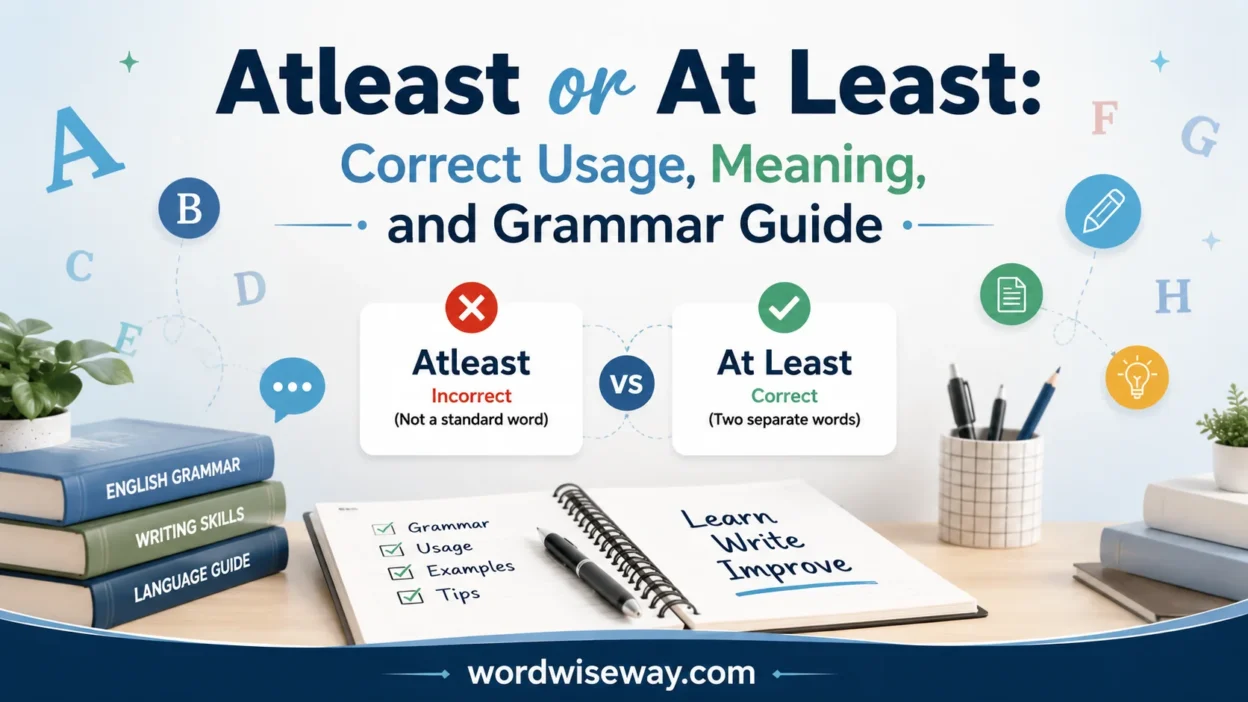
- Correct: at least
- Incorrect: atleast
The correct phrase always has a space because it is made of two separate words:
- “at”
- “least”
Together they form a phrase that means minimum amount, minimum expectation, or no less than a certain level.
You will see it in writing, exams, emails, and professional communication everywhere. The spaced version is the only accepted form in standard English.
Meaning of At Least in Everyday English
The phrase at least works like a measuring line. It sets a minimum point.
Think of it as saying:
“This is the lowest limit. Anything equal or above this is fine.”
Simple meanings include:
- No less than
- Minimum amount
- Even if nothing more happens
- As a bare minimum
Now let’s break it into real-life situations so it actually sticks.
Quantity meaning
- I need at least 3 hours to finish this task.
- She brought at least 10 notebooks.
Time meaning
- Wait at least 5 minutes before calling again.
- The journey takes at least 2 hours.
Effort or expectation
- At least try before giving up.
- You should at least listen carefully.
The phrase sets a floor, not a ceiling.
Why “Atleast” Is Incorrect in English
Now comes the part that clears confusion for good.
“Atleast” is not a word in standard English
It exists only as a common spelling mistake. English grammar rules treat it as incorrect because:
- It merges two separate words incorrectly
- It does not follow standard phrase structure
- It is not accepted in exams or formal writing
Why people still use it
Let’s be honest. It happens for simple reasons:
- Fast typing on phones
- Autocorrect habits
- Social media shortcuts
- Lack of proofreading
Once someone sees it enough online, it starts looking “normal” even though it is not correct.
Important reality check
If you write “atleast” in:
- Academic exams
- Professional emails
- Job applications
- Articles or blogs
It will be marked as an error.
Read More: In Fact or Infact: Which Is Correct?
Correct Usage of At Least With Real Examples
Now let’s make this phrase feel natural in your writing.
At least for quantity
- You should drink at least 8 glasses of water daily.
- The class had at least 30 students today.
- I need at least 2 pens to complete the task.
At least for time
- The project will take at least one week.
- Wait at least 10 minutes before opening it.
- She studied at least 3 hours yesterday.
At least for advice or effort
- At least try before saying it is impossible.
- You should at least ask for help.
- He could at least respond to the message.
At least for emotional or situational relief
- At least it did not rain during the event.
- At least you arrived safely.
- At least we know what went wrong.
This use often carries a comforting tone.
Common Mistakes People Make With At Least
Even if people know the rule, mistakes still sneak in.
Writing it as one word
- Incorrect: I need atleast 5 minutes
- Correct: I need at least 5 minutes
Confusing it with “almost”
- Incorrect idea: At least means almost
- Correct meaning: It means minimum, not nearly
Overusing it in casual writing
People sometimes add it too often:
- At least I tried
- At least I came
- At least I saw it
While correct, repetition can make writing sound flat.
Forgetting spacing in fast typing
This is the most common issue. Speed beats accuracy in chats.
Simple Trick to Remember the Correct Form
Here’s a memory trick that actually works.
Split it mentally:
- at + least = two words
Now test it:
- Can you separate them? Yes
- Does “atleast” make sense alone? No
That alone solves the confusion.
Quick analogy
Think of it like a stop sign:
- “at” is the starting point
- “least” is the minimum limit
They are connected but not merged.
At Least vs Similar Expressions
Let’s compare it with similar phrases so you don’t mix them up.
| Expression | Meaning | Example |
| at least | minimum amount | at least 5 minutes |
| at most | maximum limit | at most 10 people |
| at best | best possible case | at best, it might work |
| at worst | worst possible case | at worst, we try again |
Key difference
- At least = minimum
- At most = maximum
If you mix these up, your meaning flips completely.
Where At Least Is Commonly Used
You will see this phrase everywhere in daily life.
Education
- Assignments
- Exams
- Essays
- Study plans
Digital communication
- WhatsApp messages
- Instagram captions
- Comments and replies
Professional writing
- Emails
- Reports
- Articles
- Proposals
Everyday speech
- Conversations
- Instructions
- Advice
It is one of the most flexible English phrases.
Test Yourself
Try spotting correct and incorrect usage.
Question 1
I need atleast 5 minutes to finish this.
Question 2
She should at least try once.
Question 3
We waited atleast an hour for the bus.
Answers
- Question 1: Incorrect
- Question 2: Correct
- Question 3: Incorrect
If you got them right, you’ve got the rule locked in.
Case Study: Why Small Spacing Mistakes Matter
Let’s look at a real writing scenario.
Scenario
A student submits an essay with multiple instances of “atleast.” The teacher marks it down even though the ideas are correct.
Outcome
- Content quality: Good
- Grammar score: Reduced
- Final grade: Lower than expected
Lesson
Small spelling errors affect credibility. Even tiny ones like spacing can influence perception.
Now flip the scenario.
A polished version uses:
- at least correctly throughout
Result:
- Higher clarity
- Better evaluation
- Stronger impression
Small fix. Big difference.
Expert Note on Language Precision
Linguists often highlight something simple:
“Precision in grammar is not about complexity. It is about consistency.”
Using at least correctly shows attention to detail. It tells readers you care about clarity.
Frequently Asked Questions
Q1. Why do people write “atleast” instead of “at least”?
People often combine it because it looks like a single phrase in fast reading and informal writing, especially on social media.
Q2. Which is correct: atleast or at least?
The correct form is at least, as English grammar rules always separate the two words.
Q3. Is “atleast” accepted in formal English?
No, atleast is considered a writing mistake and is not accepted in professional documents.
Q4. Why is “at least” written as two words?
Because “at” and “least” serve different grammatical roles, forming a correct minimum amount number situation expression.
Q5. Where is this mistake commonly seen?
It is often seen in emails, essays, and social media posts where informal writing is common.
Q6. Does this mistake affect clarity?
Yes, using atleast instead of at least can reduce clarity communication and make writing less professional.
Q7. How can I remember the correct form?
Follow a simple rule: always write it as two words, which improves grammar improvement and sentence flow.
Q8. Is this a common spelling mistake?
Yes, atleast is one of the most common spelling mistakes in everyday English usage.
Q9. Can students make this mistake in exams?
Yes, students often confuse it in essays and written exams due to fast writing habits.
Q10. What is the best way to avoid this error?
Practice correct usage in emails, essays, and daily writing to build confidence and accuracy.
Conclusion
The confusion between atleast and at least is one of the most common issues in everyday English usage, especially for learners, students, and even experienced writers. The main reason behind this mistake is that the phrase looks like it could function as a single word, but English grammar clearly separates it into two parts. Only at least is correct, and it should always be used in emails, essays, social media posts, and professional documents to maintain clarity and correctness.
Understanding this small but important rule significantly improves writing quality, grammar accuracy, and overall communication clarity. When writers consistently avoid the incorrect form atleast, their language instantly appears more polished and professional. With regular practice and awareness, this simple correction becomes automatic, helping learners build stronger confidence in English writing and reducing one of the most frequent writing mistakes found in daily communication.

Emma Smith has dedicated 14 years to Princeton University’s English Department, mentoring students in textual interpretation, literary movements, and critical frameworks. Her research explores Shakespearean drama, Victorian serial fiction, postcolonial narrative theory, and manuscript studies and probing how literary forms evolve across cultures and centuries. Emma has delivered lectures at international humanities congresses and published findings in distinguished academic journals, underscoring her commitment to scholarly depth and vibrant teaching.