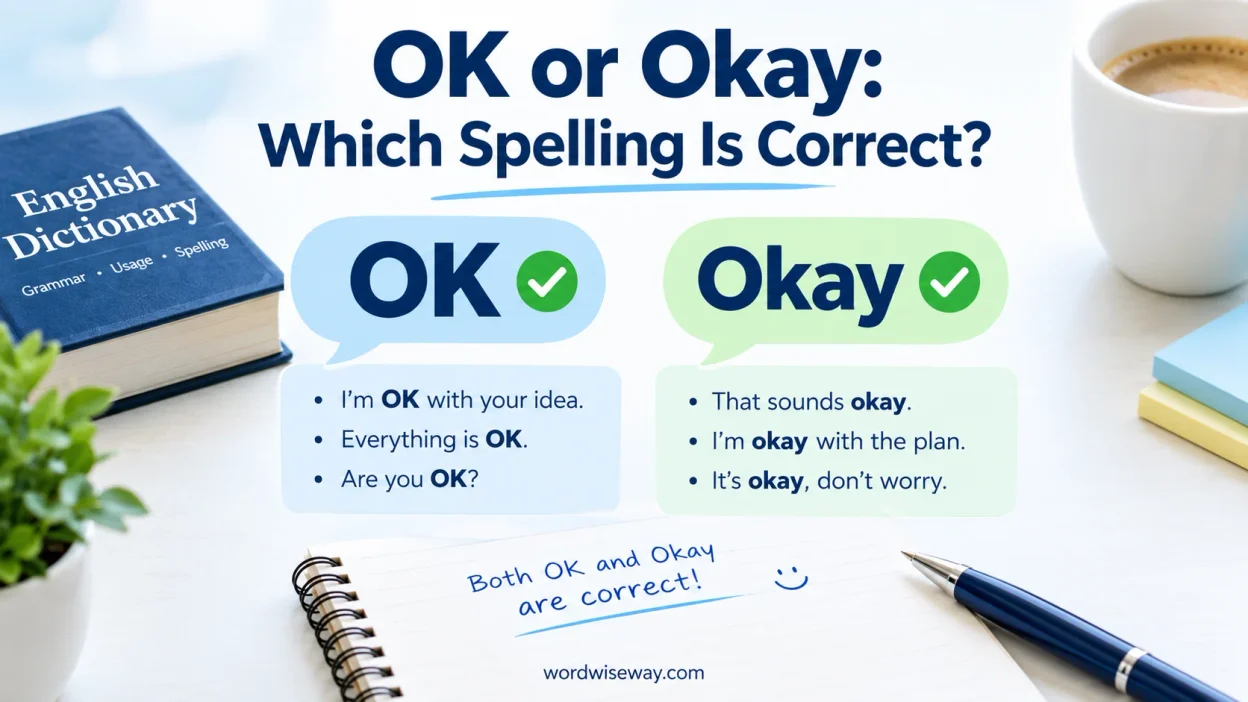
OK or Okay: Correct Spelling, Meaning, and Difference explains why both forms can look different yet share the same meaning.
The difference usually comes from usage, style, and context rather than definition. Both are acceptable spellings in everyday English.You’ll see OK and Okay in texting, school writing, conversations, workplace emails, social media, and professional writing.
This wide use can cause confusion for learners who have spelling doubts about which version sounds more formal or correct. However, both forms remain widely understood.In most situations, OK and Okay express agreement, acceptance, or acknowledgment. Tone, formality, and region can influence your choice.
Native speakers use both, so you can confidently use either form while keeping your communication clear and professional for readers in everyday writing too.
Quick Answer:
OK and okay are both correct spellings. They generally have the same meaning and pronunciation.
Use OK when you want the shorter, compact form. It works especially well in brief responses, signs, labels, messages, and casual communication.
Use okay when you prefer the complete alphabetic form. It often fits smoothly into ordinary prose and conversational sentences.
| Question | Answer |
| Is OK correct? | ✓ Yes |
| Is okay correct? | ✓ Yes |
| Do they usually mean the same thing? | ✓ Yes |
| Is okay simply a misspelling of OK? | ✗ No |
| Is OK always more formal? | ✗ No |
| Is okay always more formal? | ✗ No |
| Is Okey the standard spelling? | ✗ No |
| Can both appear in professional writing? | ✓ Yes, depending on context and style |
Cambridge Dictionary lists okay as also spelled OK and gives both forms grammatical uses as an exclamation, adjective, adverb, verb, and noun.
Key Difference
The main difference isn’t meaning. It is form and style.
OK is compact and visually distinctive. Because it consists of two letters, it works particularly well when space matters or when someone wants a quick response.
Okay looks more like an ordinary full English word. Writers often choose it in flowing prose, dialogue, and sentences where they want the expression to blend naturally with surrounding words.
Consider these examples:
- “OK, I’ll call you later.”
- “Okay, I’ll call you later.”
- “Is everything OK?”
- “Is everything okay?”
The meaning remains essentially the same. The spelling changes, but the underlying expression does not.
Is OK Correct?
Yes. OK is a correct and established English form.
It isn’t merely internet shorthand. Dictionaries recognize it as a genuine English word with several grammatical functions. Cambridge, for example, lists OK as an exclamation, adjective, adverb, noun, and verb.
You can use OK to show agreement:
“Can you send the file today?”
“OK.”
You can use it to describe something acceptable:
“The revised schedule looks OK.”
You can also use it to describe a satisfactory condition:
“Are you OK?”
The form appears frequently in short communication because it delivers meaning with remarkable economy.
Is Okay Correct?
Yes. Okay is equally correct.
In fact, okay isn’t an informal mistake created by people expanding the abbreviation. It has become an established spelling in its own right.
Cambridge Dictionary lists okay as an alternative spelling of OK and describes its use as a discourse marker, adjective, and adverb.
For example:
- “Okay, let’s start.”
- “Are you okay?”
- “The results were okay.”
- “Did you sleep okay?”
The full spelling can feel particularly natural when it appears repeatedly in ordinary prose.
OK vs. Okay Comparison Table
| Feature | OK | Okay |
| Correct English form | ✓ | ✓ |
| Same basic meaning | ✓ | ✓ |
| Used as an interjection | ✓ | ✓ |
| Used as an adjective | ✓ | ✓ |
| Used as an adverb | ✓ | ✓ |
| Used as a noun | ✓ | ✓ |
| Used as a verb | ✓ | ✓ |
| Common in conversation | ✓ | ✓ |
| Common in messages | ✓ | ✓ |
| Suitable for professional contexts | Depends on style | Depends on style |
| Standard spelling | ✓ | ✓ |
What Does OK Mean?
OK can carry several related meanings depending on the sentence.
Most commonly, it expresses agreement, acceptance, permission, or satisfactory condition. Cambridge Dictionary also records its use when someone wants to check whether another person understands or agrees.
Here are some common meanings.
OK Means Agreement
When someone says OK, they may mean “I agree” or “I accept.”
“Let’s meet at seven.”
“OK.”
The response doesn’t necessarily mean enthusiasm. It simply confirms acceptance.
OK Means Acceptable
You can use OK to describe something that meets a reasonable standard.
“The revised plan is OK.”
Here, OK means acceptable or satisfactory.
OK Means Safe or Well
You can ask whether someone is OK when you’re checking their condition.
“You fell down. Are you OK?”
In this context, the word can mean safe, healthy, or not seriously harmed.
OK Can Mean Permission
The expression can also refer to approval.
“Did you get the OK from your manager?”
Here, OK functions as a noun meaning permission or approval. Cambridge Dictionary specifically lists this noun use.
What Does Okay Mean?
Okay carries essentially the same core meanings as OK.
It can mean acceptable, satisfactory, safe, healthy, permitted, or agreed depending on context.
For example:
“Is it okay if I leave early?”
Here, okay means acceptable or permitted.
In another sentence:
“Don’t worry. Everything will be okay.”
The word expresses reassurance.
However, okay can also communicate a less positive evaluation.
“The movie was okay.”
This often means the movie was acceptable but not especially impressive. Context and tone do a lot of the heavy lifting.
OK or Okay as Different Parts of Speech
One reason this expression is so useful is its grammatical versatility.
OK or Okay as an Adjective
Both forms can describe something as acceptable, satisfactory, or safe.
Examples:
- “The food is OK.”
- “The food is okay.”
- “Are you OK?”
- “Are you okay?”
- “Is it OK to start?”
- “Is it okay to start?”
In each case, the word describes a condition, standard, or level of acceptability.
OK or Okay as an Adverb
Both forms can also describe how something happens.
“Did you sleep OK?”
“Did you sleep okay?”
Here, the expression means something like “satisfactorily” or “well enough.”
Cambridge Dictionary gives examples of OK/okay functioning as an adverb to describe something happening satisfactorily.
OK or Okay as a Verb
OK can function as a verb meaning to approve or authorize something.
“The director OK’d the proposal.”
You can also use okay as a verb:
“The director okayed the proposal.”
Cambridge records both OK and okay as verbs and gives forms such as OK’d, OKing, okayed, and okaying.
In edited writing, the exact form may depend on the publication’s style preferences.
OK or Okay as an Interjection
As an interjection, OK and okay can signal agreement, understanding, a transition, or the start of an action.
“OK, let’s begin.”
“Okay, let’s begin.”
Cambridge’s grammar guidance notes that okay/OK can work as a discourse marker when speakers agree, change topics, check understanding, or move to another stage of a conversation.
That makes the word especially common in spoken English.
Is OK More Formal Than Okay?
Not automatically.
It would be misleading to say that OK is always informal while okay is always formal. Both forms occur in informal English, and neither spelling alone determines the overall register of a sentence.
For instance:
“Are you OK?”
and
“Are you okay?”
Both sound perfectly natural in everyday English.
The surrounding situation matters more.
A legal document, academic paper, company policy, or technical report may require a more precise term such as acceptable, approved, satisfactory, or authorized. In such cases, replacing that precise term with OK or okay may reduce clarity.
The important distinction is therefore context, not a simple formal-versus-informal rule.
Is Okay More Professional Than OK?
There is no universal rule saying that okay is more professional than OK.
Professional writing follows the style conventions of the organization, publication, or project. A company might prefer one form for consistency. Another organization may use the other.
For example:
“The proposal is OK for publication.”
is understandable.
So is:
“The proposal is okay for publication.”
However, a formal report might instead say:
“The proposal is approved for publication.”
That third version removes the conversational ambiguity and states the exact status.
This distinction matters because OK/okay can mean anything from “acceptable” to “fine” to “approved,” depending on context.
When Should You Use OK?
Choose OK when the compact form fits your context naturally.
Common situations include:
- Short responses: “OK.”
- Text messages: “OK, I’ll be there.”
- Brief confirmations: “OK, received.”
- Labels: “OK to proceed.”
- Dialogue: “OK, let’s go.”
- Quick questions: “Are you OK?”
Its brevity gives it a crisp visual quality.
For example, a button, sign, or short instruction may benefit from the compact form because two letters take very little space.
When Should You Use Okay?
Choose okay when you prefer the full spelling or when it flows better in your prose.
It works naturally in:
- Conversational writing
- Dialogue
- Personal messages
- General prose
- Explanations
- Questions about permission or condition
For example:
“Is it okay if we move the meeting to Friday?”
The full form fits comfortably into the sentence.
Likewise:
“Everything is okay now.”
The word doesn’t feel abbreviated or visually abrupt.
OK, Okay, O.K., or Okey?
Several forms appear in English-language writing, but they don’t have equal status.
OK
OK is a standard modern spelling.
It is short, recognizable, and widely used.
Okay
Okay is also a standard spelling.
It represents the same expression and has the same basic pronunciation and meanings.
O.K.
O.K. is an older punctuated form.
You may encounter it in older books, historical documents, or publications following particular style conventions. Modern writers generally encounter OK more often.
Okey
Okey isn’t the standard English spelling of this expression.
If you mean the familiar English expression, use OK or okay instead.
Why Are Both OK and Okay Used?
The history of OK is unusually interesting for such a tiny word.
The form emerged in the United States during the 19th century. One well-documented early use appeared in print in 1839 in the Boston Morning Post. The word emerged during a period when playful abbreviations and intentionally humorous misspellings were fashionable.
The famous explanation connects OK with “oll korrect,” a humorous misspelling of “all correct.” That explanation is supported by historical evidence.
Another important episode came during the 1840 presidential campaign. OK became associated with Martin Van Buren’s nickname, “Old Kinderhook,” because Van Buren came from Kinderhook, New York. The political campaign helped spread an already existing expression even further.
The history matters because it explains why OK doesn’t behave like an ordinary abbreviation today. Over time, it became a fully established part of everyday English.
The modern okay spelling developed alongside the expression and became firmly established as a full-word form.
The Origin of OK
The origin of OK has attracted plenty of competing stories over the years.
Some popular explanations connect it to phrases involving ships, military language, Native American languages, or foreign expressions. These stories have circulated widely, but they don’t have the same historical support as the documented 19th-century evidence.
The “oll korrect” explanation has particularly strong historical support because an early printed example survives from 1839.
The political use connected with Old Kinderhook is also historically significant. However, it isn’t generally treated as the original creation of the expression. Instead, the campaign helped popularize an expression that was already in circulation.
That distinction is easy to miss.
OK didn’t suddenly appear because of the presidential campaign. The political connection helped spread it.
OK vs. Okay in American English
In American English, both OK and okay are widely understood and accepted.
You’ll encounter OK in compact communication:
“OK, I’ll handle it.”
You’ll also see okay throughout ordinary prose:
“It’s okay to ask questions.”
Neither sentence requires a correction.
The better choice depends on the writing context, surrounding words, and any applicable style guide.
OK vs. Okay in British English
British English also uses both forms.
Cambridge Dictionary’s British English resources list okay and OK as alternative forms and document their use as interjections, adjectives, and adverbs.
Therefore, OK isn’t an exclusively American spelling, and okay isn’t restricted to British English.
Both forms have become international features of English.
Common Expressions
“Are You OK?”
This usually asks whether someone is safe, well, or feeling all right.
“You look tired. Are you OK?”
The full form works just as well:
“You look tired. Are you okay?”
“It’s OK.”
This can mean that something is acceptable or that a situation isn’t a problem.
“I’m sorry I’m late.”
“It’s OK.”
Depending on tone, the phrase can sound reassuring, neutral, or even slightly dismissive.
“Okay, Then.”
This phrase often signals a transition.
“Okay, then, let’s start.”
It can mean that the speaker has accepted the situation and is ready to move forward.
“OK With Me”
This expression means something is acceptable to the speaker.
“Friday works OK with me.”
A more formal alternative might be:
“Friday works for me.”
“Is That Okay?”
This asks whether something is acceptable or permitted.
“Is it okay if I bring my sister?”
This is especially common when asking for permission.
“OK, Got It.”
This usually signals understanding.
“The meeting starts at nine.”
“OK, got it.”
Here, OK doesn’t mean that the meeting itself is satisfactory. It signals that the listener understands the information.
Common Grammar and Usage Questions
Is OK a Word?
Yes. OK functions as an established English word.
Dictionaries list it in several grammatical roles rather than treating it merely as an informal abbreviation.
Is Okay a Word?
Yes. Okay is also a standard English word.
Cambridge explicitly treats okay as an alternative spelling of OK.
Is OK a Short Form of Okay?
Historically, the relationship is more complicated than simply saying that one is a shortened version of the other.
OK developed as an abbreviation-like expression in the 19th century. Okay later became an established spelling representing the same spoken form.
Today, however, the two forms generally function as spelling variants of the same expression.
Can OK and Okay Be Used Interchangeably?
Usually, yes.
You can write:
“Are you OK?”
or:
“Are you okay?”
Both are grammatical.
Still, a particular publication, company, school, or editor may have a preferred style. When a style guide gives a specific instruction, consistency matters.
Is “O.K.” Still Correct?
O.K. is recognizable and historically established, but it is less common in modern general writing than OK.
Whether you should use it depends on the style system you’re following.
Is “Okey” a Correct Spelling?
No, not when you mean the standard English expression.
Use OK or okay.
Which Form Is More Common in American English?
Both forms are common. Their frequency varies by context and source.
Rather than assuming one form is universally preferred, look at the type of writing you’re producing and follow its established style.
Should I Write OK or Okay in an Email?
Either can work in an informal or conversational email.
For example:
“OK, I’ll review the document today.”
or:
“Okay, I’ll review the document today.”
For highly formal communication, a more specific word may be better:
“I approve the revised schedule.”
That sentence communicates the exact action instead of relying on the broad meaning of OK.
Different Writing Situations
| Writing situation | Natural choices | Example |
| Text message | OK / Okay | “OK, see you soon.” |
| Casual email | OK / Okay | “Okay, I’ll check it.” |
| Dialogue | OK / Okay | “Okay, let’s go.” |
| Personal writing | OK / Okay | “Everything is okay.” |
| Professional email | OK / Okay, depending on style | “OK, I’ll review it.” |
| Academic writing | Context-dependent | “The results were acceptable.” |
| Signs and labels | OK is compact | “OK to Enter” |
| Asking permission | OK / Okay | “Is it okay to leave?” |
| Checking someone’s condition | OK / Okay | “Are you OK?” |
| Expressing approval | OK / Okay | “We got the OK.” |
The table highlights an important point: correctness and appropriateness aren’t always the same question.
Both spellings can be correct while one fits a particular sentence or publication style better.
Common Mistakes
Several misconceptions cause unnecessary confusion.
Treating OK as Incorrect
Some writers assume that OK is merely texting shorthand.
That’s incorrect. Major dictionaries recognize it as an established English form.
Treating Okay as a Misspelling
Okay isn’t an error created by spelling out OK.
It is a recognized spelling in its own right.
Assuming Okay Is Always More Formal
The full spelling may look more conventional in prose, but that doesn’t make it automatically formal.
A sentence such as “The results were okay” remains conversational because of the word’s meaning and surrounding language.
Assuming OK Always Means “Good”
This is another subtle mistake.
OK can mean satisfactory without meaning excellent.
“The food was OK.”
That sentence can suggest that the food was acceptable but not remarkable. Cambridge specifically records this sense of OK/okay as meaning “not bad but certainly not good.”
Using Okey
When writing the standard English expression, Okey is not the normal spelling.
Stick with OK or okay.
Examples in Sentences
Here are several examples showing how both forms work naturally.
- “OK, let’s begin the meeting.”
- “Okay, I’ll send the file tonight.”
- “Are you OK?”
- “Are you okay after the trip?”
- “Is it OK if I sit here?”
- “Is it okay if I sit here?”
- “The project looks OK.”
- “The project looks okay.”
- “The manager gave us the OK.”
- “Everything should be okay.”
- “Did the package arrive OK?”
- “Did the package arrive okay?”
Notice the pattern. The meaning usually stays intact while the spelling changes.
A Practical Rule
When you’re unsure, ask one simple question:
Does your style guide or context require a particular form?
If not, choose the version that reads naturally and use it consistently.
A useful rule of thumb is:
- Choose OK for compact, quick, or visually concise writing.
- Choose okay when the full word flows naturally in prose.
- Use the terminology required by your organization’s style guide when one exists.
- Replace either form with a more precise word when the context demands exact meaning.
For example, instead of:
“The request is OK.”
you might write:
“The request is approved.”
if approval is specifically what you mean.
That small change can turn a vague statement into a precise one.
Read More: Signor or Signer: Difference and Which Word Should You Use?
FAQs
Is OK or Okay the correct spelling?
Both OK and Okay are correct spellings. They have the same basic meaning, so your choice usually depends on style, context, and personal preference.
Do OK and Okay mean exactly the same thing?
Yes. In most situations, both words express agreement, acceptance, acknowledgment, or that something is satisfactory. The difference is mainly in how they look or sound in a particular context.
Is Okay more formal than OK?
Okay can sometimes feel a little more polished or complete, especially in formal writing. However, OK is also widely accepted in professional communication.
Can I use OK in formal writing?
Yes, you can. OK appears in emails, business communication, reports, and other forms of writing. Still, the surrounding sentence and overall tone matter more than the spelling alone.
Is O.K. still considered correct?
Yes. O.K. is an older form of the same word. You may still encounter it in older texts or certain style preferences, but OK and Okay are much more common today.
Why do people spell the word as OK?
OK became popular as a short, convenient form that works especially well in quick communication. Today, people use it constantly in texting, online conversations, emails, and everyday speech.
Which form sounds more natural in texting?
Both OK and Okay are common in texting. OK often feels shorter and more direct, while Okay can sound slightly softer or more conversational depending on the message.
Can OK and Okay change the tone of a sentence?
Sometimes they can. A brief OK may sound very direct, while Okay can feel a little warmer or less abrupt. However, the full message and situation usually have a much bigger effect on tone.
Should I use OK or Okay in school writing?
Either form may be acceptable when the word fits the assignment and your teacher’s style requirements. For more formal school writing, you can choose the form that best matches the tone of the rest of your work.
Do native English speakers prefer OK or Okay?
Native English speakers use both forms regularly. Neither spelling is strange or incorrect, so you can choose OK or Okay based on the context, tone, and style you want.
Conclusion
When you’re choosing between OK and Okay, you don’t need to worry about picking the “wrong” spelling. Both forms are correct and share the same basic meaning. The real difference comes from context, tone, and personal writing style. Whether you’re sending a quick text or writing a professional email, both versions can communicate agreement, acceptance, or acknowledgment clearly.
Your choice can depend on how you want the message to feel. OK is short, familiar, and especially common in quick communication, while Okay may look a little more complete in some forms of writing. O.K. is also a recognized older form, although you’ll encounter it less often today. Paying attention to your audience and the level of formality can help you choose naturally.
Ultimately, there’s no need to treat OK and Okay as competing spellings. They’re simply two accepted forms that have become part of everyday English. Once you understand how tone, setting, and style affect their use, you can write with confidence and choose the form that fits your sentence best.

Evelyn Shaw has spent 14 years at Yale University’s English Department, leading students through close readings, genre studies, and interpretive methodologies. Her scholarly interests include Renaissance drama, gothic fiction, feminist literary criticism, and archival research and examining how texts generate meaning across historical periods. Evelyn has presented at major academic conferences and published essays in peer-reviewed journals, reflecting her passion for rigorous analysis and student-centered learning.