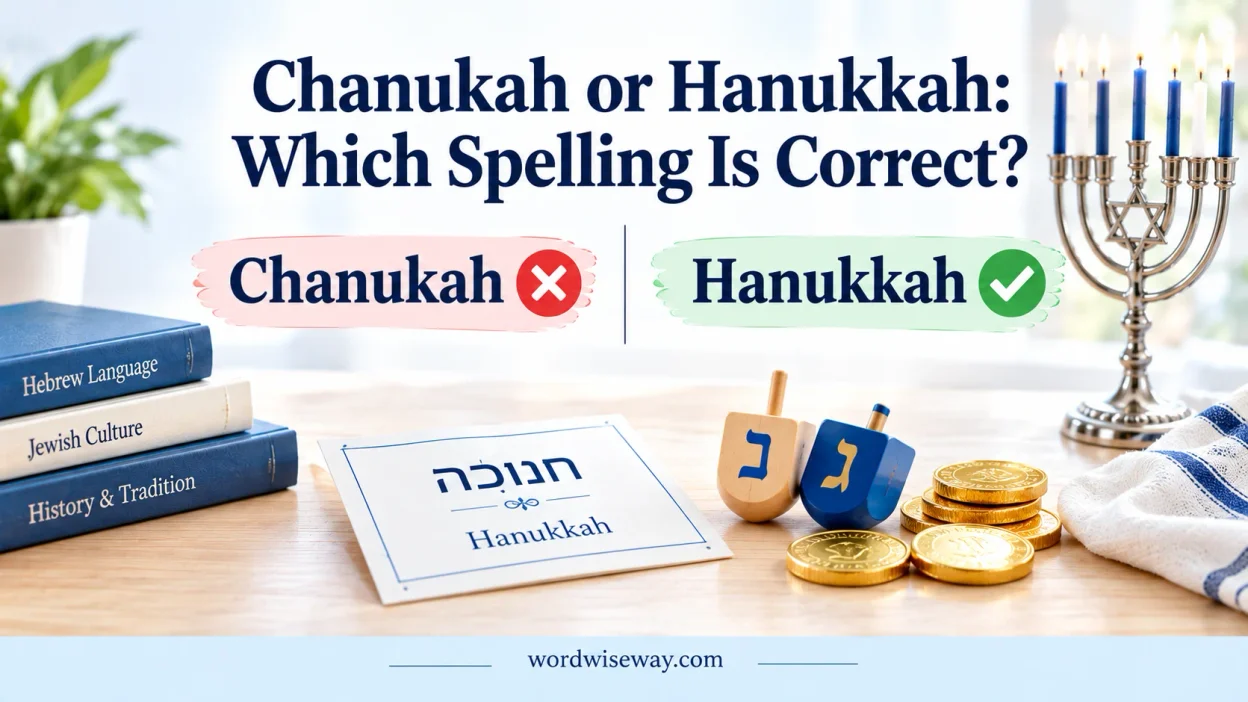
Chanukah or Hanukkah: Correct Spelling, Meaning and Usage can confuse learners because both spellings appear in books, online, and messages.
The truth is simple: both forms are correct and refer to the same festival, not two separate holidays. The difference comes from how a Hebrew word is written in English, creating variation in its written form and English spelling.
The meaning and usage remain connected to the Jewish Festival of Lights, a festival celebrated in winter by people around the world. This spelling confusion can appear in news articles, holiday cards, school lessons, social media posts, and everyday writing.
The versions exist because language translation rules, pronunciation differences, and historical spelling systems influence translation from Hebrew into English.Historical and modern English can create different forms, while the origin stays the same. The usage may vary depending on the writer, source, or style, but either form can be used when writing correctly.
Once you understand these rules, it becomes clear and easy to know why both versions are widely known.
Quick Answer:Chanukah or Hanukkah?
Hanukkah and Chanukah are both correct and refer to the same Jewish holiday.
Hanukkah is a very common spelling in contemporary English. Chanukah is also an established spelling and reflects a different approach to representing the Hebrew pronunciation. There isn’t a separate holiday called Chanukah and another called Hanukkah.
The original Hebrew form is חֲנֻכָּה. Because English doesn’t have a perfect letter-for-letter equivalent for every Hebrew sound in this word, transliteration produces different results.
| Spelling | Refers to the same holiday? | Established English form? | Main difference |
| Hanukkah | Yes | Yes | Uses H for the initial Hebrew consonant |
| Chanukah | Yes | Yes | Uses Ch to represent the initial consonant |
| Hanukah | Yes | Yes | Uses one K |
| Chanukka | Yes | Yes | Uses Ch and ends without H |
The important point is simple: spelling variation doesn’t create a difference in meaning.
What’s the Difference?
The main difference lies in how English represents the sounds and letters of the original Hebrew word.
Hebrew and English don’t share the same alphabet. When a Hebrew word is written using English letters, the writer must make several choices. That’s why transliteration can behave more like a sound-mapping exercise than ordinary English spelling.
The first Hebrew letter in חֲנֻכָּה is commonly called chet, although you may also see spellings such as het, heth, or cheth. English doesn’t have a single letter that perfectly represents its sound. Transliteration systems therefore use different conventions, including H, Ch, and sometimes Kh.
That’s where the opening difference comes from:
- Hanukkah uses H.
- Chanukah uses Ch.
- Hanukah simplifies the spelling by using one K.
- Chanukka uses the same basic Ch approach while ending with A.
So, if you’ve written Hanukkah instead of Chanukah, you haven’t changed the name of the holiday. You’ve simply chosen another established transliteration.
Why Are Chanukah and Hanukkah Spelled Differently?
The answer begins with a linguistic problem: Hebrew sounds don’t always fit neatly into English spelling.
Transliteration means representing words from one writing system with the characters of another. It differs from translation because the goal isn’t to replace the original meaning with an English word. Instead, the goal is to represent the original word’s sounds or letters in another alphabet.
For example, the Hebrew word חֲנֻכָּה doesn’t automatically tell an English writer whether the first consonant should become H, Ch, or another representation. Different traditions have developed different solutions.
That explains why you’ll encounter several forms in English.
Dictionary and language references identify Hanukkah and Chanukah among the established spellings, while other variants also occur.
Why Does Chanukah Start With “Ch”?
The Ch in Chanukah represents the initial Hebrew consonant rather than the English sound usually associated with ch in words such as chair.
This distinction matters.
An English reader who sees ch may instinctively expect the sound heard in church. However, the Hebrew consonant in the original word has a different sound. Sources describing Jewish pronunciation commonly represent that sound with a guttural or throat-based consonant.
That’s why Chanukah can look slightly unusual to an English speaker. The spelling attempts to preserve something about the original Hebrew sound that ordinary English spelling doesn’t represent neatly.
Why Does Hanukkah Have Two Ks?
The double k in Hanukkah isn’t random.
The Hebrew spelling contains a kaf with a dagesh, a small mark that can indicate a doubled consonant in certain grammatical contexts. Transliteration systems sometimes represent that feature with kk in English.
That’s why you’ll see:
Hanukkah
rather than simply:
Hanukah
Both forms occur in English, but the double-K spelling has become particularly familiar.
Is Hanukkah More Correct Than Chanukah?
There isn’t a universal rule saying that Hanukkah is correct while Chanukah is wrong.
In fact, the absence of a single standardized English transliteration is one of the central reasons these variants exist. Jewish educational references explicitly recognize several established spellings.
Hanukkah has become especially common in contemporary English-language usage. However, that frequency doesn’t turn Chanukah into an error.
Think of the difference as a matter of transliteration convention rather than a spelling contest.
A useful way to remember it is:
One Hebrew word can have several English spellings without having several meanings.
The same principle explains why you may encounter Hanukah, Chanukka, and other forms alongside the two most familiar versions.
What Does Hanukkah Mean?
The Hebrew name Hanukkah is commonly understood to mean “dedication.” The meaning connects directly to the historical and religious story behind the holiday.
Hanukkah commemorates the rededication of the Temple in Jerusalem after the Maccabean revolt against Seleucid rule in the second century BCE. The holiday lasts eight days and is closely associated with the lighting of a special nine-branched candelabrum commonly called a hanukkiah.
The word’s connection to dedication is therefore more than an interesting dictionary detail. It helps explain why the holiday carries this particular name.
Why Is Hanukkah Called the Festival of Lights?
Hanukkah is often called the Festival of Lights because candle lighting plays a central role in its observance.
A traditional account tells of a small quantity of ritually pure oil that was sufficient for one day but burned for eight days. This story became an important explanation for the eight-day celebration. The account of the oil miracle appears in later Jewish sources, including the Babylonian Talmud, rather than in the Books of Maccabees themselves.
The distinction is worth knowing because historical accounts of Hanukkah contain different layers of tradition. The rededication of the Temple is central to the holiday’s historical background, while the oil miracle became central to its later religious tradition.
How Do You Pronounce Hanukkah?
English speakers commonly pronounce Hanukkah with an initial sound that resembles an English H. However, pronunciations vary.
Some speakers use a pronunciation closer to the Hebrew or Israeli form, including a stronger guttural consonant. Jewish communities also differ in pronunciation traditions because Hebrew has been spoken through different regional and cultural traditions.
The spelling Hanukkah can therefore hide some of the complexity of the original pronunciation.
How Do You Pronounce Chanukah?
The spelling Chanukah signals the initial consonant differently.
The Ch is intended to represent the Hebrew sound rather than the English ch sound found in words such as chocolate or chair. Some Jewish pronunciation traditions preserve a stronger guttural quality in this consonant.
As a result, an English reader shouldn’t automatically pronounce Chanukah as though it were an ordinary English word beginning with ch.
Do Chanukah and Hanukkah Sound the Same?
They can sound slightly different depending on the speaker and pronunciation tradition, but they refer to the same Hebrew word and holiday.
English speakers often adapt unfamiliar Hebrew sounds to the sounds available in English. Someone familiar with Hebrew may pronounce the initial consonant more distinctly than someone who learned the word through English.
The difference therefore involves pronunciation tradition as well as spelling convention.
The Jewish English Lexicon records distinct pronunciation forms associated with the two common spellings, which illustrates how spelling and pronunciation can interact in English usage.
Other Spellings of Hanukkah
Once the transliteration issue becomes clear, the other spellings make much more sense.
You may encounter:
- Hanukkah
- Chanukah
- Hanukah
- Chanukka
- Hanukka
- Hannukah
- Channukah
Not every form has the same frequency or editorial status. Some represent established transliteration choices, while others can arise from different spelling conventions or attempts to reproduce the sound.
The key difference usually comes down to a few choices:
| Spelling choice | Example | What changes? |
| H or Ch | Hanukkah / Chanukkah | Representation of the first Hebrew consonant |
| One K or two Ks | Hanukah / Hanukkah | Representation of the Hebrew consonant |
| Final A or AH | Chanukka / Chanukah | Treatment of the final Hebrew letter |
| Additional N | Hanukkah / Hannukah | Transliteration or spelling variation |
There are many documented variants because the original Hebrew word doesn’t map perfectly onto English orthography.
Hanukkah vs. Chanukah in Modern English
Modern English usage tends to favor Hanukkah, although Chanukah remains firmly established.
That distinction can matter when you’re writing an article, preparing educational material, or communicating with a broad English-speaking audience. A common spelling may be easier for readers to recognize immediately.
However, context matters.
If a Jewish organization, publication, school, community, or individual uses Chanukah, changing it automatically to Hanukkah can remove an intentional transliteration preference.
Which Spelling Should You Use?
For general English writing, Hanukkah is a widely recognized choice.
That doesn’t make Chanukah incorrect. If you prefer the latter or you’re following a particular community or publication’s convention, Chanukah is an established alternative.
The most practical rule is consistency.
If a document begins with Hanukkah, don’t randomly switch to Chanukah halfway through. Likewise, if your chosen style uses Chanukah, keep that spelling throughout the piece unless you’re discussing the spelling difference itself.
Chanukah or Hanukkah in a Sentence
Both spellings can appear naturally in English sentences.
Hanukkah examples:
- Many families celebrate Hanukkah for eight nights.
- Hanukkah begins on the 25th day of Kislev in the Hebrew calendar.
- Candle lighting is an important part of Hanukkah observance.
Chanukah examples:
- The family gathered to celebrate Chanukah together.
- Chanukah is also known as the Festival of Lights.
- Different communities use different spellings of Chanukah.
Notice what happens when you switch the spelling. The meaning stays exactly the same.
Common Mistakes
Treating Chanukah as a Misspelling
Calling Chanukah a simple spelling mistake misses the linguistic reason behind the variation.
It’s an established English form, not merely a typo for Hanukkah.
Assuming “Ch” Has the English CH Sound
This mistake comes from applying normal English spelling rules to a Hebrew transliteration.
The Ch in Chanukah represents a Hebrew consonant and doesn’t necessarily have the sound English readers expect from ch.
Assuming Every Variant Is Equally Common
Although many spellings exist, they aren’t all equally frequent.
Hanukkah and Chanukah are among the best-established forms, while other versions appear less often.
Changing Between Spellings
Switching between Hanukkah and Chanukah within the same article can make your writing look inconsistent.
Choose one spelling for your main text. If the article targets the spelling question itself, introduce the alternative naturally where it helps readers understand the distinction.
A Clear Comparison
| Feature | Chanukah | Hanukkah |
| Same Jewish holiday | ✅ Yes | ✅ Yes |
| Established English spelling | ✅ Yes | ✅ Yes |
| Based on the Hebrew word חֲנֻכָּה | ✅ Yes | ✅ Yes |
| Uses “Ch” for the initial consonant | ✅ Yes | ❌ No |
| Uses “H” for the initial consonant | ❌ No | ✅ Yes |
| Common English spelling | Yes | Yes |
| Different meaning | ❌No | ❌ No |
| Different holiday | ❌ No | ❌ No |
The table captures the central point: the difference is primarily transliteration, not meaning.
Why Transliteration Matters
Transliteration can look like a tiny spelling issue until you encounter a language with sounds and letters that English doesn’t represent neatly.
Hebrew provides a clear example.
A writer isn’t simply copying the Hebrew word into English. The writer is making choices about how to represent its consonants and vowels with another alphabet. Different communities, scholars, publishers, and historical traditions can make different choices.
That explains why multiple English forms can survive for decades or even centuries.
It also explains why insisting that only one transliteration can ever be correct oversimplifies the language.
Historical Context Behind Hanukkah
The spelling question makes more sense when the holiday itself is understood.
Hanukkah commemorates the rededication of the Temple in Jerusalem following the Maccabean revolt in the second century BCE. The holiday begins on 25 Kislev in the Hebrew calendar and lasts eight days.
The name’s connection to dedication reflects this rededication.
The eight-day celebration is also linked to the traditional account of the oil that lasted eight days. Historical and religious sources preserve different explanations and layers of the holiday’s development, so the Temple rededication and the later oil tradition shouldn’t be treated as though they originated in exactly the same source.
This background also explains why the holiday’s name carries such a specific meaning rather than simply functioning as an arbitrary label.
Read More: Develope or Develop: Correct Spelling, Meaning and Usage
FAQs
Is Hanukkah the correct spelling?
Yes. Hanukkah is a widely used English spelling of the Jewish holiday. It is considered correct, just like Chanukah, depending on the spelling system being used.
Is Chanukah also spelled correctly?
Yes. Chanukah is also a correct English spelling. It represents the Hebrew pronunciation in a different way and refers to the same holiday as Hanukkah.
Do Chanukah and Hanukkah mean the same thing?
Yes. Chanukah and Hanukkah refer to the same Jewish festival. The different spellings don’t indicate different holidays or meanings.
Why does Hanukkah have two common spellings?
The original Hebrew word doesn’t map perfectly onto English letters. Different systems for transliterating Hebrew sounds have produced forms such as Hanukkah and Chanukah.
Which spelling is more common in English?
Hanukkah is widely used in modern English, particularly in general writing and media. However, Chanukah remains a standard and recognizable spelling.
Can I use Chanukah in formal writing?
Yes. Chanukah can be used in formal writing. The important point is to use the spelling consistently throughout your article, essay, card, or other written work.
Does the spelling change the pronunciation?
The spelling can influence how an English reader expects the word to sound, but both forms represent the same Hebrew name. The difference mainly reflects how Hebrew sounds are represented with English letters.
Why does the word start with C in Chanukah?
The C in Chanukah is one way English writers represent the initial Hebrew sound. Other transliteration systems use H, which gives the spelling Hanukkah.
Is Hanukkah always written with two Ks?
In the common English spelling Hanukkah, two k letters are used. Other transliterations may differ slightly, so you may encounter additional spelling variations.
Should I use Hanukkah or Chanukah?
Either spelling is acceptable. If you’re writing for a particular publication, school, organization, or audience, check its preferred style and then use that form consistently.
Conclusion
Hanukkah and Chanukah may look different, but they name the same Jewish festival. The spelling difference comes from the way the original Hebrew word is represented in English. Once you understand this, the apparent spelling puzzle becomes much easier to navigate.
For everyday English, you can use either Hanukkah or Chanukah. If you’re writing for a school, website, publication, or organization, check whether it follows a particular style. Consistency matters more than treating one spelling as the only correct option.
Ultimately, knowing why both forms exist helps you write with confidence and avoid unnecessary confusion. Whether you encounter Hanukkah in an article or Chanukah on a holiday card, you’re looking at two English spellings for the same meaningful Jewish tradition.

Emma Smith has dedicated 14 years to Princeton University’s English Department, mentoring students in textual interpretation, literary movements, and critical frameworks. Her research explores Shakespearean drama, Victorian serial fiction, postcolonial narrative theory, and manuscript studies and probing how literary forms evolve across cultures and centuries. Emma has delivered lectures at international humanities congresses and published findings in distinguished academic journals, underscoring her commitment to scholarly depth and vibrant teaching.