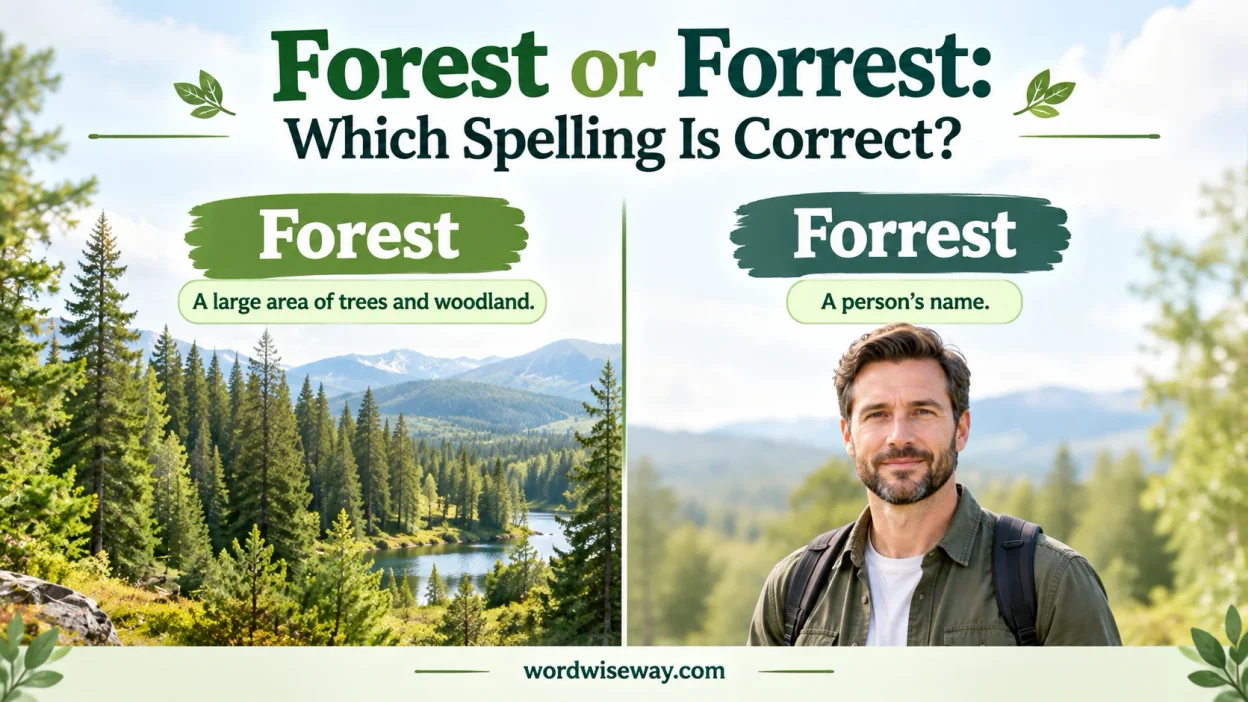
When you ask Forest or Forrest: Which Spelling Is Correct?, the correct spelling depends on meaning. Forest is the English word for a large area filled with trees, wildlife, and natural vegetation. It describes nature, a natural area, or woodland areas and appears in books, maps, and environmental discussions.
Forrest, with a double R, is usually a proper name or surname, such as Forrest Gump or Nathan Bedford Forrest. Although the spellings look identical and sound the same when spoken, the extra letter creates a clear difference in meaning and usage. This distinction prevents spelling mistakes and common mistakes.
Using the correct word improves grammar, spelling accuracy, writing confidence, and clarity. Whether you’re writing an email, school paper, essay, blog, or social media caption, choosing the appropriate choice makes your message clearer and more professional. These memory tips make the forest or forrest mix-up easy to remember.
Quick Answer:
Forest is the correct spelling when you mean a wooded area or a large area of land covered with trees.
Forrest is primarily used as a first name or surname.
| Word | Main use | Meaning | Example |
| forest | Common noun | A large area covered with trees | We walked through the forest. |
| Forrest | Proper name | A person’s first or last name | Forrest called me yesterday. |
The easiest rule is straightforward:
- Talking about trees and woodland? Use forest.
- Talking about a person’s name? Use Forrest if that’s their actual spelling.
- Referring to an official name? Follow the established spelling of that name.
Oxford defines forest as a large area of land thickly covered with trees. The dictionary also recognizes a secondary figurative use for a dense mass of tall, narrow objects.
Forest: Definition and Meaning
The word forest is an ordinary English noun. It describes a substantial area dominated by trees and other vegetation.
You can use it when discussing nature, geography, wildlife, conservation, travel, or landscapes. It can also appear in compounds such as forest fire, forest floor, forest canopy, and forest ranger.
For example:
- We explored the forest during our weekend trip.
- Several rare birds live in the forest.
- The wildfire spread quickly through the dry forest.
- A narrow trail leads deep into the forest.
- The researchers studied the forest ecosystem.
The word can be countable or uncountable, depending on how you’re using it. You might talk about a forest when referring to one particular wooded area, or discuss forest more generally as a type of land cover.
What Does Forest Mean?
At its core, forest means a large wooded area.
Oxford traces the English word through Middle English and Old French to Late Latin forestis. Its historical meaning had a legal connection to woodland and land reserved for hunting.
Modern English uses the word much more broadly. You don’t need a royal hunting ground for something to qualify as a forest in everyday speech.
For instance, you could write:
The hikers disappeared into the forest before sunset.
Here, forest identifies the physical environment. It isn’t a person’s name and doesn’t need capitalization unless it appears at the beginning of a sentence or within an official name.
Forest as a Common Noun
Because forest is a common noun, you normally write it in lowercase.
Correct:
- The forest was unusually quiet.
- We drove past a dense forest.
- Many animals depend on the forest.
Incorrect in ordinary usage:
- The Forest was unusually quiet.
- We drove past a dense Forest.
However, capitalization can change when Forest forms part of a proper name. For example, an officially named location might contain the word Forest. In that situation, capitalization follows the established name rather than ordinary noun rules.
Examples of Forest in a Sentence
Here are several examples showing how naturally forest works in different contexts:
- The trail winds through a dense forest.
- Scientists are studying changes in the tropical forest.
- We heard birds calling from the forest canopy.
- The village sits near the edge of a large forest.
- Heavy rain made the forest floor slippery.
- A forest fire can spread rapidly under dry conditions.
Notice the pattern. In every example, forest refers to woodland or something directly associated with it.
Forrest: Definition and Meaning
Forrest looks almost identical to forest, but its grammatical role is usually different.
In English, Forrest is commonly used as a given name or surname. Name references trace it to an English surname connected with forest. The surname originally described someone who lived near or worked in a forest.
That history explains why the two spellings feel so closely related.
For example:
- Forrest arrived before everyone else.
- I spoke with Forrest after the meeting.
- Forrest is her family name.
- Mr. Forrest lives nearby.
In each sentence, Forrest identifies a person. That’s why it begins with a capital letter.
What Does Forrest Mean?
As a name, Forrest carries a meaning historically connected with forest or woodland.
Behind the Name identifies Forrest as an English name derived from a surname meaning “forest,” originally associated with someone who lived near a forest. It also lists Forest as a related variant.
The surname has an even more direct historical connection. FamilySearch describes Forrest as an English topographic name for someone who lived in or near a royal forest, or as an occupational name for someone who worked there.
So the extra r doesn’t give the name an unrelated meaning. Instead, it belongs to the history and spelling of the proper name.
Forrest as a Proper Noun
When Forrest identifies a particular person, it functions as a proper noun.
That means you capitalize it.
For example:
- Forrest is my cousin.
- I emailed Forrest yesterday.
- Forrest works at the local library.
- The coach thanked Forrest after the game.
You shouldn’t change someone’s name simply because another spelling looks more familiar. If a person’s legal or established name is Forrest, that spelling should remain intact.
The same principle applies to surnames. A family named Forrest doesn’t become Forest simply because the latter is the standard spelling of the common noun.
Key Differences
The distinction becomes much easier when you compare the words side by side.
| Feature | Forest | Forrest |
| Word type | Common noun | Proper noun |
| Typical meaning | A wooded area | A person’s name |
| Capitalization | Usually lowercase | Capitalized |
| Extra letter | One r | Two r’s |
| Typical context | Nature, geography, wildlife | Names and surnames |
| Example | The forest is vast. | Forrest is here. |
One small letter creates a major grammatical difference.
Think of forest as a place and Forrest as a label attached to a person. That simple distinction will solve most spelling questions immediately.
Why Do People Confuse Forest and Forrest?
The confusion comes from several overlapping factors.
First, the words are visually similar. Forest contains six letters, while Forrest contains seven. The only difference is the additional r.
Second, the two forms are closely related historically. Forrest developed from a surname connected with the word forest.
Third, the pronunciation is generally very similar. Behind the Name gives Forrest an American pronunciation of /ˈfɔr.ɪst/, while Oxford gives American pronunciations for forest that are also built around the same basic sounds.
That creates an interesting spelling trap. Your ear may not tell you which form someone means.
Context has to do the detective work.
If someone says, “We walked through the forest,” you know they’re talking about woodland. If someone says, “Forrest called earlier,” you’re dealing with a person’s name.
Which One Should You Use?
The choice depends entirely on meaning.
Use Forest When You Mean a Woodland Area
Choose forest when the sentence describes land covered with trees.
Examples include:
- a forest trail
- a forest ecosystem
- a forest fire
- a forest ranger
- a forest canopy
- a dense forest
- a tropical forest
For example:
The researchers spent three weeks studying the forest ecosystem.
Here, forest describes the type of ecosystem. Using Forrest would make the sentence look as though you’re referring to someone’s name.
Use Forrest When Referring to a Person
Choose Forrest when that is the person’s established spelling.
For example:
Forrest joined the team last year.
You could not replace Forrest with forest without changing the grammatical role of the word.
The lowercase form would also look incorrect because a person’s name is normally capitalized.
Is Forrest a Correct Spelling of Forest?
Forrest is a correct spelling of a name, but it isn’t normally an alternative spelling of the common noun forest.
That’s the key distinction.
If you want to say that a large wooded area surrounds a village, write:
The village is surrounded by a forest.
Don’t write:
The village is surrounded by a Forrest.
However, if a person named Forrest lives in the village, this is perfectly correct:
Forrest lives in the village.
The words may be historically connected, but modern usage gives them different jobs.
Pronunciation
In common American English, forest and Forrest are pronounced very similarly, and often essentially the same.
Oxford lists American pronunciations for forest including /ˈfɔrəst/ and /ˈfɑrəst/. Behind the Name gives Forrest as /ˈfɔɹ.ɪst/ in American English.
Regional pronunciation can vary, especially with the vowel quality in the first syllable. Still, the extra r in the spelling does not normally create a dramatic pronunciation difference.
That’s why relying on sound alone can lead to mistakes.
When you hear the word, ask yourself what the speaker means. If it’s a wooded landscape, the spelling is forest. If it’s someone’s name, check whether that person’s name is Forrest.
Common Mistakes
A few recurring mistakes are worth watching.
Using Forrest for a Woodland Area
This is probably the most common error.
Incorrect:
We spent the afternoon hiking through the Forrest.
Correct:
We spent the afternoon hiking through the forest.
The sentence describes a physical environment, not a person.
Writing a Person’s Name as Forest
The opposite mistake can also happen.
Suppose someone’s name is Forrest. Writing Forest changes the spelling of their name.
Incorrect:
Forest Smith sent the email.
Correct:
Forrest Smith sent the email.
Names deserve special care because their spelling isn’t determined by the standard dictionary form of a related word.
Incorrect Capitalization
Don’t capitalize forest simply because you’re using it as an important word.
Correct:
The children explored the forest.
Correct:
Forrest arrived at noon.
The difference isn’t stylistic. It’s grammatical.
Forest or Forrest in Different Contexts
Context makes the distinction almost effortless.
Nature and Environment
Use forest when discussing trees, habitats, ecosystems, wildlife, or wooded land.
Examples:
- forest habitat
- forest conservation
- forest wildlife
- forest management
- forest ecosystem
The related word forestry refers to the science or practice of planting and caring for trees and forests.
Geography and Travel
Use forest when describing a landscape or destination.
For example:
The road passes through a dense forest before reaching the mountains.
Again, the word identifies a physical area.
People’s Names
Use Forrest when the person spells their name that way.
For example:
Forrest moved to Chicago last year.
The capitalization and context immediately signal that you’re dealing with a name.
Titles, Places, and Organizations
Official names require a little more care.
A location, organization, business, or other named entity may use Forest, Forrest, or another established spelling. Don’t “correct” an official name based solely on the ordinary dictionary word.
The safest rule is simple: preserve the official spelling.
A Simple Memory Trick
Here’s an easy way to remember the difference:
Forest = trees.
Forrest = person.
The extra r in Forrest can remind you that you’re dealing with a special spelling rather than the ordinary landscape word.
This isn’t an etymological rule. It’s simply a practical memory aid.
When proofreading, ask one question:
Am I talking about a wooded area or someone’s name?
If you’re talking about woodland, choose forest.
If you’re writing a person’s name and their spelling is Forrest, use Forrest.
Forest or Forrest: Quick Grammar Check
Use this quick test before you finalize your sentence.
| If you’re talking about… | Choose… | Example |
| A wooded area | forest | The forest is enormous. |
| Trees and wildlife | forest | Many animals live in the forest. |
| A forest ecosystem | forest | The forest ecosystem is changing. |
| A person’s first name | Forrest | Forrest called me. |
| A person’s surname | Forrest | Mr. Forrest signed the document. |
| An official name | Check the official spelling | Follow the established name. |
A few practice examples make the rule even clearer:
- We walked through the forest.
- Forrest joined us for lunch.
- The birds disappeared into the forest.
- I sent the message to Forrest.
- The forest contains several rare species.
- Forrest is listed as the author.
There isn’t much mystery once you identify the word’s role.
Read More: Trunk or Treats: Ideas, Tips, Themes, and How to Plan the Event
FAQs
Is “forest” the correct spelling for a wooded area?
Yes. Forest is the standard English spelling for a large area covered with trees, plants, and wildlife. You use it as a common noun when talking about nature or woodland.
Why do some people write “forrest” instead of “forest”?
The extra r often causes confusion because forest and Forrest sound very similar when spoken. People may also remember names such as Forrest Gump, which can influence the spelling.
Is “Forrest” an English word?
Forrest is mainly used as a personal name or surname. It isn’t the standard spelling for a wooded area. You may encounter it in names such as Forrest Gump or Nathan Bedford Forrest.
Can I use “Forrest” when talking about trees?
Generally, no. When you mean a natural area containing many trees, use forest. Forrest would normally refer to someone’s name rather than the place itself.
What is the main difference between forest and Forrest?
The key difference is both spelling and usage. Forest refers to a wooded natural area, while Forrest is generally a personal name or surname.
Are forest and Forrest pronounced the same?
In ordinary English pronunciation, they are pronounced the same or nearly the same. This similarity is one reason people sometimes confuse their written forms.
Is “Forrest Gump” spelled with one R or two?
The character’s name is Forrest Gump, with two r’s. Here, Forrest is a proper name, so it doesn’t follow the spelling used for the natural area.
How can I remember the spelling of forest?
Think of forest as the word for a place filled with trees. If you’re describing woodland or nature rather than naming a person, forest is the spelling you need.
Is “forest” used as a noun or an adjective?
Forest is commonly used as a noun when it names a wooded area. It can also appear before another noun in phrases such as “forest habitat” or “forest ecosystem.”
Which spelling should I use in formal writing?
Use forest when referring to a wooded area in an essay, report, email, or other formal writing. Use Forrest when it is part of someone’s established name or surname.
Conclusion
Choosing between forest and Forrest becomes easy once you understand their roles. Forest is the correct spelling when you mean a wooded area filled with trees, plants, and wildlife. Forrest, on the other hand, usually appears as a personal name or surname.
The confusion often comes from their similar pronunciation. That extra r can slip into your writing, especially when you’ve seen names such as Forrest Gump. A simple memory trick can help: think of forest as the natural place, while Forrest belongs to a person’s name.
Using the right spelling makes your writing clearer and more polished. Whether you’re writing an essay, blog post, email, or social media caption, choose forest when discussing nature or woodland. Save Forrest for names where that spelling is actually intended.

Amelia Sanders has spent 14 years in Harvard University’s English Department, helping students navigate literary analysis, interpretive theory, and narrative techniques. Her academic pursuits center on 18th-century British prose, romantic poetry, diasporic writing, and digital editing exploring how textual choices influence cultural perspectives. Amelia has spoken at major international meetings and contributed essays to respected academic volumes, demonstrating her dedication to thoughtful scholarship and effective teaching.