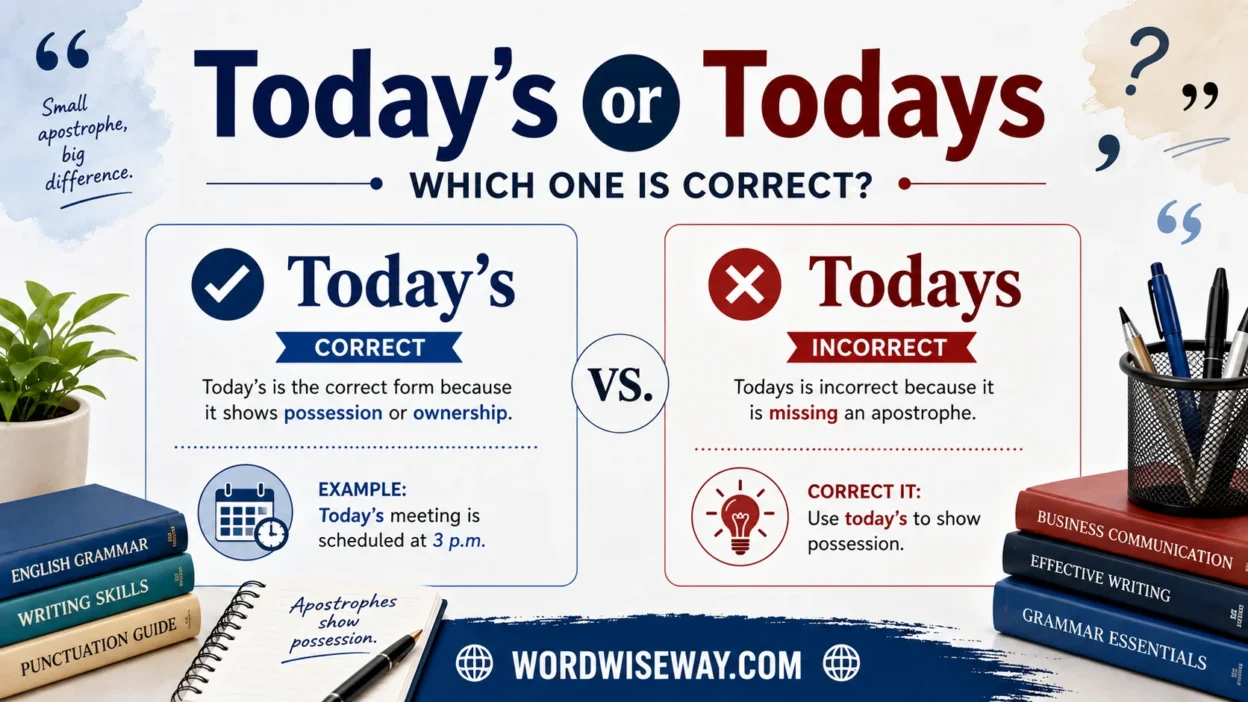
Today’s or Todays: Correct Spelling, Meaning, and Usage helps you avoid a common grammar mistake in daily writing.
If you have paused mid-sentence with your fingers on the keyboard wondering whether to write today’s or todays, you are not alone. English learners, native speakers, students, professionals, and writers often face this grammar question. The simple rule is easy to understand. Today’s is the correct form because it shows possession or means of today. Todays is almost always wrong and can reduce your credibility.
You may encounter this difference in a work email, reports, social media posts, articles, or school work. This guide explains correct spelling, meaning, usage, plural forms, possessive forms, contractions, the origin of the word, regional usage, common mistakes, real-world examples, and Google Trends data.
I used to second-guess myself, but once I learned the rule, I could apply and use it confidently in every situation.
Quick Answer:
- ✅ Today’s is the correct spelling because it shows possession or means “of today.” It is the form you should use in professional and everyday writing.
- ❌ Todays is usually incorrect because it removes the apostrophe that gives the word its proper meaning and grammatical role.
- ✅ Use today’s in sentences like today’s meeting, today’s news, or today’s work when talking about something connected to the present day.
- ❌ Avoid writing todays meeting or todays events because these forms are not accepted in standard English.
Understanding Today’s or Todays in English Grammar
The correct form is “Today’s.”
The incorrect form in standard English is “Todays.”
That difference comes down to one thing: the apostrophe.
In English, an apostrophe often shows possession or connection. So “today’s” means something that belongs to today.
For example:
- Today’s weather → the weather of today
- Today’s news → news belonging to today
- Today’s meeting → meeting happening today
Now compare that with “todays.” Without the apostrophe, the word loses its grammatical structure in formal writing.
It may still appear in casual typing or design, but it does not follow standard grammar rules.
Why Today’s Is the Correct Form (Possessive Apostrophe Rule)
The core rule of possession
English uses apostrophes to show ownership or association. This rule applies to people, objects, and even abstract concepts like time.
Here’s the pattern:
- John’s book → book belonging to John
- Sarah’s idea → idea belonging to Sarah
- Today’s plan → plan belonging to today
So “today’s” is not random. It follows a deeply rooted grammatical structure.
How apostrophes compress language
Without apostrophes, English would feel heavier and longer.
We would need to say:
- the news of today
- the schedule of today
- the events of today
Instead, we compress meaning:
- today’s news
- today’s schedule
- today’s events
This small punctuation mark saves space and improves readability.
Table: Why Today’s works grammatically
| Phrase | Structure | Meaning |
| Today’s weather | Possessive | Weather belonging to today |
| Today’s update | Possessive | Update of today |
| Today’s goal | Possessive | Goal for today |
Why Todays Appears but Is Incorrect in Standard English
At first glance, “todays” feels like it should exist. English already uses “s” for plurals, so the logic seems familiar.
But here’s the problem: “today” doesn’t behave like a normal countable noun.
We don’t usually talk about multiple “todays” in formal grammar. Time flows in sequence, not in stackable units.
Where “todays” shows up in real life
Even though it’s incorrect in formal English, you will still see it in:
- Social media captions
- Quick notes or drafts
- Design layouts or branding
Examples:
- todays mood
- todays plan
- todays update
These are shortcuts, not grammar rules.
Why people use it anyway
Three main reasons explain the habit:
- Fast typing removes punctuation
- Social media encourages informal writing
- Visual similarity to plural words creates confusion
It feels natural, but natural does not always mean correct.
Common Confusion Patterns with Today’s or Todays
This confusion does not exist in isolation. It belongs to a bigger pattern in English where time-related words often get miswritten.
Time words that follow the same rule
| Incorrect | Correct |
| tomorrows plan | tomorrow’s plan |
| yesterdays news | yesterday’s news |
| weeks schedule | week’s schedule |
| months report | month’s report |
Why this pattern confuses learners
There are three psychological triggers:
- Words ending in “s” look plural
- Apostrophes feel optional in casual typing
- English pronunciation does not clearly signal punctuation
So the brain guesses instead of applying the rule.
Real-Life Examples and Case Studies of Today’s vs Todays
Grammar becomes clearer when you see it in real situations. Let’s look at how a tiny apostrophe changes perception.
Case Study: Social media post clarity
A fitness influencer writes:
Todays workout will challenge your limits
Most readers understand it, but something feels slightly off. It looks rushed and unpolished.
Now compare:
Today’s workout will challenge your limits
The meaning is identical, but the second version feels cleaner, more intentional, and more professional.
That small mark improves trust.
Case Study: Business communication
Incorrect:
Todays meeting has been rescheduled to 3 PM
Correct:
Today’s meeting has been rescheduled to 3 PM
In professional writing, grammar errors can quietly affect credibility. Even if the message is understood, the tone feels less polished.
Case Study: Educational content
Teachers and educational platforms rely heavily on clarity. A missing apostrophe can confuse learners who are still building grammar foundations.
For example:
- “Todays lesson is about grammar” forces a mental correction
- “Today’s lesson is about grammar” flows naturally
The second reduces cognitive load.
Grammar Rules Behind Apostrophes and Time Expressions
Time as possession in English
English often treats time like something that owns events.
Instead of saying:
the events of today
we compress it into:
today’s events
This pattern is consistent across time expressions.
Examples of time possession
- today’s schedule
- yesterday’s meeting
- tomorrow’s deadline
- last week’s results
Each one follows the same structure: time + ’s + noun.
Table: Time expression structure
| Time word | Correct form | Meaning |
| Today | Today’s news | News of today |
| Yesterday | Yesterday’s update | Update of yesterday |
| Tomorrow | Tomorrow’s plan | Plan for tomorrow |
Quick Memory Tricks and Practical Cheat Sheet
Sometimes grammar rules stick better when you simplify them.
Here’s a quick way to remember this forever.
Substitution trick
Replace “today” with a person’s name.
- Today’s weather → John’s weather ✔
- Todays weather → Johns weather ✖
If it fails with a name, it fails in grammar.
Simple rule to remember
- If something belongs to “today,” use ’s
- If there is no apostrophe, meaning becomes unclear
One-line memory hook
👉 “If it belongs, it gets an apostrophe.”
Common Myths About Today’s or Todays
Let’s clear a few misunderstandings that often circulate online.
Myth: Todays is acceptable informal English
Not exactly. It appears informally, but it is still incorrect in standard grammar.
Myth: Apostrophes are optional now
They are not. They remain important for clarity, especially in formal writing.
Myth: People always understand it anyway
True, but understanding is not the same as correctness. Grammar also affects tone and professionalism.
Final Clarity Summary
Let’s bring everything together clearly.
- Today’s = correct form
- Todays = incorrect in standard English
The apostrophe shows possession. Without it, meaning becomes less structured and less professional.
That tiny mark carries more weight than it looks like. It keeps writing smooth, readable, and precise.
Read More: Families or Family’s: Correct Spelling, Meaning, and Usage
FAQs
Is “todays” ever correct in English?
No, todays without an apostrophe is rarely correct in standard English. Most of the time, writers need today’s when they want to show possession or describe something connected to the present day.
Why does “today’s” have an apostrophe?
The apostrophe in today’s shows possession. It tells readers that something belongs to or relates to today, such as today’s meeting or today’s schedule.
What is the difference between today’s meeting and todays meeting?
Today’s meeting is correct because the meeting is connected to today. Todays meeting is incorrect because it misses the apostrophe needed to show the relationship.
Can I use today’s in formal writing?
Yes, today’s is completely acceptable in formal writing. You can use it in emails, reports, articles, academic work, and professional documents.
Is today’s a contraction?
Yes, today’s can work as a contraction in some cases, meaning “today is” or “today has.” However, it is also commonly used as a possessive form.
How can I quickly remember the correct spelling?
A simple trick is to ask whether you mean “of today.” If yes, use today’s with an apostrophe. This small check can prevent common spelling mistakes.
Why do people confuse todays and today’s?
People often confuse them because the words look almost identical. The small apostrophe is easy to miss, but it changes the grammar and meaning.
Is today’s used differently in British and American English?
No major difference exists between British and American English for today’s. Both varieties use the apostrophe form in the same way.
Where do people commonly make this mistake?
This mistake often appears in emails, social media posts, school work, reports, and online articles where writers type quickly and overlook the apostrophe.
How important is using today’s sentences correctly?
Using today’s correctly improves clarity and makes your writing look more professional. Small grammar details can have a big impact on how readers understand your message.
Conclusion
Understanding the difference between today’s and todays is simple once you remember the role of the apostrophe. Today’s is the correct choice when you mean something related to today or want to show possession, while todays is generally not used in standard English. This small grammar rule helps you write clearer sentences and avoid common mistakes.
Whether you are creating emails, reports, articles, social media posts, or school assignments, choosing the right form improves your overall writing quality. By practicing this rule and checking your sentences carefully, you can confidently use today’s in every situation.

Evelyn Shaw has spent 14 years at Yale University’s English Department, leading students through close readings, genre studies, and interpretive methodologies. Her scholarly interests include Renaissance drama, gothic fiction, feminist literary criticism, and archival research and examining how texts generate meaning across historical periods. Evelyn has presented at major academic conferences and published essays in peer-reviewed journals, reflecting her passion for rigorous analysis and student-centered learning.