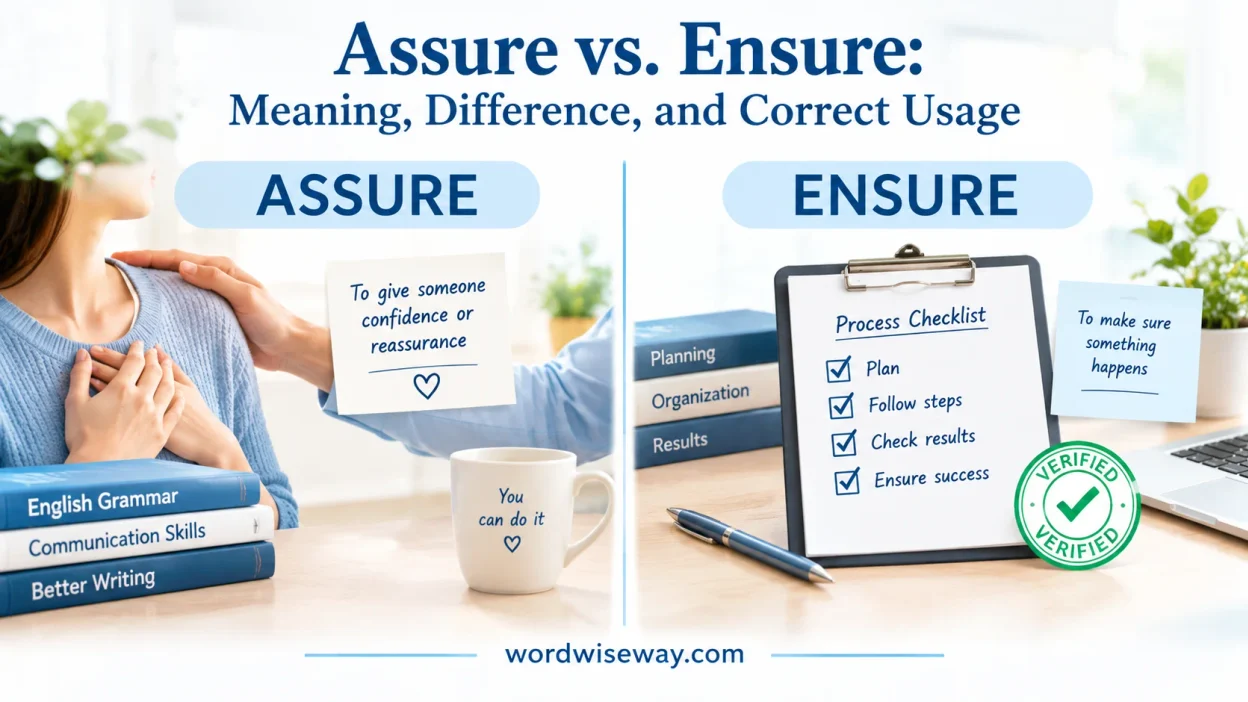
Assure vs. Ensure: Meaning, Difference, and Correct Usage becomes easier when you understand each word’s job. In an email, essay, resume, or text, the right word matters. Assure, ensure, and insure sound similar, but these verbs have different uses. Assure means to tell someone something confidently and remove doubts or worries.
Ensure means making something certain or making sure an outcome happens. Insure usually means financial protection against loss, damage, or risk. A simple way to remember the difference is to assure a person, ensure an outcome, and insure against a risk.
Their meanings, origins, common patterns, synonyms, regional differences, and real-life examples can reduce confusion. In everyday speech, texting, and professional writing, knowing the best choice makes your message clear and professional.
Quick Answer:
Assure means to tell someone something confidently to remove doubt or worry.
She assured me that the package would arrive today.
Ensure means to make something certain or take action so that a particular result happens.
She checked the address to ensure that the package would arrive at the right location.
A useful memory trick is:
- Assure a person.
- Ensure a result.
- Insure something against financial risk.
So, if you’re talking directly to someone’s confidence, use assure. If you’re talking about making an outcome happen, use ensure.
What Does “Assure” Mean?
Assure is a verb that means to give someone confidence, certainty, or reassurance about something. It often appears when a person has a concern, doubt, question, or fear.
The important feature is the person receiving the reassurance.
For example:
The teacher assured the students that the test would be fair.
The teacher isn’t making the test fair simply by speaking. Instead, the teacher is giving the students confidence about what to expect.
Similarly:
I assure you that I checked the report carefully.
Here, you receive the speaker’s assurance. The sentence communicates confidence and removes doubt.
Assure Definition and Meaning
The core meaning of assure is to convince someone that something is true, safe, reliable, or certain.
It can express:
- Reassurance
- Confidence
- Certainty
- A promise
- A firm statement
- Removal of doubt
The word often appears in situations where one person wants another person to feel confident.
For instance, imagine a customer worries that an order has been lost. A customer-service representative might say:
We assure you that your order is being processed.
The representative is addressing the customer’s concern. That’s why assure fits.
How to Use Assure in a Sentence
One of the most common structures is:
assure + person + that-clause
Examples include:
- The manager assured me that the problem would be fixed.
- She assured him that she had received the message.
- The doctor assured the patient that the procedure was routine.
- They assured us that the information was accurate.
Another common structure is:
assure + person + of + noun
Examples:
- The company assured customers of its commitment to quality.
- The guide assured us of a safe journey.
- The manager assured employees of continued support.
The construction “I assure you” is also common. It emphasizes that the speaker wants the listener to trust the statement.
I assure you, nothing was overlooked.
Here, the speaker isn’t describing an action that guarantees an outcome. The speaker is giving another person confidence.
What Does “Ensure” Mean?
Ensure means to make something certain or take the necessary steps to produce a particular result.
Unlike assure, it doesn’t primarily focus on reassuring a person. Instead, it focuses on what happens.
For example:
Please review the instructions to ensure that every field is completed.
The review is an action intended to produce a result: every field should be completed.
Another example makes the distinction clearer:
The coach assured the players that the team was prepared.
Cgave the players confidence.
The coach added extra practice sessions to ensure that the team was prepared.
The extra practice was an action intended to create a certain condition.
Ensure Definition and Meaning
The central idea behind ensure is making certain.
You can ensure:
- Accuracy
- Safety
- Completion
- Compliance
- Quality
- Availability
- Consistency
- Success of a process
- Prevention of a problem
For example:
Double-check the figures to ensure accuracy.
The person isn’t reassuring accuracy. The person is taking an action that helps make the figures accurate.
How to Use Ensure in a Sentence
A common structure is:
ensure + that-clause
Examples:
- Check the lock to ensure that the door is secure.
- Save the document to ensure that your work isn’t lost.
- Arrive early to ensure that you have enough time.
- Follow the instructions to ensure that the machine operates correctly.
You can also use ensure + noun:
- These checks ensure quality.
- Regular maintenance ensures safety.
- Proper storage ensures freshness.
- Careful planning ensures efficiency.
The word therefore works naturally when an action, process, or condition leads toward a particular outcome.
Key Differences
Although assure and ensure share the idea of certainty, their grammatical focus separates them.
| Word | Main Meaning | Typical Focus | Example |
| Assure | Give someone confidence or remove doubt | Person | She assured me that everything was ready. |
| Ensure | Make something certain | Result, condition, or action | She checked everything to ensure it was ready. |
| Insure | Protect against financial loss through insurance | Risk or property | They insured the vehicle against damage. |
The easiest question to ask is: Who or what is receiving the certainty?
If a person receives reassurance, assure usually fits.
If an outcome becomes certain because of an action, ensure usually fits.
Consider these two sentences:
The manager assured the customer that the issue would be resolved.
The manager reviewed the system to ensure the issue was resolved.
The first sentence centers on communication. The second centers on action and outcome.
Assure Focuses on People
A person often follows assure directly.
She assured her parents that she would be home early.
The pilot assured the passengers that the flight was safe.
The technician assured me that the device was working properly.
In each example, someone receives confidence from another person.
Ensure Focuses on Outcomes
Ensure commonly connects to a desired condition or result.
The technician tested the device to ensure proper operation.
The company updated its security system to ensure customer data remained protected.
She set an alarm to ensure that she wouldn’t miss the meeting.
The focus isn’t on calming someone’s feelings. It’s on taking action to make an outcome more certain.
Examples
Seeing the words in context is often more useful than memorizing definitions.
Examples With Assure
Here are several natural examples:
- The doctor assured me that the results were normal.
- She assured her friend that everything was under control.
- The manager assured customers of the company’s support.
- He assured us that the information was correct.
- The teacher assured the class that help was available.
- They assured investors that the project remained on schedule.
Each sentence involves communication with a person or group.
Examples With Ensure
Now consider examples focused on results:
- Check the measurements to ensure accuracy.
- Wear protective equipment to ensure safety.
- Back up your files to ensure that important data isn’t lost.
- Read the instructions carefully to ensure proper use.
- The system performs automatic checks to ensure reliability.
- Arrive early to ensure enough time for registration.
Here, the word describes an action or condition that helps make something certain.
Assure and Ensure in Paired Examples
The contrast becomes especially sharp when both words appear in related situations.
The manager assured the employees that the building was safe.
The manager inspected the building to ensure safety.
In the first sentence, employees receive reassurance. In the second, inspection supports a safe condition.
Another pair:
The teacher assured the student that the answer was correct.
The teacher checked the calculation to ensure accuracy.
Again, the first sentence concerns communication. The second concerns an action and its intended result.
When to Use Assure and Ensure
Choosing the right word becomes easier when you identify the purpose of the sentence.
When Talking to a Person
Use assure when you want to emphasize reassurance or confidence.
For example:
I assure you that your concerns have been heard.
The guide assured the visitors that the route was safe.
She assured him that the meeting had been canceled.
These sentences involve someone receiving a statement intended to remove uncertainty.
When Talking About an Outcome
Use ensure when someone takes action to make a result certain.
For example:
The staff checked the equipment to ensure safety.
Save your work frequently to ensure that you don’t lose important changes.
The editor reviewed the article to ensure accuracy.
Here, the action has a practical purpose. It helps create or preserve a desired result.
When Both Words Appear Together
Sometimes a sentence can naturally contain both words.
The manager assured customers that the company had taken steps to ensure their safety.
This sentence demonstrates the distinction perfectly.
The manager assured customers by communicating confidence.
The company took steps to ensure safety by acting to produce a secure condition.
One word handles the human reassurance. The other handles the intended result.
Common Mistakes
The confusion usually appears when writers treat these words as interchangeable. They aren’t always interchangeable.
Using Ensure When You Mean Reassure
Consider:
The doctor ensured me that everything was fine.
This usage is generally incorrect in standard US English when the intended meaning is reassurance.
A better version is:
The doctor assured me that everything was fine.
Why? The doctor is speaking to me and giving me confidence.
Using Assure for an Outcome
Now consider:
Please assure that all doors are locked.
This sounds unnatural because the sentence focuses on an outcome rather than a person receiving reassurance.
A better version is:
Please ensure that all doors are locked.
The person needs to take action to make the condition certain.
Confusing “Assure That” With “Ensure That”
Both words can appear before that, which makes the distinction trickier.
Compare:
She assured me that the package had arrived.
She checked the tracking information to ensure that the package had arrived.
The word that doesn’t determine which verb you need. The meaning does.
With assure, a person typically receives the assurance.
With ensure, the clause usually describes the condition or result being made certain.
Assure vs. Ensure vs. Insure
A third word often enters the picture: insure.
These three words look remarkably similar. Their meanings, however, have developed along different paths in modern US English.
Assure generally concerns a person’s confidence.
Ensure concerns making an outcome certain.
Insure commonly concerns financial protection against risk through insurance.
| Word | Meaning | Example |
| Assure | Give someone confidence | She assured me that the plan was safe. |
| Ensure | Make something certain | We checked the plan to ensure its accuracy. |
| Insure | Protect financially through insurance | They insured their home against certain risks. |
A quick memory device works well:
A person gets assured. A result gets ensured. A risk gets insured.
For example:
The agent assured me that my policy was active.
I checked the documents to ensure everything was correct.
I insured my car against covered losses.
The three words may appear in the same conversation, but they serve different purposes.
Grammar and Usage
Grammar provides another useful way to separate these words.
Assure + Person + That
This is one of the most recognizable patterns.
Subject + assure + person + that + statement
Examples:
The manager assured us that the problem was temporary.
She assured him that the report was complete.
They assured me that the appointment was confirmed.
The person receiving reassurance usually appears immediately after assure.
Assure + Person + Of
Another established pattern uses of.
Subject + assure + person + of + noun
Examples:
The company assured customers of continued support.
The guide assured us of a safe return.
The manager assured employees of the company’s commitment.
This structure still revolves around giving someone confidence.
Ensure + Noun
Ensure can directly introduce a noun describing the desired result.
Examples:
These procedures ensure quality.
Regular inspections ensure safety.
Careful preparation ensures consistency.
Ensure + That-Clause
Another common structure is:
ensure + that + desired condition
Examples:
Check the form to ensure that every section is complete.
Lock the door to ensure that the room remains secure.
Test the connection to ensure that the system works properly.
This structure makes ensure especially useful in instructions, professional writing, technical documents, and formal explanations.
Assure vs. Ensure in American English
In standard US English, both assure and ensure remain common and useful words. They aren’t simply different spellings of the same term.
Assure is particularly natural in interpersonal communication:
I assure you that everything is fine.
Ensure is common when describing procedures, safeguards, requirements, and intended results:
Follow these steps to ensure accurate results.
The distinction matters most when the sentence needs precision. In casual conversation, speakers sometimes use related forms loosely. In careful writing, however, choosing the word that matches the intended meaning makes the sentence clearer.
For business writing, academic work, instructions, reports, and website content, the person-versus-result distinction provides a reliable guide.
A Practical Case Study: The Airport Example
Imagine an airline passenger arrives at the airport and worries about missing a flight.
An employee might say:
“I assure you that your flight is still scheduled to depart on time.”
The employee is reassuring the passenger.
Now imagine the airline checks the boarding system, confirms the gate, and coordinates the boarding process.
Those actions help:
Ensure that passengers receive accurate boarding information.
The two words describe different parts of the same situation.
Assure describes communication with the passenger.
Ensure describes actions intended to produce a reliable outcome.
This distinction works in countless real-world situations.
Read More: Principle vs Principal: Meaning, Differences, and Examples
How to Remember
When you’re unsure which word belongs in a sentence, don’t stare at the spelling. Look at the sentence’s purpose.
Ask yourself these questions:
- Am I giving a person confidence? Use assure.
- Am I making an outcome certain? Use ensure.
- Am I talking about insurance or financial protection? Use insure.
You can also remember this compact formula:
Assure = person
Ensure = result
Insure = financial protection
For example:
She assured me that the reservation was confirmed.
He checked the system to ensure the reservation was confirmed.
She insured the property against covered risks.
Once the focus changes, the correct word usually becomes obvious.
Quick Comparison
| Feature | Assure | Ensure |
| Primary idea | Give confidence | Make certain |
| Main focus | Person | Result or condition |
| Common pattern | Assure someone that… | Ensure that… |
| Another pattern | Assure someone of… | Ensure something |
| Often expresses reassurance | ✓ Yes | ✗ No |
| Often describes preventive action | Sometimes | ✓ Yes |
| Example | She assured me that she was ready. | She practiced to ensure she was ready. |
The table reveals the core difference without requiring a complicated grammar rule.
FAQs
What does assure mean?
Assure means to give someone confidence by telling them something positively or confidently. It usually involves a person who needs reassurance.
What does ensure mean?
Ensure means to make certain that something happens or remains true. It focuses on an action, result, condition, or outcome rather than a person.
What is the difference between assure and ensure?
The main difference is their object. You assure a person, while you ensure an outcome. For example, you can assure your friend that everything is fine, but ensure that the task gets completed.
Is insure the same as assure and ensure?
No. Insure usually relates to financial protection against a risk, loss, or damage. Although all three words have related origins, modern usage gives them different roles.
How can I remember assure and ensure?
Use a simple memory trick: assure a person, ensure a result, and insure against a risk. This pattern makes the distinction easier to recall when you’re writing quickly.
Can I use ensure when talking about a person?
Usually, ensure doesn’t directly mean giving a person confidence. If you’re telling someone something to remove their doubts or worries, assure is generally the appropriate word.
Is assure common in professional writing?
Yes. Assure works well in professional emails, letters, and other situations where you need to give someone confidence. For example, you can assure a client that their concern is being addressed.
Is ensure suitable for essays and resumes?
Yes. Ensure is useful in essays, resumes, reports, and other formal writing when you want to describe making sure that a result occurs. It often fits naturally with words such as quality, accuracy, or completion.
What are common mistakes with assure, ensure, and insure?
A common mistake is treating the three words as interchangeable because they sound similar. Remember their basic roles: assure relates to a person, ensure to an outcome, and insure to financial protection.
Which word should I use in everyday speech?
Choose the word based on what you mean. Use assure when you’re giving someone confidence, ensure when you’re making something certain, and insure when discussing protection against financial risk.
Conclusion
Understanding assure vs. ensure becomes much simpler once you connect each word with its purpose. Assure focuses on a person’s confidence, ensure focuses on making a result certain, and insure generally deals with protection against financial risk. Although the words look and sound alike, their meanings aren’t interchangeable in most situations.
When you’re writing an email, essay, resume, or everyday text, pause for a moment and identify what you’re trying to express. Are you giving someone confidence, making sure something happens, or talking about protection against loss? That small distinction can help you choose the appropriate word and make your writing clearer.
With regular practice, these three terms become easier to use naturally. Instead of memorizing complicated rules, remember the practical pattern: assure a person, ensure an outcome, and insure against a risk. Once that pattern sticks, you can use each word confidently in professional writing and everyday communication.

Amelia Sanders has spent 14 years in Harvard University’s English Department, helping students navigate literary analysis, interpretive theory, and narrative techniques. Her academic pursuits center on 18th-century British prose, romantic poetry, diasporic writing, and digital editing exploring how textual choices influence cultural perspectives. Amelia has spoken at major international meetings and contributed essays to respected academic volumes, demonstrating her dedication to thoughtful scholarship and effective teaching.