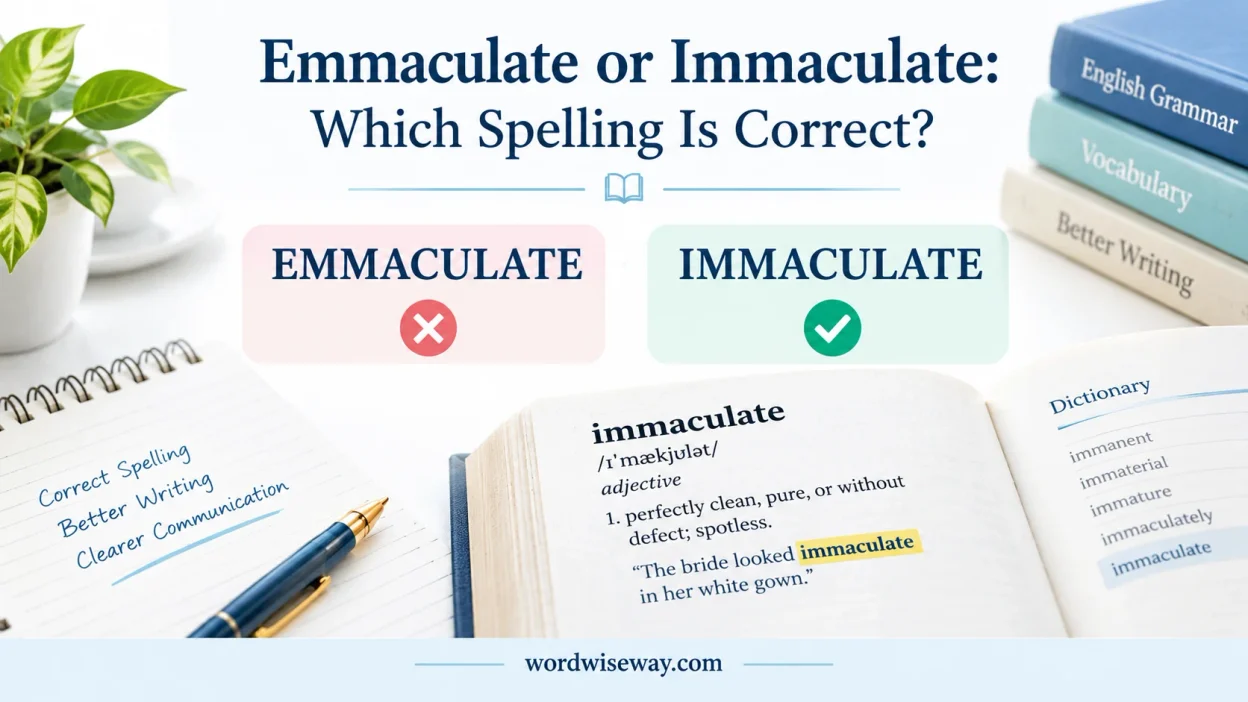
The emaculate vs immaculate debate can confuse writers because the wrong word looks right and sounds smooth. In Emmaculate or Immaculate: Correct Spelling, Meaning, and Usage, the answer is clear: immaculate is the correct spelling. Emmaculate is an incorrect common typo that often appears online.
Immaculate means perfectly clean, spotless, flawless, or free from flaws and mistakes. You can use it to describe a room, performance, or carefully designed website. Its meaning, usage, and origin make the spelling easier to remember.
This small spelling problem can affect your message, credibility, and professional writing. Many people search for help when they’re unsure, especially after a mistyped word appears in an email, essay, or school assignment. Simple memory tricks, clear steps, and real-life examples can help you avoid this confusion and write more confidently.
Quick Answer:
Immaculate is the correct spelling.
Emmaculate is a misspelling of immaculate and shouldn’t be used in standard English writing.
| Spelling | Correct? | Meaning | Example |
| Immaculate | ✓ Correct | Perfectly clean, neat, or flawless | The kitchen was immaculate. |
| Emmaculate | ✗ Incorrect | Not the standard spelling | She described the room as immaculate. |
The easiest spelling cue is to remember IM + MACULATE. The word begins with im, followed by another m at the start of the next part. That gives you the distinctive mm in immaculate.
Is Immaculate the Correct Spelling?
Yes. Immaculate is the standard English spelling.
The word is an adjective, which means it describes a person, thing, condition, performance, or quality. Its core meanings center on being exceptionally clean, free from flaws, or without mistakes. Standard English dictionaries recognize these meanings and give the US pronunciation as /ɪˈmæk.jə.lət/.
The spelling is:
I-M-M-A-C-U-L-A-T-E
Notice the two m’s near the beginning:
im + maculate = immaculate
That double m is one of the easiest details to lose when writing quickly. Someone may hear the first syllable and instinctively produce emmaculate, especially because English contains many words beginning with em-.
However, emmaculate isn’t the spelling to use in an essay, email, article, report, school assignment, or professional document. When the intended word means spotless or flawless, write immaculate.
Is Emmaculate a Word?
Emmaculate is generally used as a misspelling of immaculate, rather than as the standard form of the adjective.
That distinction matters because a spelling can appear online without being an accepted standard form. Search results, informal messages, user-generated writing, and typing errors can circulate incorrect spellings widely. Repeated exposure can make an error look legitimate.
If you’re writing the word yourself, don’t treat emmaculate as a spelling variant. Use immaculate.
For example:
- ✓ The hotel room was immaculate.
- ✗ The hotel room was emmaculate.
The first sentence uses the standard spelling.
What Does Immaculate Mean?
Immaculate generally describes something that has no dirt, defects, faults, or imperfections. Its exact meaning depends on the noun it modifies.
The word commonly carries two closely related ideas:
- Perfectly clean or tidy
- Perfect and without mistakes or flaws
Dictionaries describe both senses. For example, an immaculate garden can be exceptionally neat and well maintained, while an immaculate performance can be flawless or exceptionally well executed.
Think of immaculate as a word that removes the visible signs of disorder or imperfection.
Immaculate Meaning: Completely Clean
The most concrete use of immaculate relates to cleanliness and condition.
If you walk into a room and find polished surfaces, neatly arranged furniture, clean floors, and no visible clutter, you might call the room immaculate.
Consider these examples:
- The newly renovated kitchen looked immaculate.
- Her white dress remained immaculate throughout the event.
- The mechanic returned the car in immaculate condition.
- Their garden was immaculate from the front gate to the back patio.
In these sentences, the word suggests more than ordinary cleanliness. Immaculate often implies an unusually high standard of neatness or care.
Calling something clean is straightforward. Calling it immaculate raises the bar.
Immaculate Meaning: Perfect or Flawless
The word can also move beyond physical cleanliness.
For example, you might describe a performance as immaculate when it contains no noticeable mistakes. You could also describe someone’s work, technique, timing, record, or execution this way.
Examples include:
- The pianist delivered an immaculate performance.
- Her timing was immaculate throughout the presentation.
- The designer produced an immaculate final draft.
- The team’s defensive execution was immaculate in the final minutes.
Here, immaculate doesn’t mean that the object has been physically cleaned. Instead, it means the result appears exceptionally precise or free from errors. This figurative use is well established in English.
Quick Comparison
The difference is simple, but the spelling can trip people up.
| Feature | Immaculate | Emmaculate |
| Standard spelling | ✓ Yes | ✗ No |
| Begins with | im- | em- |
| Double m | ✓ Yes | ✓ Yes |
| Standard adjective | ✓ Yes | ✗ No |
| Can mean spotless | ✓ Yes | ✗ No |
| Can mean flawless | ✓ Yes | ✗ No |
| Recommended in formal writing | ✓ Yes | ✗ No |
The important point is that this isn’t a case of two words having different meanings.
There isn’t a standard meaning difference between emmaculate and immaculate. Instead, one is the established spelling and the other is a common error.
That makes the choice easy whenever you’re editing your writing: choose immaculate.
Why Do People Spell Immaculate as Emmaculate?
The error probably feels natural because pronunciation and spelling don’t line up perfectly.
The first part of immaculate is pronounced with a short vowel sound. In US English, the word begins with the sound represented in the pronunciation /ɪˈmæk.jə.lət/.
When someone hears the word rather than sees it, the initial sound may not immediately suggest the letters im.
There’s another source of confusion, too. English uses em- as a beginning in many familiar words, including words such as embrace, employ, and emotion. That pattern can make emmaculate look believable at first glance.
But spelling by sound alone can be risky.
A better strategy is to remember the visual structure:
IM + MACULATE
The first part is im, not em.
How to Remember the Correct Spelling
Spelling tricks work best when they’re short enough to recall under pressure. You don’t need a complicated rhyme or an elaborate mnemonic.
Remember the Double M
The most useful detail is the pair of m’s:
IMMACULATE
You can mentally spot the word as:
I M M A C U L A T E
The first m belongs to im-. The second begins the following part of the word.
If you’re typing quickly, pause after im and check that another m follows.
Break Immaculate Into Parts
Instead of memorizing nine letters as one long sequence, divide the word visually:
IM + MACULATE
That structure makes the spelling easier to recognize.
You can also focus on the opening:
IMM…
Once imm is on the page, the incorrect emm… version becomes easier to catch during proofreading.
Connect the Spelling With the Meaning
Create a mental connection between the word and something spotless.
Picture an immaculate white shirt with not a single visible mark. Then connect that image with the spelling IMMACULATE.
This works because you’re linking the spelling to meaning instead of memorizing isolated letters.
Pronunciation
In US English, immaculate is pronounced /ɪˈmæk.jə.lət/. The main stress falls on the second syllable.
The pronunciation contains several sounds that can make the written form less obvious. That’s one reason relying entirely on pronunciation can lead to mistakes.
The word has four syllables in standard pronunciation:
im-mac-u-late
The strongest emphasis falls on the mac syllable.
Pronunciation helps you say the word correctly, but it shouldn’t be your only spelling guide. When accuracy matters, remember the written opening imm-.
How to Use Immaculate in a Sentence
The word works naturally in several contexts. Its meaning becomes clearer when you look at the noun or situation around it.
Immaculate for Cleanliness
Use immaculate when something looks exceptionally clean, tidy, or well maintained.
Examples:
- The house was immaculate before the guests arrived.
- She keeps her workspace immaculate.
- The hotel maintained an immaculate lobby.
- His shoes looked immaculate after polishing.
Here, the word focuses on physical condition.
Immaculate for Appearance
Immaculate can describe clothing, grooming, presentation, or overall appearance.
Examples:
- He arrived in an immaculate suit.
- Her presentation was polished and immaculate.
- The classic car remained in immaculate condition.
- The garden had an immaculate appearance.
This usage often suggests careful attention to detail.
Immaculate for Performance
When something happens without noticeable mistakes, immaculate can describe the performance.
Examples:
- The athlete delivered an immaculate performance.
- Her presentation was immaculate from beginning to end.
- The technician completed an immaculate repair.
- The orchestra gave an immaculate performance.
In this sense, the word moves from physical cleanliness to precision and excellence.
Immaculate for Records
You can also use immaculate for a record that contains no losses, violations, errors, or blemishes, depending on the context.
For example:
- The pitcher entered the final inning with an immaculate record.
- The company had maintained an immaculate safety record.
- She built an immaculate academic record.
The exact meaning comes from the noun that follows it. An immaculate room is spotless. An immaculate record is free from the particular problems that would damage that record.
Common Mistakes
Even familiar words can become spelling traps. Immaculate has a few predictable ones.
Writing Emmaculate Instead of Immaculate
This is the central mistake.
Remember:
✓ immaculate
✗ emmaculate
The first vowel is i, not e.
Forgetting the Second M
Another mistake produces a form such as imaculate.
That spelling drops one of the two m’s.
The correct spelling is:
IMMACULATE
Not:
IMACULATE
The double m is essential.
Confusing Pronunciation With Spelling
English pronunciation doesn’t always provide a perfect spelling map.
If you write only what you think you hear, you can easily produce a nonstandard form. Instead, memorize the word’s visual pattern and check it when needed.
Treating Emmaculate as an Alternative Spelling
Emmaculate shouldn’t be presented as a second standard spelling.
If you’re correcting a sentence, replace it with immaculate.
Immaculate Synonyms
Several words can overlap with immaculate, but each carries its own shade of meaning.
| Synonym | Main idea | Example |
| Spotless | Completely free from dirt or marks | The kitchen was spotless. |
| Pristine | Extremely clean, fresh, or untouched | The beach looked pristine. |
| Flawless | Without defects or mistakes | Her performance was flawless. |
| Impeccable | Extremely good with no faults | His manners were impeccable. |
| Unblemished | Free from marks, damage, or faults | She had an unblemished record. |
| Perfect | Completely meeting an ideal standard | The timing was perfect. |
Spotless usually emphasizes cleanliness. Flawless often emphasizes the absence of mistakes or defects. Pristine can suggest something that remains in an exceptionally original or untouched condition.
Immaculate sits comfortably across several of these meanings. That’s why it can describe both a spotless room and a flawless performance.
Immaculate vs. Spotless
Immaculate and spotless overlap strongly when you’re talking about cleanliness.
However, spotless has a particularly direct connection to the absence of dirt or marks. Immaculate can carry a broader sense of perfection, order, and careful maintenance.
Compare these sentences:
- The kitchen was spotless.
- The kitchen was immaculate.
Both sentences tell you the kitchen was extremely clean. The second can suggest a broader impression of order and perfection.
That’s why immaculate works particularly well when you want the description to feel more comprehensive.
Immaculate vs. Pristine
Pristine often suggests something clean, fresh, original, or untouched.
For example:
- The forest remained pristine.
- The museum kept the artifact in immaculate condition.
A pristine object or environment may seem untouched by damage or human interference. An immaculate object may instead look exceptionally clean and carefully maintained.
The distinction isn’t absolute. Context decides which word sounds more natural.
Immaculate vs. Flawless
These words are close, especially when discussing quality.
Flawless focuses strongly on the absence of mistakes, defects, or imperfections.
Immaculate can do the same, but it also has a strong cleanliness and condition-related meaning.
Compare:
- She gave a flawless performance.
- She gave an immaculate performance.
Both sentences can mean that the performance contained no noticeable mistakes. However, flawless directly emphasizes the absence of errors, while immaculate can add a sense of precision and exceptional execution.
Immaculate in Different Contexts
The word becomes especially useful when you understand how its meaning shifts with context.
Immaculate Appearance
When describing someone’s clothing or presentation, immaculate means exceptionally neat, clean, and polished.
For example:
He arrived at the ceremony looking immaculate.
The sentence doesn’t merely say that his clothes were clean. It suggests that his overall appearance showed careful attention to detail.
The related adverb immaculately works in the same way:
She was immaculately dressed for the interview.
The adverb can describe something done in a perfectly neat or faultless manner.
Immaculate Condition
The phrase immaculate condition is useful when describing objects or property that have been exceptionally well preserved or maintained.
Examples include:
- a car in immaculate condition
- a house in immaculate condition
- furniture in immaculate condition
- equipment in immaculate condition
Here, the word communicates a combination of cleanliness, preservation, and lack of visible damage.
Immaculate Performance
This expression shifts the word into the figurative realm.
An immaculate performance is one that appears exceptionally precise, controlled, or free from mistakes.
You might describe a speech, concert, sporting performance, presentation, or technical task this way.
Immaculate Record
An immaculate record means a record without the type of negative events or blemishes relevant to that context.
For example, a sports record might be called immaculate when it contains no losses. A professional record might receive the description when it has no disciplinary problems.
The phrase therefore depends heavily on context. Immaculate doesn’t automatically mean exactly the same thing every time.
A Simple Case Study: Choosing the Right Spelling
Imagine you’re proofreading a sentence for a school article:
The classroom was emmaculate after the students finished cleaning.
At first glance, the sentence looks fine. The meaning is clear. Yet the spelling needs correction.
The improved version is:
The classroom was immaculate after the students finished cleaning.
Why?
First, immaculate is the standard spelling. Second, the meaning fits perfectly because the sentence describes an exceptionally clean classroom.
Now consider a different sentence:
The dancer delivered an immaculate performance.
Here, immaculate doesn’t describe cleanliness. It describes the quality of the performance. The dancer performed with exceptional precision and without noticeable mistakes.
This example shows why understanding meaning matters alongside spelling. Once you know how the word behaves in different contexts, you’re less likely to treat it as a vague synonym for simply clean.
Quick Facts
- Part of speech: Adjective
- Standard spelling: immaculate
- Common misspelling: emmaculate
- US pronunciation: /ɪˈmæk.jə.lət/
- Core meaning: Perfectly clean, neat, or free from flaws
- Figurative meaning: Exceptionally precise or without mistakes
- Related adverb: immaculately
- Related nouns: immaculacy and immaculateness
- Useful spelling clue: Remember the opening imm-
Final Verdict
If you’re choosing between emmaculate and immaculate, the answer is straightforward: immaculate is correct.
Use immaculate when you mean exceptionally clean, neat, well maintained, flawless, or free from imperfections. Don’t use emmaculate as an alternative spelling.
The most useful spelling trick is simple:
IM + MACULATE = IMMACULATE
Keep an eye on the first vowel and the double m. Those two details prevent the most common spelling errors.
Once the correct form becomes familiar, the distinction is easy to spot. Whether you’re describing an immaculate room, an immaculate appearance, an immaculate performance, or an immaculate record, the spelling stays the same.
Read More: Jist or Gist: Correct Spelling, Meaning, and Correct Usage
FAQs
Is “Emmaculate” a correct spelling?
No. Emmaculate is a common spelling mistake. The correct spelling is immaculate, with two “m” sounds represented by the letters “imm.”
What does “immaculate” mean?
Immaculate means perfectly clean, spotless, flawless, or free from mistakes. It can describe physical things, appearances, work, performances, or other things without noticeable flaws.
Is “Emaculate” ever acceptable in English?
No. Emaculate isn’t the standard English spelling of the word. In formal, academic, or professional writing, use immaculate instead.
Why do people spell immaculate as emaculate?
The mistake often happens because immaculate can sound as though it begins with “em.” When people rely on pronunciation instead of checking the spelling, they may leave out one “m.”
How do you remember the spelling of immaculate?
A simple memory trick is to focus on the beginning: im + maculate. Remembering the double “m” can help you avoid writing emaculate by mistake.
What is the difference between emaculate and immaculate?
There is no meaningful vocabulary difference because emaculate is an incorrect spelling, while immaculate is the standard word. Only immaculate should be used when you mean perfectly clean or flawless.
Can immaculate describe a person’s appearance?
Yes. Immaculate can describe someone’s appearance, clothing, or grooming when it looks exceptionally neat, clean, and well-maintained.
Can immaculate describe a room or place?
Yes. You can call a room or place immaculate when it is extremely clean, tidy, and free from visible mess or flaws.
Can immaculate describe work or performance?
Yes. Immaculate can describe work, performance, or execution when it is exceptionally precise, polished, or free from noticeable mistakes.
How can I use immaculate in a sentence?
You can use immaculate as an adjective, such as: “The designer kept the website immaculate and easy to navigate.”
Conclusion
When choosing between emmaculate and immaculate, there’s no real contest. Immaculate is the correct spelling, while emmaculate is a common spelling mistake that can sneak into otherwise polished writing. Remembering the double m and the i at the beginning can help you avoid this tiny but noticeable error.
The word immaculate has a useful range of meanings. It can describe something perfectly clean, completely flawless, or carefully executed. Whether you’re talking about an immaculate room, an immaculate appearance, or an immaculate performance, the word adds precision when you want to emphasize an exceptionally high standard.
A single spelling error might seem insignificant, but repeated mistakes can weaken otherwise strong writing. Once you understand the meaning, spelling, and everyday usage of immaculate, the confusion becomes much easier to avoid. Keep the correct form in mind, and emmaculate can stay where it belongs: out of your writing.