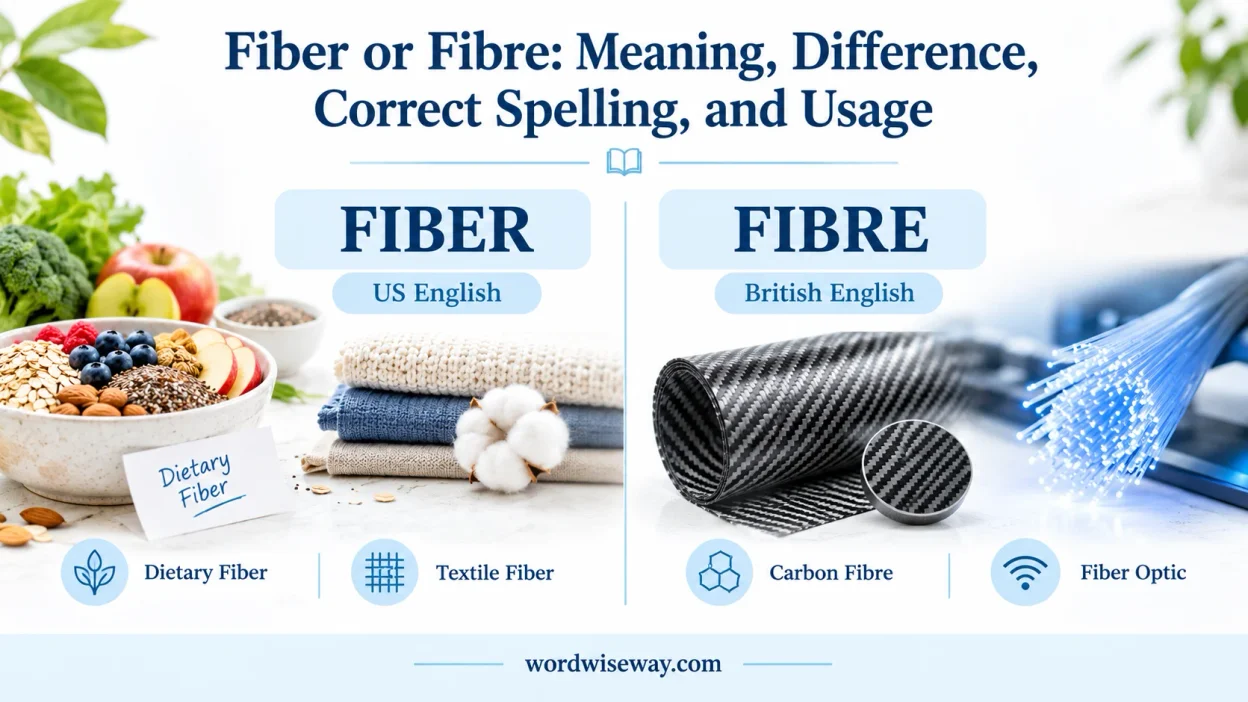
Fiber or Fibre: Correct Spelling, Difference, and Usage depends on regional English rules.
Fiber is preferred in American English, especially in the United States, while fibre is common in British English, including the United Kingdom, Canada, and Australia. Both have the same meaning, but their spelling differs. This distinction matters when writing an essay, blog, medical report, or social media post, where clarity and professionalism matter.
The origin of these words explains their difference. Both spellings are centuries old, but the French spelling fibre became more prevalent during the 18th century. British educators favored French and Latin forms over Anglicized forms. The -re ending was common in French, so fibre became the standard spelling, despite being unphonetic.
In the post-independence United States, Americans gradually favored more phonetic fiber. During the 19th century, it steadily gained ground and became the preferred form around 1910. Today, both forms are correct, so your usage should depend on the English variety you choose.
Quick Answer:
Fiber is the correct spelling in American English, while fibre is the standard spelling in British English.
| Spelling | Standard variety | Example |
| Fiber | US English | Whole grains contain dietary fiber. |
| Fibre | British English | Whole grains contain dietary fibre. |
Both words have the same pronunciation and meaning. They can describe a thin strand in a material, a threadlike structure in the body, dietary material found in plants, or strands used in technologies such as optical communications.
If you’re writing for readers in the United States, choose fiber. If you’re following British spelling conventions, choose fibre.
What’s the Difference?
The main difference between fiber and fibre is spelling rather than meaning.
American English generally favors the -er ending in this word, while British English retains the -re ending. The same regional distinction appears in several other words, including center/centre and meter/metre, although each pair has its own usage details.
Consider these sentences:
- The doctor recommended more fiber in the diet.
- The doctor recommended more fibre in the diet.
The message remains the same. Only the spelling changes.
That’s why calling fibre an outright misspelling in an American context can be misleading. It is a standard British form. Likewise, fiber isn’t a mistake simply because a British reader expects fibre.
A Simple Rule to Remember
Think about your audience before choosing the spelling:
- 🇺🇸 US English → fiber
- 🇬🇧 British English → fibre
- 🇨🇦 Canadian English → fibre is commonly used
- 🇦🇺 Australian English → fibre
- 🇳🇿 New Zealand English → fibre
When a publication or organization follows a particular style guide, its established spelling convention should take priority.
What Does Fiber Mean?
The word fiber has several related meanings. At its core, it describes something threadlike, slender, or strand-shaped.
The word can refer to natural materials, manufactured materials, structures in the human body, dietary components, and specialized technologies. Context usually tells you which meaning applies.
Fiber as a Material or Strand
In materials and textiles, a fiber is a thin, threadlike element that can form part of a larger material.
Cotton provides a familiar example. Cotton fibers can be spun into yarn and then woven or knitted into fabric. Other fibers come from plants, animals, minerals, or manufactured materials.
Common examples include:
- Cotton fiber
- Wool fiber
- Silk fiber
- Glass fiber
- Carbon fiber
- Synthetic fiber
- Natural fiber
A single fiber can be tiny, but millions of fibers can combine to create something much stronger or more useful. A shirt, rope, composite material, or industrial fabric may depend on the properties of countless individual strands.
Fiber in the Human Body
The word also describes threadlike structures within the body.
For example, you may encounter:
- Muscle fiber
- Nerve fiber
- Fibers in connective tissue
Here, fiber doesn’t mean dietary material. It describes the shape or structural form of something.
That distinction matters because the surrounding words determine the intended meaning.
Fiber in Nutrition
In nutrition, dietary fiber refers to carbohydrates and related plant components that aren’t fully digested in the small intestine.
Dietary fiber occurs naturally in foods such as:
- Fruits
- Vegetables
- Whole grains
- Beans
- Lentils
- Nuts
- Seeds
Dietary fiber can be broadly discussed as soluble and insoluble, although many foods contain a mixture of different fiber types.
In the United States, the current Daily Value for dietary fiber on Nutrition Facts labels is 28 grams per day based on a 2,000-calorie diet.
The spelling remains fiber in American nutrition writing. British writing generally uses fibre.
Fiber in Telecommunications
In technology, fiber often appears in the term fiber-optic.
Fiber-optic systems use very thin strands of glass or other suitable material to carry information as light signals. This technology supports high-speed data transmission across networks.
That’s why you may see phrases such as:
- Fiber-optic cable
- Fiber-optic network
- Fiber internet
- Optical fiber
British English commonly changes these forms to fibre-optic, fibre-optic network, and related spellings.
What Does Fibre Mean?
Fibre carries the same core meanings as fiber. The difference is the spelling convention.
In British English, you might read about dietary fibre, natural fibres, carbon fibre, or optical fibre. The underlying concepts remain unchanged.
For example:
Whole grains are a useful source of dietary fibre.
An American writer would normally write:
Whole grains are a useful source of dietary fiber.
Neither sentence changes the nutritional concept. The spelling simply follows a different variety of English.
Fibre in Textiles
British English uses fibre for thin strands used to create materials such as cloth and rope.
You might see:
- Natural fibre
- Synthetic fibre
- Cotton fibre
- Glass fibre
- Carbon fibre
These expressions describe the same materials that American English calls natural fiber, synthetic fiber, cotton fiber, glass fiber, and carbon fiber.
Fibre in Food
British English commonly uses fibre when discussing the indigestible or non-digestible components of plant foods.
For example:
- Fibre-rich foods
- Dietary fibre
- Fibre content
- High-fibre cereal
The American equivalents use fiber.
Fibre in Technology
The British spelling also appears in telecommunications and computing.
For example:
- Fibre-optic cable
- Fibre-optic broadband
- Optical fibre
- Fibre network
Again, the technology doesn’t change because the spelling does.
Why Are Fiber and Fibre Spelled Differently?
The difference comes from the separate spelling traditions that developed within varieties of English.
British English generally preserved forms ending in -re in words such as fibre, while American English adopted or standardized several corresponding forms ending in -er.
This pattern is especially visible in words influenced by French spelling traditions. Over time, American English developed its own spelling preferences, particularly during the standardization of American dictionaries and written conventions.
The result is a word pair with two accepted regional forms:
fiber → American English
fibre → British English
It’s worth remembering that spelling differences between American and British English aren’t random. They often reflect centuries of linguistic development, editorial choices, pronunciation history, and regional standardization.
Fiber or Fibre in American English
If you’re writing specifically in US English, use fiber.
That applies across the major meanings of the word.
Common US English Examples
- Dietary fiber
- Fiber content
- Fiber supplement
- High-fiber foods
- Natural fiber
- Synthetic fiber
- Carbon fiber
- Glass fiber
- Fiber-optic cable
- Optical fiber
- Muscle fiber
- Nerve fiber
For example:
This cereal contains 8 grams of dietary fiber per serving.
The manufacturer used carbon fiber to reduce the material’s weight.
The company installed a new fiber-optic network.
The spelling stays consistent even when the subject changes from nutrition to engineering.
Fiber or Fibre in British English
If you’re writing in British English, use fibre.
Common examples include:
- Dietary fibre
- Fibre content
- Fibre supplement
- High-fibre foods
- Natural fibre
- Synthetic fibre
- Carbon fibre
- Glass fibre
- Fibre-optic cable
- Optical fibre
- Muscle fibre
- Nerve fibre
For example:
This cereal contains 8 grams of dietary fibre per serving.
The manufacturer used carbon fibre to reduce the material’s weight.
The company installed a new fibre-optic network.
The meaning remains identical to the American versions.
Fiber or Fibre in Other English-Speaking Countries
English doesn’t stop at the United States and United Kingdom. Other countries have developed their own combinations of spelling conventions.
Canada
Canadian English often uses fibre, although Canadian spelling can combine British and American conventions depending on the word and context.
For formal writing, consistency matters more than trying to force every word into one country’s pattern.
Australia
Australian English generally uses fibre.
You’ll commonly encounter expressions such as:
- Dietary fibre
- Fibre-rich foods
- Carbon fibre
- Fibre-optic technology
New Zealand
New Zealand English also commonly follows the fibre spelling.
The important lesson is simple: don’t assume that every English-speaking country follows American spelling.
Fiber vs. Fibre in Common Phrases
The spelling difference becomes especially noticeable in compound terms.
| US English | British English |
| dietary fiber | dietary fibre |
| fiber content | fibre content |
| high-fiber foods | high-fibre foods |
| fiber supplement | fibre supplement |
| natural fiber | natural fibre |
| synthetic fiber | synthetic fibre |
| carbon fiber | carbon fibre |
| glass fiber | glass fibre |
| fiber-optic cable | fibre-optic cable |
| optical fiber | optical fibre |
| muscle fiber | muscle fibre |
| nerve fiber | nerve fibre |
The table reveals an important point: the regional spelling can affect an entire phrase, not just the standalone noun.
If you’re using American English, don’t write an otherwise US-style article and suddenly switch to fibre-optic halfway through. That creates an inconsistent spelling system.
Examples in Sentences
Seeing the words in context makes the distinction much easier to remember.
US English Examples
Nutrition:
Adding more dietary fiber can make meals more filling.
Textiles:
The fabric contains a blend of natural and synthetic fibers.
Engineering:
Carbon fiber combines low weight with high strength.
Telecommunications:
The provider expanded its fiber-optic network.
Biology:
The tissue contains specialized muscle fibers.
British English Examples
Nutrition:
Adding more dietary fibre can make meals more filling.
Textiles:
The fabric contains a blend of natural and synthetic fibres.
Engineering:
Carbon fibre combines low weight with high strength.
Telecommunications:
The provider expanded its fibre-optic network.
Biology:
The tissue contains specialized muscle fibres.
Notice what stays the same: the meaning, grammar, pronunciation, and sentence structure.
Only the spelling convention changes.
A Closer Look at Dietary Fiber and Fibre
The nutrition meaning deserves special attention because it’s one of the most common uses of the word.
Dietary fiber isn’t simply “rough food.” It covers a broader group of nondigestible carbohydrates and related substances. In US food-labeling rules, dietary fiber includes certain naturally occurring plant components as well as specific isolated or synthetic nondigestible carbohydrates that meet defined criteria.
Foods naturally containing fiber include:
- Whole grains
- Fruits
- Vegetables
- Beans
- Lentils
- Nuts
- Seeds
Fiber can also behave differently depending on its chemical structure. Soluble fiber can interact with water and may form viscous mixtures, while insoluble fiber generally contributes bulk to digestive contents.
The important spelling point is unchanged:
US English: dietary fiber
British English: dietary fibre
So if you’re writing a US-focused nutrition article, fiber is the form to use.
Fiber in Science, Engineering, and Technology
The word becomes especially versatile in technical writing.
Carbon Fiber
Carbon fiber consists of very thin carbon-based filaments that can be processed into materials with high strength and stiffness relative to their weight.
Engineers use carbon-fiber composites in areas such as aerospace, automotive manufacturing, sporting equipment, and other applications where weight and structural performance matter.
British English writes this as carbon fibre.
Glass Fiber
Glass fiber consists of fine glass filaments used in products such as insulation, reinforced plastics, and certain composite materials.
The British form is glass fibre.
Optical Fiber
Optical fiber carries information using light through a thin waveguide, typically made from glass or specialized plastic.
A single optical fiber can have a tiny diameter, yet fiber-optic systems can transmit enormous amounts of information over long distances.
British English uses optical fibre.
These examples show why the spelling isn’t limited to everyday vocabulary. It appears throughout science, manufacturing, medicine, engineering, and technology.
Common Mistakes
The biggest errors usually come from mixing spelling systems, not from misunderstanding the word itself.
Mixing American and British Spellings
A sentence might use fiber in one paragraph and fibre in another without any reason.
That isn’t always technically incomprehensible, but it weakens consistency.
For professional writing, pick the spelling that matches your audience and keep it throughout the article.
Assuming Fibre Is a Typo
If you mainly read American English, fibre may look unusual.
However, it is a standard British spelling. Treating it as an error ignores the regional nature of English spelling.
Assuming Fiber Is Wrong in British English
The reverse mistake happens too.
A British reader may expect fibre, but fiber is the standard American form. It isn’t an accidental spelling invented by an individual writer.
Changing Only the Standalone Word
Writers sometimes change fiber to fibre but forget related compounds.
For consistent British English:
- fiber → fibre
- fiber-rich → fibre-rich
- carbon fiber → carbon fibre
- fiber-optic → fibre-optic
The same principle works in reverse for US English.
Case Study: Choosing the Right Spelling for One Article
Imagine you’re writing an article about nutrition for readers in the United States.
Your draft contains:
Dietary fibre helps increase the fiber content of meals.
The reader can understand the sentence, but the spelling is inconsistent.
A US English revision would be:
Dietary fiber helps increase the fiber content of meals.
Now imagine a British audience. The natural version becomes:
Dietary fibre helps increase the fibre content of meals.
This small change illustrates a larger editorial principle: localize the spelling system, not just individual words.
The same rule applies to a technical article. If the audience uses British English, carbon fibre and fibre-optic fit naturally. For US readers, carbon fiber and fiber-optic are the expected forms.
How to Remember
A simple memory trick can save you from second-guessing the spelling.
Remember the American “ER”
For US English, think:
US → fiber
The American spelling uses -er.
Remember the British “RE”
For British English, think:
British → fibre
The British spelling keeps -re.
You can also remember the visual pair:
fiber = American
fibre = British
That’s enough. There’s no need to memorize a complicated linguistic formula.
Which One Should You Use?
Choose the spelling based on the English variety your writing follows.
| Your audience | Use |
| United States | fiber |
| United Kingdom | fibre |
| Canada | fibre is commonly used |
| Australia | fibre |
| New Zealand | fibre |
| Mixed international audience | Follow the publication’s chosen style |
If you’re writing an American English article, fiber should be your default.
That includes headings, body text, tables, examples, image text, captions, and related compounds. Consistency makes the article feel deliberate rather than patched together.
Is Fiber or Fibre Correct?
Both are correct, but they belong to different spelling conventions.
Fiber is correct in American English.
Fibre is correct in British English and is also common in several other varieties that generally follow British spelling conventions.
The question isn’t really “Which word is correct?” It’s “Which English variety are you using?”
Once you answer that, the choice becomes straightforward.
Read More: Emmaculate or Immaculate: Correct Spelling, Meaning, and Usage
FAQs
1. Is fiber or fibre the correct spelling?
Both fiber and fibre are correct spellings. Fiber is standard in American English, while fibre is preferred in British English and several other varieties.
2. What is the main difference between fiber and fibre?
The main difference is spelling, not meaning. Both words refer to the same thing, but fiber follows American spelling conventions and fibre follows British conventions.
3. Is fiber American or British English?
Fiber is the standard American English spelling. You’ll commonly see it in writing from the United States, including articles, reports, and everyday communication.
4. Is fibre used in British English?
Yes. Fibre is the preferred spelling in British English and is also widely used in countries such as the United Kingdom, Australia, and Canada.
5. Why does fibre have an -re ending?
The -re ending reflects the French influence on English spelling. The word entered English through French from Latin, which helped establish the spelling fibre.
6. When did fiber become the preferred American spelling?
The spelling fiber gradually became more common in the United States during the 19th century and became the preferred form around 1910.
7. Do fiber and fibre have the same meaning?
Yes. Fiber and fibre have the same meaning. The difference comes from regional spelling traditions rather than a difference in definition or usage.
8. Should I use fiber or fibre in an article?
Choose the spelling that matches your target audience. Use fiber for American English readers and fibre when following British English or another variety that uses the British form.
9. Is fibre an older spelling than fiber?
Both spellings are centuries old, so fibre isn’t simply an older version of fiber. Their popularity changed over time as American and British spelling conventions developed differently.
10. Can I use both fiber and fibre in the same article?
It’s better to stay consistent. Choose fiber or fibre based on your intended variety of English, then use that spelling throughout the article unless you’re specifically discussing the difference.
Conclusion
Fiber and fibre may look different, but they carry the same meaning. The real distinction comes from regional English conventions. American English generally uses fiber, while British English and several other varieties prefer fibre. Once you know which audience you’re writing for, choosing between the two becomes straightforward.
The history behind these spellings also explains why both remain in use today. Fibre reflects stronger French and Latin influence on traditional British spelling, while fiber gradually became the preferred American form because of its more phonetic structure. Neither spelling is inherently wrong when used within the appropriate variety of English.
For everyday writing, consistency matters most. Choose fiber when following American English and fibre when following British English or a related regional standard. Whether you’re writing an article, report, or casual post, matching your spelling to your audience keeps your message clear and polished.

Evelyn Shaw has spent 14 years at Yale University’s English Department, leading students through close readings, genre studies, and interpretive methodologies. Her scholarly interests include Renaissance drama, gothic fiction, feminist literary criticism, and archival research and examining how texts generate meaning across historical periods. Evelyn has presented at major academic conferences and published essays in peer-reviewed journals, reflecting her passion for rigorous analysis and student-centered learning.