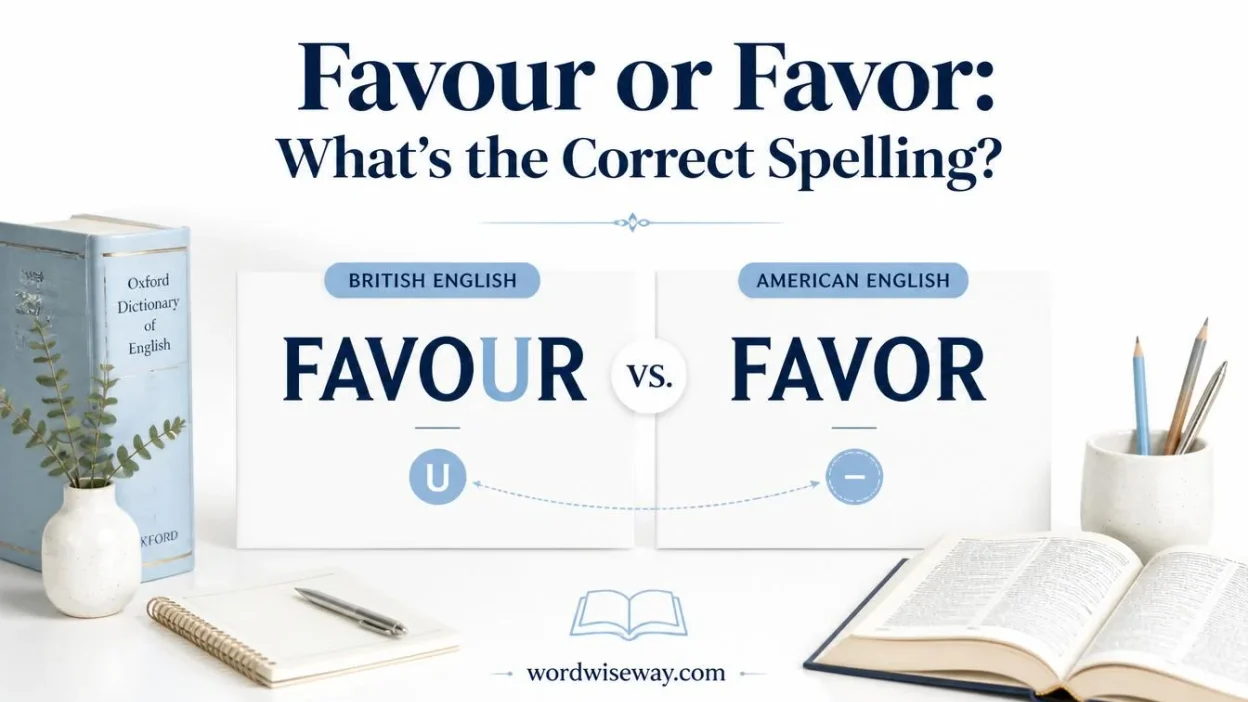
Favour or Favor: Correct Spelling, Difference, and Usage can confuse English learners and native speakers because the correct spelling depends on regional spelling and English varieties. Favor is standard in American English, while favour is preferred in British English and other varieties.
This spelling difference reflects regional variation, not a difference in meaning or pronunciation. Americans dropped the U, making favor the common American spelling, while favour remained the traditional British spelling. Both forms are correct within their respective spelling conventions.
For written English, choose the version that matches your audience, context, and regional preference. In the United States, use favor in formal writing, emails, and everyday communication. Under British English conventions, use favour. Both spellings can describe a kind act, support, approval, or a request for help.
Quick Answer:
Favour and favor are both correct spellings. The correct choice depends on the type of English you’re using.
| Spelling | English Variety | Example |
| Favour | British English | Could you do me a favour? |
| Favor | American English | Could you do me a favor? |
The main difference is the letter u. British English generally keeps the -our spelling, while American English commonly uses -or.
So, remember this simple rule:
- Favour = British English
- Favor = American English
- Both have the same meaning.
- Neither spelling is inherently wrong.
- Your choice should match the spelling system used throughout your writing.
For American English, favor is the form to use.
What’s the Difference?
The difference between favour and favor is primarily regional spelling rather than meaning or pronunciation.
British English traditionally uses spellings such as favour, colour, honour, and labour. American English generally drops the u, producing favor, color, honor, and labor.
This distinction doesn’t change how the word functions in a sentence. Both forms can work as a noun or a verb.
For example:
- British English: She did me a favour.
- American English: She did me a favor.
- British English: The committee favoured the proposal.
- American English: The committee favored the proposal.
The grammar remains the same. Only the spelling changes.
What Does Favour or Favor Mean?
The word favour/favor has several related meanings. Its exact meaning depends on how you use it in a sentence.
Favour or Favor as a Noun
As a noun, favour/favor commonly refers to a helpful act performed for someone.
For example:
Could you do me a favor?
Here, the speaker is asking another person to help them with something.
The noun can also refer to support, approval, or preference.
For example:
The proposal gained public favor.
In this sentence, favor means approval or support.
The word can also describe a small gift given to guests at an event.
Each guest received a party favor.
That usage is especially common in American English.
Favour or Favor as a Verb
As a verb, favour/favor means to prefer, support, approve of, or treat someone more positively.
Consider this example:
The committee favored the second proposal.
Here, favored means the committee preferred or supported the second proposal.
The verb can also describe a situation in which circumstances benefit one person, team, option, or outcome.
The evidence favors the simpler explanation.
In this case, the evidence supports one explanation more strongly than another.
British English Uses Favour
In British English, favour is the standard spelling.
You’ll see it in everyday expressions, formal writing, journalism, academic work, and professional communication.
Examples include:
- Could you do me a favour?
- She asked me for a small favour.
- The committee favoured the new proposal.
- Public opinion was in favour of the change.
- The decision was favourable to both sides.
British spelling keeps the u in the base word and many of its derivatives.
This pattern is useful because once you recognize it, several related spellings become easier to remember.
American English Uses Favor
In American English, favor is the standard spelling.
The same meanings and grammatical functions apply. The spelling simply removes the u.
Examples include:
- Could you do me a favor?
- She asked me for a small favor.
- The committee favored the new proposal.
- Public opinion was in favor of the change.
- The decision was favorable to both sides.
If you’re writing an American English article, essay, email, report, or website, favor is generally the appropriate choice.
Why Does Favour Have a “U” in British English?
The difference comes from the historical development of English spelling.
English absorbed vocabulary from several languages over many centuries. French had a major influence on English after the Norman Conquest, and many spelling traditions continued evolving afterward.
Words ending in -our became established in British English. When American English developed its own spelling conventions, many of these words adopted shorter -or forms.
That produced familiar pairs such as:
| British English | American English |
| favour | favor |
| colour | color |
| honour | honor |
| labour | labor |
| neighbour | neighbor |
| rumour | rumor |
| humour | humor |
This doesn’t mean American English simply removes letters at random. The change reflects a broader spelling pattern that became established in American usage.
Favour/Favor as a Verb
The verb favour/favor has several useful applications.
First, it can mean to prefer one option over another.
The manager favored the first design.
Second, it can mean to support an idea, plan, or person.
Most members favored the proposed changes.
Third, it can describe conditions that benefit a particular outcome.
The weather favored an early start.
The spelling changes depending on regional English, but the verb’s core meanings remain the same.
Favour/Favor in Different Verb Forms
The spelling difference continues when you change the tense or form.
| British English | American English |
| favour | favor |
| favoured | favored |
| favouring | favoring |
| favours | favors |
Notice something important here: American English doesn’t merely change the base word. The spelling pattern continues through related forms.
For example:
- British: The manager favoured the proposal.
- American: The manager favored the proposal.
This consistency helps readers recognize which spelling system you’re following.
Favour/Favor as a Noun
As a noun, favour/favor commonly refers to a kind act or helpful request.
The expression do me a favor is particularly common in American English.
For example:
Can you do me a favor and check this document?
The word can also mean approval or support.
The proposal found favor with the board.
Another meaning appears in expressions involving preference.
The evidence is in favor of the defendant.
In each case, context reveals the precise sense.
Common Noun Meanings
| Meaning | Example |
| Helpful act | Can you do me a favor? |
| Support | The plan gained public favor. |
| Approval | The proposal found favor with the committee. |
| Preference | The evidence is in favor of one explanation. |
| Small gift | The guests received party favors. |
Common Expressions
Some expressions make this spelling difference especially noticeable.
Do Me a Favour or Favor
This phrase means to help someone by doing something for them.
British English:
Could you do me a favour?
American English:
Could you do me a favor?
The meaning and tone are the same.
In Favour or Favor Of
This expression means supporting, approving, or choosing something.
British English:
The committee voted in favour of the proposal.
American English:
The committee voted in favor of the proposal.
It’s common in formal discussions, voting, decisions, and arguments.
Return the Favour or Favor
This means to help someone because they previously helped you.
For example:
You helped me with my project, so I’ll return the favor.
The expression often describes ordinary reciprocity. One person helps another, and the kindness eventually comes back around.
Find Favour or Favor With
This expression means to gain approval or acceptance.
For example:
The new policy found favor with many employees.
Here, favor means approval rather than a physical act of assistance.
Favourable vs. Favorable
The spelling difference doesn’t stop at favour/favor. It also appears in related words.
Favourable is the British English spelling.
Favorable is the American English spelling.
Both words generally mean positive, beneficial, advantageous, or approving.
| British English | American English |
| favourable | favorable |
| unfavourable | unfavorable |
Examples:
- British: The company received a favourable response.
- American: The company received a favorable response.
If you choose favor for American English, use favorable rather than mixing regional spellings.
Favouritism vs. Favoritism
Another related spelling difference appears in favouritism and favoritism.
British English uses favouritism, while American English uses favoritism.
The word refers to unfair preference given to a particular person or group.
For example:
The manager was accused of favoritism after repeatedly giving one employee special opportunities.
The spelling follows the same regional pattern:
- British English: favouritism
- American English: favoritism
This is a useful reminder that spelling differences often extend across an entire word family.
Favour or Favor Pronunciation
The spelling difference doesn’t normally create a meaningful difference in pronunciation between the two forms.
Both spellings represent the same basic English word. The pronunciation may vary slightly by regional accent, but the added u in favour doesn’t create a separate syllable.
The word has two syllables, with the main stress on the first syllable.
In everyday speech, the ending is relatively light. The spelling therefore tells you more about the regional writing convention than about how the word sounds.
Favour or Favor Examples in Sentences
Seeing the words in context makes the distinction much easier.
British English Examples
- Could you do me a favour before you leave?
- She asked for a small favour.
- The committee favoured the original proposal.
- The decision was favourable to both parties.
- Most members voted in favour of the plan.
- The new policy received a favourable response.
- He returned the favour the following week.
- The evidence seemed to favour one explanation.
American English Examples
- Could you do me a favor before you leave?
- She asked for a small favor.
- The committee favored the original proposal.
- The decision was favorable to both parties.
- Most members voted in favor of the plan.
- The new policy received a favorable response.
- He returned the favor the following week.
- The evidence seemed to favor one explanation.
The meanings don’t change. The spelling system does.
Favour vs. Favor Side-by-Side
A direct comparison can make the rule almost impossible to forget.
| British English | American English | Meaning |
| favour | favor | A helpful act or support |
| favoured | favored | Preferred or supported |
| favouring | favoring | Preferring or supporting |
| favours | favors | Present-tense verb or plural noun |
| favourable | favorable | Positive or beneficial |
| unfavourable | unfavorable | Negative or disadvantageous |
| favouritism | favoritism | Unfair preference |
The pattern is consistent. British forms generally retain u, while American forms use o.
Which One Should You Use?
The best spelling depends on your intended English variety.
Use favor when you’re writing in American English. This is the standard form for American readers and follows the broader American -or spelling pattern.
Use favour when you’re deliberately following British English conventions.
The most important rule is consistency.
Imagine reading a document that uses color, honour, favour, and labor all on the same page. Each individual spelling may be recognizable, but the mixture creates an uneven texture. Consistent spelling makes writing look more deliberate.
Choose Your Spelling Based on Your Audience
- American audience: favor
- British audience: favour
- American academic writing: favor
- British academic writing: favour
- American business writing: favor
- British business writing: favour
- Mixed international audience: choose one consistent style and follow it
When a school, employer, publication, or organization specifies a style guide, follow its requirements first.
Common Mistakes
Assuming One Spelling Is Wrong
One of the biggest mistakes is treating favour or favor as an incorrect spelling simply because it looks unfamiliar.
Both are standard forms.
The difference is regional, much like color and colour.
Mixing Regional Spellings
Another common mistake is switching between spelling systems in the same document.
For example:
The favourable results gave the company more favor with investors.
The sentence mixes British and American forms.
If you’re using American English, write:
The favorable results gave the company more favor with investors.
If you’re using British English, write:
The favourable results gave the company more favour with investors.
Thinking the U Changes the Meaning
The u doesn’t create a different definition.
Favour and favor mean the same thing.
The letter simply reflects the spelling convention you’re following.
Forgetting Related Words
Writers sometimes remember the base word but forget its derivatives.
For example, someone may correctly write favor but then use favourable in the same American English document.
Remember the whole family:
American: favor → favored → favorable → favoritism
British: favour → favoured → favourable → favouritism
An Easy Way to Remember
Here’s a simple memory trick:
British English favors “u.” American English usually favors the shorter spelling.
Think of these pairs together:
- favour / favor
- colour / color
- honour / honor
- labour / labor
- neighbour / neighbor
Once you recognize the -our/-or pattern, favour/favor becomes much easier to remember.
A quick mental check can also help. If your document already uses color, honor, and neighbor, favor will usually fit the same American spelling pattern.
Read More: Fiber or Fibre: Correct Spelling, Difference, and Usage
FAQs
Is “favour” or “favor” the correct spelling?
Both favour and favor are correct spellings. Favour is standard in British English, while favor is standard in American English.
What is the main difference between favour and favor?
The main difference is spelling. Favour contains the letter u, while favor does not. The meaning remains the same.
Is favor American English?
Yes. Favor is the standard spelling used in American English. It is common in American books, websites, emails, and other forms of writing.
Is favour British English?
Yes. Favour is the standard British English spelling. It is also used in several other varieties of English that follow British spelling conventions.
Does favour mean the same thing as favor?
Yes. Both words have the same meaning and can refer to a kind act, support, approval, or a request for help.
Should I use favor in an American English article?
Yes. If you’re writing for an American audience, favor is usually the better choice because it follows standard American English spelling conventions.
Should I use favour when writing British English?
Yes. Favour is the appropriate form when you’re following British English spelling rules, especially in formal or professional writing.
Why does favor have no “u”?
The American spelling favor developed after American English adopted several spelling changes that removed the u from words such as favour.
Can I use favour and favor in the same article?
It’s best to choose one spelling based on your target variety of English and use it consistently. Mixing both forms can make your writing look inconsistent.
How do I remember whether to write favour or favor?
Think about your audience. Use favor for American English and favour for British English. This simple regional rule makes the spelling easier to remember.
Conclusion
Choosing between favour and favor becomes easy once you know which variety of English you’re using. Both spellings are correct, and neither changes the meaning of the word. The key difference is regional: favor belongs to American English, while favour is the standard form in British English and other varieties influenced by it.
When you write, let your audience guide your spelling choice. If your readers are mainly in the United States, use favor. If you’re following British English conventions, choose favour. The same rule applies across articles, emails, school assignments, professional documents, and other forms of written communication.
Most importantly, stay consistent. Mixing both spellings in the same piece can make your writing look careless, even though both forms are correct. Pick the version that fits your audience, use it throughout your writing, and you won’t have to second-guess whether favour or favor is the right choice.

Emma Smith has dedicated 14 years to Princeton University’s English Department, mentoring students in textual interpretation, literary movements, and critical frameworks. Her research explores Shakespearean drama, Victorian serial fiction, postcolonial narrative theory, and manuscript studies and probing how literary forms evolve across cultures and centuries. Emma has delivered lectures at international humanities congresses and published findings in distinguished academic journals, underscoring her commitment to scholarly depth and vibrant teaching.