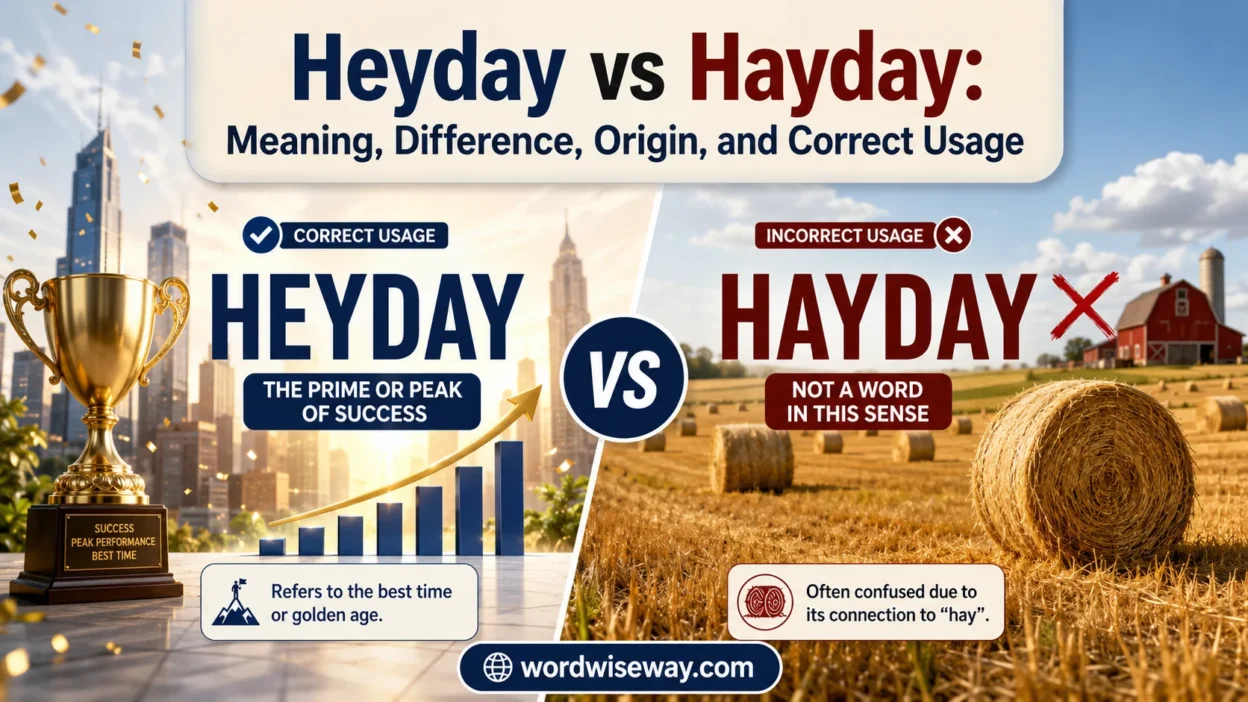
Heyday vs Hayday: Meaning, Difference, Origin, and Correct Usage helps English learners, native speakers, student groups, writers, and every writer understand this exact query with clarity and confidence.
Many people, students, and writers experience spelling confusion when comparing heyday vs hayday. Through years of English usage and professional writing, it becomes clear that heyday is the correct word, while hayday is generally considered a misspelling.
The term heyday refers to the peak, prime, best period, or most successful years of a person, organization, activity, or event. Using the incorrect spelling can create misunderstandings and reduce clarity in academic, professional, and everyday communication.
Many spelling mistakes occur because words are interpreted according to how they sound rather than how they developed historically, which is one reason the confusion between heyday and hayday continues to appear in modern writing.
The origin and etymology of heyday are particularly interesting. Despite its appearance, the word has no connection to hay, the harvested crop, or to a literal “day” involving hay. Linguists trace the term to the exclamation hey, an expression historically used to show surprise, excitement, joy, wonder, or high spirits.
According to language historians and etymological studies, the word may have been influenced partly by Low German expressions similar to exclamations such as “hurrah.” Over time, this energetic interjection evolved into a noun describing a period of vigor, prosperity, success, and prominence.
Historical records show that forms of the word appeared in English literature as early as the sixteenth century. Early examples can be found in works associated with English writer John Skelton, including Magnyfycence (1530), where variants of the expression appeared in lively dialogue.
Additional references appear in sixteenth-century dictionaries and literary texts, including works by Richard Huloet and Nicholas Udall. By the late 1500s, the noun form of heyday had become established in English, eventually developing the meaning we recognize today: a person’s or institution’s most successful, influential, or prosperous period. This linguistic journey highlights the rich history of English vocabulary and demonstrates how words evolve through centuries of cultural and literary use.
Quick Answer
Heyday is the correct English spelling for a peak, prime, or highly successful period. Hayday is generally a spelling mistake, while Hay Day is the name of a farming game. The confusion mainly comes from their similar pronunciation, so checking the meaning and context can help you choose the right form.
- Heyday describes a period when something was at its best.
- Hayday should generally be avoided in standard English.
- Hay Day is a proper name and should keep its two-word spelling.
- Using the correct form makes your writing clearer and more accurate.
Hayday or Heyday Meaning Explained Clearly
At first glance, “Hayday” and “Heyday” look like twins. Same rhythm. Same structure. But in real grammar and usage, only one is correct in standard English.
Heyday (Correct Word in English Grammar)
The word “heyday” is a real English noun. It refers to:
- The peak period of success
- A golden age of something
- The time when something is at its best or most powerful
For example:
- The company was in its heyday during the early 2000s.
- The actor’s heyday came in the 1990s.
In simple terms, heyday = prime time.
It often carries a nostalgic feeling. You are looking back at a time when something was strong, popular, or thriving.
Hayday (Common Misspelling or Brand Reference)
Now here is where confusion starts.
“Hayday” is not a standard English word.
It appears mainly in three situations:
- A spelling mistake for “heyday”
- A stylized brand or username
- A reference to the mobile game Hay Day
So when you see “hayday” in casual writing, it is usually incorrect unless it refers to branding.
Hay Day (Separate Proper Noun)
There is also Hay Day, a popular farming simulation game developed by Supercell. This is not a grammar term at all.
It is a proper noun with intentional spacing:
- Correct: Hay Day
- Incorrect grammar form: “hayday”
So now we have three forms:
- Heyday → correct English word
- Hayday → incorrect spelling or brand usage
- Hay Day → game title
Hayday or Heyday Grammar Differences Explained
To really understand this, you need to see how grammar classifies each form.
Read More: Losing vs Loosing: The Complete Guide to Spelling and Usage
Heyday as a Lexical Word
“Heyday” is a dictionary-recognized noun. It works in sentences as a subject or object.
Examples:
- The sport reached its heyday in the 1980s.
- That artist is past his heyday now.
- Social media influencers are in their heyday today.
It behaves like a normal noun you can place in time-related descriptions.
Hayday as an Error in Grammar Usage
When people write “hayday,” grammar systems flag it as incorrect because:
- It does not exist in standard dictionaries
- It breaks historical spelling origin rules
- It is not used in academic or professional English
However, the human brain often creates this spelling because:
- “Hay” is a familiar word
- “Day” is a familiar word
- So the combination feels natural
This is called phonetic assumption, where spelling is guessed based on sound.
Hay Day as a Proper Noun Exception
Proper nouns are different from grammar rules. They follow branding decisions.
So even though “Hay Day” looks like two normal words, it is a fixed name. You cannot change it to “Hey Day” or “Hayday” without altering meaning.
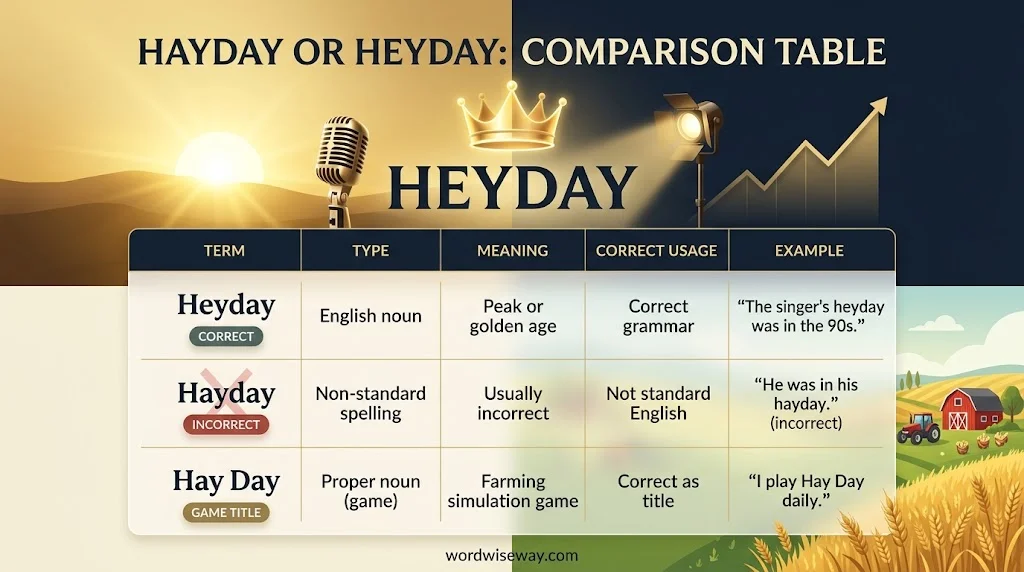
Comparison Table
Here is a clear breakdown to remove confusion instantly.
| Term | Type | Meaning | Correct Usage | Example |
| Heyday | English noun | Peak or golden age | Correct grammar | “The singer’s heyday was in the 90s.” |
| Hayday | Non-standard spelling | Usually incorrect | Not standard English | “He was in his hayday.” (incorrect) |
| Hay Day | Proper noun (game) | Farming simulation game | Correct as title | “I play Hay Day daily.” |
This table alone explains most of the confusion people face online.
Why People Confuse Hayday or Heyday
Language confusion rarely happens randomly. There are real psychological and linguistic reasons behind it.
Sound-Based Spelling
Both “hayday” and “heyday” sound identical when spoken. English does not always give spelling clues through pronunciation, so users guess.
Familiar Word Blocks
People recognize:
- “Hay” as animal feed or grass
- “Day” as time measurement
So they naturally combine them.
Internet Search Influence
Search engines and social media often show mixed usage. Once users see both forms, they assume both are correct.
Autocorrect and Typing Speed
Mobile typing also contributes:
- Fast typing leads to phonetic spelling
- Autocorrect sometimes does not correct rare words
The True Meaning of Heyday in Modern English
To fully master “heyday,” you need to understand its emotional tone.
The word does not just mean “best time.” It also implies:
- A period that has passed
- A sense of nostalgia
- A peak that may not return
Examples in real-life contexts
- Music: “The band’s heyday was during the vinyl era.”
- Technology: “Flip phones had their heyday before smartphones.”
- Sports: “That team’s heyday came with their championship run.”
Each example carries a feeling of time moving forwar
Hayday or Heyday in Digital Writing and SEO
In 2026, spelling matters more than ever online. Search engines rely heavily on correct word usage.
Case Study: How Spelling Changes Meaning Online
Let’s look at a practical example.
Scenario
A content writer publishes two articles:
- Article A uses “heyday” correctly
- Article B uses “hayday” throughout
Result
- Article A gets indexed properly
- Article B receives lower visibility or is flagged as incorrect spelling usage
Why this happens
Search algorithms prioritize:
- dictionary-backed words
- semantic clarity
- consistent usage patterns
This shows that correct grammar is not just academic. It directly affects digital performance.
Common Mistakes
Even experienced writers sometimes slip. Here are the most frequent mistakes:
Mistake 1: Treating Hayday as a real word
Incorrect:
- “She was in her hayday.”
Correct:
- “She was in her heyday.”
Mistake 2: Mixing Hay Day with Heyday
Incorrect:
- “The game heyday is fun.”
Correct:
- “The game Hay Day is fun.”
Mistake 3: Using heyday for future events
Incorrect:
- “The company will reach its heyday next year.”
Better:
- “The company is expected to reach its peak next year.”
Because “heyday” often implies a past or present peak, not a future prediction.
Simple Memory Trick to Remember Heyday
Here is an easy way to lock it in your mind:
Think of “HEY, that was the DAY!”
It helps you remember:
- “Hey” signals attention or emotion
- “Day” refers to a time period
- Together, it means a memorable peak period
Once you connect it emotionally, spelling becomes automatic.
Real-Life Usage Examples of Heyday
Let’s see how naturally the word appears in writing.
- “The fashion industry’s heyday was marked by bold experimentation.”
- “In its heyday, the platform dominated global communication.”
- “Every technology has a heyday before something newer replaces it.”
- “That city was in its heyday during the industrial boom.”
Notice how it always points to a peak moment in time.
Hayday or Heyday in Academic and Professional Writing
In formal writing, only one version is accepted.
Acceptable usage
- Essays
- Research papers
- News articles
- Business reports
Correct form: heyday
Using “hayday” in these contexts may:
- reduce credibility
- introduce spelling errors
- affect grading or evaluation
Professional writing standards are strict about dictionary accuracy.
Hayday or Heyday in Everyday Communication
In casual texting or social media, people sometimes write “hayday” without correction. While communication still works, it creates inconsistency.
However, clarity improves when you use:
- heyday in descriptive contexts
- Hay Day when referring to the game
- avoid hayday entirely unless intentional branding
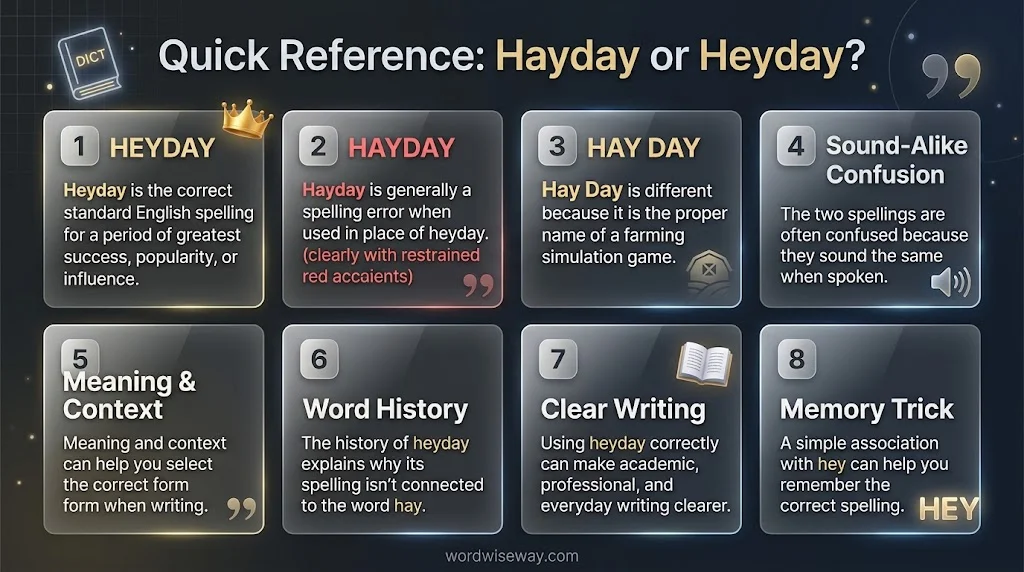
Key Insights
- Heyday is the correct standard English spelling for a period of greatest success, popularity, or influence.
- Hayday is generally a spelling error when used in place of heyday.
- Hay Day is different because it is the proper name of a farming simulation game.
- The two spellings are often confused because they sound the same when spoken.
- Meaning and context can help you select the correct form when writing.
- The history of heyday explains why its spelling isn’t connected to the word hay.
- Using heyday correctly can make academic, professional, and everyday writing clearer.
- A simple association with hey can help you remember the correct spelling.
My Personal Experience
As an English language specialist, I’ve noticed that heyday and hayday can easily trip up even confident writers. When reviewing articles, student assignments, and online content, I’ve often seen hayday appear where heyday belongs. The mistake usually happens because both forms sound identical during conversation. I’ve learned that checking the surrounding sentence and intended meaning is often enough to spot the problem quickly.
One thing I emphasize when helping writers is that spelling shouldn’t depend entirely on pronunciation. English contains countless words whose written forms don’t perfectly match their sounds. When someone writes hayday, I first look at what they’re trying to express. If they mean a period of exceptional success, heyday is the appropriate choice. This small distinction can make writing look much more polished and dependable.
After seeing this mistake repeatedly, I started using a simple review habit: whenever I encounter hayday, I pause and ask whether the writer means the English noun heyday or the title Hay Day. That quick check prevents unnecessary errors. From my experience, learning the meaning behind a word makes its spelling easier to remember than relying on memorization alone.
Quick Reference Summary
- Heyday = correct English word meaning peak time
- Hayday = incorrect spelling in standard English
- Hay Day = mobile farming game title
Simple. Clean. No confusion needed.
Practice:
Test your understanding by choosing the correct form in each sentence. Remember, heyday is the standard English noun for a peak or highly successful period, while hayday is generally a misspelling.
Choose the Correct Word
- The singer enjoyed her ______ during the 1990s.
a) heyday
b) hayday - The company was at its ______ before the new technology changed the market.
a) hayday
b) heyday - That actor became extremely popular during his ______.
a) heyday
b) hayday - The phrase “in its ______” describes something during its most successful period.
a) hayday
b) heyday - I remember when flip phones were in their ______.
a) heyday
b) hayday
Answers
- heyday
- heyday
- heyday
- heyday
- heyday
Quick Challenge
Write two original sentences using heyday correctly. Then write one sentence explaining why hayday is usually incorrect in standard English.
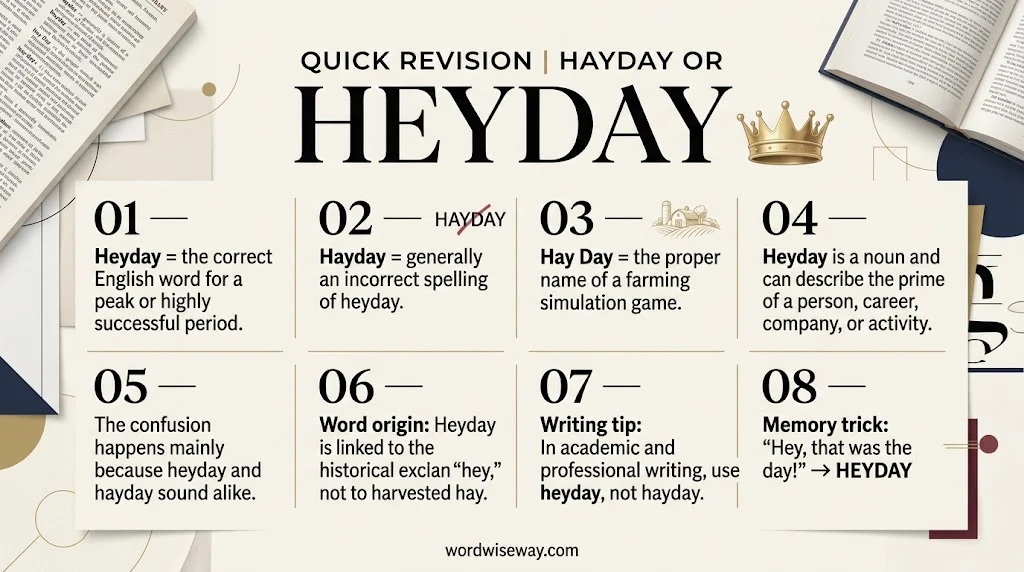
Quick Revision
- Heyday = the correct English word for a peak or highly successful period.
- Hayday = generally an incorrect spelling of heyday.
- Hay Day = the proper name of a farming simulation game.
- Heyday is a noun and can describe the prime period of a person, career, company, or activity.
- The confusion happens mainly because heyday and hayday sound alike.
- Heyday is linked to the historical exclamation hey, not to harvested hay.
- In academic and professional writing, use heyday, not hayday.
- Easy memory trick: “Hey, that was the day!” → heyday.
FAQs
1. Is heyday or hayday the correct spelling?
The correct spelling is heyday. The form hayday is usually considered a spelling mistake and is not accepted in standard English.
2. What does heyday mean?
Heyday refers to the peak, highest point, or most successful period in a person’s life, career, organization, or event.
3. Why do people confuse heyday with hayday?
Many people assume the word is connected to hay and farming. However, the term has a different historical origin and is not related to harvested hay.
4. Is hayday a real English word?
In modern English, hayday is generally treated as a misspelling of heyday rather than a standard dictionary word.
5. Where did the word heyday come from?
The word likely developed from the exclamation hey and historical forms such as heyda, which expressed surprise, excitement, or joy.
6. What do major dictionaries say about heyday?
Sources such as the Oxford English Dictionary (OED) and etymological references trace the word back to the early 1500s and describe its historical development.
7. Can heyday be used in professional writing?
Yes. Heyday is appropriate for academic, professional, educational, and formal writing when referring to a peak period of success.
8. How can I remember the correct spelling?
Think of heyday as being connected to the exclamation hey! rather than hay. This simple association helps avoid spelling errors.
9. What is an example of heyday in a sentence?
“That company reached its heyday during the late 1990s when it dominated the market.”
10. Why is understanding the difference important?
Using the correct spelling improves grammar, clarity, communication, and overall writing quality while preventing confusion and misunderstandings.
Conclusion
Understanding the difference between heyday and hayday is important for clear and accurate communication. Although the two spellings look similar, heyday is the correct term and has a rich linguistic history dating back to the early 1500s. Its origins are linked to expressions of excitement and celebration rather than to hay or farming. By learning its meaning, history, and proper usage, writers, students, and professionals can strengthen their vocabulary, improve grammatical accuracy, and avoid common spelling mistakes in both formal and everyday writing.
The distinction also becomes useful when you encounter these terms in different forms of writing. A careful writer considers the intended meaning before choosing a spelling, especially when two forms sound alike. This habit can make editing easier and help you spot small errors before they affect the quality of your work. When heyday appears in the right context, the meaning becomes clear without needing extra explanation.
For anyone developing stronger English skills, this small spelling distinction offers a useful lesson about language itself. Familiar sounds can sometimes lead you toward the wrong written form, so it’s worth checking meaning as well as pronunciation. With regular reading and careful writing practice, heyday becomes easier to recognize and use naturally. Over time, these small improvements can make your overall English more precise and confident.

Evelyn Shaw has spent 14 years at Yale University’s English Department, leading students through close readings, genre studies, and interpretive methodologies. Her scholarly interests include Renaissance drama, gothic fiction, feminist literary criticism, and archival research and examining how texts generate meaning across historical periods. Evelyn has presented at major academic conferences and published essays in peer-reviewed journals, reflecting her passion for rigorous analysis and student-centered learning.