Learn Hers or Her’s: Correct Spelling, Meaning, and Usage Explained with clear rules about apostrophes, hers, and her’s.
Many English learners, students, and writers find spelling challenging because some English words create confusion. The difference between these forms is a common spelling mistake because people think an apostrophe always shows ownership. In English, apostrophes can replace missing letters in contractions like they’re and shouldn’t, or show possession with –‘s in titles like The Time Traveler’s Wife.
The possessive pronoun hers already shows ownership, so adding an apostrophe is incorrect usage. The same rule applies to theirs. Using her’s in emails, essays, or social media posts can look unprofessional and grammatically incorrect.
This guide explains correct spelling, grammar, and spelling rules with practical examples, sample sentences, and tips to improve writing skills.
Quick Answer
If you’re looking for the short version, here it is:
| Word | Correct? | Meaning |
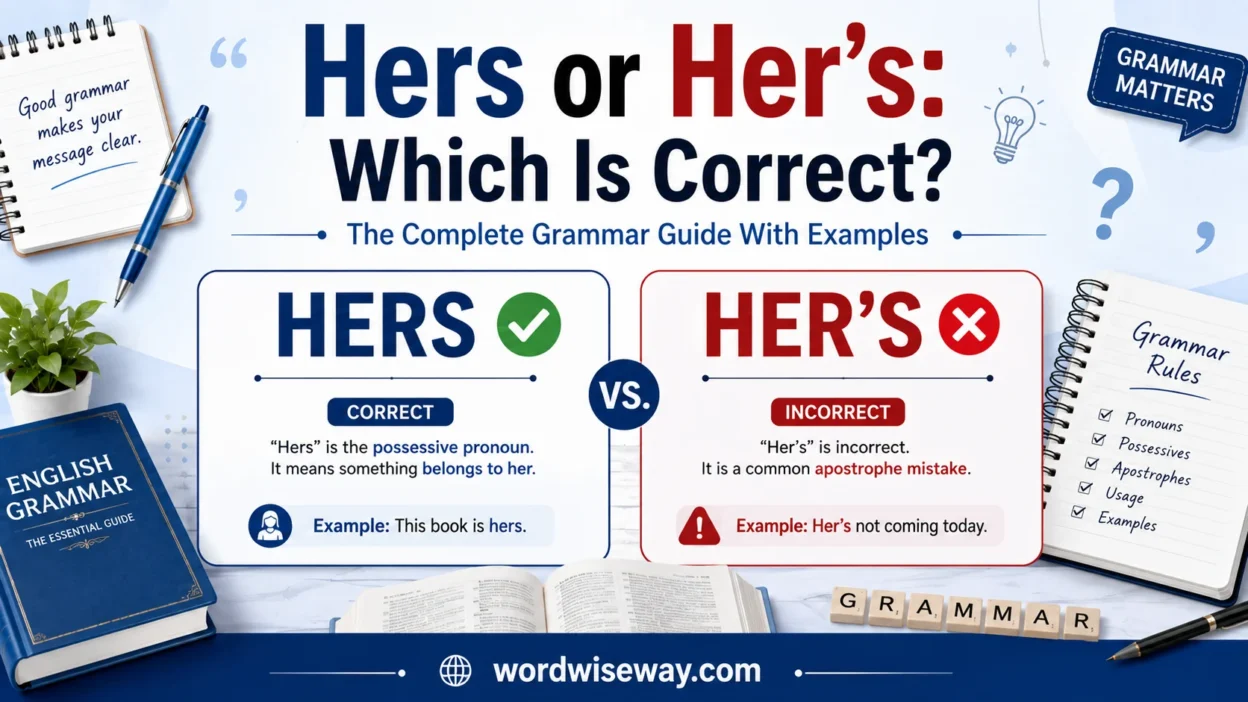
| Hers | ✅ Yes | Possessive pronoun showing ownership |
| Her’s | ❌ No | Incorrect spelling |
Correct Examples
- The backpack is hers.
- That decision was hers.
- The victory belongs to hers? No. The victory is hers.
Incorrect Examples
- The backpack is her’s.
- That decision was her’s.
The apostrophe should never appear in the word hers.
What Does “Hers” Mean?
The word hers is a possessive pronoun.
A possessive pronoun shows ownership without repeating a noun.
Consider this sentence:
The red bicycle belongs to Emma.
Instead of repeating Emma’s name, you can write:
The red bicycle is hers.
The word hers replaces the phrase her bicycle.
This makes writing smoother and less repetitive.
Examples of Hers in Sentences
- The responsibility is hers.
- The final vote was hers.
- That achievement is hers alone.
- The blue umbrella is hers.
- The winning idea was hers.
Notice something interesting.
The noun doesn’t follow hers.
That’s one of the easiest ways to identify a possessive pronoun.
Why “Her’s” Is Incorrect
Many people assume ownership always requires an apostrophe.
That’s true for many nouns.
Examples include:
- Sarah’s laptop
- Michael’s jacket
- The teacher’s office
However, possessive pronouns follow a different rule.
Words such as:
- mine
- yours
- his
- hers
- ours
- theirs
already indicate possession.
Because ownership is already built into these words, they do not need apostrophes.
Adding an apostrophe creates a grammatical error.
Think of It This Way
Imagine ownership is already baked into the word.
Adding an apostrophe is like adding extra sugar to a cake that’s already sweet enough.
The apostrophe serves no purpose because possession is already present.
Understanding Possessive Pronouns
To fully understand why hers is correct, it’s helpful to understand possessive pronouns.
What Is a Possessive Pronoun?
A possessive pronoun replaces a noun phrase while showing ownership.
Instead of saying:
That notebook belongs to her.
You can say:
That notebook is hers.
The second sentence sounds more natural and efficient.
Common Possessive Pronouns
| Subject Pronoun | Possessive Adjective | Possessive Pronoun |
| I | My | Mine |
| You | Your | Yours |
| He | His | His |
| She | Her | Hers |
| We | Our | Ours |
| They | Their | Theirs |
Notice an important pattern.
None of these possessive pronouns use apostrophes.
Not one.
That pattern alone can help you avoid dozens of common grammar mistakes.
Why People Write “Her’s”
If her’s is incorrect, why do so many people write it?
Several factors contribute to the confusion.
Confusion With Possessive Nouns
Most people learn early that apostrophes often indicate ownership.
Examples include:
- Lisa’s computer
- Mark’s wallet
- The dog’s collar
Writers naturally assume the same rule applies everywhere.
Unfortunately, possessive pronouns are exceptions.
Influence of Contractions
Apostrophes frequently appear in contractions.
Examples:
- don’t
- isn’t
- she’s
- it’s
Because apostrophes appear so often in English, many writers instinctively add one where it doesn’t belong.
Overcorrection
Sometimes people know apostrophes indicate possession.
As a result, they insert apostrophes into any word that appears possessive.
This leads to mistakes such as:
- your’s
- her’s
- their’s
All three are incorrect.
Her vs. Hers: Understanding the Difference
Many writers confuse her and hers.
Although related, they serve different grammatical purposes.
What Is “Her”?
The word her can function as:
- An object pronoun
- A possessive adjective
Her as an Object Pronoun
Examples:
- I saw her yesterday.
- We invited her to the meeting.
- The teacher praised her.
Her as a Possessive Adjective
Examples:
- Her phone is ringing.
- Her project won first place.
- Her car is parked outside.
In these examples, a noun follows her.
What Is “Hers”?
The word hers functions only as a possessive pronoun.
Examples:
- The phone is hers.
- The project was hers.
- The car is hers.
Quick Comparison
| Word | Function | Example |
| Her | Object Pronoun | I met her yesterday. |
| Her | Possessive Adjective | Her laptop is new. |
| Hers | Possessive Pronoun | The laptop is hers. |
Easy Trick to Remember the Correct Form
Grammar becomes much easier when you use memory shortcuts.
The Mine and Yours Test
Consider these words:
- Mine
- Yours
- Hers
- Ours
- Theirs
None contain apostrophes.
Now look at these versions:
- Mine’s ❌
- Your’s ❌
- Her’s ❌
- Our’s ❌
- Their’s ❌
They all look wrong because they are wrong.
If mine doesn’t need an apostrophe, then hers doesn’t either.
Quick Memory Rule
Possessive pronouns own things without apostrophes.
Simple.
Effective.
Easy to remember.
Real-World Examples of Correct Usage
Let’s examine how hers appears in everyday communication.
Everyday Conversation
- That coffee mug is hers.
- The dog followed her because the leash was hers.
- The final choice was hers.
Academic Writing
- The hypothesis was hers.
- The original research concept was hers.
- The conclusion reflected her findings, but the interpretation was hers.
Workplace Communication
- The presentation was hers.
- The proposal was hers from start to finish.
- The successful strategy was hers.
Social Media Usage
- The viral post was hers.
- That incredible artwork is hers.
- The account belongs to her, and the content is hers.
Across every context, the spelling remains exactly the same.
Hers. Never her’s.
Common Mistakes and How to Fix Them
Even experienced writers occasionally make mistakes.
Let’s examine the most common ones.
Mistake: Adding an Apostrophe
Incorrect:
The notebook is her’s.
Correct:
The notebook is hers.
Mistake: Using Hers Before a Noun
Incorrect:
Hers notebook is on the desk.
Correct:
Her notebook is on the desk.
Remember:
- Her comes before nouns.
- Hers replaces nouns.
Mistake: Confusing Her and Hers
Incorrect:
The backpack is her.
Correct:
The backpack is hers.
Possessive Nouns vs. Possessive Pronouns
This distinction explains nearly every apostrophe mistake.
Possessive Nouns Need Apostrophes
Examples:
| Noun | Possessive Form |
| Sarah | Sarah’s |
| James | James’s |
| Teacher | Teacher’s |
| Dog | Dog’s |
These nouns require apostrophes to indicate ownership.
Possessive Pronouns Do Not
Examples:
| Possessive Pronoun | Correct Form |
| Mine | Mine |
| Yours | Yours |
| His | His |
| Hers | Hers |
| Ours | Ours |
| Theirs | Theirs |
The ownership meaning is already built into these words.
No apostrophe needed.
The Grammar Logic Behind Hers
English grammar follows patterns rather than random rules.
The possessive pronoun system evolved to create efficiency.
Imagine if every possessive pronoun used apostrophes:
- Mine’s
- Your’s
- Her’s
- Our’s
- Their’s
The language would become cluttered.
Instead, English developed streamlined possessive pronouns.
That’s why modern grammar uses:
- mine
- yours
- hers
- ours
- theirs
without punctuation.
This system keeps writing cleaner and easier to read.
Examples Quiz: Can You Spot the Correct Version?
Test your knowledge.
Question 1
The umbrella is ______.
- hers ✅
- her’s ❌
Question 2
That success was entirely ______.
- hers ✅
- her’s ❌
Question 3
The final decision was ______.
- hers✅
- her’s ❌
Question 4
______ backpack is near the door.
- Her✅
- Hers ❌
Question 5
The backpack is ______.
- Hers✅
- Her ❌
Answer Pattern
A simple rule emerges:
- Before a noun → her
- Replacing a noun → hers
Hers, His, Yours, and Theirs: A Pattern Worth Remembering
One of the fastest ways to master English grammar is recognizing patterns.
Correct Forms
| Pronoun | Correct Form |
| Mine | Mine |
| Yours | Yours |
| His | His |
| Hers | Hers |
| Ours | Ours |
| Theirs | Theirs |
Incorrect Forms
| Incorrect Word |
| Mine’s |
| Your’s |
| His’ |
| Her’s |
| Our’s |
| Their’s |
Notice the consistency.
English possessive pronouns almost never use apostrophes.
Once you understand this pattern, you’ll automatically avoid multiple grammar mistakes.
A Simple Case Study: How One Apostrophe Changes Credibility
Imagine two job applicants.
Applicant A writes:
The portfolio is her’s.
Applicant B writes:
The portfolio is hers.
The difference appears tiny.
Yet hiring managers, editors, teachers, and clients often notice grammar details.
A misplaced apostrophe can create the impression of carelessness.
Strong grammar builds credibility.
Weak grammar can quietly undermine it.
That doesn’t mean perfection is required. Everyone makes mistakes.
However, learning simple rules like hers vs. her’s helps make your writing more polished and professional.
Quick Reference Cheat Sheet
Use “Her” When
- A noun follows.
- You need a possessive adjective.
- You need an object pronoun.
Examples:
- Her laptop
- Her idea
- I called her
Use “Hers” When
- Replacing a noun.
- Showing ownership.
- Ending a possessive phrase.
Examples:
- The laptop is hers.
- The idea was hers.
- The victory belongs to her and the trophy is hers.
Never Use
- Her’s ❌
- Hers’ ❌
Read More: Halves or Halfs: Correct Spelling, Meaning, and Difference
FAQs
1. Is “hers” the correct spelling?
Yes, hers is the correct spelling when you want to show that something belongs to a female person or someone already mentioned. It works as a possessive pronoun and does not need an apostrophe.
2. Is “her’s” ever correct in English?
No, her’s is not considered correct in standard English. Adding an apostrophe creates a spelling mistake because possessive pronouns like hers already show ownership.
3. Why do people write “her’s” by mistake?
Many people believe an apostrophe always shows possession, but this rule only applies to some nouns. Possessive pronouns follow different grammar rules.
4. What is the difference between hers and her’s?
Hers means something belongs to her, while her’s is an incorrect form. The apostrophe should not be added because the word already carries the possessive meaning.
5. Does hers mean the same as her?
No, her usually comes before a noun, such as “her book,” while hers replaces the noun, such as “The book is hers.”
6. Can I use hers in formal writing?
Yes, hers is completely acceptable in formal writing, including essays, reports, and professional communication.
7. Do possessive pronouns need apostrophes?
No, possessive pronouns like hers, theirs, yours, and ours do not use apostrophes because their meaning is already clear.
8. How can I remember the correct use of hers?
Remember that words showing possession do not always need an apostrophe. If the word is a possessive pronoun, use hers without adding extra marks.
9. Is hers a noun or a pronoun?
Hers is a possessive pronoun. It replaces a noun and shows ownership without repeating the object being discussed.
10. What are some examples of using hers correctly?
Examples include “This laptop is hers” and “The decision was hers.” In both sentences, hers shows belonging without an apostrophe.
Conclusion
Understanding the difference between hers and her’s helps you avoid a simple but common English mistake. Although apostrophes are useful for contractions and showing possession in some cases, they are not used with possessive pronouns. The correct form is always hers when you want to show ownership.
By learning these grammar rules and practicing with examples, you can improve your spelling, writing confidence, and overall English accuracy. Small details like this can make your emails, essays, and everyday communication look clearer and more professional.

Emma Smith has dedicated 14 years to Princeton University’s English Department, mentoring students in textual interpretation, literary movements, and critical frameworks. Her research explores Shakespearean drama, Victorian serial fiction, postcolonial narrative theory, and manuscript studies and probing how literary forms evolve across cultures and centuries. Emma has delivered lectures at international humanities congresses and published findings in distinguished academic journals, underscoring her commitment to scholarly depth and vibrant teaching.