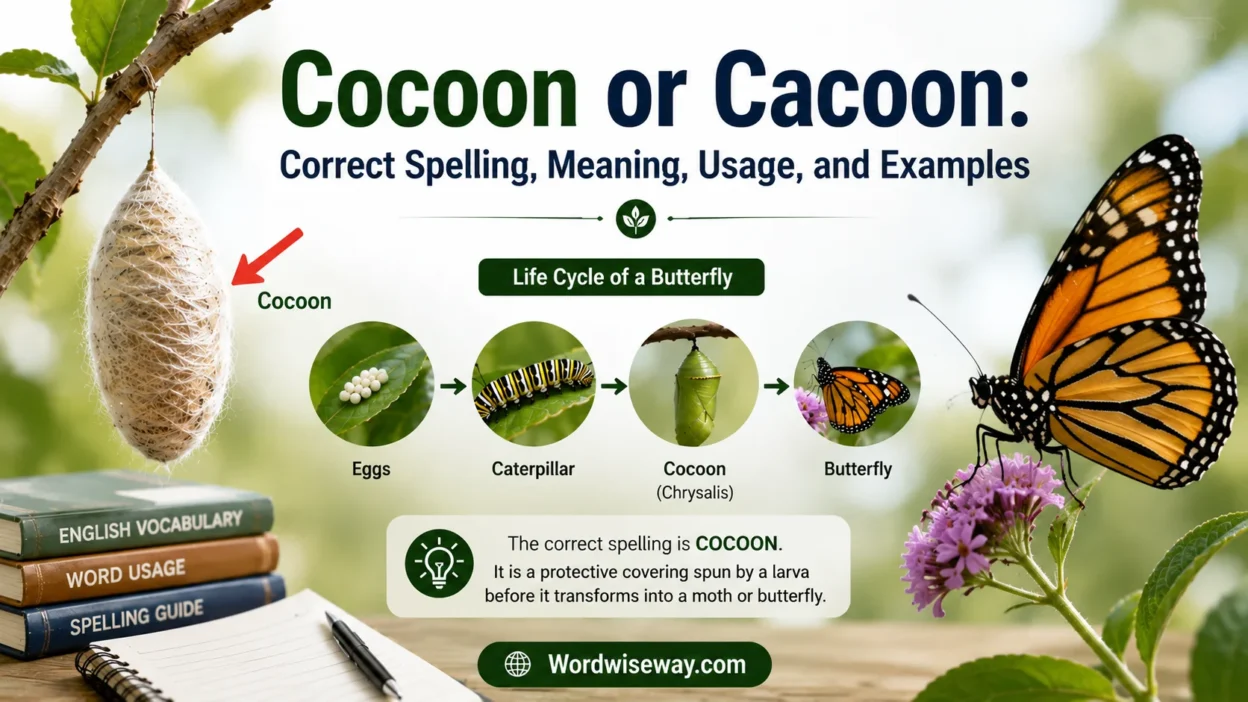
Cocoon or Cacoon: Correct Spelling, Meaning, and Correct Usage helps explain this common spelling confusion.
Many English learners, writers, and students keep second-guessing whether cacoon or cocoon is the correct word. The correct spelling is cocoon, while cacoon is a common misspelling. This comparison improves accuracy and clarity in writing.
A cocoon is a protective covering made by insects like caterpillars and butterflies. Understanding its meaning, usage, and difference helps you avoid common mistakes. From my personal experience, checking a dictionary can clear confusion and build confidence in professional writing and casual writing.
Quick Answer:
Cocoon is the correct spelling.
Cacoon is generally an incorrect spelling and should not be used in normal English writing.
| Word | Correct Spelling | Meaning | Usage |
| Cocoon | ✅ Yes | A protective covering made by some insects | Common and correct |
| Cacoon | ❌ No | Usually a spelling mistake for cocoon | Avoid in writing |
Example:
✅ The caterpillar built a cocoon before transforming into a butterfly.
❌ The caterpillar built a cacoon before transforming into a butterfly.
If you’re writing an essay, article, email, or school assignment, always choose cocoon.
What Does Cocoon Mean?
The word cocoon has a few meanings, but all of them connect to the idea of protection, covering, and safety.
In nature, a cocoon is a protective layer that some insects create around themselves during a major transformation. Inside this covering, the insect develops into its adult form.
Moths are among the most common insects associated with cocoons. A moth caterpillar spins a layer of silk around itself and stays protected while its body changes.
A cocoon works like a natural survival chamber. It protects the developing insect from weather, predators, and other outside dangers.
Cocoon as a Noun
As a noun, cocoon describes the protective covering itself.
Examples:
- The silkworm created a soft silk cocoon.
- The insect remained inside its cocoon until it was fully developed.
- Scientists studied the structure of the insect’s cocoon.
The noun form is the most common use of the word.
Cocoon as a Verb
Although less common, cocoon can also work as a verb. It means to surround or protect someone or something.
Examples:
- She cocooned herself in a warm blanket during the cold evening.
- The small house was cocooned by tall trees.
- He created a quiet space where he could cocoon himself from distractions.
This figurative meaning does not involve insects. Instead, it describes creating comfort, privacy, or protection.
What Does Cacoon Mean?
The word cacoon is usually not considered a standard English word when someone intends to describe an insect covering.
Most of the time, people write cacoon because they are unsure about the spelling of cocoon.
English contains many words where similar sounds create spelling confusion. For example:
- Receive vs recieve
- Separate vs seperate
- Cocoon vs cacoon
The mistake happens because people often guess spelling based on sound. However, correct spelling depends on the accepted form of the word.
Is Cacoon a Real Word?
In everyday English, cacoon is not the accepted spelling for the insect covering.
When you search for “cacoon meaning,” you are usually looking for information about cocoon.
For formal writing, exams, articles, and professional communication, avoid using cacoon.
Why Do People Spell Cocoon as Cacoon?
The confusion between cocoon or cacoon happens for several reasons.
Similar Pronunciation
When people hear the word spoken, the first vowel sound can be unclear. The pronunciation kuh-KOON does not immediately reveal whether the first part should be written as “co” or “ca.”
English Spelling Patterns
English borrows words from many languages, which creates unusual spelling patterns. Some words follow historical spelling rules rather than simple sound rules.
Memory Mistakes
People may remember the sound but forget the exact spelling. Since “ca” appears frequently in English words, they may accidentally write cacoon.
A simple memory trick:
Cocoon has two “co” sounds: co + coon.
Think of it as:
CO + COON = COCOON
This small trick makes the correct spelling easier to remember.
Cocoon vs Cacoon: Key Differences
Understanding the difference becomes easy when you compare them directly.
| Feature | Cocoon | Cacoon |
| Spelling | Correct | Incorrect in standard English |
| Pronunciation | Kuh-KOON | Usually intended as cocoon |
| Meaning | Protective insect covering or protective space | No standard meaning in this context |
| Common Usage | Science, nature, literature, daily language | Mostly spelling errors |
| Recommended Use | Yes | No |
How to Pronounce Cocoon
The correct pronunciation of cocoon is:
kuh-KOON
The second part receives more emphasis.
Break it down:
- Co → “kuh”
- Coon → “koon”
Example:
“The butterfly remained inside the cocoon.”
The word sounds smooth because the stress falls naturally on the second syllable.
How to Remember the Spelling of Cocoon
Spelling mistakes become easier to avoid when you connect words with simple ideas.
Here are some tips:
- Remember that a cocoon starts with “co”, not “ca.”
- Think about the word “coconut” because both begin with “co.”
- Break the word into two parts: co + coon.
- Visualize a caterpillar inside a round protective covering.
Small spelling habits create stronger language skills over time.
Examples of Cocoon in Sentences
Seeing the word in real sentences helps you understand how it works.
Everyday Examples
- The child wrapped himself in a blanket and felt like he was inside a cozy cocoon.
- The bedroom became a peaceful cocoon away from the busy city.
- The baby slept safely in a warm cocoon of blankets.
Scientific Examples
- A moth develops inside a protective cocoon.
- Researchers observed how insects form their cocoons during development.
- The silkworm creates a silk cocoon that humans use to produce silk fabric.
Figurative Examples
The word cocoon often appears in books, movies, and everyday speech to describe comfort or isolation.
Examples:
- After a long day, she enjoyed her quiet home as a personal cocoon.
- The village felt like a peaceful cocoon surrounded by mountains.
This use gives the word a deeper emotional meaning.
Common Mistakes When Using Cocoon
Many learners make small mistakes when using this word. Here are the most common ones:
Writing Cacoon Instead of Cocoon
This is the biggest mistake.
Incorrect:
- The butterfly came out of a cacoon.
Correct:
- The butterfly came out of a cocoon.
Confusing Cocoon With Chrysalis
Many people think these words mean exactly the same thing. They are related but different.
A cocoon is usually a silk covering created by insects like moths.
A chrysalis is the hard outer stage where many butterflies transform.
Not every butterfly creates a cocoon.
Using Cocoon Only for Insects
The word has expanded beyond biology. Writers often use it to describe emotional comfort, privacy, or protection.
Example:
- “Her reading corner became her little cocoon.”
This does not mean an actual insect covering. It means a safe and comfortable place.
Cocoon vs Chrysalis: Are They the Same?
Although people often use these words interchangeably, they describe different things.
| Cocoon | Chrysalis |
| Usually a silk covering | A hardened insect body stage |
| Commonly linked with moths | Commonly linked with butterflies |
| Created around the insect | Part of the insect’s transformation stage |
| Provides protection | Allows metamorphosis |
A moth caterpillar may spin a cocoon around itself, while many butterflies form a chrysalis without creating a silk covering.
Understanding this difference helps you use scientific terms more accurately.
The Origin and History of the Word Cocoon
The word cocoon has an interesting history. It entered English from French and is connected to words related to shells and coverings.
Historically, cocoons became especially important because of silk production. Silkworm cocoons contain silk fibers that humans have used for thousands of years to create fabric.
Today, the word has moved beyond science. Writers use “cocoon” to describe anything that provides comfort, shelter, or protection.
The journey of this word shows how language changes over time. A simple insect covering became a powerful metaphor for safety and personal space.
Real-Life Uses of the Word Cocoon
The word cocoon appears in many areas.
Science and Nature
Scientists study cocoons to understand insect growth and biological transformation.
Important facts:
- Moths commonly create cocoons.
- Silkworm cocoons are used in silk production.
- Cocoons protect insects during vulnerable stages.
Design and Technology
The idea of a cocoon has inspired modern designs.
Examples:
- Cozy furniture designs are sometimes called cocoon chairs.
- Protective technology uses the idea of creating safe spaces.
- Some vehicle designs focus on creating a protected environment.
Everyday Language
People use cocoon as a metaphor for comfort.
Examples:
- A warm home can feel like a cocoon.
- A quiet room can become a personal cocoon.
- A supportive community can act like a social cocoon.
The word carries a feeling of safety and shelter.
Read More: Constant vs Consistent : Difference, Meaning, and Correct Usage
FAQs
What is the correct spelling: cocoon or cacoon?
The correct spelling is cocoon. The word cacoon is a common spelling mistake and is not accepted as the standard English spelling. Using cocoon ensures your writing remains accurate and professional.
What does the word cocoon mean?
A cocoon is a protective covering made by some insects, such as caterpillars, during their development stage. It protects the insect while it changes into an adult butterfly or moth.
Is cacoon a real English word?
No, cacoon is not considered a correct English word in standard usage. It is usually a spelling error caused by confusion with the correct word cocoon.
How do you use cocoon in a sentence?
You can use cocoon when talking about insect development or protection. For example: “The caterpillar formed a cocoon before becoming a butterfly.”
Can cocoon be used as a verb?
Yes, cocoon can also be used as a verb. It means to surround or protect someone or something. For example: “She cocooned herself in a warm blanket during the cold evening.”
What is the origin of the word cocoon?
The word cocoon comes from the French word cocon, which means a covering or shell. Over time, it became part of the English language to describe insect coverings.
Why do people confuse cocoon with cacoon?
People often confuse these spellings because the pronunciation can make the spelling unclear. The similar sounds of “co” and “ca” sometimes lead to the incorrect form cacoon.
What are some synonyms of cocoon?
Depending on the context, synonyms for cocoon include covering, shell, case, wrap, and protective layer. These words may not always have exactly the same meaning but can describe a form of protection.
Is cocoon only related to butterflies?
No, a cocoon is not only related to butterflies. Many moths and other insects create cocoons during their life cycle. However, butterflies are the most commonly associated with this term.
How can I remember the spelling of cocoon?
A simple way to remember cocoon is to focus on the “co” beginning and the double “oo” in the middle. Remember that cocoon has two “o” letters together, not “ca” at the start.
Conclusion
Understanding the difference between cocoon and cacoon helps you avoid a frequent spelling mistake in English. The correct word is always cocoon, which refers to a protective covering created by insects during their transformation process. Using the correct spelling improves the quality and accuracy of your writing.
Whether you are a student, writer, or English learner, remembering this small spelling rule can make a big difference. Whenever you feel unsure about a word like cocoon, checking its meaning and spelling in a reliable dictionary can strengthen your vocabulary and help you write with more confidence.

Emma Smith has dedicated 14 years to Princeton University’s English Department, mentoring students in textual interpretation, literary movements, and critical frameworks. Her research explores Shakespearean drama, Victorian serial fiction, postcolonial narrative theory, and manuscript studies and probing how literary forms evolve across cultures and centuries. Emma has delivered lectures at international humanities congresses and published findings in distinguished academic journals, underscoring her commitment to scholarly depth and vibrant teaching.