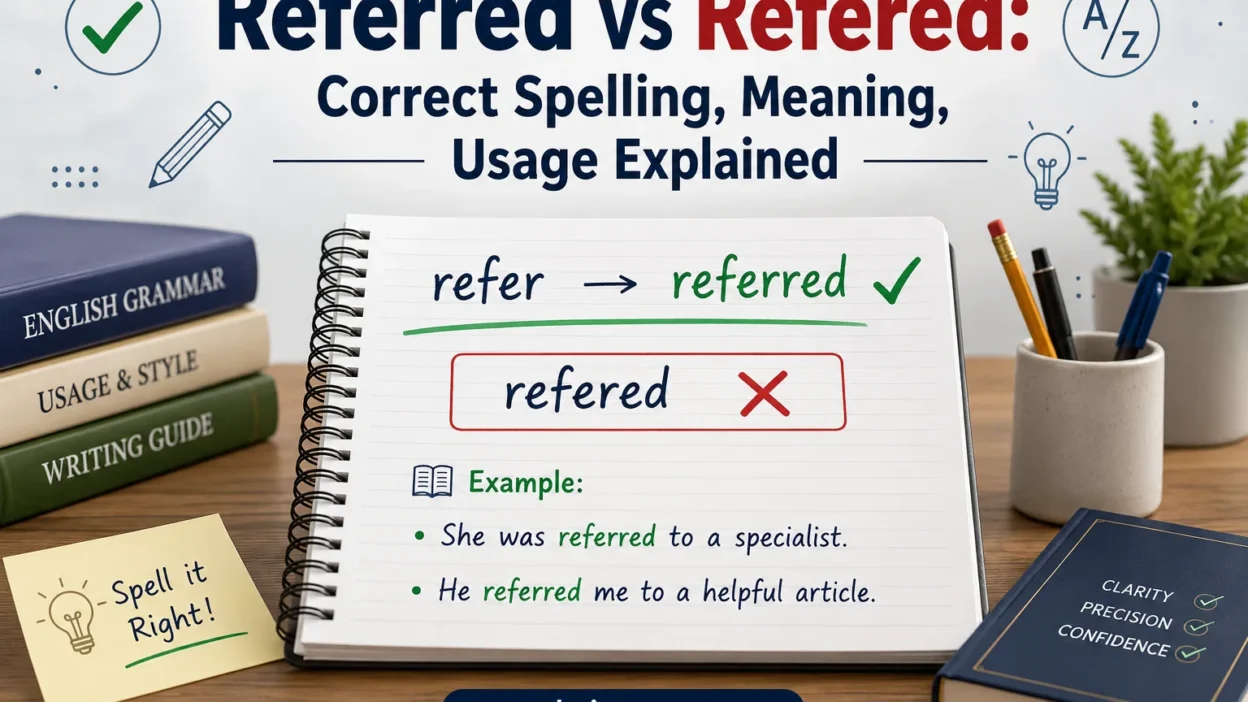
Referred vs Refered: Correct Spelling, Meaning, Usage is often confusing for english learners, writers, and professionals dealing with spelling, and usage in english writing and written communication. Many face spelling errors, errors, and misunderstandings when using the word refer and its referred word in real context and writing tasks. This impacts clarity, accuracy, and standard spelling in academic writing and professional writing across emails and reports.
The confusion in language learning and English language comes from the consonant-vowel-consonant (cvc) combination, where English grammar rules require doubling the final consonant before adding -ed, forming referred instead of refered. This rule is often ignored, especially by non-native speakers, leading to a common mistake, common spelling mistake, and repeated incorrect spelling in sentence and text. Such grammar rules and language rules are essential for correct word usage.
Quick Comparison Table
| Word | Meaning | Correct? |
| refer | present action | ✔ |
| referred | past action | ✔ |
| refered | spelling mistake | ❌ |
The Correct Spelling of Referred vs Refered
The only correct form
The correct spelling is referred.
The incorrect form
“Refered” is always wrong in English grammar.
Why only one is accepted
English follows spelling patterns. When certain verbs change into past tense, they double their final consonant. “Refer” belongs to that group.
Meaning of Refer and Referred
What “refer” means
The verb “refer” means:
- To direct someone to a source or person
- To mention something in speech or writing
- To point attention toward something
Simple examples of refer
- I refer you to the manual.
- She refers students to online notes.
- He refers to past experiences often.
What “referred” means
“Referred” is:
- The past tense of refer
- The past participle form
It means the action already happened.
Examples of referred
- The doctor referred the patient to a specialist.
- I referred your message to the manager.
- She has referred this issue before.
Why Refered Is Incorrect
The grammar rule it breaks
English often doubles the final consonant in specific verb patterns before adding “-ed.”
The structure of “refer”
Refer ends in a consonant-vowel-consonant pattern (r-e-r). The stress falls on the last syllable.
The correct transformation
- refer → referred ✔
- refer → refered ❌
Why spelling matters here
Dropping one “r” breaks standard English spelling rules and makes the word incorrect in all contexts.
Grammar Rule Behind Referred
The double consonant rule
When a verb:
- Ends in consonant + vowel + consonant
- Has stress on the final syllable
You double the final letter before adding “-ed.”
Similar examples
- prefer → preferred
- control → controlled
- commit → committed
- refer → referred
Why English does this
It helps preserve pronunciation and keeps word patterns consistent across verbs.
How Referred Is Used in Sentences
As a past tense verb
Used when something already happened:
- The teacher referred the student to counseling.
- I referred your request yesterday.
As a past participle
Used with helping verbs:
- She has referred many clients this year.
- They had referred the matter earlier.
In passive voice
Used when the subject receives action:
- The case was referred to HR.
- The issue was referred to management.
Common Mistakes With Referred
Writing “refered” instead of “referred”
This is the most common mistake and always incorrect.
Mixing verb forms
- Incorrect: He refered me to a doctor.
- Correct: He referred me to a doctor.
Confusing related words
- refer (verb)
- referral (noun)
- referee (person in sports context)
Real-Life Usage Examples of Referred
Workplace examples
- I referred the email to HR.
- The manager referred the issue to IT support.
Medical examples
- The patient was referred to a specialist.
- Doctors referred him for tests.
Education examples
- The professor referred students to research papers.
- She referred the assignment guidelines.
Everyday examples
- My friend referred me to this website.
- He referred me to a mechanic.
Memory Tricks to Remember Referred
Trick 1: Double R rule
Think: if you refer again in the past, you double the “r.”
Trick 2: Sound memory
Say it aloud:
- refer (light, short)
- referred (heavier, longer ending)
Trick 3: Visual trick
Imagine the word stretching when it moves into the past:
refer → re-ferr-ed
Case Study: Why Spelling Changes Perception
Incorrect version
“We refered your request to the team.”
Correct version
“We referred your request to the team.”
What changes
The meaning stays the same, but perception changes:
- Incorrect spelling looks careless
- Correct spelling builds trust
- Small errors affect professionalism
For More Info Please Visit: Leftie vs Lefty Meaning: Differences, and Real Context
Why English Doubles Letters Like in Referred
To keep pronunciation clear
Without doubling, pronunciation would feel unnatural.
To maintain spelling consistency
English follows patterns like:
stop → stopped, refer → referred
Because of language history
English evolved from multiple languages, which created these structured spelling rules.
FAQs
Q1. What is the correct spelling: referred or refered?
The correct spelling is referred. The form refered is incorrect and considered a common spelling mistake in English writing.
Q2. Why is refered wrong?
Refered is wrong because English grammar rules require doubling the final consonant before adding -ed in verbs like refer.
Q3. What does referred mean?
Referred means to mention something, direct someone to a source, or relate one thing to another in communication.
Q4. Why do people confuse referred and refered?
They sound the same in speech, so many learners mistakenly write refered instead of applying spelling rules correctly.
Q5. Is refered used in British or American English?
No, refered is not valid in either British or American English. Only referred is correct.
Q6. What grammar rule applies to referred?
The consonant-vowel-consonant (CVC) rule applies, requiring the final consonant to be doubled before adding -ed.
Q7. Where is referred commonly used?
It is commonly used in academic writing, professional emails, reports, legal documents, and formal communication.
Q8. What is the past tense of refer?
The past tense of refer is referred.
Q9. How can I avoid this spelling mistake?
Learn and practice the CVC rule and regularly check verb spelling patterns in English writing.
Q10. Is refered a real word?
No, refered is not a real English word; it is simply a spelling error of referred.
Conclusion
The difference between referred and refered may look small, but it plays a very important role in how clear and professional your English writing appears. The correct form, referred, follows a simple grammar rule where the final consonant in refer is doubled before adding -ed. Once this rule is understood, the mistake becomes easy to avoid, especially in everyday writing tasks like emails, reports, academic work, and formal communication.
In real usage, this error is very common among learners because spoken English does not clearly show spelling differences, which leads to confusion. However, improving awareness of spelling rules, especially the consonant-vowel-consonant pattern, helps strengthen accuracy over time. With regular practice, writers can reduce errors, improve clarity, and build confidence in their English communication. Mastering such small but important details gradually leads to stronger grammar control and more polished writing in both academic and professional contexts.

Amelia Sanders has spent 14 years in Harvard University’s English Department, helping students navigate literary analysis, interpretive theory, and narrative techniques. Her academic pursuits center on 18th-century British prose, romantic poetry, diasporic writing, and digital editing exploring how textual choices influence cultural perspectives. Amelia has spoken at major international meetings and contributed essays to respected academic volumes, demonstrating her dedication to thoughtful scholarship and effective teaching.