Halves or Halfs: Correct Spelling, Meaning, and Usage explains the correct plural form and helps readers avoid common spelling mistakes in English writing.
Many people get confused between Halves and Halfs because both forms look similar. In the English language, a word can have a different meaning depending on its context and use in a sentence. Halve is a verb, Half is a noun, and Halves is the correct plural. Halfs is a misspelling and not a real word in standard English.
I once made this mistake while writing a recipe, but a commenter politely corrected me.This guide gives a simple explanation, examples, and comparison to improve grammar, spelling, and word usage. It helps learners, students, and writers understand the correct form and use Halves confidently in everyday writing, reports, and other communication.
Quick Answer:
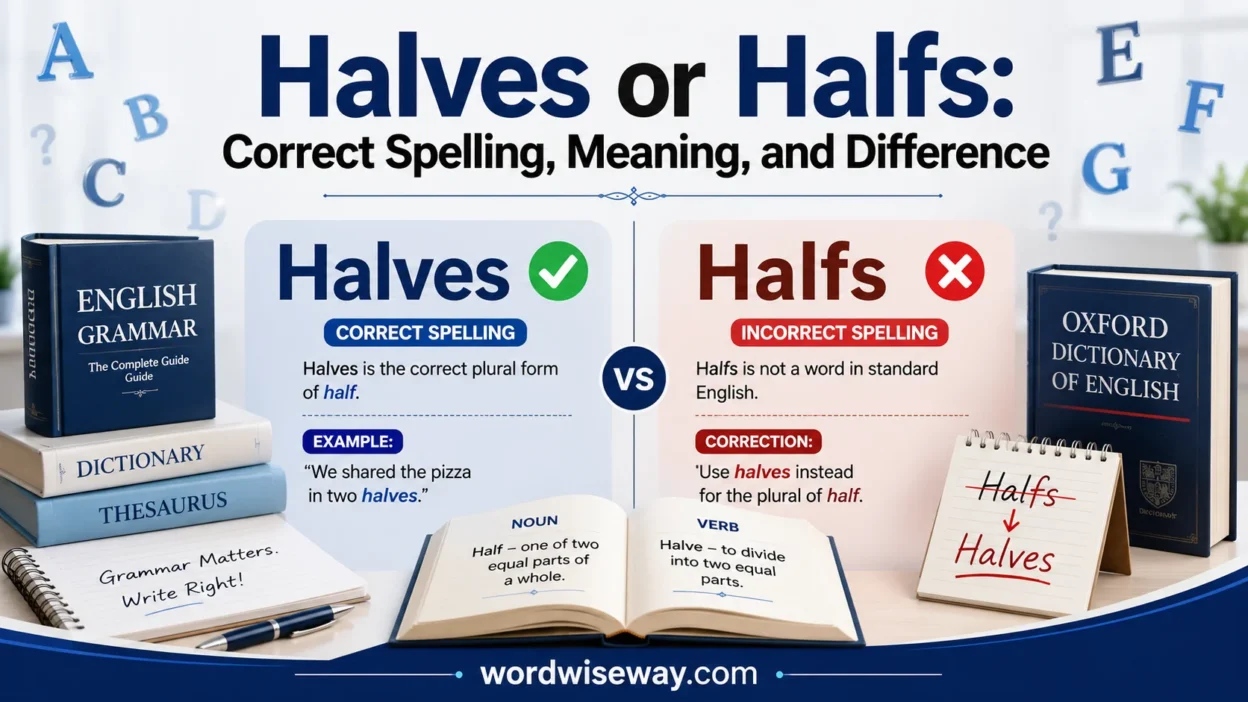
Halves is the correct plural of half.
Halfs is not accepted in standard English and should be avoided in both formal and informal writing.
Correct examples:
- The apple was cut into two halves.
- Both halves of the match were entertaining.
- The twins each received equal halves of the inheritance.
Incorrect example: - The apple was cut into two halfs.
Remember: Whenever you need the plural form of half, always write halves.
What Does “Half” Mean?
The word half means one of two equal parts of a whole. It’s a versatile word that appears in conversations, books, mathematics, sports, cooking, finance, and many other situations. Depending on how it’s used, half can function as a noun, adjective, adverb, or determiner.
Half as a Noun
As a noun, half refers to one of two equal parts.
Examples
- I finished half of the book.
- Half of the class arrived early.
- She ate only half of the pizza.
Half as an Adjective
As an adjective, half describes an amount, measurement, or period that equals one-half.
Examples
- We spent a half day exploring the city.
- He ordered a half sandwich for lunch.
Half as an Adverb
As an adverb, half describes something that is only partly complete.
Examples
- The window was half open.
- She looked half asleep during the lecture.
Everyday Uses of Half
| Context | Example |
| Fractions | Half of the pie |
| Time | Half an hour |
| Distance | Half a mile |
| Sports | First half |
| Money | Half the price |
| Cooking | Half a cup of milk |
Why Is the Plural “Halves” Instead of “Halfs”?
At first, halfs may seem logical because many English nouns become plural by adding -s. However, half belongs to a group of irregular nouns that follow a different spelling pattern.
When half becomes plural, the f changes to v, and -es is added.
Half → Halves
This spelling pattern has existed in English for centuries. Although modern pronunciation has changed over time, the plural spelling has remained the accepted standard.
The Grammar Rule Behind Halves
Many nouns ending in -f or -fe change their ending to -ves when they become plural.
| Singular | Plural |
| Half | Halves |
| Leaf | Leaves |
| Knife | Knives |
| Life | Lives |
| Calf | Calves |
| Shelf | Shelves |
| Loaf | Loaves |
| Wolf | Wolves |
| Learning these words together makes them much easier to remember. |
Exceptions to the Rule
English wouldn’t be English without exceptions. Some nouns ending in -f simply add -s instead of changing to -ves.
| Singular | Plural |
| Roof | Roofs |
| Chief | Chiefs |
| Cliff | Cliffs |
| Belief | Beliefs |
| Proof | Proofs |
| Safe | Safes |
| Gulf | Gulfs |
| Because there isn’t one universal rule, it’s always worth checking a dictionary if you’re unsure. |
Is “Halfs” Ever Correct?
No. In modern English, halfs is considered incorrect.
You may occasionally come across halfs in social media posts, online forums, or informal messages, but these examples are spelling mistakes rather than accepted usage. Major dictionaries and grammar references recognize only halves as the standard plural.
Always use halves in:
- Academic writing
- Business documents
- Professional emails
- Reports
- Books
- Articles
- Everyday communication
Using the correct spelling helps your writing appear accurate and polished.
Half vs. Halves vs. Halve
Although these words share the same root, they perform different jobs in a sentence.
| Word | Part of Speech | Meaning | Example |
| Half | Noun, adjective, adverb | One of two equal parts | Half the cake remained. |
| Halves | Plural noun | More than one half | The two halves fit perfectly together. |
| Halve | Verb | To divide into two equal parts | Halve the recipe before baking. |
When to Use Half
Choose half when referring to one equal part.
Examples
- Half the meeting is over.
- I drank half the bottle.
- Half the students passed the test.
When to Use Halves
Use halves whenever you’re referring to two or more equal parts.
Examples
- She cut the orange into halves.
- Both halves of the soccer game were exciting.
- The chocolate bar broke into two equal halves.
When to Use Halve
Use halve when describing the action of dividing something into two equal pieces.
Examples
- Halve the strawberries before serving.
- We need to halve the budget.
- The company hopes to halve delivery times.
Common Mistakes to Avoid
Many spelling mistakes happen because writers apply regular plural rules where irregular ones are required.
| Incorrect | Correct |
| two halfs | two halves |
| several halfs | several halves |
| both halfs | both halves |
| cut into halfs | cut into halves |
| halve of the cake | half of the cake |
Mistaking “Halfs” for the Plural
This is by far the most common error.
- ❌ Two halfs
- ✅ Two halves
Confusing Half and Halve
Remember this simple distinction:
- Half names a thing.
- Halve describes an action.
Examples: - Please halve the tomatoes.
- Eat half the tomatoes.
Forgetting Irregular Plurals
Not every word ending in -f changes to -ves, so don’t assume the same rule applies to every noun.
- Half → Halves ✅
- Knife → Knives ✅
- Roof → Roofs ✅
- Chief → Chiefs ✅
Real-World Examples of “Halves”
Mathematics
- Two halves always make one whole.
- Divide the rectangle into equal halves.
- One-half is equal to 0.5.
Cooking
- Halve the peaches before grilling.
- Cut the potatoes into halves.
- Use half the amount of butter.
Sports
- The first half ended without a goal.
- The home team dominated both halves.
- Fans applauded at the end of each half.
Business
- The company managed to halve production costs.
- The partners shared the profits in equal halves.
- Sales increased during the second half of the year.
Everyday Conversation
- Let’s split the bill in half.
- Each child received one half.
- The loaf broke into two neat halves.
- Half the guests arrived early.
- Both halves tasted delicious.
An Easy Way to Remember
A simple memory trick is to group half with other familiar -ves words.
- Leaf → Leaves
- Knife → Knives
- Life → Lives
- Wolf → Wolves
- Half → Halves
When you remember the pattern instead of a single word, the correct spelling becomes much easier to recall.
Grammar Tip: If a noun ends in -f or -fe, don’t automatically add -s. First, check whether it belongs to the irregular -ves group.
Practical Example
Imagine you’re writing:
“The sandwich was cut into two halfs.”
The sentence communicates the idea, but the spelling is incorrect. Replacing halfs with halves fixes the mistake immediately.
Correct sentence:
“The sandwich was cut into two halves.”
Using the correct plural makes your writing look more professional and shows a solid understanding of English grammar.
“Small grammar choices make a big difference. Using the correct word helps your writing sound clear, natural, and credible.”
Halves in Different Contexts
The word halves appears in many areas of daily life. While its meaning stays the same, the context changes how people use it. Understanding these situations makes the word easier to remember and use correctly.
Halves in Mathematics
In mathematics, halves describe two equal parts that make one whole. It’s one of the first fraction concepts children learn.
Examples
- Two halves equal one whole.
- Divide the rectangle into two equal halves.
- The teacher shaded both halves of the circle.
Halves in Cooking
Recipes often use both half and halve. Knowing the difference prevents confusion in the kitchen.
Examples
- Halve the lemons before squeezing them.
- Cut the potatoes into halves.
- Add half the amount of sugar if you prefer a less sweet dessert.
Halves in Sports
Many sports divide games into two halves.
Examples
- The first half ended without a goal.
- The home team played much better in the second half.
- Both halves of the match were highly competitive.
Halves in Business
Businesses use half, halves, and halve when discussing profits, expenses, production, and performance.
Examples
- The company hopes to halve its operating costs.
- The partners divided the profits into equal halves.
- Sales doubled during the second half of the year.
Halves in Medicine
Healthcare professionals also use these words when discussing medication and dosage.
Examples
- Break the tablet into two halves.
- Never halve medication unless your doctor or pharmacist advises it.
- Some tablets are designed to be split into equal halves.
Common English Expressions Using Half
English contains many everyday expressions with half. Although they don’t always use the plural halves, understanding them improves both vocabulary and fluency.
| Expression | Meaning | Example |
| Better half | Husband, wife, or partner | My better half loves hiking. |
| Half the battle | A major part of success | Planning is half the battle. |
| Halfway there | Partially completed | We’re halfway there already. |
| Half-hearted | Without enthusiasm | He made a half-hearted attempt. |
| Half-baked | Poorly planned | That idea feels half-baked. |
| Cut in half | Divide into two equal pieces | Cut the sandwich in half. |
| By halves | Incomplete or partially | Don’t do the job by halves. |
Real-Life Scenario
Imagine you’re preparing a recipe for a family dinner. The instructions say:
“Halve four tomatoes and arrange the halves on a baking tray.”
Each word has a different purpose:
- Halve tells you what action to perform.
- Halves refers to the tomato pieces after you’ve cut them.
Understanding this distinction helps you recognize the correct form naturally.
Easy Memory Tricks
You don’t need to memorize dozens of grammar rules to remember this spelling. A few simple tricks are enough.
Think of the “-ves” Family
Group these words together:
- Half → Halves
- Leaf → Leaves
- Knife → Knives
- Life → Lives
- Wolf → Wolves
Remembering them as one family makes each spelling easier to recall.
Remember the Phrase
Repeat this sentence:
“Two halves make one whole.”
You’ll see this sentence in math classes, books, and everyday conversation, making it an easy reminder.
Associate It with the Verb
Think of the sequence:
- Halve the apple.
- You now have two halves.
This simple connection reinforces both words at the same time.
Mini Grammar Quiz
Test your understanding with these quick questions.
Which sentence is correct?
- A. Two halfs make one whole.
B. Two halves make one whole.
Answer: B - A. Halve the orange before serving.
B. Half the orange before serving.
Answer: A - A. Both halves were equal.
B. Both halfs were equal.
Answer: A - A. Half the class was absent.
B. Halves the class was absent.
Answer: A - A. She cut the bread into halves.
B. She cut the bread into halfs.
Answer: A - Which word is a verb?
- A. Half
- B. Halves
- C. Halve
Answer: C
- Which spelling is accepted in standard English?
- A. Halfs
- B. Halves
Answer: B
- Which sentence is correct?
- A. The game had two exciting halves.
- B. The game had two exciting halfs.
Answer: A
- Which word means “to divide into two equal parts”?
- A. Half
- B. Halves
- C. Halve
Answer: C
- Which sentence is correct?
- A. Divide the rectangle into two halves.
- B. Divide the rectangle into two halfs.
Answer: A
Read More: Whose vs Who’s: Correct Usage and Difference
FAQs
What is the correct spelling, Halves or Halfs?
Halves is the correct spelling when you want to describe more than one half of something. Halfs is not accepted in standard English and is considered a spelling mistake.
Why is Half changed to Halves in plural form?
The word Half follows an irregular plural rule. Instead of simply adding “s,” the f changes to v and becomes Halves, similar to other English spelling patterns.
Is Halfs a real word in English?
No, Halfs is not a correct English word. It is a common misspelling that happens because many plural words are formed by adding “s” at the end.
How do I use Halves in a sentence?
You can use Halves when talking about two or more equal parts. For example, “She divided the cake into two halves” shows that the cake was separated into equal sections.
Is Half a noun or a verb?
Half can work as a noun when referring to one of two equal parts. Halve is the verb form, meaning to divide something into two equal parts.
Why do people confuse Halves and Halfs?
Many writers get confused because most English nouns create plurals by adding “s” or “es.” However, some words like Half have irregular plural forms.
Are Halves and Half pronounced differently?
Yes, Half and Halves have slightly different pronunciations because the ending sound changes in the plural form. The spelling change also reflects this difference.
Can I use Halves in formal writing?
Yes, Halves is completely correct for both formal and informal writing. You can use it in reports, articles, recipes, and everyday communication.
What is the difference between Half and Halves?
Half refers to one part of two equal sections, while Halves refers to more than one part. The meaning depends on whether you are discussing one or multiple sections.
How can I remember the correct spelling?
A simple way to remember is that Half changes its “f” to “v” in the plural form, making Halves. Practicing examples can help make this spelling natural.
Conclusion
Understanding the difference between Halves and Halfs helps improve your English spelling and writing accuracy. Although the two forms may look similar, only Halves is correct because English uses irregular plural rules for this word.
By learning the correct form, checking examples, and paying attention to spelling patterns, you can avoid this common mistake. Whether you are writing a recipe, report, or everyday message, using Halves correctly makes your communication clearer and more professional.