Have you ever stopped while writing an email or report and wondered whether the correct phrase is laid out or layed out? You’re not alone. It’s one of those grammar mistakes that catches both beginners and experienced writers because the verbs lay and lie are among the most confusing in English.
I’ve run into this mistake more times than I can count while editing business documents, website content, and client projects. Early in my career, I occasionally saw layed out in reports and marketing copy, even from skilled professionals. A single spelling error may seem minor, but it can make polished writing look less credible and distract readers from your message.
The good news is that the rule is simple once you understand it: laid out is the only correct form, while layed out is always incorrect. Whether you’re describing a project plan, a document, a room design, or information presented in an organized way, using the right phrase helps your writing sound clear, professional, and trustworthy.
In this guide, you’ll learn the difference between laid out and layed out, why the confusion happens, how the verb lay changes in different tenses, and how to avoid this common mistake with practical examples you can apply in everyday writing.
Quick Meaning
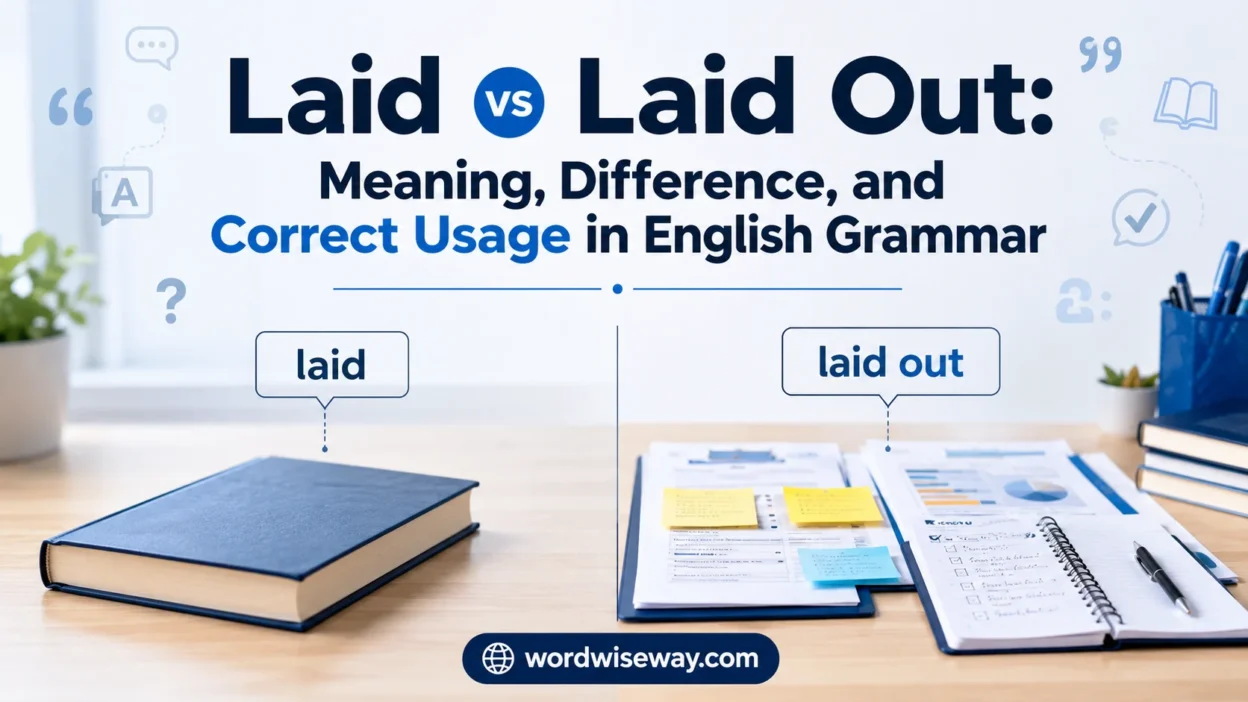
Laid out is the correct past tense of lay out, meaning arranged, organized, presented, explained, or planned in a clear way. Layed out is not a correct English spelling and should never be used in formal or informal writing.
Understanding “Lay” and the Role of “Laid” in Grammar
What “lay” actually means in simple English
The verb lay means to place something down carefully or intentionally. It always needs an object.
You don’t just “lay.” You lay something.
- Lay a book on the table
- Lay a phone beside the bed
- Lay a blanket on the grass
That object requirement is the key to understanding everything that follows.
Why “laid” is the correct past tense
Once we move into the past, lay becomes laid.
Here’s the full pattern:
- Present: I lay the book on the desk
- Past: I laid the book on the desk
- Past participle: I have laid the book on the desk
Notice something important. The meaning never changes. Only the tense does.
Real-life examples of “laid”
Let’s make this feel practical:
- She laid the clothes on the bed before packing
- He laid the tools out in the garage
- They laid the foundation for the building last year
These all involve a physical action. Something moves from one place to another.
Common mistake people make with “laid”
Many writers accidentally say:
- ❌ I have layed the phone down
- ❌ She lay the book on the table (when past tense is intended)
The correct form is always:
- ✔ I laid the phone down
- ✔ She laid the book on the table
A simple rule helps here: **“laid” always means something was physically placed.”
What “Laid Out” Really Means in English Grammar
Now we step into the second half of the confusion: laid out.
This is not just a verb. It’s a phrasal verb. That means it combines a verb with a preposition to create a new meaning.
The core meaning of “laid out”
Unlike “laid,” which focuses on placement, laid out focuses on arrangement or explanation.
It usually means:
- To organize things clearly
- To display something in a structured way
- To explain something step-by-step
Read More: “Ladder” vs “Latter” Meaning, Difference, and Real Examples
Everyday meanings of “laid out”
Let’s break it into real-world use cases.
Physical arrangement
- He laid out the clothes for tomorrow
- She laid out the tools in neat rows
- They laid out food on the table for guests
Here, order matters more than simple placement.
Planning or explanation
- The manager laid out the new policy
- The teacher laid out the exam rules
- The guide laid out the travel plan
Now it becomes abstract. You’re not just placing objects. You’re organizing ideas.
Design or structure
- The architect laid out the floor plan
- The designer laid out the website interface
In these cases, structure is everything.
Simple takeaway
If “laid” is about placing, then “laid out” is about organizing or explaining.
Laid vs Laid Out: Key Differences Explained Clearly
This is where everything clicks into place.
Meaning comparison
- Laid → physically placed something somewhere
- Laid out → arranged, structured, or explained something clearly
Grammar behavior
| Phrase | Verb Type | Object Needed | Core Function | Example |
| Laid | Simple past verb | Yes | Physical placement | She laid the book down |
| Laid out | Phrasal verb | Yes | Organization or explanation | She laid out the plan |
Mental shortcut
Here’s a simple way to remember:
- Laid = drop it somewhere
- Laid out = line it up or explain it
Real-world analogy
Imagine your desk:
- You lay your notebook down → laid
- You arrange your notebooks neatly for study → laid out
Same objects. Different intention.
Common Mistakes with “Laid vs Laid Out”
Even experienced writers slip here. Let’s look at the most frequent errors.
Mistake 1: Using “laid” when structure is needed
- ❌ The teacher laid the rules clearly
- ✔ The teacher laid out the rules clearly
Why? Because rules require explanation, not just placement.
Mistake 2: Using “laid out” for simple placement
- ❌ He laid out the pen on the desk
- ✔ He laid the pen on the desk
No organization needed here. Just placement.
Mistake 3: Mixing past forms incorrectly
- ❌ She layed out the clothes
- ✔ She laid out the clothes
“Layed” is not a word in standard English.
Case Study: A Workplace Email Confusion
Let’s look at a real-world scenario.
The situation
A project manager sends this email:
“I laid the project details to the team.”
Team members get confused. Did she present them? Or physically place documents somewhere?
The corrected version
“I laid out the project details to the team.”
Now the meaning is clear. She explained the structure, not physically placed anything.
What this shows
Small grammar choices change how professional your communication feels. One word can shift clarity by a mile.
Memory Tricks to Never Confuse Them Again
Trick 1: The “table test”
Ask yourself:
- Did I physically place something? → use laid
- Did I organize or explain something? → use laid out
Trick 2: The “mental picture trick”
- Laid = one object dropped somewhere
- Laid out = multiple items arranged in order
Trick 3: The “story rule”
If you can imagine someone explaining steps or planning, it’s laid out.
If you imagine someone setting something down, it’s laid.
Practice Section: Test Your Understanding
Choose the correct form:
- She ___ the books on the table
- The manager ___ the new strategy clearly
- He ___ the tools before starting the repair
- They ___ the rules for the competition
Answers
- laid
- laid out
- laid
- laid out
Quick Reference Guide
When to use “laid”
Use it when:
- Something is physically placed
- Action is simple and direct
Examples:
- laid the phone down
- laid the bag on the floor
When to use “laid out”
Use it when:
- Things are organized
- Plans or ideas are explained
- Structure matters
Examples:
- laid out the plan
- laid out the clothes
- laid out instructions
My Personal Experience
While editing articles, business documents, and website content, I’ve often come across the incorrect phrase “layed out.” At first glance, it can look acceptable, but every reliable dictionary and grammar reference confirms that “laid out” is the only correct form. Since then, I always double-check this phrase before publishing because even a small grammar mistake can reduce the professionalism and credibility of otherwise well-written content.
FAQs
1. Is “layed out” ever acceptable in professional business communication?
Ans: No. “Layed out” is a grammatically incorrect spelling variation that does not exist in standard English. Using it in professional settings can instantly weaken your professional credibility.
2. What is the correct past tense form of the phrasal verb “lay out”?
Ans: The correct past tense and past participle form is always “laid out.”
3. Why do native speakers often struggle with “laid out” vs. “layed out”?
Ans: The confusion happens often because the verbs “lay” and “lie” have highly challenging verb patterns. This frequently leads writers to incorrectly assume that “layed” follows standard English spelling rules.
4. How do trusted style guides treat the phrase “laid out”?
Ans: Trusted style guides across both US and UK English conventions unanimously recognize “laid out” as the only correct form, treating “layed out” as an absolute grammar mistake.
5. Can I use “laid out” when organizing meetings, schedules, or calendar planning?
Ans: Yes. When a plan, calendar structure, or digital schedule is finalized and displayed using online booking tools, it is correctly described as being laid out.
6. What is the difference between the noun “layout” and the phrase “laid out”?
Ans: “Layout” is a single word used as a noun or adjective to describe a design structure. Laid out is the related phrasal verb used to discuss the actual action of creating or arranging that design.
7. Does this rule apply to fields like architecture, textiles, or digital spaces?
Ans: Yes, across every creative subfield and the broader design world, when you want to discuss the way something was designed or structured, you must use laid out.
8. How does mastering this phrase improve my writing?
Ans: Mastering these precise rules demonstrates sophisticated language control, ensures formatting consistency, and improves the overall readability and tone of your text.
9. What are common mistakes to avoid in digital communication?
Ans: You should check your emails, reports, broadcasts, and high-level strategy documents to ensure “layed out” is completely avoided so your writing stays polished and confident.
10. Is there a simple rule to remember so I can stop overthinking this?
Ans: Just remember: The word “layed” is always wrong in English. Whether you are dealing with business management or design variants, the correct past form is always spelled with an “i” laid out.
Conclusion
Mastering basic grammar foundations like the distinction between “laid out” and “layed out” is essential for anyone handling professional writing and business communication. While complex verb patterns create persistent confusion even among native speakers, choosing the correct spelling is a non-optional requirement to protect your credibility. Whether you are organizing digital schedule tools, drafting a critical project document, or working within a design subfield like architecture, absolute precision matters more than ever.
By consistently applying the correct phrasal verb form, you simplify your communication flow, eliminate common mistakes, and ensure your message stays entirely polished, confident, and textually accurate.

Emma Smith has dedicated 14 years to Princeton University’s English Department, mentoring students in textual interpretation, literary movements, and critical frameworks. Her research explores Shakespearean drama, Victorian serial fiction, postcolonial narrative theory, and manuscript studies and probing how literary forms evolve across cultures and centuries. Emma has delivered lectures at international humanities congresses and published findings in distinguished academic journals, underscoring her commitment to scholarly depth and vibrant teaching.