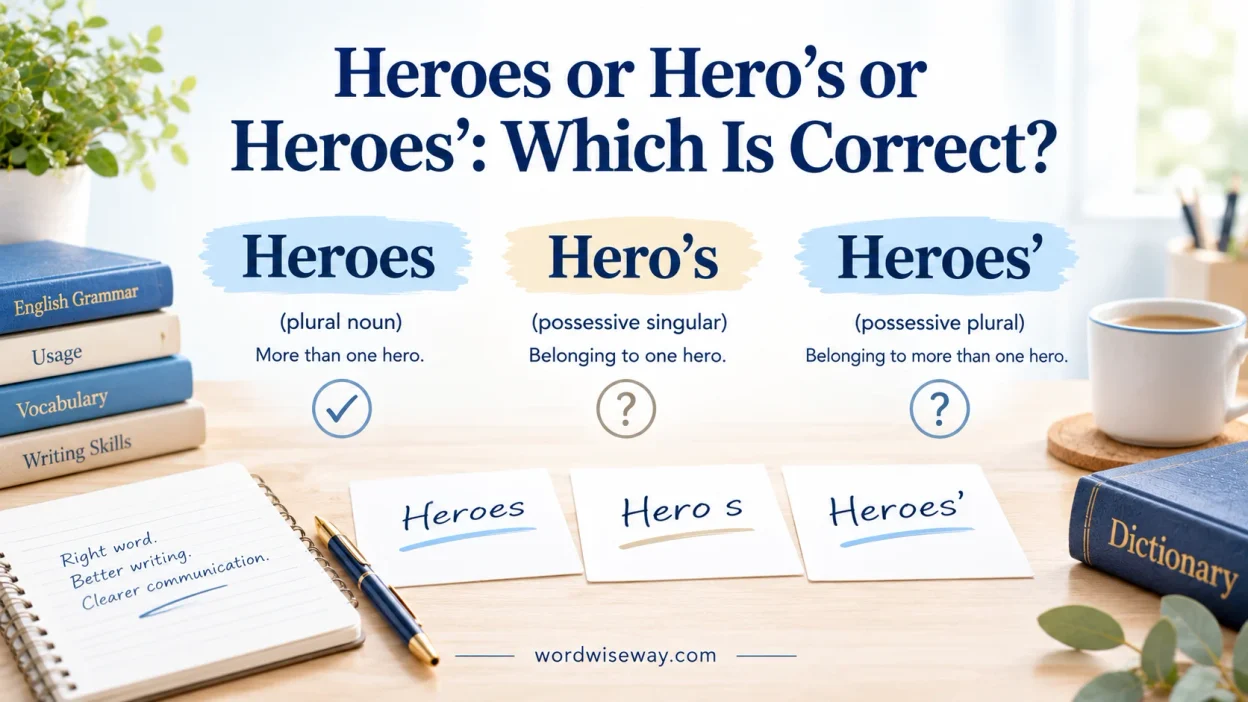
Heroes or Hero’s or Heroes’: Which Is Correct? Understanding English spelling, grammar, and apostrophe rules helps you choose the correct form and avoid common mistakes in writing.
The word heroes is the correct plural of hero. It describes people admired for courage, noble qualities, and outstanding achievements. Although heros looks similar, it is generally a misspelling. Many nouns ending in a consonant followed by o form their plurals by adding es, as in potatoes, tomatoes, and echoes. However, exceptions include pianos and photos.
Possessive forms follow different rules. Hero’s shows ownership by one hero, while heroes’ indicates ownership by multiple heroes. For example, “The firefighters were true heroes” uses the correct plural form. Interestingly, Heros is also a valid scientific genus name in ichthyology, the study of fish, associated with the cichlid family in South America. Understanding these differences improves grammatical accuracy and makes your English writing clearer.
Quick Answer:
The correct form depends on what you want to say.
| Form | Grammatical function | Meaning | Example |
| hero | Singular noun | One hero | The hero arrived. |
| heroes | Plural noun | More than one hero | The heroes arrived. |
| hero’s | Singular possessive | Something belongs to one hero | The hero’s shield was damaged. |
| heroes’ | Plural possessive | Something belongs to multiple heroes | The heroes’ shields were damaged. |
The easiest rule is:
- Heroes = more than one hero
- Hero’s = belonging to one hero
- Heroes’ = belonging to multiple heroes
- Hero’s can also mean hero is or hero has when used as a contraction
Here’s the key distinction to remember:
No apostrophe means plural. An apostrophe before “s” usually means singular possession. An apostrophe after “s” usually means plural possession.
What Does “Heroes” Mean?
Heroes Is the Plural of Hero
Heroes is the standard plural form of hero. Use it when you’re talking about two or more people who are considered heroic.
For example:
- The firefighters became heroes after rescuing the family.
- The story follows three heroes.
- The children dressed as comic-book heroes.
- Several local heroes attended the ceremony.
Notice that heroes has no apostrophe. You don’t need an apostrophe simply because you’re making a noun plural.
That point matters because writers sometimes add an apostrophe when they see a word ending in s. An apostrophe doesn’t normally create a plural. It usually signals possession or contraction.
Why Is the Plural “Heroes” Instead of “Heros”?
The correct spelling is heroes, not heros.
The noun hero follows a common English plural pattern in which some words ending in -o take -es.
So:
- hero → heroes
- potato → potatoes
- tomato → tomatoes
- echo → echoes
However, English doesn’t apply this pattern perfectly to every word ending in -o. Some words simply take -s, such as photo → photos and piano → pianos.
For hero, however, heroes is the standard plural spelling.
Examples of “Heroes” in Everyday Writing
Consider these examples:
The heroes returned to the village.
Here, heroes simply means multiple heroic people. Nothing belongs to anyone, so no apostrophe appears.
Many fictional heroes face difficult choices.
Again, the word refers to several heroes. It’s just a plural noun.
The museum honors military heroes.
The word heroes identifies multiple people. It doesn’t show ownership.
A useful test is to replace heroes with people.
If the sentence still works grammatically, you probably need the ordinary plural:
The heroes arrived.
The people arrived.
Neither word needs an apostrophe.
What Does “Hero’s” Mean?
Hero’s Is Usually the Singular Possessive Form
Hero’s is the singular possessive form of hero.
Use it when one hero owns, has, creates, controls, or is closely associated with something.
The standard formation is:
hero + ’s = hero’s
For example:
- The hero’s sword was missing.
- The hero’s courage inspired everyone.
- The hero’s costume was damaged.
- We learned about the hero’s childhood.
- The hero’s decision changed the story.
In each sentence, you’re dealing with one hero.
The apostrophe comes before the s because hero is singular.
How to Recognize Singular Possession
Try asking:
“Does this thing belong to one hero?”
If the answer is yes, use hero’s.
For example:
The hero’s shield was broken.
Whose shield was broken?
One hero’s shield.
Therefore, hero’s is correct.
Another example:
The hero’s voice echoed through the hall.
Whose voice?
One hero’s voice.
Again, hero’s works.
This ownership test is one of the fastest ways to choose the correct form.
“Hero’s” Doesn’t Always Mean Physical Ownership
Possession doesn’t necessarily mean someone physically owns an object.
English uses possessive forms to show many kinds of relationships.
For example:
The hero’s courage impressed the crowd.
Courage isn’t an object that the hero owns like a backpack. The possessive simply connects courage with the hero.
Likewise:
- the hero’s story
- the hero’s reputation
- the hero’s actions
- the hero’s family
- the hero’s decision
- the hero’s name
The relationship can involve association, origin, responsibility, connection, or characteristic, not just ownership.
When “Hero’s” Means “Hero Is” or “Hero Has”
“Hero’s” Can Be a Contraction
There’s another important use of hero’s.
Sometimes hero’s isn’t possessive at all. It can be a contraction of hero is or hero has.
For example:
The hero’s ready to leave.
Here, hero’s means:
The hero is ready to leave.
Likewise:
The hero’s arrived at the castle.
Here, hero’s means:
The hero has arrived at the castle.
Context usually makes the meaning obvious.
You can test it by expanding the contraction.
If hero is or hero has fits naturally, hero’s may be a contraction.
Examples of the Two Uses
Compare these sentences:
The hero’s armor was damaged.
Here, hero’s shows possession or association. The armor belongs to or is associated with one hero.
The hero’s wearing armor.
Here, hero’s means hero is.
The apostrophe looks identical, but the grammar differs.
That’s why context matters.
What Does “Heroes’” Mean?
Heroes’ Is the Plural Possessive Form
Heroes’ shows that something belongs to or relates to multiple heroes.
The formation looks like this:
heroes + ’ = heroes’
Because heroes is already a plural noun ending in s, standard English generally adds only an apostrophe.
Examples include:
- The heroes’ equipment was stored safely.
- The heroes’ families attended the event.
- The heroes’ stories inspired future generations.
- The heroes’ medals were displayed in the museum.
- The heroes’ decisions changed the course of the battle.
In each case, you’re talking about more than one hero.
Why Does the Apostrophe Come After the “S”?
The position of the apostrophe tells you something important.
Compare:
hero’s
The apostrophe comes before the s. This normally indicates one hero possessing or being associated with something.
heroes’
The apostrophe comes after the s. This normally indicates multiple heroes possessing or being associated with something.
Compare these two sentences:
The hero’s uniform was blue.
One hero has the uniform.
The heroes’ uniforms were blue.
Multiple heroes have uniforms.
That single apostrophe changes the number of owners.
Side-by-Side Comparison
The following table puts the three forms under the same grammatical microscope.
| Word | Number | Possessive? | Main meaning | Example |
| hero | Singular | No | One hero | The hero smiled. |
| heroes | Plural | No | Two or more heroes | The heroes smiled. |
| hero’s | Singular | Yes | Something associated with one hero | The hero’s smile was unforgettable. |
| heroes’ | Plural | Yes | Something associated with multiple heroes | The heroes’ smiles were unforgettable. |
The difference becomes much easier when you focus on number first.
Ask whether you’re talking about:
One hero → hero
More than one hero → heroes
Then ask whether you’re showing possession.
One hero + possession → hero’s
Multiple heroes + possession → heroes’
It’s essentially a two-step grammar puzzle.
How to Choose the Correct Form
Step One: Decide How Many Heroes You Mean
Start with the number.
If you mean one person:
hero
If you mean two or more:
heroes
For example:
The hero entered the room.
One hero.
The heroes entered the room.
More than one hero.
Step Two: Check Whether You Mean Possession
Now ask whether something belongs to or is associated with the hero or heroes.
If one hero has the relationship:
hero’s
If multiple heroes have the relationship:
heroes’
For example:
The hero’s story became famous.
One hero.
The heroes’ stories became famous.
Multiple heroes.
The Two-Question Method
When you’re stuck, ask yourself:
- How many heroes are there?
- Am I showing possession or association?
Your answer will usually reveal the correct form.
| Question | Answer | Correct form |
| One hero? No possession? | Yes | hero |
| Multiple heroes? No possession? | Yes | heroes |
| One hero? Possession? | Yes | hero’s |
| Multiple heroes? Possession? | Yes | heroes’ |
This method works because it separates two issues that writers often mix together: plurality and possession.
Common Mistakes
Using “Hero’s” as the Plural
One of the most common errors is using hero’s when you mean several heroes.
Incorrect:
The hero’s saved the city.
If you mean several heroic people, the correct sentence is:
The heroes saved the city.
Why?
Because you’re describing multiple people, not possession.
The apostrophe doesn’t make hero plural. In this case, it creates confusion.
Writing “Heros” Instead of “Heroes”
Another common spelling mistake is:
heros
The standard spelling is:
heroes
For example:
❌ The heros arrived.
✅ The heroes arrived.
The plural of hero adds -es, producing heroes.
Confusing “Hero’s” With “Heroes’”
Consider this sentence:
The heroes’ leader gave a speech.
This means the leader belongs to or is associated with multiple heroes.
Now compare:
The hero’s leader gave a speech.
This suggests a leader associated with one hero, although the exact meaning depends on context.
The number of heroes changes the possessive form.
Confusing “Heroes” With “Heroes’”
Consider:
❌ The heroes equipment was expensive.
The sentence needs an apostrophe because the equipment is associated with the heroes.
Correct:
✅ The heroes’ equipment was expensive.
However:
The heroes arrived with expensive equipment.
Here, heroes doesn’t need an apostrophe because you’re not directly marking the equipment as belonging to them.
The surrounding sentence determines the grammar.
Examples in Context
When You Mean Multiple Heroes
Use heroes when you’re simply talking about several heroes.
- The heroes entered the stadium.
- Several heroes received awards.
- The story has five main heroes.
- Those firefighters became local heroes.
- The children admired their favorite fictional heroes.
No apostrophe appears because none of these sentences expresses possession through the word heroes.
When One Hero Owns or Is Associated With Something
Use hero’s when one hero has the relationship.
- The hero’s shield was damaged.
- The hero’s family attended the ceremony.
- The hero’s story became famous.
- The hero’s actions changed everything.
- The hero’s decision surprised the audience.
The basic pattern is:
one hero + possession = hero’s
When Multiple Heroes Own or Share Something
Use heroes’ when multiple heroes have the relationship.
- The heroes’ equipment was inspected.
- The heroes’ families gathered together.
- The heroes’ stories were published.
- The heroes’ uniforms were displayed.
- The heroes’ achievements were celebrated.
The pattern is:
multiple heroes + possession = heroes’
When “Hero’s” Means “Hero Is” or “Hero Has”
The word hero’s can also function as a contraction.
Examples:
- The hero’s ready for the final challenge.
- The hero’s already left.
- The hero’s waiting outside.
- The hero’s completed the mission.
Try expanding the contraction:
The hero is ready.
The hero has already left.
If the expanded sentence makes sense, hero’s may be functioning as a contraction rather than a possessive.
The Possessive Apostrophe Rule Behind “Hero’s” and “Heroes’”
Singular Possessive Nouns Usually Take ’s
For a singular noun, English normally forms the possessive with ’s.
Examples:
- teacher → teacher’s
- student → student’s
- doctor → doctor’s
- friend → friend’s
- hero → hero’s
For example:
The student’s notebook is missing.
One student owns or uses the notebook.
The hero’s sword is missing.
One hero owns or uses the sword.
Plural Possessive Nouns Ending in S Usually Take an Apostrophe
When a plural noun already ends in s, the possessive generally adds an apostrophe after the s.
Examples:
- teachers → teachers’
- students → students’
- doctors → doctors’
- friends → friends’
- heroes → heroes’
For example:
The students’ classroom was renovated.
Multiple students are associated with the classroom.
Likewise:
The heroes’ equipment was stored nearby.
Multiple heroes are associated with the equipment.
Why “Heroes” and “Hero’s” Are Different
The two forms differ in both spelling and grammatical function.
Heroes is simply the plural of hero.
Hero’s is normally the singular possessive form.
So:
The heroes arrived.
means multiple heroes arrived.
The hero’s car arrived.
means a car associated with one hero arrived.
The apostrophe isn’t decorative punctuation. It carries grammatical information.
A Simple Memory Trick
If the three forms keep getting tangled together, use this compact rule:
Heroes = many
Hero’s = one owner
Heroes’ = many owners
Think of the apostrophe as a little ownership marker.
1.When it appears before the s in hero’s, you’re usually dealing with one hero.
2.When it appears after the s in heroes’, you’re usually dealing with several heroes.
3.When there’s no apostrophe in heroes, you’re simply using the plural.
The Fastest Visual Test
Look at the ending:
hero’s → apostrophe before s → one hero’s possession
heroes’ → apostrophe after s → multiple heroes’ possession
heroes → no apostrophe → plural
This tiny visual distinction can save you from a surprisingly large number of grammar mistakes.
Case Study: One Hero vs. Several Heroes
Imagine a story about a group of superheroes.
You write:
The heroes arrived at the headquarters.
Here, heroes means several superheroes.
Now suppose one superhero owns a special vehicle:
The hero’s vehicle was parked outside.
The vehicle belongs to one hero.
Later, all the superheroes receive new vehicles:
The heroes’ vehicles were parked outside.
Now the vehicles belong to multiple heroes.
The three sentences tell a miniature grammatical story:
| Sentence | Meaning |
| The heroes arrived. | Multiple heroes |
| The hero’s vehicle arrived. | One hero’s vehicle |
| The heroes’ vehicles arrived. | Multiple heroes’ vehicles |
The punctuation changes because the relationship changes.
Read More: Blonder or Brunette: Meaning, Differences, and Usage
FAQs
1. Is it Heroes or Heros?
Heroes is the correct plural spelling of hero. You use it when talking about two or more people admired for their courage, achievements, or helpful actions. Heros is generally a spelling mistake in everyday English.
2. Is Hero’s Correct?
Yes, hero’s is correct when you want to show that something belongs to one hero. For example, “The hero’s courage inspired everyone.” The apostrophe and s indicate possession, not a plural noun.
3. When Should You Use Heroes’?
Use heroes’ when something belongs to more than one hero. For example, “The heroes’ efforts saved the village.” Since heroes is already plural, you place the apostrophe after the final s.
4. What Is the Plural of Hero?
The plural of hero is heroes. English often adds -es to certain nouns ending in o. Other examples include potato/potatoes and tomato/tomatoes. Remembering these examples can make spelling easier.
5. Why Is Heros Usually Incorrect?
Heros is generally incorrect because the standard plural spelling requires -es, producing heroes. Although some English nouns ending in o simply add -s, hero follows the -es pattern.
6. What Is the Difference Between Hero’s and Heroes?
Hero’s is the singular possessive form, while heroes is the ordinary plural form. For example, “The hero’s medal was shining” refers to one hero’s medal. “The heroes received medals” refers to multiple heroes.
7. What Is the Difference Between Heroes’ and Heroes?
Heroes simply refers to multiple heroes, whereas heroes’ indicates possession by those heroes. Compare “The heroes arrived early” with “The heroes’ uniforms were ready.” The apostrophe changes the grammatical meaning.
8. Is Heroes’ Grammatically Correct?
Yes, heroes’ is grammatically correct when you need the plural possessive form. For example, “The heroes’ stories inspired the students.” The apostrophe follows the s because the noun is already plural.
9. Does Heros Have Any Other Meaning?
Yes, Heros can appear as a scientific genus name in ichthyology, the study of fish. The genus belongs to the cichlid family and includes fish native to South America. However, in ordinary writing, use heroes as the plural of hero.
10. How Can You Remember the Correct Spelling?
Remember three simple forms: hero means one person, heroes means multiple people, and hero’s shows ownership by one person. Use heroes’ for ownership by multiple heroes. Practicing these forms in short sentences will help you avoid spelling and apostrophe mistakes.
Quick Revision
The difference between these forms becomes simple once you separate plurality from possession.
| What you mean | Correct form | Example |
| One heroic person | hero | The hero arrived. |
| More than one heroic person | heroes | The heroes arrived. |
| Something associated with one hero | hero’s | The hero’s shield was broken. |
| Something associated with multiple heroes | heroes’ | The heroes’ shields were broken. |
Remember these four patterns:
- Hero = one
- Heroes = more than one
- Hero’s = one hero’s possession
- Heroes’ = multiple heroes’ possession
One final check can settle most cases: count the heroes first, then check for possession. If you mean several people, use heroes. If something belongs to one hero, use hero’s. Or something belongs to several heroes, use heroes’.
Once that distinction becomes familiar, the apostrophe stops looking like a tiny punctuation trap and starts doing its real job: showing the grammatical relationship between words.
Conclusion
The difference between heroes, hero’s, and heroes’ becomes simple once you understand their meanings. Heroes is the correct plural of hero and refers to two or more people admired for their courage, achievements, or noble actions. In contrast, hero’s shows that something belongs to one hero, while heroes’ indicates ownership by multiple heroes. Each form has a specific purpose, so choosing the right one makes your writing clearer and more accurate.
Remember that heros is generally a misspelling when you want to write the plural of hero. The spelling rule adds -es to form heroes, just as it does with words such as potatoes and tomatoes. However, Heros can also appear as a scientific genus name in ichthyology. Understanding the context helps you distinguish an ordinary spelling mistake from a valid scientific term.
Whether you’re writing a school assignment, a blog post, a social media caption, or a professional document, correct word forms matter. Keep the apostrophe rule in mind: hero’s shows possession by one hero, while heroes’ shows possession by several heroes. With a little practice, you’ll recognize these differences naturally and use each form confidently in everyday English writing.

Evelyn Shaw has spent 14 years at Yale University’s English Department, leading students through close readings, genre studies, and interpretive methodologies. Her scholarly interests include Renaissance drama, gothic fiction, feminist literary criticism, and archival research and examining how texts generate meaning across historical periods. Evelyn has presented at major academic conferences and published essays in peer-reviewed journals, reflecting her passion for rigorous analysis and student-centered learning.