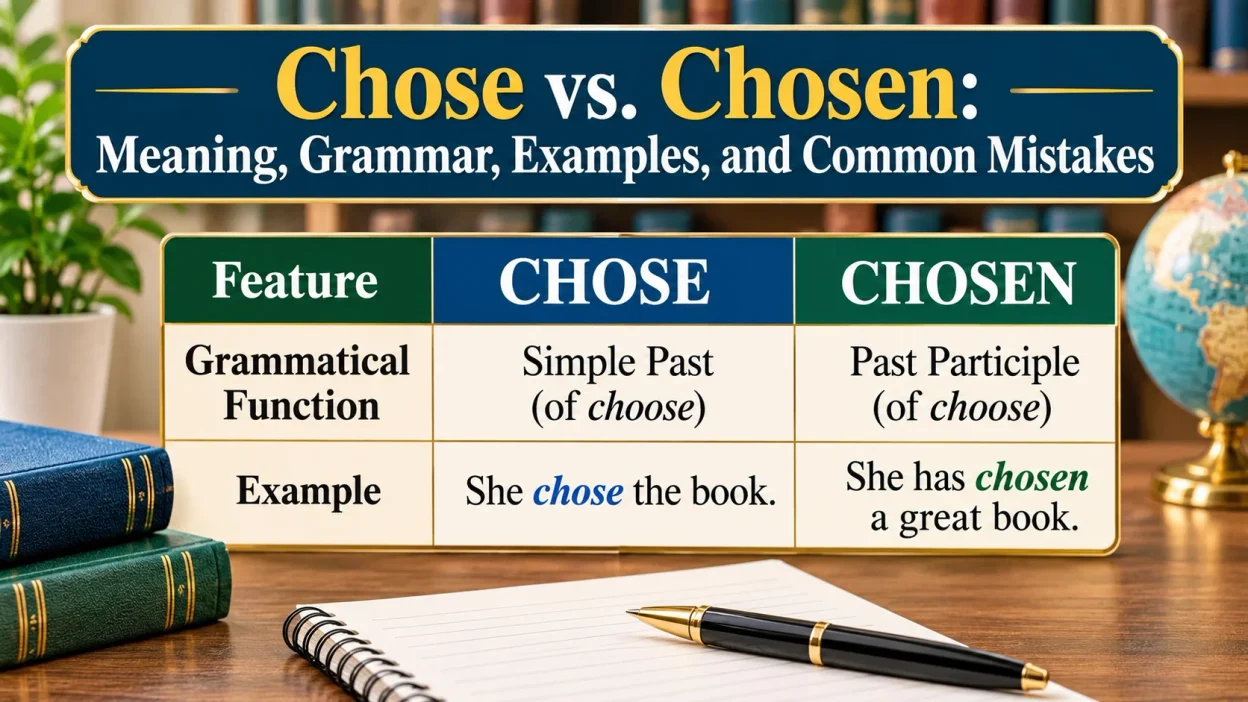
Chose vs. Chosen: Meaning, Grammar, and Examples helps you learn the correct usage of this irregular verb in English.
If you feel confused, understanding its forms makes the difference clearer. Choose is the base form, chose is the simple past tense, and chosen is the past participle. These forms work in different grammatical situations, but a simple rule makes them easier to remember.
For example, “Yesterday, I chose the blue shirt” describes a completed past action at a specific time. However, “I have chosen the blue shirt” uses have with chosen. Similarly, “She has chosen the blue shirt” uses has. You can also use had chosen when one past event happened before another.
The key is to notice the pattern and practice these examples. Helping verbs explain tense and when an action occurs. Once you understand this small difference, choosing between chose and chosen becomes much easier, helping you use both forms naturally and correctly.
Quick Answer:
Chose is the simple past tense of choose. Use it when someone made a decision in the past.
Chosen is the past participle of choose. Use it with helping verbs in perfect tenses and passive constructions. It can also function as an adjective.
- Chose: She chose the blue dress yesterday.
- Chosen: She has chosen the blue dress.
- Chosen in passive voice: The blue dress was chosen by Sarah.
Here’s a quick comparison:
| Feature | Chose | Chosen |
| Verb form | Simple past tense | Past participle |
| Main use | Describes a past decision | Forms perfect tenses and passive constructions |
| Typical structure | Subject + chose | Subject + helping verb + chosen |
| Example | He chose the winning design. | He has chosen the winning design. |
| Can stand alone as the main verb? | Yes | Not in an ordinary perfect-tense or passive verb phrase |
| Adjective use | Uncommon | Common, as in “the chosen candidate” |
Easy rule to remember: If you’re describing a past decision without a helping verb, use chose. If your sentence requires a past participle, use chosen.
What Does Chose Mean?
Chose is the simple past tense of the verb choose. It describes an action in which someone selected an option, made a decision, or decided what to do.
The word usually appears when the writer wants to report a completed decision. The decision might involve selecting an object, choosing a career, accepting an opportunity, or deciding between several possibilities.
For example:
- Maria chose a blue notebook for her classes.
- We chose the earlier train to avoid traffic.
- Daniel chose to study computer science.
- The committee chose three finalists for the competition.
- They chose a quiet restaurant for dinner.
In each sentence, chose tells readers that the selection happened in the past.
When to Use Chose in a Sentence
You should use chose when your sentence describes a past choice and doesn’t require a past participle.
To describe a completed decision
Use chose when someone made a decision that occurred in the past.
Example: I chose the smaller apartment because it was closer to work.
The sentence reports a completed decision and explains the reason behind it.
To describe a choice made at a specific time
Past-time expressions often appear alongside chose.
Examples:
- She chose her university last spring.
- We chose our seats before the show started.
- He chose the winning photograph yesterday.
Words such as yesterday, last week, and two years ago often signal the simple past. However, the sentence’s grammatical structure matters more than any single time expression.
To report someone’s decision
Use chose when explaining what another person decided.
Example: The manager chose Alex to lead the new project.
Here, chose describes the manager’s completed decision.
To describe a past action in a story
The simple past helps move a story forward by reporting completed actions.
Example: Nora opened the application, reviewed the requirements, and chose the scholarship that matched her goals.
The word chose fits naturally alongside the other simple past verbs.
More Examples of Chose in Sentences
| Sentence | Why Chose Is Correct |
| I chose the green jacket. | It describes a completed past decision. |
| She chose to stay home. | It reports a decision made in the past. |
| They chose a new team captain. | It describes a completed selection. |
| We chose the wrong entrance. | It reports a past choice. |
| He chose mathematics as his major. | It identifies a past academic decision. |
Notice that none of these examples needs have, has, or had before chose. The word already expresses the simple past tense.
What Does Chosen Mean?
Chosen is the past participle of choose. A past participle is a verb form used in grammatical structures such as perfect tenses and passive voice.
Unlike chose, chosen usually needs another verb when it forms part of a verb phrase. Common examples include has chosen, have chosen, had chosen, and was chosen.
Consider these sentences:
- I have chosen a new career path.
- She has chosen her favorite book.
- They had chosen a location before the meeting.
- Maya was chosen as the class representative.
- The winning design has been chosen.
Each sentence uses chosen in a grammatical structure that requires the past participle.
When to Use Chosen in a Sentence
Understanding the main grammatical patterns will help you recognize where chosen belongs.
With have or has in the present perfect tense
Use chosen after have or has when describing a past action connected to the present.
Examples:
- I have chosen my final project topic.
- She has chosen a different approach.
- They have chosen their preferred dates.
The present perfect often emphasizes a result, experience, or decision relevant to the current situation.
For example, She has chosen a university tells readers that the decision is complete and matters now. It doesn’t necessarily identify when she made the decision.
With had in the past perfect tense
Use chosen after had when one past action occurred before another past event.
Examples:
- We had chosen a restaurant before our friends arrived.
- He had chosen his subjects before the registration deadline.
- The judges had chosen the finalists before the ceremony began.
The past perfect helps establish the order of past events. The choice happened first, and another event followed.
In passive voice
Use chosen with a form of be when the sentence focuses on the person or thing selected rather than the person making the selection.
Examples:
- A winner was chosen by the judges.
- She was chosen for the leadership position.
- The final design has been chosen.
- Three students were chosen to represent their school.
Compare these sentences:
- Active: The committee chose the winner.
- Passive: The winner was chosen by the committee.
The meaning remains similar, but the sentence structure changes. The active sentence emphasizes the committee’s action. The passive sentence emphasizes the winner.
As an adjective
Chosen can also describe someone or something selected for a particular purpose.
Examples:
- She was the chosen candidate for the role.
- The chosen route avoided the busiest roads.
- Each student received a copy of the chosen reading.
In these examples, chosen describes a noun. This adjective use explains why the word can sometimes appear without a helping verb immediately before it.
More Examples of Chosen in Sentences
| Sentence | Grammatical Function |
| I have chosen a new notebook. | Present perfect tense |
| She had chosen the topic earlier. | Past perfect tense |
| The captain was chosen by the team. | Passive voice |
| The chosen candidate accepted the offer. | Adjective modifying “candidate” |
| The date has been chosen. | Present perfect passive |
The key is to examine the complete sentence rather than judge the word by itself.
Key Differences
The main difference between chose and chosen is grammatical, not semantic. Both relate to making a selection, but each performs a different job in a sentence.
Chose works as the simple past-tense verb. Chosen works as a past participle or adjective.
Grammar Comparison
| Grammar feature | Chose | Chosen |
| Verb form | Simple past | Past participle |
| Example without a helping verb | She chose the red one. | Not normally used this way as a main verb |
| Perfect tense | Incorrect after have | She has chosen the red one. |
| Passive voice | Incorrect after was | The red one was chosen. |
| Adjective | Less common | The chosen option |
| Typical question | What did she choose? | What has she chosen? |
Remember that a helping verb doesn’t automatically mean chosen is correct in every sentence. The full verb structure determines the right form.
For instance, did choose is correct because did takes the base form choose. However, did chosen is incorrect.
Chose vs. Chosen in Different Tenses
The easiest way to understand the difference is to compare sentences that describe related events.
Simple past: She chose a new laptop yesterday.
This sentence reports a completed action. The verb chose carries the past-tense meaning.
Present perfect: She has chosen a new laptop.
This sentence uses has chosen to connect a completed decision with the present situation.
Past perfect: She had chosen a new laptop before the sale ended.
The phrase had chosen places the decision before another past event.
Passive voice: A new laptop was chosen by the team.
The sentence uses was chosen to focus on the item selected.
These examples describe similar decisions, yet each construction serves a different purpose.
Chose vs. Chosen in Active and Passive Voice
Active and passive voice affect how writers organize a sentence. They also help explain why chose and chosen appear in different places.
In active voice, the subject performs the action.
- The teacher chose three students.
- The company chose a new supplier.
- The judges chose the winning entry.
In passive voice, the subject receives the action.
- Three students were chosen by the teacher.
- A new supplier was chosen by the company.
- The winning entry was chosen by the judges.
The active sentences use chose because they report past actions. The passive sentences use chosen after were because passive verb phrases require a past participle.
You can often omit the person who performed the action when that information isn’t important.
For example, The winner was chosen yesterday is complete and natural. Readers don’t need to know who made the selection to understand the sentence.
Chose vs. Choose vs. Chosen
The verb choose has three commonly used forms that learners should recognize: choose, chose, and chosen.
Although all three refer to selecting or deciding, they serve different grammatical purposes. Understanding the complete pattern helps prevent errors beyond the chose-versus-chosen distinction.
What Does Choose Mean?
Choose is the base form of the verb. It appears in the present tense with plural subjects and with I and you. It also follows modal verbs and appears in infinitives and commands.
Examples:
- I choose my clothes carefully.
- They choose a different topic every semester.
- You can choose any available seat.
- She wants to choose her own career.
- Choose the answer that best fits the question.
Notice the difference between She chooses and She chose. The first describes a present-tense habit or action, while the second reports a past decision.
Choose vs. Chose vs. Chosen Comparison Table
| Verb form | Main grammatical use | Example |
| Choose | Base form, commands, and present tense with I, you, we, and they | I choose the blue shirt. |
| Chooses | Present tense with he, she, and it | She chooses the blue shirt. |
| Chose | Simple past tense | She chose the blue shirt yesterday. |
| Chosen | Past participle | She has chosen the blue shirt. |
The form chooses deserves attention because learners sometimes confuse present-tense and past-tense forms. English adds -s or -es to many verbs in the third-person singular present tense, but the past form of choose changes to chose.
How to Remember Choose, Chose, and Chosen
A simple memory trick can make the three forms easier to recall.
- Choose: Think about a choice you make now or the base form used in a sentence.
- Chose: Think about a choice you already made in the past.
- Chosen: Look for a grammatical structure that needs a past participle.
Try this sequence:
1.”I choose a course.”
2. “I chose a course yesterday.”
3. “I have chosen a course.”
The subject and object stay the same, but the verb form changes to match the sentence structure.
Common Mistakes
Even experienced English writers occasionally confuse irregular verbs. Fortunately, most mistakes involving chose and chosen follow a few predictable patterns.
Using Chose After Have, Has, or Had
One of the most common errors is using chose after a perfect-tense helping verb.
Incorrect: She has chose a new subject.
Correct: She has chosen a new subject.
Why? The present perfect requires have or has followed by a past participle. Because chosen is the past participle of choose, it completes the verb phrase correctly.
The same rule applies to had.
Incorrect: They had chose their seats before the show.
Correct: They had chosen their seats before the show.
Remember: Use have chosen, has chosen, and had chosen, not have chose, has chose, or had chose.
Using Chosen Without the Required Verb Structure
Another common mistake occurs when writers use chosen as a simple past-tense verb.
Incorrect: He chosen the best option yesterday.
Correct: He chose the best option yesterday.
The corrected sentence uses the simple past tense without a helping verb. However, chosen would be correct in a sentence such as He had chosen the best option before the deadline.
Using Chose in Passive Constructions
Passive voice requires a past participle, so chose doesn’t fit after a form of be in an ordinary passive construction.
Incorrect: The winner was chose by the judges.
Correct: The winner was chosen by the judges.
Other examples include:
- Incorrect: The final candidate was chose yesterday.
- Correct: The final candidate was chosen yesterday.
- Incorrect: Three applicants were chose for interviews.
- Correct: Three applicants were chosen for interviews.
A useful editing trick is to look for phrases such as was, were, is, and are followed by a verb that expresses an action received by the subject. In those passive constructions, check whether the verb uses its past participle.
Confusing Did Choose With Did Chose
This error follows a different rule. After did or didn’t, English uses the base form of the main verb.
Incorrect: Did she chose the red dress?
Correct: Did she choose the red dress?
Incorrect: He didn’t chose the available option.
Correct: He didn’t choose the available option.
The helping verb did already marks the past tense. The main verb therefore returns to its base form, choose.
This pattern applies to many English verbs:
- Did you go? Not Did you went?
- Did she speak? Not Did she spoke?
- Did they choose? Not Did they chose?
Assuming Every Irregular Verb Follows the Same Pattern
Irregular verbs don’t all form their past tense and past participle in the same way. Comparing related verbs can help you recognize their patterns, but you shouldn’t assume they all behave identically.
| Base form | Simple past | Past participle |
| Choose | Chose | Chosen |
| Speak | Spoke | Spoken |
| Write | Wrote | Written |
| Break | Broke | Broken |
| Take | Took | Taken |
| See | Saw | Seen |
These examples show why memorizing all three forms of an irregular verb is useful. When you’re uncertain, check a reliable dictionary rather than guessing from the spelling.
Chose vs. Chosen in Everyday Writing
Knowing the grammatical rule is only half the job. Applying it in real situations helps you recognize the correct form more quickly.
Chose vs. Chosen in School and Academic Writing
Students often use these words when describing assignments, courses, research topics, and academic decisions.
Examples:
- I chose biology as my optional subject.
- The teacher has chosen five students for the presentation.
- We had chosen our research topic before the semester began.
- A group leader was chosen during the first class.
These examples illustrate how the context determines the verb form. A simple report of a past decision uses chose, while perfect-tense and passive constructions use chosen.
Chose vs. Chosen in Business Communication
Professional writing often describes decisions about hiring, suppliers, projects, and strategies.
Examples:
- The company chose a new software provider last month.
- Management has chosen a different marketing strategy.
- The hiring panel had chosen a finalist before the second interview.
- A new project manager was chosen by the department head.
In business communication, the correct verb form helps readers understand when a decision occurred and how the sentence presents it.
Chose vs. Chosen in Personal Conversations
Everyday conversations provide simple opportunities to practice these forms.
Examples:
- “I chose the movie we watched last night.”
- “Have you chosen a gift for your friend?”
- “We had chosen a meeting place before the weather changed.”
- “She was chosen to organize the family celebration.”
These sentences sound natural because each verb form matches its grammatical structure.
How to Choose Between Chose and Chosen
When you’re unsure which word belongs in a sentence, follow these practical steps. They work for everyday writing, academic assignments, and professional communication.
Identify the Verb Structure
First, determine how the sentence expresses the choice.
If you’re reporting a completed past action, chose is usually correct.
Example: Lena chose the blue folder yesterday.
If the sentence uses a perfect tense or passive voice, check whether it requires chosen.
Example: Lena has chosen the blue folder.
Check for a Helping Verb
Look for have, has, or had. These verbs commonly signal a perfect-tense construction that requires a past participle.
- I have chosen my topic.
- She has chosen her seat.
- They had chosen their team before the match.
However, remember that helping verbs don’t always require chosen. For example, did choose is correct because did takes the base form of the main verb.
Check Whether the Sentence Uses Passive Voice
Look for a form of be, such as is, was, were, or been, followed by the verb in a passive construction.
Examples:
- The winner was chosen.
- The candidates were chosen.
- The final option has been chosen.
These sentences use chosen because the subject receives the action.
Read the Complete Sentence
Sometimes, the best way to catch a mistake is to read the sentence aloud and check how its parts fit together.
Consider these examples:
| Sentence | Correct Form | Reason |
| She ___ the topic yesterday. | Chose | Simple past tense |
| She has ___ the topic. | Chosen | Present perfect tense |
| They had ___ a location. | Chosen | Past perfect tense |
| The winner was ___. | Chosen | Passive voice |
| Did she ___ the topic? | Choose | Base form after did |
The goal isn’t to memorize isolated sentences. It’s to recognize the grammatical pattern and apply it to new situations.
Chose vs. Chosen Practice Exercises
Ready to test your understanding? Complete the following sentences using choose, chooses, chose, or chosen.
Fill-in-the-Blank Questions
- Sarah _____ the blue dress for the wedding yesterday.
- I have _____ a topic for my research project.
- They _____ a new team captain every season.
- The winner was _____ by a panel of judges.
- Did you _____ the correct answer?
- He had _____ his university before the deadline.
- My sister _____ to walk to school every morning.
- We _____ a different route last weekend.
- The final candidate has been _____ for the position.
- You can _____ whichever option suits your needs.
Answers and Explanations
Check your answers
Reveal answers
Review any mistakes by identifying the verb structure first. Once you recognize why each answer works, similar questions become much easier.
Read More:Begun vs. Began: Meaning, Differences, Rules, and Examples
FAQs
What Is the Main Difference Between Chose and Chosen?
Chose is the simple past tense of choose, while chosen is the past participle. Chose works alone as a past-tense verb, but chosen usually needs a helping verb.
Is Chose the Past Tense of Choose?
Yes, chose is the simple past tense of choose. For example, “I chose the blue shirt yesterday” describes an action completed in the past.
When Should I Use Chosen in a Sentence?
Use chosen with a helping verb such as have, has, or had. For example, “She has chosen a new book” uses chosen correctly.
Can I Use Chosen Without a Helping Verb?
Yes, chosen can appear without a helping verb when it works as an adjective or modifier. For example, “The chosen candidate accepted the position.”
Is It Correct to Say I Have Chose?
No, the correct phrase is “I have chosen.” The verb have requires the past participle chosen, not the simple past form chose.
Should I Write She Has Chose or She Has Chosen?
Write “She has chosen.” Has is a helping verb that requires the past participle chosen in this sentence.
How Do I Use Had Chosen Correctly?
Use had chosen when describing an action that happened before another past event. For example, “I had chosen my outfit before the guests arrived.”
What Is the Difference Between Chose and Have Chosen?
Chose describes a completed past action, while have chosen uses the present perfect tense. The latter often connects a past decision to the present.
How Can I Remember When to Use Chose or Chosen?
Remember this simple pattern: choose, chose, chosen. Use chose for the simple past and chosen with have, has, or had in perfect tenses.
Which Is Correct: The Option I Chose or the Option I Chosen?
“The option I chose” is correct because chose works as the simple past tense. You can also say “the option I have chosen” because have correctly accompanies chosen.
Conclusion
Chose vs. Chosen: Meaning, Grammar, and Examples helps you learn the correct usage of this irregular verb in English. If you feel confused, understanding its forms makes the difference clearer. Choose is the base form, chose is the simple past tense, and chosen is the past participle. These forms work in different grammatical situations, but a simple rule makes them easier to remember.
For example, “Yesterday, I chose the blue shirt” describes a completed past action at a specific time. However, “I have chosen the blue shirt” uses have with chosen. Similarly, “She has chosen the blue shirt” uses has. You can also use had chosen when one past event happened before another.
The key is to notice the pattern and practice these examples. Helping verbs explain tense and when an action occurs. Once you understand this small difference, choosing between chose and chosen becomes much easier, helping you use both forms naturally and correctly.