Sewed or Sewn: Difference, Meaning, Rules, and Examples explains how these similar verb forms differ in meaning, tense, and everyday English usage.
In English grammar, sew, sewed, and sewn describe joining fabric with a thread and needle. Sewed is the simple past tense, while sewn commonly serves as the past participle. These irregular verbs can cause word confusion because their pronunciation may sound alike. However, they aren’t always interchangeable. Understanding their meaning, spelling, context, and grammar rules helps you distinguish between these different forms and choose the correct word. Clear sentence structure also improves writing and language learning.
Consider these examples: “She sewed a button onto her shirt” describes a completed action, while “The button has been sewn onto the shirt” uses a past participle. In gardening and agriculture, sown comes from sow and describes planting or spreading seeds. Although sewn and sown may sound alike, their semantic differences become clear through context. Learning these English verbs improves vocabulary, correct usage, and word choice while clarifying common sewing terminology.
Sewed or Sewn:
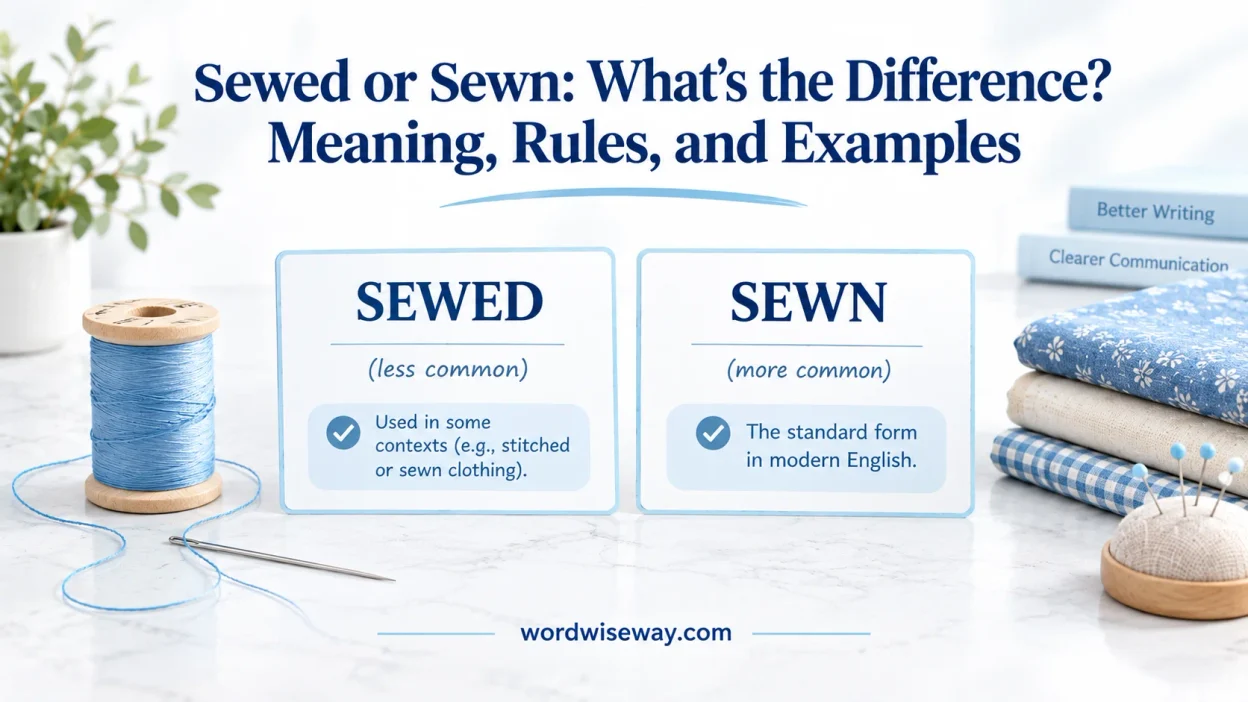
Sewed and sewn are both correct forms of the verb sew. However, they usually serve different grammatical purposes.
- Sewed is the simple past tense of sew. Use it to describe an action completed in the past.
- Sewn is the more common past participle. Use it with helping verbs such as have, has, and had, or in passive constructions.
- Sewed can also function as a past participle in some sentences, although sewn is often the more natural choice.
| Word | Grammatical role | Example |
| Sew | Base form | I sew my own clothes. |
| Sewed | Simple past tense | I sewed a pocket onto the jacket. |
| Sewn | Past participle | I have sewn the pocket onto the jacket. |
| Sewing | Present participle or gerund | She is sewing a new dress. |
The easiest rule to remember: Use sewed for a straightforward past action and usually use sewn with have, has, or had.
For example, “She sewed the patch yesterday” is correct. “She has sewn the patch” is also correct because the helping verb has requires a past participle.
What Does Sewed Mean?
Sewed is the simple past tense of the verb sew, which means to join fabric, leather, or another material using a needle and thread.
When you describe a sewing action that happened in the past, sewed is the standard choice. The sentence can include a specific time or simply describe something that happened earlier.
For example, consider this sentence: “My grandmother sewed a beautiful quilt last winter.” The word sewed tells you that the action took place in the past.
You don’t need a helping verb to use sewed in the simple past tense. The word carries the past meaning on its own.
Here are a few common examples:
- I sewed a loose button onto my coat.
- She sewed a dress for the school celebration.
- They sewed the torn seam before leaving home.
- My aunt sewed a pillowcase from leftover fabric.
- He sewed a small tear in his backpack.
In each sentence, sewed describes a completed action. The sentences don’t need have, has, or had to express the simple past.
Examples of Sewed in Sentences
Seeing the word in different situations makes its meaning easier to understand. Although sewing often involves clothes, the verb can describe many activities involving materials and stitches.
Consider these examples:
Clothing repairs: “I sewed the missing button onto my shirt before work.”
The sentence describes a completed repair. The past-tense verb sewed tells readers what happened.
Handmade gifts: “Maya sewed a small fabric bag for her friend.”
Here, sewed describes the action Maya performed to create the gift.
School projects: “The students sewed colorful patterns onto their fabric squares.”
The word identifies an action that the students completed.
Home decorations: “We sewed matching curtains for the living room.”
The verb describes a past activity without requiring an auxiliary verb.
Unexpected repairs: “Daniel sewed the ripped pocket while watching television.”
The sentence remains grammatically correct even though it doesn’t specify an exact date or time.
Notice that every example follows a straightforward pattern: subject, sewed, and the rest of the sentence. Other sentence structures are possible, but the simple past remains the key feature.
Is Sewed the Past Tense of Sew?
Yes. Sewed is the standard simple past tense of sew.
The verb sew follows an irregular pattern because its past participle can take the form sewn. However, its simple past form is sewed, not sew or sewn.
Compare these sentences:
- Present: “I sew my own clothes.”
- Past: “I sewed my own clothes last year.”
- Present perfect: “I have sewn several garments.”
The first sentence describes a present habit. The second places the action in the past. The third connects a completed action to the present through the present perfect tense.
Remember that sewn doesn’t replace sewed in every past-tense sentence. If you write “I sewn a dress yesterday,” you’re using the wrong verb form for the simple past in standard English.
The correct sentence is “I sewed a dress yesterday.”
What Does Sewn Mean?
Sewn is the past participle of sew and commonly appears with auxiliary verbs. It also appears in passive constructions and can describe the condition of something that stitching has joined or repaired.
For example, “I have sewn the hem of my trousers” uses the present perfect tense. The helping verb have works with the past participle sewn to form the verb phrase.
You can also use sewn to describe a completed result. Consider the sentence, “The label was sewn inside the jacket.” Here, the sentence emphasizes the label and what happened to it rather than who performed the action.
The word appears in many everyday contexts:
- She has sewn a new collar onto the shirt.
- We have sewn the torn fabric together.
- He had sewn the patch on before the event.
- The buttons were sewn securely onto the coat.
- The two fabric pieces have been sewn together.
These examples show why sewn is useful. It works with perfect-tense constructions and helps form passive sentences.
Examples of Sewn in Sentences
The grammatical role of sewn becomes clearer when you compare different sentence patterns.
Present perfect: “She has sewn a new pocket onto the bag.”
The structure has sewn describes a completed action with a connection to the present.
Past perfect: “By noon, he had sewn the final seam.”
The phrase had sewn places the completed action before another point in the past.
Passive voice: “The name was sewn onto the uniform.”
The sentence emphasizes the name and its placement rather than the person who stitched it.
Present perfect passive: “The costume has been sewn by hand.”
The phrase has been sewn combines the present perfect tense with the passive voice.
Describing a finished result: “The sewn edges give the blanket a neat finish.”
Here, sewn modifies the noun edges. It describes edges that have been stitched.
These patterns illustrate an important point: sewn doesn’t always need to appear immediately after have, has, or had. It can also follow other auxiliary verbs or function as a participial adjective.
Is Sewn the Past Tense of Sew?
Not usually. Sewn is the past participle, while sewed is the simple past tense.
The difference matters because English uses these forms in different grammatical constructions.
| Sentence | Correct? | Explanation |
| I sewed the shirt yesterday. | Yes | Sewed expresses the simple past. |
| I have sewn the shirt. | Yes | Sewn follows the helping verb have. |
| I sewn the shirt yesterday. | No | The simple past requires sewed. |
| I have sewed the shirt. | Yes | Sewed can also function as a past participle. |
| The shirt was sewn by hand. | Yes | Sewn forms a passive construction. |
The fourth example deserves special attention. Although sewn is the more conventional past participle in many contexts, sewed is also accepted as a past participle in standard English.
Therefore, the distinction isn’t an absolute rule that sewed can never follow a helping verb. Instead, sewn is often the more familiar and natural choice in perfect-tense and passive constructions.
Key Differences
The main difference between sewed and sewn concerns grammatical function rather than meaning. Both words refer to the action of joining materials with stitches.
However, the sentence structure determines which form sounds most natural.
| Comparison point | Sewed | Sewn |
| Main grammatical role | Simple past tense | Past participle |
| Typical pattern | Subject + sewed | Subject + have/has/had + sewn |
| Example | I sewed the sleeve. | I have sewn the sleeve. |
| Common passive pattern | Less usual in many contexts | The sleeve was sewn by hand. |
| Can follow have? | Yes, in accepted usage | Yes, commonly |
| Describes a finished result? | Sometimes, depending on construction | Commonly |
The most useful distinction is straightforward: sewed usually reports a past action, while sewn often forms part of a larger verb phrase.
When to Use Sewed
Use sewed when you want to describe a completed action in the simple past tense.
This form works especially well when you mention a past event, a particular occasion, or something someone finished earlier.
Examples include:
- I sewed the loose hem yesterday.
- Sarah sewed her costume last weekend.
- We sewed the curtains before moving into the house.
- The tailor sewed a new pocket onto my jacket.
- My sister sewed a small toy for her nephew.
You can also use sewed in questions and negative sentences with the auxiliary verb did.
For example:
- Question: “Did you sew this dress yourself?”
- Negative: “I didn’t sew this dress myself.”
Notice that the verb changes back to its base form after did or didn’t. You shouldn’t write “Did you sewed this dress?” or “I didn’t sewed this dress.”
The auxiliary verb already carries the past-tense marking. Adding -ed to the main verb would create an incorrect construction.
When to Use Sewn
Use sewn when the sentence calls for a past participle. This usually happens in perfect tenses and passive constructions.
The word frequently appears with have, has, had, be, and related auxiliary forms.
Examples:
- I have sewn three buttons onto the coat.
- She has sewn the torn seam.
- They had sewn the costumes before rehearsal.
- The patch was sewn onto the backpack.
- The fabric has been sewn into a simple pouch.
The choice also depends on what you want to emphasize. In “The tailor sewed the jacket,” the sentence focuses on the tailor’s action. In “The jacket was sewn by hand,” the sentence highlights the jacket and how it was made.
Both sentences are correct, but they use different grammatical structures.
Can Sewed and Sewn Be Used Interchangeably?
Sometimes, but not in every sentence. Both forms can express a completed sewing action, yet their grammatical roles and common usage patterns differ.
Consider these examples:
- “She sewed the patch yesterday.” This is a simple past construction.
- “She has sewn the patch.” This is a present perfect construction.
- “She has sewed the patch.” This is also accepted, although has sewn is often the more conventional choice.
- “The patch was sewn onto the sleeve.” This is a standard passive construction.
You shouldn’t assume that the words are interchangeable simply because they share a meaning. A verb form must fit the structure of the sentence.
For everyday writing, use sewed for the simple past and sewn for the past participle. This approach will produce natural, grammatically sound sentences in most situations.
Sew, Sewed, and Sewn: All Verb Forms Explained
Understanding the complete verb pattern makes the difference easier to remember. The verb sew has several forms, each serving a distinct purpose in a sentence.
| Verb form | Function | Example |
| Sew | Base form | I want to sew a button onto this shirt. |
| Sews | Third-person singular present | She sews clothes for her family. |
| Sewing | Present participle or gerund | He is sewing a pocket. |
| Sewed | Simple past | He sewed the pocket yesterday. |
| Sewn | Past participle | He has sewn the pocket securely. |
The base form sew appears after modal verbs and certain auxiliary constructions. The form sews applies to third-person singular subjects in the simple present, such as he, she, or it.
Meanwhile, sewing appears in continuous tenses and can function as a noun. For example, “She enjoys sewing” uses the word as a gerund.
The two forms that cause the most confusion are sewed and sewn. Once you recognize their usual roles, the rest of the verb pattern becomes easier to use correctly.
Sew vs. Sewed
The difference between sew and sewed is mainly about time and sentence structure.
Use sew for present habits, general facts, instructions, and actions following certain helping verbs. Use sewed to describe a completed action in the simple past.
Compare these sentences:
- Present habit: “I sew my own clothes.”
- Past action: “I sewed my own clothes last summer.”
- Instruction: “Sew the two edges together.”
- Modal construction: “You can sew the button back on.”
The word sew doesn’t always indicate that an action is happening right now. It can describe a regular activity or appear in an instruction.
By contrast, sewed places the action in the past when used as the simple past tense.
Sew vs. Sewn
The difference between sew and sewn becomes clear when you look at the verb phrase.
Use sew as the base form and sewn as a past participle in constructions that require it.
For example:
- “I sew clothes for my family.”
- “I have sewn clothes for my family.”
- “The clothes were sewn by hand.”
- “The tailor will sew the missing button.”
In the second sentence, have requires a past participle. Third, were sewn forms a passive construction. In the fourth, will is followed by the base form sew.
That last example highlights another common rule: after modal verbs such as will, can, could, and should, use the base form rather than sewed or sewn.
For instance, “I will sew the hem tomorrow” is correct. “I will sewn the hem tomorrow” is not.
Common Mistakes
Even experienced writers sometimes confuse irregular verb forms. Fortunately, most mistakes become easy to fix once you identify the sentence’s grammatical structure.
Using Sewn Without the Required Helping Verb
A common mistake is using sewn as though it were the simple past tense.
Incorrect: “I sewn a button onto my shirt yesterday.”
Correct: “I sewed a button onto my shirt yesterday.”
The first sentence lacks the auxiliary structure needed for the past participle. The second uses the correct simple past form.
However, sewn can appear without a helping verb when it functions as an adjective or participial modifier.
For example, “The sewn patch looked neat” is grammatically correct. Here, sewn describes the patch rather than serving as the main verb in a simple past construction.
Using Sewed Instead of Sewn in Perfect Tenses
Writers sometimes believe that sewed is always wrong after have, has, or had. That rule is too strict because sewed can function as a past participle.
Consider these examples:
- “She has sewn the torn pocket.” This is a common, natural construction.
- “She has sewed the torn pocket.” This is also accepted.
- “She had sewn the final seam before dinner.” This is a standard past perfect construction.
Although both past participles occur in English, sewn is often the more familiar choice in perfect tenses and passive constructions.
If you’re unsure which form to use in formal writing, choose sewn after have, has, and had. It’s a reliable option that follows common usage.
Confusing Sew With Similar-Sounding Words
The words sew, sow, and so can sound alike in many varieties of English. However, they have different meanings and grammatical functions.
| Word | Meaning | Example |
| Sew | To join material with stitches | I will sew the torn sleeve. |
| Sow | To plant seeds | We sow seeds in the spring. |
| So | Used to express a result or degree | The fabric was so soft. |
These words aren’t interchangeable. A sentence about repairing a shirt needs sew, while a sentence about planting a garden needs sow.
Remember the context. If needles, thread, fabric, or stitches are involved, sew is probably the word you need.
How to Remember the Difference Between Sewed and Sewn
A simple memory trick can help you choose the correct form without stopping to analyze every sentence.
Think of sewed as the straightforward past action and sewn as the participle that commonly works with helping verbs.
Use these example pairs to reinforce the pattern:
- “I sewed the button yesterday.”
- “I have sewn the button onto the shirt.”
- “She sewed the costume last night.”
- “She had sewn the costume before the show.”
- “They sewed the fabric together.”
- “The fabric was sewn together carefully.”
You can also use a quick sentence test.
Ask yourself:
- Am I describing a completed action in the simple past? Use sewed.
- Am I using have, has, or had to form a perfect tense? Prefer sewn, though sewed is also possible.
- Am I using a passive construction such as was or were plus a past participle? Sewn is a common, natural choice.
- Am I describing a finished item, as in “a sewn patch”? Use sewn as a modifier.
One small grammatical check can prevent most errors. Instead of memorizing dozens of separate sentences, learn the pattern and apply it whenever you write.
Read More: Great Minds Think Alike: Meaning, Origin, and Examples
FAQs
1. Is it sewed or sewn?
Both words are correct, but they serve different grammatical purposes. Sewed usually describes a completed action in the past, while sewn commonly appears with helping verbs such as has, have, or had. For example, “She sewed a dress” and “She has sewn a dress” are both correct.
2. What is the past tense of sew?
The simple past tense of sew is sewed. Use it when describing an action that happened in the past. For example, “My grandmother sewed a beautiful quilt last winter.” This sentence describes a finished action at a specific time.
3. Is sewn the past participle of sew?
Yes, sewn is the traditional and widely used past participle of sew. It often follows has, have, or had, as in “I have sewn the torn pocket.” However, sewed can also function as a past participle in some contexts.
4. Can I use sewed and sewn interchangeably?
Not always. Both forms can be grammatically correct in certain situations, but their usage depends on the sentence structure. For example, “She sewed the curtains yesterday” uses the simple past, while “She has sewn the curtains” uses the present perfect tense.
5. Which sentence is correct: “I have sewed” or “I have sewn”?
“I have sewn” is the more widely preferred form in standard English. Although “I have sewed” is also accepted, many writers and speakers choose sewn after have because it clearly follows the traditional past participle pattern.
6. What is the difference between sew, sewed, and sewn?
Sew is the base form, sewed is the simple past tense, and sewn is commonly the past participle. For example, “I sew clothes,” “I sewed a shirt yesterday,” and “I have sewn three shirts this week” demonstrate their different grammatical roles.
7. Is sewn an irregular verb?
Sewn is a form of the irregular verb sew. Its forms don’t follow the regular pattern of adding -ed to create every past-tense form. The principal forms are sew, sewed, and sewn, although sewed can also appear as a past participle.
8. What does sewn mean in everyday English?
Sewn means joined, attached, or repaired using a needle and thread. For example, “The torn sleeve has been sewn” means someone repaired the sleeve with stitching. The word can also describe clothing or other fabric items made by stitching pieces together.
9. What is the difference between sewn and sown?
Sewn relates to stitching fabric, while sown relates to planting or scattering seeds. For example, “The button was sewn onto the coat” describes needlework, whereas “The seeds were sown in spring” describes planting. Although these words can sound alike, their meanings are different.
10. How can I remember when to use sewed or sewn?
Remember that sewed often works with a specific past time, such as yesterday or last week. Sewn commonly follows has, have, or had. Compare “He sewed the patch yesterday” with “He has sewn the patch.” These patterns make choosing the correct form easier.
Conclusion
Choosing between sewed and sewn becomes easier when you understand how each word works. Sewed usually describes an action completed in the past, while sewn commonly appears with helping verbs such as has, have, and had. Both forms belong to the verb sew, but their grammatical roles can differ depending on the sentence.
The easiest way to remember the difference is to practice with everyday examples. You might say, “I sewed a button onto my shirt yesterday,” or “I have sewn the button securely.” Reading each sentence aloud and noticing its tense can help you develop better grammar habits. With regular practice, these verb forms will feel more natural.
Also, remember not to confuse sewn with sown. Sewn relates to stitching fabric with a needle and thread, whereas sown describes planting seeds. Although the words may sound alike, their meanings are distinct. Paying attention to context will help you choose the right word and communicate clearly in your writing.

Emma Smith has dedicated 14 years to Princeton University’s English Department, mentoring students in textual interpretation, literary movements, and critical frameworks. Her research explores Shakespearean drama, Victorian serial fiction, postcolonial narrative theory, and manuscript studies and probing how literary forms evolve across cultures and centuries. Emma has delivered lectures at international humanities congresses and published findings in distinguished academic journals, underscoring her commitment to scholarly depth and vibrant teaching.