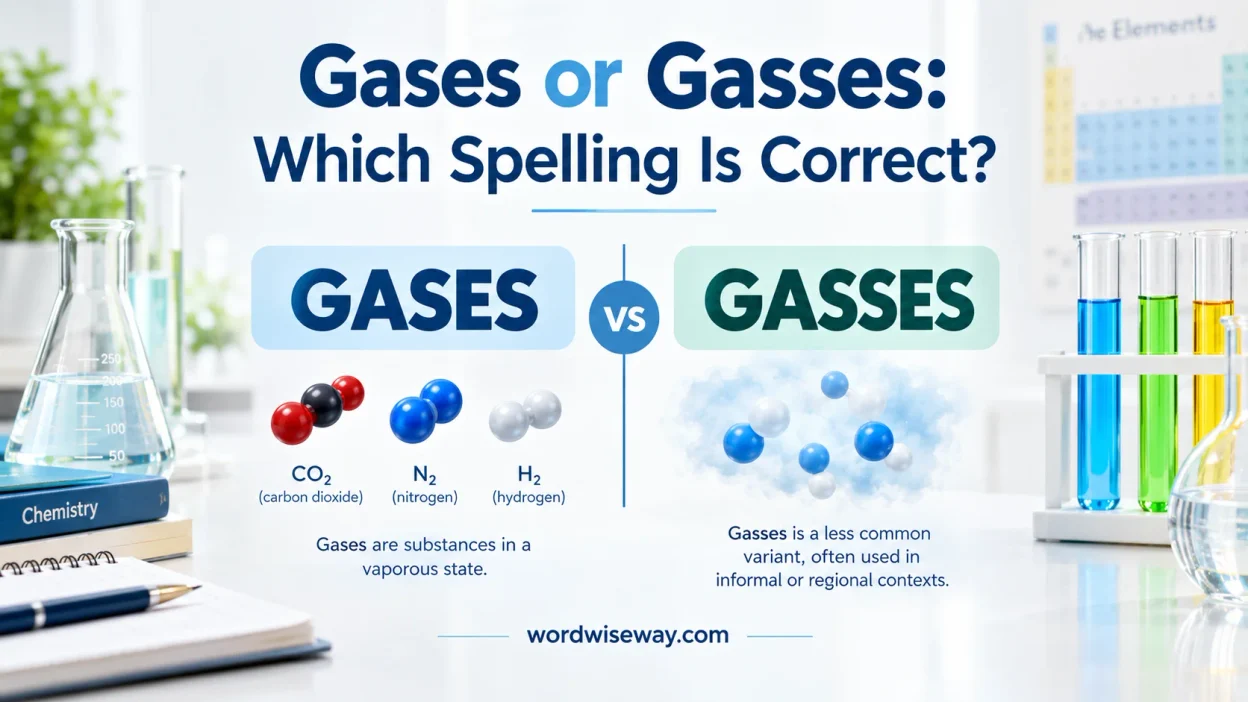
Gases or Gasses: Correct Spelling, Meaning, and Usage can seem tricky because small spelling changes may alter a word’s meaning.
In English, even experienced writers sometimes find it difficult to remember the proper uses of similar forms. Gases is the plural of gas, while gasses is a verb. Adding one letter changes the grammatical role, so writers may mistakenly substitute one for the other.
The difference becomes clearer when you focus on the context and grammatical roles. This correct spelling distinction matters in everyday contexts and academic contexts, where you need to write accurately. A simple trick can help you remember which form fits your sentence.
When you read the given sentence, ask whether the word names some gas or describes an action. This easy way helps you choose the correct form correctly. In this article, I’ll teach you to recognize these different spellings and avoid the common error.
Quick Answer
Gases is the standard and most widely recommended spelling when you’re using the plural of gas.
For example:
Oxygen and nitrogen are both gases.
However, gasses is also recorded as a less common plural noun. Oxford lists gases first and gasses as less frequent, while Cambridge also recognizes gasses as a plural of gas.
There’s an important grammatical detail to remember:
| Word | Function | Meaning | Example |
| gas | Noun | One gas or gas as a substance | Oxygen is a gas. |
| gases | Noun | More than one gas | Several gases were detected. |
| gases | Verb | Third-person singular form of gas | The process gases the material. |
| gasses | Noun | Less common plural of gas | Certain industrial gasses can be hazardous. |
So, if you’re writing a normal sentence about several gases, choose gases. It’s the safer, more familiar form for general, academic, and scientific writing.
What Does Gases Mean?
Gases is the standard plural of the noun gas.
A gas is a substance that exists in a gaseous state rather than as a solid or liquid. Common examples include oxygen, nitrogen, hydrogen, helium, and carbon dioxide.
When you refer to more than one type or quantity of gas, gases works as the plural noun.
For example:
- Oxygen and nitrogen are gases.
- Scientists analyzed several gases.
- Some gases can trap heat in Earth’s atmosphere.
- The laboratory stores different gases for testing.
- Toxic gases can create serious environmental problems.
Oxford gives gases as the regular plural and uses examples involving air and toxic gases. Cambridge likewise uses gases in scientific and environmental examples.
Gases as the Plural of Gas
The easiest rule is straightforward:
gas → gases
When gas means a substance in the gaseous state, its usual plural is gases.
This form appears throughout science, environmental writing, medicine, engineering, and everyday English.
Consider the difference:
- One gas was released.
- Several gases were released.
The first sentence discusses one substance. The second discusses multiple substances.
You’ll also see gases in established terms such as:
- greenhouse gases
- noble gases
- toxic gases
- atmospheric gases
- inert gases
- exhaust gases
- industrial gases
These expressions are common because they refer to multiple gases or multiple types of gas.
How to Use Gases in a Sentence
Use gases when the word functions as a plural noun.
Here are several natural examples:
- Scientists measured the concentration of different gases.
- Plants exchange gases with the surrounding air.
- The atmosphere contains several important gases.
- Some industrial processes release harmful gases.
- The experiment examined how gases behave under pressure.
The surrounding sentence usually makes the meaning obvious. If gases follows words such as several, different, many, or various, you’re almost certainly looking at the plural noun.
What Does Gasses Mean?
Gasses is a real English spelling, but its role deserves careful attention.
As a noun, gasses is recognized by major dictionaries as a less frequent plural of gas. Oxford lists gases as the main plural and gasses as less frequent. Cambridge also defines gasses as a plural of gas.
That means the statement “gasses is always wrong” isn’t accurate.
However, gases remains the better default choice for most writing.
Gasses as a Plural Noun
You may encounter gasses in published scientific, technical, or general writing.
For example:
- The equipment measures different gasses.
- Several gasses were detected in the sample.
These sentences use gasses as a plural noun. The form is recognized, but gases is generally the more familiar and preferred spelling.
This distinction matters because spelling guides sometimes oversimplify the issue by treating gasses as automatically incorrect. Dictionary evidence doesn’t support that absolute claim. Cambridge explicitly records gasses as a plural of gas, while Oxford labels it less frequent.
Gasses Is Not the Standard Present-Tense Verb Form
Here’s where the confusion gets especially interesting.
If gas is being used as a verb, the third-person singular present form is gases:
- The machine gases the material.
- The system gases the chamber.
- The process gases the sample.
Oxford lists the verb forms as gas, gases, gassed, gassing.
So this pattern is correct:
gas → gases → gassed → gassing
Don’t assume that gasses must be the verb simply because it contains an extra s. English spelling doesn’t always reward that kind of guesswork.
Key Differences
The biggest difference is frequency and grammatical context.
| Feature | Gases | Gasses |
| Standard plural of gas | Yes | Yes, but less frequent |
| Common in general writing | Yes | Less common |
| Common in scientific writing | Yes | Less common |
| Can be a verb form? | Yes | No, not the standard third-person singular form |
| Third-person singular of gas | gases | Not gasses |
| Best default choice | Yes | Usually no |
The safest practical rule is simple: use gases unless you have a specific reason to choose gasses.
That approach keeps your writing aligned with the most common dictionary form and avoids distracting readers with an unusual spelling.
Why Is the Plural of Gas Gases?
The spelling gases follows an established English plural pattern.
Many nouns take -es when their endings require an extra syllable in the plural. Cambridge’s grammar guidance explains that nouns ending in sounds such as /s/ commonly form plurals with -es. Examples include bus → buses, church → churches, and kiss → kisses.
The word gas ends with the /s/ sound. Its regular plural therefore becomes:
gas + es = gases
The spelling also produces a pronunciation with an additional syllable.
This is why gases isn’t simply gas + s.
Compare:
- gas
- gases
The plural adds a syllable, making the word easier to pronounce within the normal English plural pattern.
Gases Pronunciation
Gases has two syllables.
The pronunciation differs from the singular gas because the plural ending adds another syllable.
Oxford gives the noun gas as /ɡæs/ and identifies gases as its plural.
When you read the word aloud, don’t treat the ending as though it were simply the final s in cats. The plural ending has its own syllable.
This matters because spelling and pronunciation work together here. The extra letters in gases aren’t decorative. They signal the plural ending.
Gasses Pronunciation
When gasses is used as the plural noun, it has the same basic spoken shape as the regular plural gases.
Cambridge gives gasses as /ˈɡæs.ɪz/.
That similarity helps explain why the two spellings can be confusing. They look different on paper, yet their pronunciation can be essentially the same.
The distinction is therefore mostly orthographic and stylistic, rather than a dramatic difference in sound.
Gases or Gasses in American English
For American English, gases is the best default spelling when you mean the plural of gas.
Oxford’s American Dictionary lists gases and also recognizes gasses as a less frequent plural.
That means American English doesn’t require you to treat gasses as impossible. Instead, the practical choice depends on context and audience.
If you’re writing a school assignment, article, report, or general informational content, gases will usually be the clearest option.
For example:
Correct and natural: Several greenhouse gases contribute to atmospheric warming.
Using gasses in that sentence isn’t necessarily ungrammatical. It simply uses a less common spelling.
Common Mistakes
Using Gasses as the Only Plural of Gas
A common mistake is assuming that the plural must be gasses because the singular ends in s.
That’s unnecessary.
Gas → gases is the standard plural pattern.
Instead of:
Scientists studied several gasses.
Prefer:
Scientists studied several gases.
The second version is more conventional and will look natural to most readers.
Assuming Gasses Is Always Wrong
The opposite mistake is just as misleading.
Because gases is more common, some writers assume gasses doesn’t exist. Major dictionaries disagree with that absolute rule.
Oxford lists gasses as a less frequent plural, and Cambridge explicitly defines it as a plural of gas.
Therefore, the accurate explanation is:
Gases is the standard plural. Gasses is a recognized but less frequent alternative plural.
Treating Gasses as the Verb Form
Another common misconception is that gasses must be the verb because the spelling looks like a typical third-person singular form.
For the verb gas, the correct third-person singular form is gases.
Oxford’s verb entry gives:
- I gas
- you gas
- he gases
- she gases
- it gases
- they gas
The past tense is gassed, while the -ing form is gassing.
So:
The system gases the material.
is grammatically different from:
Several gases escaped.
The first gases is a verb. The second gases is a plural noun.
Gases or Gasses in Scientific Writing
Scientific writing strongly favors gases when referring to multiple gases.
You’ll frequently see the word in chemistry, physics, environmental science, atmospheric science, and engineering.
Common expressions include:
- greenhouse gases
- noble gases
- toxic gases
- exhaust gases
- atmospheric gases
- inert gases
For example:
Oxygen, nitrogen, and carbon dioxide are different gases with different properties.
The scientific context doesn’t change the basic spelling rule. If you’re naming multiple gaseous substances, gases is the standard choice.
Oxford’s dictionary examples include terms such as greenhouse gas and noble gas, while its definition describes gases as substances like air that aren’t solid or liquid.
Gases or Gasses in Everyday Writing
You don’t need a scientific laboratory to encounter gases.
The word appears in ordinary discussions about air, fuel, cooking, transportation, weather, and the environment.
For example:
- Different gases make up Earth’s atmosphere.
- Some gases have strong odors.
- The device detects harmful gases.
- Several gases can occur during combustion.
- The atmosphere contains a mixture of gases.
In these sentences, gases is simply the plural noun.
One useful point is that gas itself has several meanings in American English. It can refer to a substance in a gaseous state, but it can also mean gasoline. Oxford’s American Dictionary identifies this North American use of gas for vehicle fuel.
That doesn’t automatically change the plural spelling question. Context determines which meaning you’re using.
Gases vs. Gasses vs. Gas
Putting all three forms together makes the distinction much easier.
| Form | Main role | Example |
| gas | Singular noun | Oxygen is a gas. |
| gases | Standard plural noun | Oxygen and nitrogen are gases. |
| gases | Third-person singular verb | The machine gases the sample. |
| gasses | Less common plural noun | Some texts use gasses for multiple gases. |
Notice something important: gases appears twice because it can perform two different grammatical jobs.
Its meaning depends on the sentence.
In “Several gases escaped,” it’s a noun.
In “The machine gases the sample,” it’s a verb.
That grammatical distinction is more useful than simply memorizing the spelling.
A Practical Case Study: Choosing the Right Form
Imagine you’re writing a sentence about an experiment.
You want to say that scientists detected oxygen, nitrogen, and carbon dioxide.
You might write:
Scientists detected three different gasses.
That spelling isn’t necessarily impossible. Dictionaries recognize it as a less frequent plural. However, the cleaner and more conventional version is:
Scientists detected three different gases.
Now change the sentence:
The machine gases the chamber before the experiment.
Here, gases isn’t a plural noun at all. It’s the third-person singular form of the verb gas.
This small example shows why you shouldn’t decide between the spellings by counting letters. Look at the grammatical role first.
How to Remember the Difference Between Gases and Gasses
Use this simple rule:
When you mean more than one gas, choose “gases” as your normal spelling.
Then remember the exception:
“Gasses” is a recognized less common plural.
And don’t make this mistake:
“Gasses” is not the standard third-person singular verb form of “gas.”
The verb form is gases.
A quick mental check can help:
One gas → several gases.
That’s the form most readers expect.
Quick Revision
| Question | Answer |
| What is the standard plural of gas? | Gases |
| Is gasses a real word? | Yes |
| Can gasses be a plural noun? | Yes, but it’s less frequent |
| Which plural should you normally use? | Gases |
| What is the third-person singular verb form of gas? | Gases |
| Is gasses the normal verb form? | No |
| Are gases and gasses pronounced similarly? | Generally, yes |
| Which spelling is best for general writing? | Gases |
The central distinction is therefore much simpler than it first appears.
Gases is the normal plural and also the third-person singular present form of the verb gas. Gasses exists as a less common plural noun, but it shouldn’t be treated as the standard verb form.
Read More: Truth or Scare: What It Was, What It Covered, and factual accuracy
FAQs
1. Is “gases” the correct plural of “gas”?
Yes, gases is the standard plural form of gas. You use it when talking about more than one gas or different types of gas. For example, scientists may study several gases in a laboratory.
Gasses is not the normal plural noun form. It functions as a verb instead. Remembering this simple grammatical difference can prevent an easy spelling mistake.
2. What does “gasses” mean?
Gasses is a verb that usually describes exposing someone or something to gas. It can also refer to filling or treating something with gas, depending on the context.
Because the two words look almost identical, writers often confuse them. Check whether you need a noun or a verb before choosing the spelling.
3. Why do “gases” and “gasses” have different meanings?
The extra s changes the grammatical form of the word. Gases works as a plural noun, while gasses works as a verb.
This small spelling difference can change the meaning of a sentence. Looking at the word’s role in the sentence makes the correct choice much easier.
4. How can I remember the spelling of “gases”?
Think of gases as the plural of gas. If you’re talking about two or more gases, use the spelling with one s in the middle.
You can also remember that gasses contains the extra letter because it serves as a verb. This quick distinction can help you avoid switching the forms accidentally.
5. Is “gasses” ever grammatically correct?
Yes, gasses can be completely correct when you use it as a verb. Its meaning depends on the sentence and the action being described.
For instance, a sentence might describe something that releases, treats, or exposes something with gas. In such cases, gasses isn’t a spelling error.
6. Is “gases” a noun or a verb?
Gases is a noun when it refers to multiple types or quantities of gas. It is the plural form of the noun gas.
The word can also appear in different grammatical structures depending on context, but for this spelling comparison, its key role is the plural noun form. Context will usually make its function clear.
7. Do professional writers confuse “gases” and “gasses”?
Yes, even experienced writers can occasionally mix them up. The words differ by only one letter, yet that letter changes their grammatical function.
The mistake becomes more likely when someone writes quickly or focuses on meaning without checking the sentence structure. A quick proofreading pass can catch the error.
8. Which spelling should I use in academic writing?
Use gases when you mean the plural of gas in academic writing. This spelling commonly appears when discussing chemistry, physics, environmental science, and related subjects.
Use gasses only when the sentence genuinely requires the verb. Checking the grammatical role before submitting your work can keep your spelling precise.
9. What is the easiest trick for choosing between “gases” and “gasses”?
First, ask yourself whether you’re naming more than one gas. If you are, choose gases. If the word describes an action, consider gasses.
This simple noun-versus-verb check works better than trying to memorize every sentence. Once you identify the word’s job, the spelling usually becomes obvious.
10. What is the main difference between gases and gasses?
Gases is the plural of gas, while gasses is a verb. The extra s isn’t decorative because it changes how the word functions.
When you encounter either spelling, look at the surrounding words before making your choice. That small habit can help you write more accurately in everyday, professional, and academic contexts.
Conclusion
Gases and gasses may look nearly identical, but they don’t serve the same grammatical purpose. Gases is the plural form of gas, while gasses functions as a verb. One extra letter creates the difference, so paying attention to sentence structure matters.
The easiest way to remember the distinction is to identify what the word is doing. If you’re referring to multiple types or quantities of gas, gases is the form you need. If you’re describing an action, gasses may be appropriate.
Once you understand this noun-and-verb distinction, the spelling becomes much easier to manage. Instead of guessing between the two forms, read the sentence carefully and check the word’s role. That quick habit can make your writing clearer, more accurate, and more professional.

Amelia Sanders has spent 14 years in Harvard University’s English Department, helping students navigate literary analysis, interpretive theory, and narrative techniques. Her academic pursuits center on 18th-century British prose, romantic poetry, diasporic writing, and digital editing exploring how textual choices influence cultural perspectives. Amelia has spoken at major international meetings and contributed essays to respected academic volumes, demonstrating her dedication to thoughtful scholarship and effective teaching.