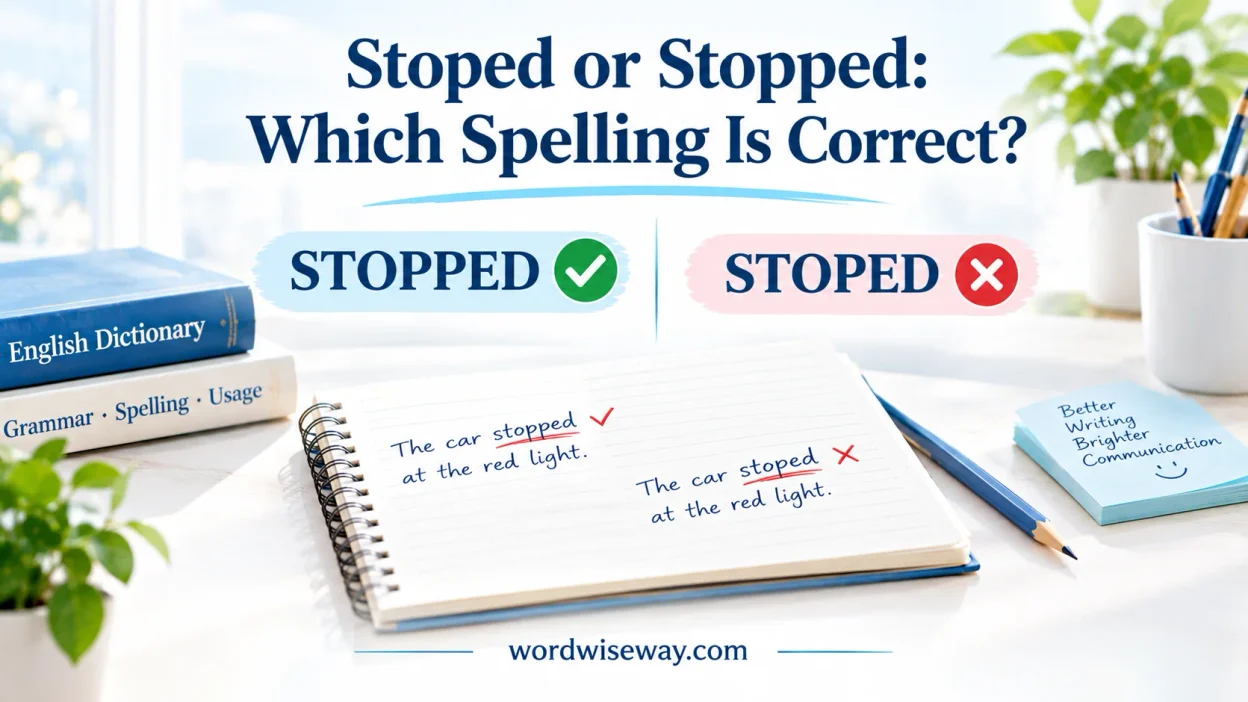
Stoped or Stopped: Correct Spelling, Meaning, and Usage helps people understand why stopped is correct and stoped is not in English writing. Many people search for stoped or stopped because they are unsure about the spelling, meaning, and usage.
At a glance, the words seem similar, but stopped is the standard and accepted form. This common confusion often appears among students, bloggers, and professionals who want clean grammar. The mistake happens when adding the suffixes ed to verbs. English rules can feel tricky, but the last consonant in stop is doubled before adding ed.
When writing an email, essay, or social media post, you may be wondering which form to write, but you are not alone. This article gives you a simple way to learn why the spelling changes and understand the difference between the two forms. Use stopped in real-life sentences, and you can naturally write it with confidence.
Once the form becomes familiar, you can never mix up stoped and stopped again, keeping your English natural and accurate.
Quick Answer:
Stopped is the correct spelling in standard US English when you’re using the past tense or past participle of stop.
Stoped is not the standard spelling of the verb’s past form.
| Word | Correct? | Use | Example |
| Stopped | ✅ Yes | Past tense and past participle of stop | The bus stopped outside my house. |
| Stoped | ❌ No | Incorrect spelling for the past form of stop | The bus stoped outside my house. |
The basic change is simple:
stop + ed → stopped
The final p doubles before -ed. This same spelling pattern appears in verbs such as plan → planned, drop → dropped, and shop → shopped.
What Does Stopped Mean?
Stopped is the past tense and past participle of the verb stop. It can describe something that ended, something that ceased moving, or something that someone prevented from happening.
The word can describe physical movement:
The car stopped at the red light.
It can also describe an activity coming to an end:
She stopped talking when the teacher entered.
In another context, stopped can mean prevented:
The guard stopped the child from entering the room.
So although the spelling stays the same, the meaning depends on the sentence around it.
Stop as a Verb
The base verb is stop. Its common forms are:
| Verb form | Word | Example |
| Base form | stop | Please stop making noise. |
| Past tense | stopped | The noise stopped suddenly. |
| Past participle | stopped | The machine has stopped. |
| Present participle | stopping | The machine is stopping. |
| Third-person singular | stops | The bus stops here. |
Regular verbs commonly form their past tense and past participle with -ed. However, spelling changes can occur when that ending attaches to the base form.
Why Is It Stopped and Not Stoped?
The answer lies in the double-consonant spelling rule.
When a short, one-syllable verb ends with a single vowel followed by a single consonant, the final consonant is commonly doubled before -ed or -ing.
That gives us:
- stop → stopped
- stop → stopping
- plan → planned
- plan → planning
- drop → dropped
- drop → dropping
The Double-Consonant Rule
Think of the word stop as having this basic structure:
s + t + o + p
The final p follows the short vowel o. When you add -ed, English doubles the final consonant:
stop + ed → stopped
Without the extra p, you get:
stoped ❌
With the doubled consonant, you get:
stopped ✅
This isn’t simply a matter of memorizing one troublesome word. Once you understand the pattern, several other spellings become easier.
Stop + ed: How the Spelling Changes
The transformation looks like this:
stop → stopped
The process has two parts:
- Start with the base verb stop.
- Double the final p before adding -ed.
So the result is:
stopp + ed = stopped
The same principle helps explain why planned has two n’s and dropped has two p’s.
Is Stoped Ever Correct?
For the ordinary past tense or past participle of stop, stoped is not correct.
If you want to say that someone or something came to a halt, ended an activity, or prevented something, use stopped.
For example:
- The rain stopped.
- We stopped the car.
- He stopped working.
- The music stopped suddenly.
- She stopped him from leaving.
The spelling stoped usually appears because someone applies the simple verb + -ed pattern without accounting for the consonant-doubling rule.
It’s an understandable mistake. English spelling has plenty of rules that become clearer once you see the pattern behind them.
Key Difference
The difference is straightforward:
| Feature | Stopped | Stoped |
| Standard spelling | ✅ | ❌ |
| Past tense of stop | ✅ | ❌ |
| Past participle of stop | ✅ | ❌ |
| Contains doubled consonant | Yes, pp | No |
| Example | She stopped running. | She stoped running. ❌ |
A useful memory trick is to connect the spelling with another word family:
stop → stopped → stopping
Once you remember that p doubles in both forms, stoped starts looking unusual.
When to Use Stopped
The word stopped has several common uses. Understanding them can help you choose the right form naturally rather than simply memorizing its spelling.
Stopped for Coming to a Halt
Use stopped when a person, vehicle, object, or moving thing no longer moves.
For example:
- The train stopped at the station.
- The cyclist stopped near the corner.
- The car stopped suddenly.
- The elevator stopped between floors.
Here, stopped describes the end of movement.
The word can also describe something that was already moving and then became still. For instance, saying The clock stopped means the clock ceased operating or moving.
Stopped for Ending an Action
Stopped can also mean that someone no longer continued an activity.
Consider these examples:
- Maya stopped laughing.
- We stopped talking.
- He stopped studying for the evening.
- They stopped playing after sunset.
This use is especially important because stop + -ing has a specific meaning. It means an activity is no longer continuing.
Stopped for Preventing Something
The verb can also mean prevented.
For example:
- The fence stopped the dog from escaping.
- The rain stopped us from playing outside.
- The teacher stopped the students from leaving early.
In these sentences, stopped doesn’t mean that the subject itself came to a halt. Instead, it means the subject prevented another action or event.
That distinction matters because context does much of the grammatical work.
Stopped as a Past Participle
Stopped also functions as a past participle.
You’ll often see it after helping verbs such as has, have, and had:
- The machine has stopped working.
- The rain has stopped.
- The workers have stopped.
- The engine had stopped before help arrived.
The past simple and past participle of stop use the same spelling: stopped.
Stopped in Different Sentence Structures
The spelling doesn’t change when the grammatical structure changes. What changes is the role stopped plays in the sentence.
Simple Past
Use stopped for a completed action in the past.
The bus stopped near the school.
She stopped reading after dinner.
The rain stopped before noon.
The action happened and ended in the past.
Present Perfect
Use has stopped or have stopped when the past action connects with the present.
The machine has stopped working.
The children have stopped playing.
The noise has stopped now.
Here, stopped works as the past participle after has or have.
Past Perfect
Use had stopped when one past event happened before another past event.
The rain had stopped before we left.
The engine had stopped when the mechanic arrived.
The structure makes the sequence clearer.
Passive Constructions
Stopped can also appear in passive sentences:
The car was stopped by the officer.
The project was stopped because of technical problems.
In these examples, the subject receives the action rather than performing it.
Stop vs. Stopped vs. Stopping
These three forms are closely related, yet they don’t perform the same job.
| Form | Main use | Example |
| stop | Base or present form | I stop here every morning. |
| stopped | Past tense or past participle | I stopped here yesterday. |
| stopping | Present participle or gerund | I am stopping here now. |
Here’s another useful comparison:
Stop talking.
She stopped talking.
She is stopping talking.
The first gives a command. The second describes a completed change. The third uses the -ing form to describe an action in progress or a developing situation.
The spelling changes because English uses different suffixes and grammatical forms.
Stop + -ing vs. Stop + to
One particularly useful distinction involves what comes after stop.
Stop + -ing means ending an activity.
She stopped reading.
This means she was reading and no longer continued.
However, stop + to-infinitive means pausing one activity in order to do another.
She stopped to read the sign.
Here, she stopped what she was doing so that she could read the sign. The two structures look similar, but their meanings differ significantly.
| Structure | Meaning | Example |
| stop + -ing | End an activity | He stopped running. |
| stop + to + verb | Pause another activity to do something | He stopped to rest. |
That small grammatical difference can completely change the sentence.
Common Mistakes
Spelling mistakes often happen when writers rely on a basic formula without checking how the base word ends.
Writing Stoped Instead of Stopped
This is the most direct mistake.
❌ The train stoped suddenly.
✅ The train stopped suddenly.
The correct form doubles the final p.
Forgetting the Double P
The easiest way to catch this error is to remember the word family:
stop → stopped → stopping
Both stopped and stopping retain the doubled p.
Confusing Stopped and Stopping
These forms shouldn’t be swapped.
❌ The bus is stopped at the station.
✅ The bus is stopping at the station.
However, stopped can be correct when you’re describing a completed event:
The bus stopped at the station.
The surrounding words determine which form fits.
Using Stop in the Wrong Tense
Consider this pair:
❌ Yesterday, the machine stop.
✅ Yesterday, the machine stopped.
Because yesterday places the action in the past, the past form stopped is required.
Examples of Stopped in Everyday English
The word appears constantly in ordinary communication. Here are examples across several situations.
Transportation
- The taxi stopped outside the hotel.
- The train stopped at the next station.
- The driver stopped at the traffic light.
Conversations
- She stopped speaking for a moment.
- He stopped answering my questions.
- Everyone stopped talking when the teacher entered.
Work and School
- I stopped working at six.
- The students stopped writing when the bell rang.
- She stopped studying to take a short break.
Weather
- The rain stopped during the afternoon.
- The wind finally stopped.
- The snow stopped before sunrise.
Machines
- The computer stopped responding.
- The fan stopped suddenly.
- The engine stopped after several minutes.
These examples show why stopped is such a versatile word. It can describe movement, activities, machines, weather, communication, and prevention.
Why Do Other Words Double Their Final Consonants?
The pattern extends beyond stop.
| Base verb | Past form | Present participle |
| stop | stopped | stopping |
| plan | planned | planning |
| drop | dropped | dropping |
| shop | shopped | shopping |
| commit | committed | committing |
The exact rule becomes more detailed with longer words and different endings. In general, however, a short vowel followed by a single final consonant often triggers doubling when an appropriate vowel-starting suffix is added.
This explains why English spelling sometimes looks more complicated than simply attaching -ed.
Pronunciation
In standard US English, stopped has one syllable. The -ed ending is pronounced with a /t/ sound because the base verb ends in the voiceless /p/ sound.
The spelling has two p’s, but you don’t pronounce two separate p sounds.
That’s an important distinction:
Double letter in spelling ≠ double sound in pronunciation.
The doubled p exists because of the spelling rule. It doesn’t mean you should pause or pronounce an exaggerated second p.
Memory Trick
If stop means to bring something to a halt, picture the word hitting a tiny spelling speed bump:
sto + p → sto + pp + ed
Remember:
Stop doesn’t just stop. It stops with two P’s.
That quick phrase can make the correct spelling easier to recall.
You can also memorize this three-word family:
stop → stopped → stopping
Once the pattern clicks, stoped starts looking as though something important is missing.
Read More: Openned or Opened: Correct Spelling, Meaning, and Usage
FAQs
Is “Stoped” a correct English spelling?
No. Stoped is generally considered a misspelling. The correct past-tense and past-participle form of stop is stopped.
Why does “Stop” become “Stopped”?
The final consonant is doubled before adding -ed because stop follows the English consonant-doubling rule. Therefore, stop + ed becomes stopped.
What does “Stopped” mean?
Stopped means that someone or something came to an end, ceased moving, or no longer continued an action. For example, “The car stopped.”
When should I use “Stopped” in a sentence?
Use stopped when describing an action that has already ended. It can refer to movement, activity, work, conversation, or many other situations.
Is “Stoped” ever acceptable in standard English?
No, stoped is not the standard spelling of the past tense or past participle of stop. In ordinary English writing, use stopped.
What is the difference between “Stoped” and “Stopped”?
The main difference is the extra p. Stopped has two p’s and is the correct form, while stoped has one p and is a spelling error.
Can I use “Stopped” in formal writing?
Yes. Stopped is suitable for formal and informal writing, including essays, emails, reports, articles, and professional communication.
Is “Stopped” both a past tense and past participle?
Yes. Stopped can function as both the simple past tense and the past participle of stop, depending on how it is used in a sentence.
How can I remember the spelling of “Stopped”?
A useful way to remember it is to notice that stop ends with a single consonant after a short vowel sound. When -ed is added, the final p is doubled: stop → stopped.
Why do people commonly write “Stoped”?
People may write stoped because they apply a simpler spelling pattern and add -ed without doubling the final consonant. The correct pattern is stop → stopped.
Conclusion
The difference between stoped and stopped becomes much easier once you understand the spelling rule behind the word. Stopped is the correct form because the final p in stop is doubled before -ed is added. Although stoped may look reasonable at first, it is not the standard spelling used in English.
Knowing this small rule can make everyday writing more accurate. Whether you are writing an email, essay, social media post, or professional document, choosing stopped keeps your sentence clear and grammatically correct. Instead of relying only on how the word looks, remembering the consonant-doubling pattern gives you a practical way to avoid the mistake.
Once stop → stopped becomes familiar, there is little reason to hesitate between the two forms. The extra p is the key detail to remember. With regular practice and attention to common spelling patterns, you can use stopped naturally and keep stoped out of your standard English writing.

Emma Smith has dedicated 14 years to Princeton University’s English Department, mentoring students in textual interpretation, literary movements, and critical frameworks. Her research explores Shakespearean drama, Victorian serial fiction, postcolonial narrative theory, and manuscript studies and probing how literary forms evolve across cultures and centuries. Emma has delivered lectures at international humanities congresses and published findings in distinguished academic journals, underscoring her commitment to scholarly depth and vibrant teaching.