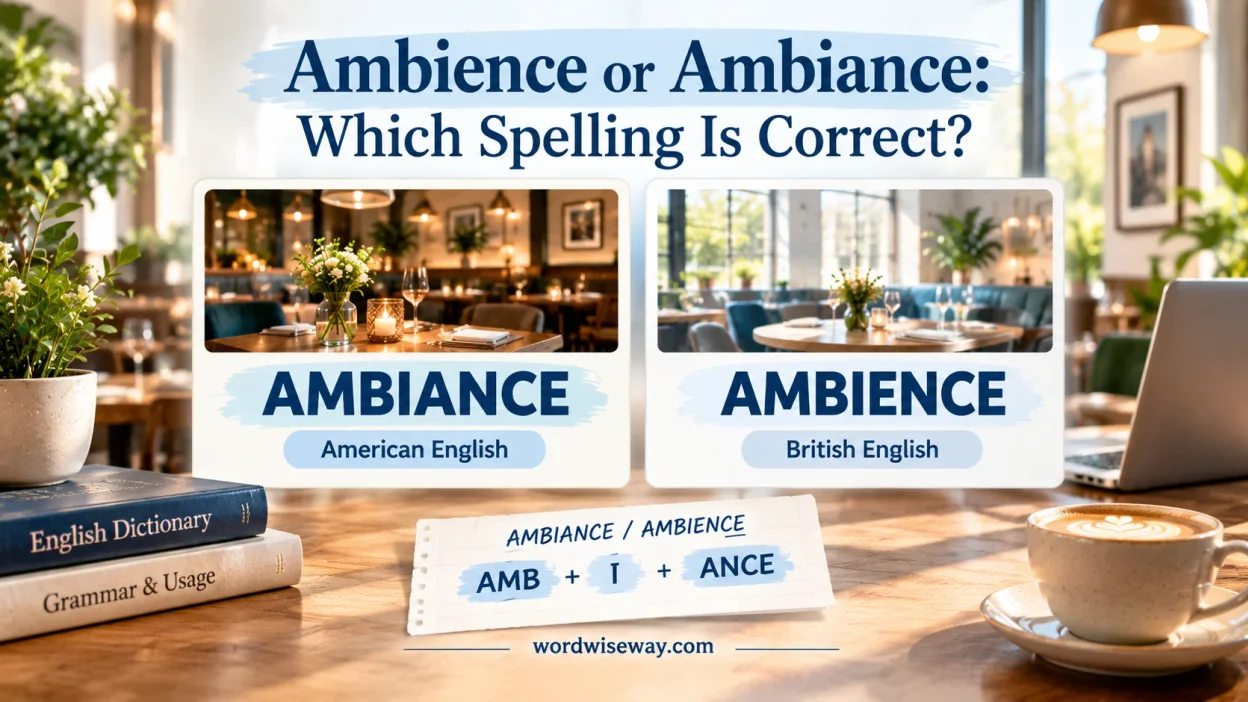
Ambience or Ambiance: Which Spelling Is Correct? Both spellings describe the same atmosphere or mood. When choosing a restaurant for an anniversary dinner with your spouse, you may notice online reviews mentioning good ambiance or good ambience. The different spellings have the same meaning and describe the environment or setting of an eatery.
The correct spelling depends on context, preference, and regional variation. Dictionaries recognize both forms. Ambiance comes from the French word, while ambience is an Anglicization that became an English word earlier. Both forms remain common in modern English.
In formal writing, blogs, books, and emails, either spelling may appear. Understanding the origin, spelling difference, pronunciation, and common usage makes the choice easier. These simple rules can help writers, students, and professionals decide which spelling to use.
Quick Answer:
Ambiance and ambience are both correct spellings. In American English, use ambiance. In British English, ambience is the more common form.
Both words refer to the mood, atmosphere, or overall character of a place or setting.
| Spelling | English Variety | Meaning | Example |
| Ambiance | American English | The atmosphere or character of a place | The restaurant has a cozy ambiance. |
| Ambience | British English | The atmosphere or character of a place | The restaurant has a cozy ambience. |
So, if you’re writing in US English, ambiance is the spelling to choose. If you’re following British English, ambience fits the usual convention.
The Key Difference
The difference between ambience and ambiance is primarily regional spelling. The words don’t normally carry different meanings.
Both describe the quality or feeling that surrounds an experience. A restaurant might have soft lighting, quiet music, comfortable furniture, and warm colors. Together, these details create its ambiance or ambience.
Think of the word as describing the invisible personality of a place. You can’t pick up ambiance and put it on a shelf, but you can certainly notice it when you walk through a door.
For example:
- The café has a relaxed ambiance.
- The hotel has an elegant ambience.
- The dim lighting creates a romantic ambiance.
- The theater’s traditional ambience suits the performance.
The meaning stays essentially unchanged. Only the preferred spelling varies by region.
What Does Ambiance Mean?
Ambiance is a noun meaning the particular mood, atmosphere, or character of a place.
In American English, it’s the standard spelling you’ll generally want to use. The word often appears when people describe restaurants, hotels, cafés, homes, stores, galleries, offices, and other physical settings.
Several elements can contribute to a place’s ambiance:
- Lighting: Bright lights can create an energetic setting, while softer lighting may feel calmer.
- Music: Background music can influence the mood without becoming the main focus.
- Decor: Furniture, artwork, colors, and decorations shape the visual character.
- Layout: An open room can feel different from a crowded or enclosed space.
- Scents: Food, flowers, candles, or other smells can affect the overall experience.
- Noise: Conversation, traffic, music, or silence can change how a setting feels.
- Temperature: A comfortable environment can contribute to a pleasant experience.
For example, a coffee shop with wooden tables, warm lighting, quiet music, and the smell of freshly brewed coffee might have a cozy ambiance.
Ambiance in a Sentence
Here are several natural examples:
- The restaurant’s ambiance makes it popular for quiet dinners.
- Soft lighting gives the room a warm ambiance.
- The hotel combines modern design with a peaceful ambiance.
- The café has a casual ambiance that attracts students.
- The garden creates a relaxing ambiance for afternoon events.
Notice that the word describes the overall character of the setting rather than one individual feature.
What Does Ambience Mean?
Ambience has the same basic meaning as ambiance. It refers to the atmosphere, mood, or character of a particular place or setting.
The spelling ambience is especially associated with British English. You’ll commonly see it in British publications, websites, books, and other forms of writing that follow British spelling conventions.
For example:
- The restaurant’s ambience is calm and sophisticated.
- The hotel is known for its peaceful ambience.
- The old theater retains much of its original ambience.
- The café has a friendly ambience.
- The lighting adds to the room’s warm ambience.
The spelling doesn’t turn the word into a different concept. It simply reflects a different regional convention.
Ambience in a Sentence
You can use ambience naturally when writing in British English:
The restaurant’s ambience changes completely after sunset.
The museum preserves the ambience of the historic building.
The soft music creates a relaxing ambience.
If your entire article uses British spellings such as colour, favourite, and centre, then ambience will usually fit that style better.
Ambiance or Ambience in American English
When you’re writing American English, ambiance is generally the preferred spelling.
This follows the broader principle of maintaining a consistent regional spelling system. American English often has spelling patterns that differ from British English, although those differences don’t apply to every word.
For US-focused content, these examples are natural:
- The restaurant has a sophisticated ambiance.
- The hotel offers a peaceful ambiance.
- Candles can create a romantic ambiance.
- The café’s casual ambiance appeals to young customers.
You may still encounter ambience in American writing. That doesn’t automatically make the spelling incorrect. It may reflect a British source, a quotation, a publication’s style preference, or a particular name.
However, if you’re writing a US English article from scratch, ambiance is the straightforward choice.
Ambience or Ambiance in British English
British English generally favors ambience.
For example, a British publication might write:
- The restaurant has a relaxed ambience.
- The hotel combines luxury with traditional ambience.
- The theater has retained its historic ambience.
This distinction resembles other regional spelling differences, although each word has its own history and usage pattern.
The important point is consistency. If you’re producing British English content, don’t randomly alternate between ambiance and ambience. Pick the spelling that matches the variety of English you’re using.
Ambiance or Ambience: Pronunciation
The two spellings are generally pronounced the same way in standard English.
The difference appears primarily in writing, not in ordinary speech. That’s why you can’t reliably determine which spelling someone means just by hearing the word.
The pronunciation can be represented approximately as:
/ˌæmbiˈɑːns/
Accent can affect the exact vowel sounds. American and British speakers may produce slightly different pronunciations because English pronunciation varies across regions.
Still, there isn’t a major pronunciation distinction corresponding to the spelling difference.
Part of Speech
Both ambiance and ambience function as nouns.
They commonly appear with adjectives that describe the atmosphere being discussed.
Common patterns include:
- a pleasant ambiance
- a relaxed ambiance
- a romantic ambiance
- a sophisticated ambience
- the restaurant’s ambiance
- the room’s ambience
- create an ambiance
- improve the ambience
For example:
The candles create a warm ambiance.
Here, ambiance is the noun receiving the action of create.
You can also use the word with possessives:
The hotel’s ambiance attracts visitors.
The sentence says that the hotel’s overall atmosphere has a particular quality.
Common Collocations
Certain adjectives frequently appear alongside these words. Learning these combinations can make your writing sound more natural.
| Common Expression | Typical Meaning |
| pleasant ambiance | A comfortable and enjoyable atmosphere |
| relaxed ambiance | A calm, informal setting |
| romantic ambiance | An atmosphere suited to romance |
| elegant ambiance | A refined or sophisticated setting |
| cozy ambiance | A warm, comfortable atmosphere |
| peaceful ambience | A quiet and calming environment |
| warm ambience | A welcoming, comfortable feeling |
| casual ambiance | An informal and easygoing setting |
For instance, a luxury hotel might promote its elegant ambiance, while a small café could emphasize its cozy ambiance.
The noun stays the same. The adjective changes the particular quality you’re describing.
Common Mistakes
Using the Wrong Regional Spelling
The biggest mistake is assuming that one form is always correct and the other is always wrong.
That’s not the case.
Ambiance and ambience are both established spellings. The practical choice depends largely on the English variety you’re following.
If you write US English, use ambiance. If you write British English, use ambience.
Treating One Spelling as Incorrect
You shouldn’t mark ambience as a spelling error simply because you normally use American English.
Likewise, ambiance isn’t inherently an incorrect spelling in British-oriented writing.
Regional spelling differences appear throughout English. The goal isn’t to eliminate every variation. It’s to use the appropriate convention consistently.
Confusing Ambiance With Atmosphere
Ambiance and atmosphere overlap considerably, but they’re not always interchangeable in every sentence.
Atmosphere has a broader range of meanings. It can describe the mood of a place, but it can also refer to the gases surrounding a planet or the general emotional tone of a situation.
For example:
The restaurant has a relaxed atmosphere.
The restaurant has a relaxed ambiance.
Both sentences work.
However:
Earth’s atmosphere contains several gases.
You couldn’t replace atmosphere with ambiance in that scientific context.
Using Ambiance for a Person’s Mood
Ambiance usually describes the character of a place, setting, or environment.
If you want to describe how a person feels, words such as mood, attitude, or emotional state may be more precise.
For example:
The room had a cheerful ambiance.
This works because the word describes the room.
By contrast:
She had a cheerful ambiance.
This sounds unusual because mood or personality would normally communicate the intended meaning more naturally.
Ambiance vs. Atmosphere: Are They the Same?
In descriptions of places, ambiance and atmosphere can often express nearly the same idea.
Both can describe the overall feeling created by a setting.
| Ambiance | Atmosphere |
| Often focuses on the character of a place | Has a broader range of meanings |
| Common in descriptions of restaurants and hospitality | Common in everyday, literary, scientific, and social contexts |
| Usually connected with a setting’s overall feel | Can describe mood, environment, or gases around a planet |
| Often has a more descriptive or lifestyle-oriented tone | Usually works in a wider variety of contexts |
Consider these examples:
The café has a peaceful ambiance.
The café has a peaceful atmosphere.
Both sound natural. The second is somewhat broader and more general.
However, atmosphere has uses that ambiance doesn’t. In science, for example, Earth’s atmosphere means the layer of gases surrounding the planet.
Ambiance vs. Environment
Environment refers more broadly to the surroundings or conditions in which someone or something exists.
Ambiance, by contrast, focuses more specifically on the perceived mood or character of a setting.
Compare these sentences:
The office environment encourages collaboration.
The office has a welcoming ambiance.
The first sentence focuses on the conditions and surroundings of the workplace. The second focuses on how the place feels.
A restaurant’s physical layout is part of its environment. The relaxing impression created by its lighting, music, décor, and layout contributes to its ambiance.
The concepts overlap, but they aren’t identical.
Ambiance or Ambience in Formal Writing
Both spellings can appear in formal writing. Your choice should follow the variety of English you’ve selected.
For American English, use ambiance:
The study examined how lighting influenced the ambiance of the dining environment.
For British English, use ambience:
The study examined how lighting influenced the ambience of the dining environment.
Consistency matters more than trying to force both spellings into the same document.
If your paper follows American conventions throughout, switching from ambiance to ambience halfway through can look careless. The same principle applies in reverse for British English.
Which One Should You Use?
Your choice becomes simple once you identify your target variety of English.
- Writing in US English? Use ambiance.
- Writing in British English? Use ambience.
- Writing for an international audience? Choose one variety and stay consistent.
- Editing existing content? Follow the spelling style already established in the document.
- Following a publication style guide? Use its preferred spelling.
For US English writing, ambiance is the spelling to use most naturally.
For British English writing, ambience is the usual choice.
Neither spelling needs to be treated as a universal error.
Examples
The easiest way to see the difference is to place the spellings side by side.
| American English | British English |
| The restaurant has a romantic ambiance. | The restaurant has a romantic ambience. |
| We enjoyed the café’s relaxed ambiance. | We enjoyed the café’s relaxed ambience. |
| The hotel creates a peaceful ambiance. | The hotel creates a peaceful ambience. |
| Soft lighting improves the room’s ambiance. | Soft lighting improves the room’s ambience. |
| The historic building has a unique ambiance. | The historic building has a unique ambience. |
These sentences demonstrate the key point: the meaning remains the same, while the preferred spelling changes.
Restaurant Example
The restaurant’s warm ambiance makes it ideal for a quiet dinner.
The lighting, music, furniture, and décor can all contribute to that impression.
Hotel Example
The hotel combines modern design with a peaceful ambience.
Here, the British spelling works naturally in a British English context.
Home Example
Plants, soft lighting, and natural colors give the living room a welcoming ambiance.
The word describes the overall character created by several design elements.
Event Example
The live music created an energetic ambiance throughout the event.
The setting feels energetic because multiple features work together.
Memory Trick
A simple way to remember the distinction is to connect ambiance with American English.
When you’re writing for a US audience, think:
American English → ambiance
For British English:
British English → ambience
This isn’t a rule that says one spelling cannot appear in the other variety. It’s a practical guide to the more commonly preferred spelling.
Read More: Speach or Speech: Which Spelling Is Correct?
FAQs
1. Is ambience or ambiance the correct spelling?
Both ambience and ambiance are correct spellings of the same word. They describe the atmosphere, mood, or overall feeling of a place.
2. What does ambience mean?
Ambience means the atmosphere or mood created by a particular place. Lighting, music, decoration, and surroundings can all affect its ambience.
3. What does ambiance mean?
Ambiance has the same meaning as ambience. It refers to the character, atmosphere, or mood of a place or setting.
4. Is ambience more common than ambiance?
Yes. Ambience is generally more common across major varieties of modern English, while ambiance is also widely recognized and used.
5. Is ambiance the French spelling?
Yes. Ambiance comes directly from French. Ambience developed as an Anglicized form that became established in English earlier.
6. Can I use ambience in American English?
Yes. Ambience is understood and accepted in American English. However, ambiance is also commonly seen, especially in descriptions of restaurants, hotels, and design.
7. Which spelling should I use in formal writing?
You can use either spelling, but ambience is a common choice in English-language formal writing. The important thing is to use one spelling consistently.
8. Do ambience and ambiance have different meanings?
No. Ambience and ambiance generally have the same meaning. Both describe the atmosphere or mood of a particular environment.
9. Why are there two spellings of ambience?
The two forms developed through different language influences. Ambiance entered English from French, while ambience developed as an English form of the word.
10. How can I remember the difference between ambience and ambiance?
Think of ambience as the established English spelling and ambiance as the French-influenced spelling. Both refer to the same atmosphere or mood.
Conclusion
Ambience and ambiance are both correct spellings for the same idea: the atmosphere or mood of a place. Whether you’re describing a cozy restaurant, a stylish hotel, or a peaceful room, either word can explain the feeling created by the surroundings.
For most everyday English writing, ambience is a familiar and widely used choice. Ambiance is also correct and retains a stronger connection to its French origin. You may see it often in writing about restaurants, interiors, art, and design, although the distinction isn’t a strict rule.
So, you don’t need to worry when you encounter either spelling. The meaning stays the same, even though the written forms differ. Choose the version that fits your preferred variety of English, keep your usage consistent, and let the surrounding context do the rest.

Emma Smith has dedicated 14 years to Princeton University’s English Department, mentoring students in textual interpretation, literary movements, and critical frameworks. Her research explores Shakespearean drama, Victorian serial fiction, postcolonial narrative theory, and manuscript studies and probing how literary forms evolve across cultures and centuries. Emma has delivered lectures at international humanities congresses and published findings in distinguished academic journals, underscoring her commitment to scholarly depth and vibrant teaching.