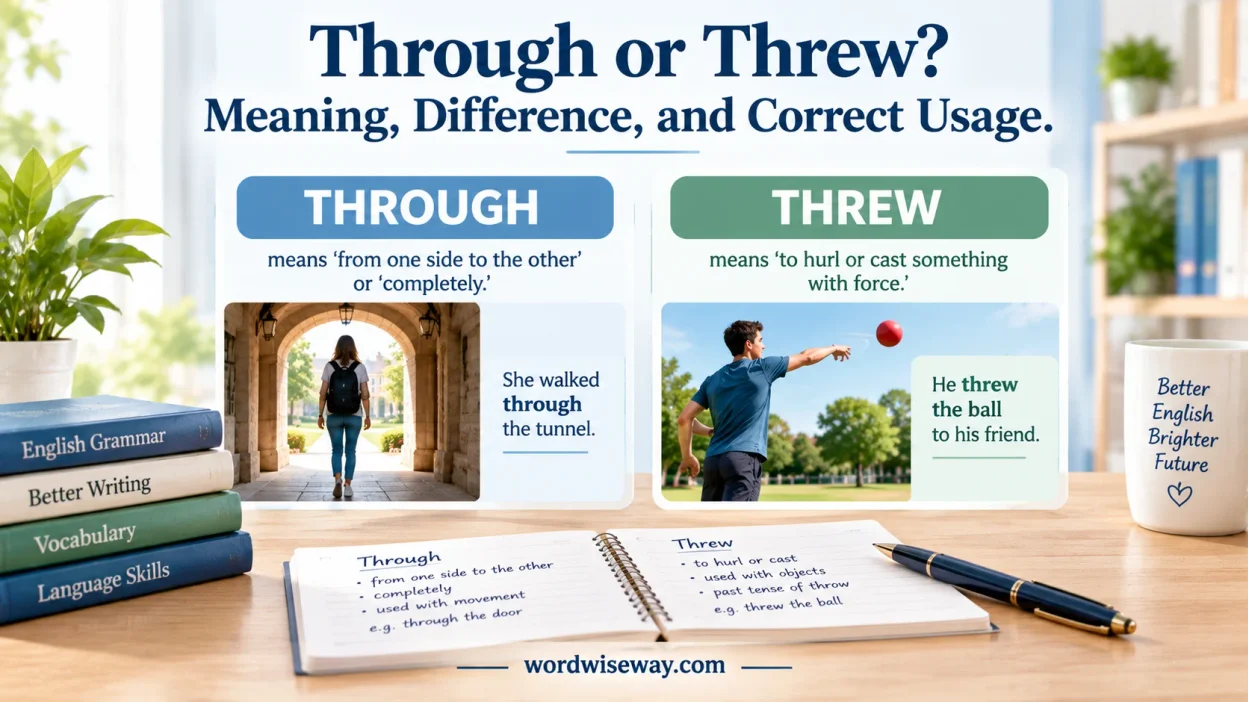
Through or Threw? Meaning, Difference, and Correct Usage becomes easier when you understand threw as the past tense of the verb throw.
It describes the action of propelling an object through the air, such as when you threw a ball. The word can also have figurative uses, including an emotional state, a tantrum, or planning and hosting a celebration.
In pottery, throw describes creating ceramics on a pottery wheel, involving ceramics, pottery, and the wheel. Related forms include thrown and throwing, while entering a particular state can express another meaning. These uses show how the action of throw changes with context.
For English learners, native speakers, and language learners, distinguishing through and threw prevents writing mistakes. Although they sound the same when spoken aloud, these homophones have different meanings and different parts of speech.
This confusion can affect emails, essays, exams, and social media posts, but real-life examples, a comparison table, and knowledge of British English and American English make the exact difference easier to understand and use confidently.
Quick Answer:
Through and threw have different meanings and grammatical functions.
- Through usually works as a preposition or adverb. It can describe movement from one side to another, movement within something, completion, or the means by which something happens.
- Threw is the simple past tense of throw. It describes an action in which someone tossed, hurled, or launched something.
| Word | Meaning | Grammar | Example |
| Through | From one side to another, within, during, or to completion | Preposition/adverb | We drove through the tunnel. |
| Threw | Past action of tossing or launching something | Verb | He threw the ball. |
| Thru | Informal spelling of through | Informal form | The drive-thru is open. |
A useful memory trick is simple: threw = throw in the past. If the sentence involves passing through something, you probably need through.
What Does Through Mean?
Through has several related meanings, which explains why you see it in many different types of sentences. Its central idea often involves moving from one point to another, moving within something, or reaching the end of a process.
Through as a Preposition
As a preposition, through commonly shows movement from one side, point, or place to another.
For example:
- The train passed through the tunnel.
- We walked through the forest.
- Light entered through the window.
- She looked through the doorway.
- The water flowed through the pipe.
Notice the relationship in each sentence. Something moves within or across a space, opening, object, or area.
In The train passed through the tunnel, the train enters the tunnel, travels inside it, and eventually exits it. The word through connects that movement with the tunnel.
Through as an Adverb
Through can also function as an adverb when it doesn’t directly introduce a noun.
Consider these examples:
- The door is open. Come through.
- The train went through.
- She stayed through until the end.
In these constructions, through still carries the idea of passing, continuing, or reaching an endpoint.
Through for Completion
One of the most useful meanings of through involves completing or experiencing something.
You may hear expressions such as:
- go through a process
- get through a difficult period
- work through a problem
- read through a document
- talk through an issue
- think through a decision
For example:
I read through the entire report before the meeting.
Here, through doesn’t describe physical movement. Instead, it shows that the reading continued across the entire report.
Likewise:
She worked through the problem step by step.
The person isn’t physically moving anywhere. The word describes progress through a process.
Through for Means or Method
Through can also explain how something happens.
For example:
- You can improve through practice.
- They learned about the problem through research.
- She found the opportunity through a friend.
- The company gained customers through online advertising.
In these sentences, through means something close to by means of, using, or as a result of.
That meaning makes through especially common in explanations about learning, communication, discovery, and personal experience.
What Does Threw Mean?
Threw is the simple past form of the irregular verb throw.
The basic verb forms are:
| Verb Form | Word | Example |
| Base form | throw | I throw the ball. |
| Simple past | threw | I threw the ball. |
| Past participle | thrown | I have thrown the ball. |
| Present participle | throwing | I am throwing the ball. |
Because throw is an irregular verb, you can’t form its past tense by simply adding -ed. The correct past form is threw, not throwed.
Threw for a Physical Action
The most common use of threw involves physically sending something through the air.
Examples include:
- She threw the ball.
- He threw the keys onto the table.
- The child threw the toy across the room.
- They threw the paper into the trash.
- She threw a stone into the water.
In every example, threw tells you that the throwing action happened in the past.
Threw in Figurative Expressions
English also uses threw in several expressions where nobody literally throws an object.
For example:
The unexpected question threw me off.
Here, threw me off means the question surprised or confused me.
Another example is:
The sudden change threw him into confusion.
The sentence doesn’t mean that someone physically tossed him. Instead, the change caused confusion.
Common expressions include:
- threw me off = confused or distracted me
- threw away = discarded something
- threw out = discarded or removed something
- threw back = returned or moved something backward
- threw open = opened something suddenly or dramatically
- threw down = placed or dropped something forcefully
Context determines the exact meaning.
Key Differences
The clearest distinction comes from meaning and grammar.
Through Describes Passage or Progress
Use through when you mean movement across, inside, or from one point to another.
We walked through the park.
The word describes the route taken by the people.
You can also use it for progress:
She worked through the difficult assignment.
Here, it describes movement through a task or process.
Threw Describes a Past Action
Use threw when someone performed the action of throwing in the past.
He threw the ball toward the fence.
The sentence tells us what he did.
A Simple Comparison
| If you mean… | Use |
| Moving from one side to another | Through |
| Moving inside a place or object | Through |
| Continuing across a process | Through |
| Reaching completion | Through |
| By means of something | Through |
| Past action of tossing something | Threw |
| Past action of hurling something | Threw |
| Past action of sending something through the air | Threw |
Examples
Seeing the words in real sentences makes the difference much easier to remember.
Examples With Through
- The children ran through the garden.
- We drove through the city before sunset.
- She looked through the old photographs.
- The sunlight came through the curtains.
- He walked through the open gate.
- I read through the instructions twice.
- They worked through the night.
- We need to talk through this problem.
- She got through the difficult exam.
- He learned the skill through regular practice.
Examples With Threw
- She threw the ball to her brother.
- He threw the keys onto the desk.
- The player threw the ball across the field.
- She threw the empty bottle away.
- The child threw the toy on the floor.
- He threw a stone into the lake.
- They threw the old papers into the trash.
- The sudden question threw me off.
- She threw open the door.
- He threw the rope toward his friend.
Through and Threw in the Same Sentence
Here’s where the distinction becomes especially clear.
She threw the ball through the window.
Both words are correct because they perform different grammatical jobs.
Threw tells you what she did. She sent the ball through the air.
Through tells you where the ball traveled. It passed from one side of the window opening to the other.
Consider another example:
He threw the paper through the open doorway.
Again, threw describes the past action. Through describes the route.
This is an excellent sentence to remember when you need to distinguish the two words.
Through vs. Threw Pronunciation
Pronunciation can help you recognize the words when listening, although spelling and context remain essential.
How to Pronounce Through
Through
throo
Give feedback
The word through contains the long oo sound found in words such as blue and true. The spelling looks complicated, but the spoken form is short.
How to Pronounce Threw
Threw
throo
Give feedback
Threw has the same standard American English pronunciation as through.
This point matters because through and threw are homophones. They have different spellings and meanings, yet they sound the same in standard American English.
That means you can’t always identify the correct spelling from speech alone. You need to use the sentence’s meaning and grammar.
Through vs. Threw vs. Thru
A third spelling often enters the conversation: thru.
Thru is an informal or abbreviated spelling of through. You may encounter it in signs, labels, business names, or informal writing.
For example:
- drive-thru
- walk-thru
- thru traffic
However, thru does not mean threw.
| Word | Meaning | Example |
| Through | Standard form meaning passage, completion, or means | We walked through the park. |
| Threw | Past tense of throw | She threw the ball. |
| Thru | Informal spelling of through | We stopped at the drive-thru. |
For formal writing, through remains the safer choice unless an established name or expression uses thru.
Common Mistakes
Even a small spelling mistake can completely change a sentence.
Using Threw Instead of Through
Incorrect:
We walked threw the tunnel.
Correct:
We walked through the tunnel.
The sentence describes movement inside and across the tunnel. It has nothing to do with throwing.
Using Through Instead of Threw
Incorrect:
She through the ball across the field.
Correct:
She threw the ball across the field.
The subject performed the past action of throwing. Therefore, threw is necessary.
Confusing Threw With Thrown
This mistake involves verb tense rather than just spelling.
Incorrect:
She has threw the ball.
Correct:
She has thrown the ball.
After has, have, or had, you generally need the past participle thrown, not the simple past threw.
Compare:
- She threw the ball yesterday.
- She has thrown the ball before.
- She had thrown the ball before the game ended.
This distinction is worth learning because threw and thrown often get mixed up by English learners.
How to Remember the Difference Between Through and Threw
A compact memory trick can save you from second-guessing yourself.
Remember “Threw = Throw in the Past”
If someone performed a throwing action earlier, choose threw.
Yesterday, he threw the ball.
If you’re describing movement, passage, or progress, choose through.
The ball rolled through the doorway.
An even better example combines both:
She threw the ball through the doorway.
Think of the sentence as two separate questions:
What did she do?
She threw the ball.
Where did the ball go?
It went through the doorway.
That mental split makes the difference surprisingly easy to remember.
Through or Threw in Common Phrases
Some expressions appear frequently enough to deserve special attention.
Common Phrases With Through
Go through means to experience, examine, or move through something.
We need to go through the report.
Get through can mean successfully completing or surviving a difficult situation.
She got through the final exam.
Look through means to examine something, often quickly or systematically.
I looked through the documents.
Work through means to deal with a problem step by step.
They worked through their differences.
Read through means to read something from beginning to end or examine it carefully.
Please read through the instructions before starting.
Common Phrases With Threw
Threw away means discarded.
He threw away the broken pen.
Threw out can mean discarded something or removed someone from a place.
She threw out the empty boxes.
Threw off can mean confused, distracted, or caused something to move away from its expected position.
The unexpected delay threw off our schedule.
Threw open means opened something suddenly or forcefully.
He threw open the door.
The important point is that these expressions still use threw because they describe past actions involving the verb throw.
A Real-World Sentence Breakdown
Consider this sentence:
The goalkeeper threw the ball through the open gate.
This single sentence demonstrates the difference perfectly.
| Word | Job | Meaning |
| threw | Past-tense verb | The goalkeeper sent the ball through the air. |
| through | Preposition | The ball traveled across the space of the open gate. |
Now change the sentence:
The goalkeeper walked through the open gate.
The throwing action disappears. Therefore, threw disappears too.
This is why grammar matters more than spelling alone. When two words sound identical, the surrounding sentence tells you which spelling belongs there.
Quick Revision:
Keep these rules nearby when you’re writing.
| Question | Correct Word |
| Does the sentence describe passage or movement? | Through |
| Does it describe movement inside something? | Through |
| Does it describe progress through a process? | Through |
| Does it mean by means of something? | Through |
| Did someone toss or launch something in the past? | Threw |
| Is it the past tense of throw? | Threw |
| Does the sentence use has, have, or had before the verb? | Usually thrown, not threw |
| Is it an informal version of through? | Thru |
The One-Sentence Rule
If you remember only one example, remember this:
She threw the ball through the window.
Threw tells you what happened.
Through tells you where something passed.
Practice:
Choose through or threw for each sentence.
- We walked ___ the narrow hallway.
- She ___ the ball toward the basket.
- The train passed ___ the tunnel.
- He ___ his old shoes away.
- Sunlight came ___ the curtains.
- They ___ the rope across the gap.
- I read ___ the entire report.
- The child ___ the toy onto the bed.
- We drove ___ the mountains.
- The question ___ me off during the interview.
- She ___ the paper ___ the open window.
- He worked ___ the difficult problem.
Answers
- through
- threw
- through
- threw
- through
- threw
- through
- threw
- through
- threw
- threw, through
- through
The trickiest sentence is number 11 because both words belong in the same sentence. The person threw the paper, while the paper traveled through the window.
Read More: Dying or Dieing: Correct Spelling, Meaning, and Usage
FAQs
What is the main difference between through and threw?
Through usually describes movement from one side or point to another, while threw is the past tense of throw. Their meanings and grammatical roles are different.
Is threw the past tense of throw?
Yes. Threw is the simple past form of throw. For example, you can say that someone threw a ball across a field yesterday.
Is through a verb like threw?
No. Through is commonly used as a preposition or adverb, although it can serve other grammatical roles in some contexts. Threw functions as a verb.
Why do through and threw sound alike?
They are homophones, meaning they have the same or very similar pronunciation but different meanings, spellings, and grammatical functions.
Can through describe movement?
Yes. Through can describe movement from one side, place, or point to another. It can also describe movement within an area or passage.
When should I use threw in a sentence?
Use threw when describing a completed action involving throwing something. For example, someone may have thrown a ball, stone, or object earlier.
Can threw be used for something other than physical throwing?
Yes. Throw can have figurative meanings, and threw can express those meanings in the past tense. Context determines the intended meaning.
Is it correct to write I went threw the door?
No. The correct sentence is “I went through the door.” Here, through describes movement from one side of the door to another.
How can I remember through and threw easily?
Connect threw with the action of throwing something. Think of through when describing movement, passage, or going from one point to another.
Why do writers confuse through and threw?
Their similar pronunciation makes them easy to mix up, especially for English learners. Checking the sentence’s meaning and grammatical role usually reveals which spelling you need.
Conclusion
Understanding through and threw becomes much easier when you focus on their meanings instead of their similar sounds. Threw is the past tense of throw, so it describes an action involving sending or propelling something. Through, on the other hand, commonly shows movement, passage, or progress from one point to another. Keeping these basic roles in mind can prevent many everyday spelling mistakes.
The confusion between these homophones is understandable because they sound alike when spoken. However, their spelling, grammar, and meaning are different. Whether you are writing an email, completing an exam, preparing an essay, or posting on social media, choosing the right word helps your sentence communicate exactly what you mean.
A simple habit can make the distinction stick: connect threw with the action of throwing, and connect through with moving or passing somewhere. Once you check what the sentence is trying to express, the correct choice usually becomes clear. With regular reading and writing practice, using both words correctly will soon feel natural.

Amelia Sanders has spent 14 years in Harvard University’s English Department, helping students navigate literary analysis, interpretive theory, and narrative techniques. Her academic pursuits center on 18th-century British prose, romantic poetry, diasporic writing, and digital editing exploring how textual choices influence cultural perspectives. Amelia has spoken at major international meetings and contributed essays to respected academic volumes, demonstrating her dedication to thoughtful scholarship and effective teaching.