Mondays Or Monday’s: Which Is Correct? is a common question among English learners and writers who feel confused by these similar forms.
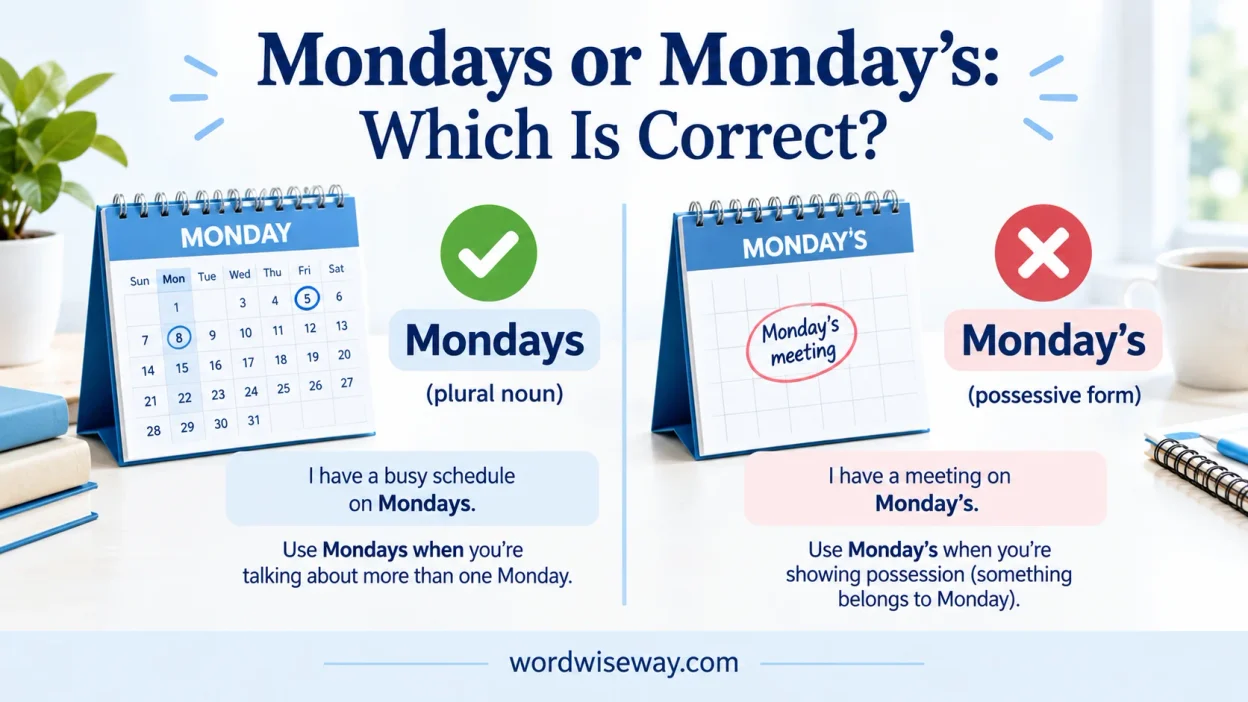
The difference is simple: Mondays is the plural form of Monday, while Monday’s uses an apostrophe to show possession. This small detail changes the meaning and can prevent grammar mistakes and common punctuation mistakes.
Use Mondays for multiple Mondays, repeated events, and regular everyday usage. For example, “I have meetings on Mondays.” Use Monday’s when something belongs to a specific Monday, such as “Monday’s schedule is busy.” This simple rule works in emails, schedules, academic work, professional communication, and business reports.
These forms should be used correctly in formal writing and casual writing. Spelling, grammar, apostrophe rules, repetition, plural, clarity, and grammar tips can help learners master this distinction. With practicing, natural English and correct English become easier.
Quick Answer:
Mondays is the plural form of Monday. Use it when you’re talking about two or more Mondays or Mondays in general.
Monday’s usually has one of two functions. It can be the possessive form of Monday, or it can be a contraction for Monday is or sometimes Monday has.
For example:
- I work from home on Mondays.
Here, Mondays refers to Mondays generally. - Monday’s meeting starts at 10 a.m.
Here, Monday’s describes a meeting associated with a particular Monday. - Monday’s going to be busy.
Here, Monday’s means Monday is.
The simplest rule is this: use “Mondays” for the plural and “Monday’s” for possession or a contraction.
What Does “Mondays” Mean?
Mondays Is the Plural of Monday
Mondays means more than one Monday. It can refer to several Mondays or to Mondays as a recurring part of the week.
Like other ordinary plural nouns, Monday normally takes -s when you want its plural form. It doesn’t need an apostrophe.
For example:
- I have classes on Mondays.
- Mondays are usually busy at work.
- We visit our grandparents on Sundays, not Mondays.
- The store opens early on Mondays.
- She practices piano every Monday.
Notice that none of these examples needs an apostrophe. You’re simply talking about the day as a plural noun.
This rule applies even when you’re talking about a repeated activity. If something happens every Monday, Mondays is often the form you’ll need.
Examples of “Mondays” in Sentences
Consider these examples:
Weekly routines
I go to the gym on Mondays.
The sentence refers to a recurring activity. It isn’t talking about one specific Monday.
General observations
Mondays feel longer after a busy weekend.
Here, Mondays means Mondays generally.
Repeated events
Our team has a meeting every other Monday.
When discussing several meetings that happen across different weeks, you might naturally refer to those days as Mondays.
Multiple dates
The three Mondays in May are already booked.
Now the plural meaning becomes especially obvious because the sentence identifies several Mondays.
The key question is simple: Are you talking about more than one Monday or Mondays as a recurring concept? If yes, use Mondays.
What Does “Monday’s” Mean?
The form Monday’s contains an apostrophe before the s. That apostrophe isn’t decoration. It tells the reader that the word has a different grammatical function.
Most commonly, Monday’s works as a possessive form.
It can also function as a contraction.
Monday’s as a Possessive Form
A possessive noun shows a relationship between one noun and another word. With Monday’s, the meaning is usually something like “belonging to Monday” or “associated with Monday.”
For example:
- Monday’s schedule is packed.
- Monday’s meeting was canceled.
- Monday’s deadline is approaching.
- Monday’s weather looks pleasant.
- Monday’s class starts at eight.
In Monday’s meeting, the apostrophe shows that the meeting is associated with Monday.
You’re not saying there are multiple Mondays. You’re identifying something connected to a particular Monday.
That’s why these two sentences mean different things:
- I dislike Mondays.
- Monday’s schedule is difficult.
The first sentence discusses Mondays in general. The second refers to a specific Monday’s schedule.
Monday’s as a Contraction
The apostrophe in Monday’s can also indicate missing letters in a contraction.
For example:
Monday’s going to be hectic.
Here, Monday’s means Monday is.
You can test it by expanding the contraction:
Monday is going to be hectic.
The sentence still works, so Monday’s is a contraction.
Another example is:
Monday’s the first day of my new schedule.
This means:
Monday is the first day of my new schedule.
Context usually makes the meaning obvious.
In some constructions, ’s can also represent has, although this use is less common with Monday. For example, a sentence such as Monday’s arrived quickly could theoretically expand to Monday has arrived quickly, although the wording sounds unusual in ordinary conversation.
Key Difference
The quickest way to understand the difference is to look at their grammatical roles.
| Form | Grammatical function | Meaning | Example |
| Mondays | Plural noun | More than one Monday or Mondays generally | I work on Mondays. |
| Monday’s | Singular possessive | Something associated with a particular Monday | Monday’s meeting is important. |
| Monday’s | Contraction | Monday is / Monday has | Monday’s going to be busy. |
| Mondays’ | Plural possessive | Something associated with multiple Mondays | The Mondays’ schedules varied. |
The first two forms cause the most confusion. Remember that the apostrophe changes the grammatical meaning.
When to Use “Mondays”
Use Mondays when you mean the plural of Monday.
Talking About Weekly Habits
If an action happens regularly on Monday, Mondays can describe the recurring day.
For example:
- I study on Mondays.
- We publish new articles on Mondays.
- She works late on Mondays.
- They play soccer on Mondays.
The word doesn’t need an apostrophe because you’re not showing possession.
Talking About Mondays in General
You can also use Mondays when making a general statement about the day.
For example:
Mondays can feel hectic after a relaxing weekend.
You’re discussing Mondays as a category of days rather than identifying one particular Monday.
Another example:
Mondays are quieter at this restaurant.
Again, the sentence refers to Mondays generally.
Talking About Multiple Mondays
When several Mondays appear in a particular period, the plural form remains Mondays.
For example:
We have three important Mondays coming up this month.
The word Mondays simply identifies multiple occurrences of the same weekday.
When to Use “Monday’s”
Use Monday’s when the apostrophe has a grammatical purpose.
Showing Possession or Association
Use Monday’s when something belongs to, comes from, or relates to a particular Monday.
For example:
Monday’s deadline is earlier than Tuesday’s.
Here, Monday’s deadline means the deadline associated with Monday.
Another example:
Monday’s weather surprised everyone.
The weather isn’t literally owned by Monday. Instead, Monday’s identifies the weather occurring on that particular day.
This broader idea of association matters. Possessive forms in English don’t always mean physical ownership.
For example, you can say:
- the company’s policy
- the city’s streets
- today’s news
- Monday’s meeting
A meeting can’t literally belong to a weekday. The apostrophe simply establishes the relationship.
Using “Monday’s” as a Contraction
Use Monday’s when it can replace Monday is or, in some contexts, Monday has.
For example:
Monday’s almost here.
Expand it:
Monday is almost here.
The meaning remains intact.
Another example:
Monday’s going to be difficult.
Expand it:
Monday is going to be difficult.
This substitution test is a useful way to identify a contraction.
Common Mistakes
Using “Monday’s” for a Simple Plural
One of the most common errors is adding an apostrophe simply because the word refers to more than one Monday.
Incorrect:
I hate Monday’s.
Correct:
I hate Mondays.
Why? Because Mondays is an ordinary plural. It doesn’t show possession.
The same principle applies to many other words:
- books, not book’s
- cars, not car’s
- students, not student’s when you simply mean multiple students
- Mondays, not Monday’s when you mean multiple Mondays
The apostrophe shouldn’t appear just because a word ends in s or because you’re talking about more than one thing.
Using “Mondays” for Possession
The opposite mistake happens when writers leave out the apostrophe in a possessive phrase.
Incorrect:
Mondays schedule is packed.
Correct:
Monday’s schedule is packed.
The first version makes Mondays look plural. The second correctly connects the schedule with one Monday.
Confusing a Possessive With a Contraction
Because Monday’s can mean different things, context matters.
Compare:
Monday’s meeting starts at nine.
Here, Monday’s is possessive.
Now compare:
Monday’s going to be busy.
Here, Monday’s means Monday is.
A quick substitution test can help. If replacing Monday’s with Monday is makes sense, you’re probably dealing with a contraction.
If the word is followed by another noun, such as meeting, schedule, deadline, or weather, it may be functioning as a possessive.
Mondays or Monday’s in Different Contexts
The surrounding words often reveal the correct form immediately.
Talking About Weekly Habits
I visit the library on Mondays.
You’re describing a recurring habit. Mondays is correct.
Talking About a Specific Monday
Monday’s class was canceled.
You’re referring to the class associated with a particular Monday. Monday’s is correct.
Talking About Something Scheduled for Monday
Monday’s appointment starts at noon.
The appointment is connected with one Monday, so the possessive form works naturally.
Talking About Monday Being Something
Monday’s going to be busy.
Here, Monday’s means Monday is.
These examples show why punctuation can’t be separated from meaning. The correct form depends on what you’re actually trying to say.
How to Remember the Difference
A simple mental test can save you from most mistakes.
Think “More Than One”
If you’re talking about multiple Mondays, choose:
Mondays
For example:
We meet on Mondays.
There is no possession and no contraction.
Think “Belonging or Associated With”
If something relates to one particular Monday, choose:
Monday’s
For example:
Monday’s meeting was long.
The meeting is associated with Monday.
Try the “Monday Is” Test
If you’re unsure whether Monday’s is a contraction, replace it with Monday is.
For example:
Monday’s going to be busy.
Becomes:
Monday is going to be busy.
It works. Therefore, Monday’s is a contraction.
This tiny test is surprisingly effective.
Mondays vs. Monday’s vs. Mondays’
There is a third form worth understanding: Mondays’.
Although it’s much less common, it can be grammatically correct.
Mondays’ is the plural possessive form. It refers to something associated with multiple Mondays.
For example:
The Mondays’ schedules were different throughout the semester.
Here, Mondays’ refers to several Mondays and shows a possessive relationship.
Compare the three forms:
- Mondays = multiple Mondays
- Monday’s = one Monday’s association or a contraction
- Mondays’ = something associated with multiple Mondays
The distinction becomes clearer when you focus on both number and possession.
| Form | Number | Possession? | Example |
| Monday | Singular | No | Monday is tomorrow. |
| Mondays | Plural | No | I work on Mondays. |
| Monday’s | Singular | Yes | Monday’s meeting is canceled. |
| Monday’s | Singular | No, when contracted | Monday’s going to be busy. |
| Mondays’ | Plural | Yes | The Mondays’ schedules differed. |
In everyday writing, you’ll use Mondays and Monday’s far more often than Mondays’.
Grammar Rules at a Glance
Several basic English grammar rules explain the entire difference.
Plural nouns usually don’t take apostrophes.
That’s why you write:
Mondays
rather than:
Monday’s
Singular possessive nouns commonly take ’s.
That’s why you write:
Monday’s schedule
The apostrophe signals the possessive relationship.
Contractions use apostrophes to represent omitted letters.
That’s why:
Monday’s going to rain.
can represent:
Monday is going to rain.
Plural possessives can use an apostrophe after the plural s.
That’s why:
Mondays’ schedules
can describe schedules belonging to or associated with multiple Mondays.
These rules aren’t special exceptions for weekdays. They follow the broader punctuation system used throughout English.
A Practical Editing Test
When proofreading your writing, ask three quick questions.
First, am I talking about more than one Monday?
If yes, use Mondays.
Second, am I connecting something with one particular Monday?
If yes, Monday’s may be the correct possessive form.
Third, can I replace “Monday’s” with “Monday is”?
If yes, you’re likely looking at a contraction.
For example:
I have meetings on Monday’s.
Ask whether you mean several Mondays. You probably do. Therefore:
I have meetings on Mondays.
Now consider:
Monday’s meeting starts at nine.
The word meeting follows the possessive form, so Monday’s makes sense.
Finally:
Monday’s going to be hectic.
Replace the contraction:
Monday is going to be hectic.
The sentence works, confirming the contraction.
Common Examples
| Incorrect or Correct | Better Form | Why |
| I work on Monday’s. | I work on Mondays. | Plural |
| Mondays schedule is full. | Monday’s schedule is full. | Possessive |
| Monday’s going to be cold. | Monday’s going to be cold. | Contraction |
| We have class every Mondays. | We have class every Monday. | “Every” takes a singular noun |
| We have classes on Mondays. | We have classes on Mondays. | Plural weekday |
| Monday’s deadline is close. | Monday’s deadline is close. | Possessive |
| Mondays are difficult. | Mondays are difficult. | General plural |
| The Mondays’ schedules differed. | The Mondays’ schedules differed. | Plural possessive |
One particularly useful point is the difference between every Monday and on Mondays.
You normally say:
I exercise every Monday.
But:
I exercise on Mondays.
Both can describe a recurring weekly habit. Their grammar differs because every normally takes a singular noun.
Why the Apostrophe Matters
An apostrophe can be tiny, but it can completely alter the meaning of a sentence.
Consider:
Mondays are busy.
This makes a general statement about multiple Mondays.
Now:
Monday’s busy.
This is a contraction meaning:
Monday is busy.
And:
Monday’s schedule is busy.
This expresses a relationship between Monday and its schedule.
Three visually similar forms can therefore perform three different grammatical jobs.
That’s why proofreading punctuation isn’t merely about making writing look polished. In some cases, punctuation carries the meaning itself.
Final Rule:
Choosing between Mondays or Monday’s becomes straightforward once you identify the intended meaning.
Use Mondays when you’re talking about multiple Mondays or Mondays generally:
I work on Mondays.
Use Monday’s when you’re showing possession or association with one Monday:
Monday’s meeting starts at nine.
Use Monday’s as a contraction when it means Monday is or, in appropriate contexts, Monday has:
Monday’s going to be busy.
And remember Mondays’ when you genuinely need the plural possessive:
The Mondays’ schedules changed.
The golden rule is simple: don’t use an apostrophe to make Monday plural. If you simply mean more than one Monday, write Mondays. When the apostrophe signals possession or missing letters, Monday’s has a legitimate job.
Read More: Elses or Else’s: Which Is Correct? and Difference
FAQs
Is Mondays or Monday’s correct?
Both can be correct, but they have different uses. Mondays refers to more than one Monday, while Monday’s usually shows possession or something connected to one particular Monday.
When should you use Mondays?
Use Mondays when you’re talking about Mondays in general, multiple Mondays, or something that happens regularly. For example, “Our weekly meeting happens on Mondays.”
When should you use Monday’s?
Use Monday’s when something belongs to or is associated with a specific Monday. For example, “Monday’s schedule is already full.”
Does Mondays need an apostrophe?
No. Mondays is simply the plural form of Monday, so it doesn’t need an apostrophe.
Why does Monday’s have an apostrophe?
The apostrophe in Monday’s can show possession. It can also appear in contractions, although that use is less common with this word. In phrases such as “Monday’s meeting,” it indicates that the meeting is associated with Monday.
Is “on Monday’s” grammatically correct?
Usually, no. If you mean that something happens every Monday, write “on Mondays.” The apostrophe isn’t needed because you’re using the plural form.
What is the plural form of Monday?
The plural form is Mondays. You use it when referring to two or more Mondays or to Mondays as a recurring day of the week.
Can Monday’s be used in formal writing?
Yes, when it serves the correct grammatical purpose. For example, “Monday’s report contains the updated figures” is appropriate because the report is associated with a specific Monday.
What is the easiest way to remember the difference?
Think of the apostrophe as a signal that something belongs to or is connected with one Monday. Without the apostrophe, Mondays simply refers to multiple Mondays or the day as a recurring event.
What is the difference between Mondays and Monday’s in a sentence?
Mondays describes repeated or multiple Mondays, while Monday’s connects something to a particular Monday. Compare “I work on Mondays” with “Monday’s deadline is approaching.”
Conclusion
The difference between Mondays and Monday’s becomes much easier once you focus on what the sentence means. Use Mondays when you’re talking about more than one Monday or something that happens regularly. Use Monday’s when you’re showing possession or connecting something to one particular Monday.
This small apostrophe can change the role of the word, so it’s worth checking your sentence before you move on. If you’re writing about weekly meetings, routines, or recurring events, Mondays is usually the form you need. If something belongs to or relates to a particular Monday, Monday’s may be appropriate.
With a little practice, you won’t need to stop and second-guess these forms every time you write them. Just ask yourself whether you mean several Mondays or something associated with one Monday. That quick check can help you keep your grammar clear and your writing polished