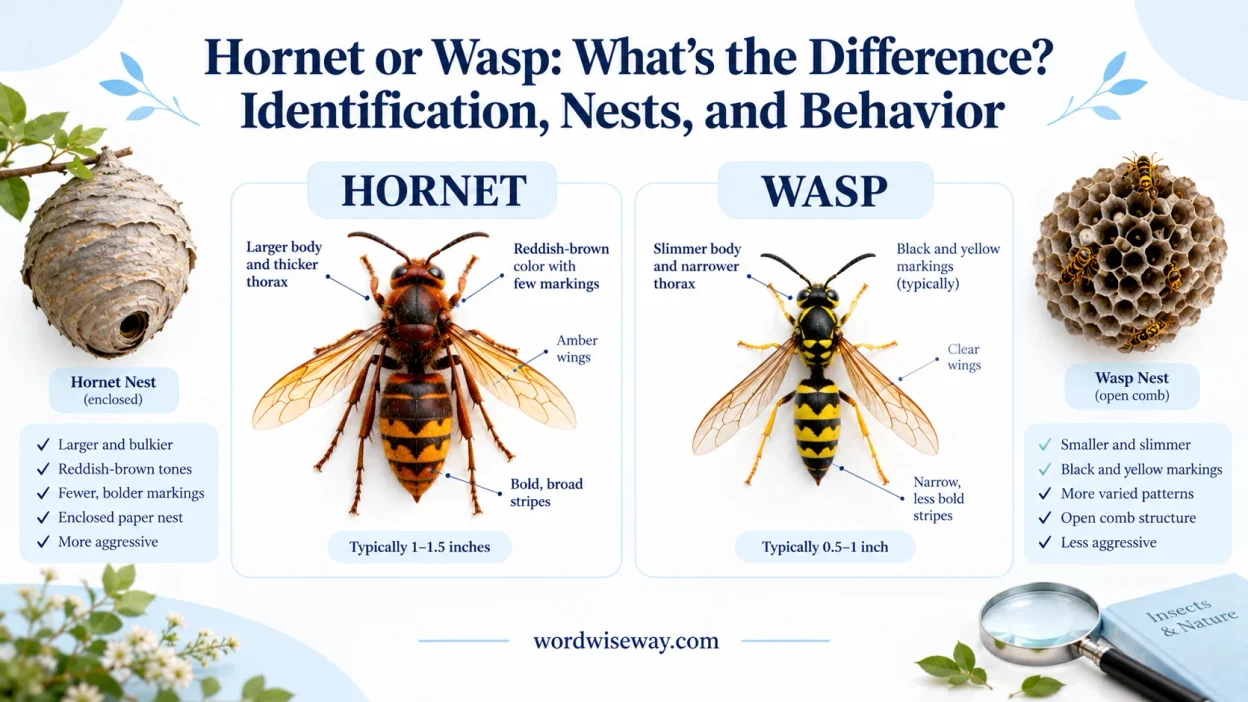
When a large flying insect appears in your garden, Hornet or Wasp: Difference, Identification, Nests, and Behavior helps explain the difference.
Its yellow-and-black bodies, buzzing flight, and painful stings may make these insects seem similar, causing confusion over whether you have seen a hornet or wasp. Proper identification requires more than size or color because a hornet is technically a type of wasp.
To tell apart different species, you can identify their physical characteristics, behavior, and nests while keeping a safe distance. A nest near your home may raise concerns about danger, but careful observation can help you understand the distinction, meanings, origins, and proper use of these terms.
For a student, gardener, homeowner, or nature enthusiast, learning to distinguish a hornet from a wasp makes it easier to understand their role in nature. Common mistakes often happen when people judge an insect only by its appearance, while usage examples show how context can change the way you describe a species or nest.
These details also address frequently asked questions about how to identify these insects correctly and understand their behavior.
Quick Answer
Hornets are wasps, but not all wasps are hornets.
The term wasp refers to a broad group of insects within the order Hymenoptera. This group includes social wasps, solitary hunting wasps, parasitoid wasps, yellowjackets, paper wasps, and hornets.
Hornets generally belong to a narrower group of large social wasps. They often have sturdy bodies and build enclosed paper nests. Many hunt other insects to feed their developing young.
However, you shouldn’t identify an insect as a hornet simply because it’s large. Some wasps become surprisingly large, while some insects commonly called hornets aren’t technically true hornets.
“Size can give you a clue, but several characteristics tell the real story.”
For everyday identification, examine the insect’s body pattern, shape, nest, behavior, and location instead of relying on size alone.
Hornet vs. Wasp at a Glance
| Feature | Hornet | Wasp |
| Basic classification | A specific group of social wasps | Broad group containing many different species |
| Typical appearance | Often robust and relatively large | Extremely variable |
| Social behavior | Generally social | Social or solitary |
| Nest style | Often enclosed paper nests | Open combs, enclosed nests, underground nests, or individual burrows |
| Diet | Insects, fruit, sugary liquids, and other foods depending on species | Nectar, insects, spiders, fruit, and other foods depending on species |
| Colony behavior | Workers defend colonies | Depends on the species |
| Ecological role | Predator and occasional pollinator | Predator, pollinator, parasitoid, scavenger, or prey |
| Identification | Requires several features | Requires species or group-specific clues |
| Can sting? | Yes | Many species can sting |
| Sting repeatedly? | Social wasps can generally sting more than once | Many female wasps can sting repeatedly |
The biggest distinction isn’t simply hornet versus wasp. It’s specific group versus broad category.
What Is a Wasp?
A wasp is an insect belonging to the order Hymenoptera. Bees and ants also belong to this enormous insect order, although they differ in important ways.
Wasps typically have a noticeably narrow connection between the thorax and abdomen. This narrow waist gives many species their familiar sleek appearance.
Yet wasps don’t share one universal body design. Some are tiny and delicate. Others are large predators with powerful jaws. Some have bright yellow markings, while others appear almost entirely black.
Their lifestyles differ just as much.
Some wasps establish colonies containing queens and workers. Others spend most of their lives alone. A solitary female may construct a small nest, capture prey, lay an egg, and leave the developing offspring to complete the next stage of its life.
Social Wasps
Social wasps live in organized colonies. Depending on the species, these colonies may contain queens, workers, males, and developing reproductive individuals.
Paper wasps and yellowjackets are familiar examples. Many social species construct nests from paper-like material made by chewing wood fibers and mixing them with saliva.
The result can look surprisingly sophisticated. A nest may contain multiple layers, chambers, and protective outer coverings.
Solitary Wasps
Solitary wasps operate differently.
A female generally builds or selects a nesting site for her offspring without maintaining a large permanent colony. She may hunt insects or spiders, place prey in a nest chamber, and provide food for a developing larva.
These wasps often attract less attention than social species because they don’t have a large colony to defend.
Some solitary wasps even spend considerable time hunting pests that gardeners would rather not see.
What Is a Hornet?
A hornet is a type of social wasp. True hornets belong to the genus Vespa, which contains several large species.
Hornets typically have robust bodies compared with many slender wasps. Their colonies can also produce substantial paper nests with multiple layers of comb.
One important complication is common naming.
In North America, the insect commonly called the bald-faced hornet isn’t a true hornet in the genus Vespa. It’s a social wasp classified in the genus Dolichovespula. Its common name stuck because of its hornet-like appearance and nesting behavior.
That example shows why common names can be tricky. A familiar name doesn’t always reveal an insect’s precise biological classification.
True Hornets
True hornets are generally larger social wasps that belong to Vespa.
They hunt other insects and can also consume sugary substances. Adults may visit fruit, tree sap, or other carbohydrate-rich food sources.
Their colonies are temporary in temperate climates. A queen typically survives the winter, establishes a new colony during the warmer season, and produces workers that gradually expand the nest.
Bald-Faced Hornets
Bald-faced hornets deserve special mention because their name creates so much confusion.
They have predominantly dark bodies with distinctive white markings on the face and abdomen. Their nests are enclosed, grayish paper structures that often hang from trees, shrubs, buildings, or other elevated locations.
Despite the name, they’re social wasps rather than true hornets.
How to Tell a Hornet From a Wasp
Identification becomes much easier when you stop searching for one magic feature.
Body Size
Many hornets are larger and more heavily built than common paper wasps. Some true hornets can reach roughly 1.5 inches in length, depending on the species and caste.
However, size isn’t a reliable standalone test.
Queens are usually larger than workers. Some other wasp species also reach impressive sizes. A large insect therefore deserves closer inspection rather than an automatic hornet label.
Body Shape
Hornets often look stockier through the thorax and abdomen.
Many paper wasps have a more elongated appearance. Their legs may also hang noticeably beneath the body while they’re flying.
Look at the entire insect rather than concentrating on the abdomen. The waist, thorax, head, wings, and legs can collectively provide stronger clues.
Color and Markings
Color can help narrow down the possibilities.
Common patterns include:
- Black and yellow
- Black and orange
- Reddish-brown and black
- Black and white
- Mostly dark brown
- Dark bodies with reddish sections
A bald-faced hornet’s white facial markings are particularly useful for recognition.
Still, color alone can mislead you. Different wasp groups can share similar color patterns, especially yellow-and-black combinations.
Wings and Legs
Wasps have two pairs of wings, although the forewings and hindwings connect during flight and can look like one pair.
Their legs also provide useful visual clues. Paper wasps often fly with their long legs dangling below the body.
These details become more useful when combined with body shape and nest architecture.
Nest Structure
The nest may be one of your strongest identification clues.
Social wasps create several distinct nest designs. Some hang from branches. Others occupy wall cavities or underground spaces. Some expose their combs beneath sheltered surfaces.
Hornets commonly create enclosed paper nests.
The architecture isn’t merely decorative. It reflects how the colony protects developing larvae from weather, predators, and other threats.
Nests
The nest often tells a more interesting story than the insect itself.
Hornet Nests
Many hornets construct enclosed paper nests.
These nests can contain multiple layers surrounding internal combs. The outer envelope provides protection while workers maintain the colony inside.
A mature nest may become surprisingly large because workers continually expand the colony as the season progresses.
You might find such nests:
- In trees
- On branches
- Around structures
- Inside sheltered spaces
- Near rooflines
- In wall cavities, depending on the species
An active nest deserves distance. The workers aren’t defending a piece of architecture. They’re defending their colony and developing offspring.
Wasp Nests
Wasp nests come in far more designs.
Paper wasps commonly build an open comb containing individual cells. The comb may hang beneath eaves, porch ceilings, railings, or other sheltered surfaces.
Yellowjackets may build nests underground or inside cavities. Some species also use spaces within buildings.
Solitary wasps can construct small individual nests in soil, wood, hollow stems, or other suitable locations.
| Nest appearance | Possible group |
| Large enclosed paper structure | Hornets or other aerial social wasps |
| Open umbrella-like comb | Paper wasps |
| Underground entrance | Some yellowjackets or solitary wasps |
| Small individual soil burrow | Solitary wasps |
| Nest inside a wall cavity | Some social wasps |
Nest appearance provides valuable evidence, but it doesn’t guarantee species identification by itself.
Behavior
Behavior can separate two visually similar insects when appearance fails.
Are Hornets More Aggressive?
The idea that every hornet is automatically “more aggressive” oversimplifies wasp behavior.
Social wasps generally become most defensive when someone approaches or disturbs their nest. A wasp feeding on a flower behaves differently from a worker defending a colony.
That distinction matters.
A solitary wasp may spend much of its time hunting prey and show little interest in people. A social colony located beside a doorway presents a different situation because repeated human activity can bring people close to the nest.
When Are Wasps Most Defensive?
Nest defense is the major reason social wasps can become difficult to approach.
Workers detect movement and vibrations around the colony. When they perceive a threat, they may respond defensively.
Disturbing a nest, blocking an entrance, hitting the structure, or attempting to handle individual insects can increase the risk of stings.
The safest approach is simple: don’t provoke an active colony.
Why Do Hornets and Wasps Sting?
Stinging serves as a defensive weapon in many social wasps.
A worker doesn’t need to sting simply because a person walks nearby. Problems become more likely when the insect feels threatened or when someone approaches its nest.
Female wasps possess the structures associated with stinging because the stinger evolved from an egg-laying organ.
That biological detail also explains why male wasps don’t sting.
What Do Hornets and Wasps Eat?
Their diets reveal why these insects matter in ecosystems.
Hornet Diet
Hornets are active predators.
Workers capture insects and other small prey, often chewing them before feeding the processed food to developing larvae.
Adults also need carbohydrates. They may consume:
- Fruit juices
- Nectar
- Tree sap
- Honeydew
- Other sugary substances
The colony therefore operates like a small biological supply chain. Workers gather protein for larvae while adults also seek carbohydrate-rich food for energy.
Wasp Diet
Wasps display even greater dietary diversity.
Depending on the species, they may consume:
- Nectar
- Fruit
- Sugary liquids
- Caterpillars
- Flies
- Spiders
- Other insects
- Honeydew
- Carrion or discarded food
Some parasitoid wasps have an especially unusual relationship with other insects. Their larvae develop by using another arthropod as a host.
That sounds harsh from a human perspective, but it’s a highly important natural control mechanism.
Hornets and Wasps in the Ecosystem
Calling every wasp a pest misses half the story.
Natural Pest Control
Predatory wasps can remove large numbers of insects from an ecosystem.
Hornets and other social wasps may hunt caterpillars, flies, and other insects. Solitary wasps can specialize in particular prey groups.
For gardens and agricultural environments, this predatory behavior can reduce populations of insects that damage plants.
Pollination
Wasps also visit flowers.
They aren’t generally as specialized for pollen transport as bees, yet some species transfer pollen while feeding on nectar.
Certain plants even have highly specialized relationships with particular wasps. These partnerships demonstrate how deeply some insects are woven into plant reproduction.
Parasitoid Wasps
Parasitoid wasps form one of the most ecologically significant wasp groups.
Instead of simply eating prey, a parasitoid female uses another insect or arthropod as a host for her developing offspring.
Many parasitoid wasps target specific pest species. Their presence can therefore help regulate insect populations naturally.
Which One Is More Dangerous?
There’s no universal answer based solely on the label.
Species, nest location, behavior, and human proximity matter more than the words “hornet” or “wasp.”
A solitary wasp flying around a garden may pose little concern. A large social colony directly beside a frequently used doorway deserves much more caution.
Individual reactions also vary. A sting can produce localized pain and swelling, while some people experience severe allergic reactions.
The practical lesson is straightforward:
- Don’t handle unfamiliar stinging insects.
- Don’t disturb active nests.
- Keep children and pets away from visible colonies.
- Give insects room when they’re repeatedly entering or leaving one location.
- Seek appropriate professional help when a colony occupies a hazardous location.
The danger isn’t determined by size alone. Context changes everything.
Common Mistakes
Mistaking Yellowjackets for Hornets
Yellowjackets often create confusion because they’re social wasps with bold yellow-and-black markings.
People may call them hornets because they’re defensive and can form large colonies. However, yellowjackets belong to different wasp groups.
The distinction becomes easier when you consider the insect’s markings, body shape, nesting behavior, and location together.
Mistaking Bees for Wasps
Bees and wasps can look remarkably similar at first glance.
A useful clue is body hair. Many bees appear fuzzier because pollen collection and related adaptations favor hairy bodies.
Wasps often have smoother, shinier bodies.
Still, nature doesn’t follow a simple cartoon color code. Some bees and wasps share similar yellow-and-black patterns.
Mistaking Hover Flies for Wasps
Hover flies can imitate wasp coloration remarkably well.
There’s an important anatomical clue, though: flies have one pair of functional wings, while wasps have two pairs.
Hover flies may also hover in one spot with unusual precision. Their large eyes can provide another useful clue.
Hornet or Wasp Identification From a Photo
A photograph can help, especially when it captures the insect clearly.
Start with the location. Then examine several characteristics.
Check the Body
Look for:
- Overall body length
- Body thickness
- Waist shape
- Head markings
- Abdomen pattern
- Leg length
- Wing appearance
Check the Nest
If a nest appears in the photograph, examine its structure without approaching it.
Ask:
- Is the nest enclosed?
- Is the comb exposed?
- Does it hang from a branch?
- Is it underground?
- Does it appear to enter a wall?
- Does it have a smooth paper envelope?
These observations can narrow the possibilities considerably.
Check the Behavior
Watch from a safe distance.
Repeatedly entering and leaving one opening suggests a nesting site. Searching flowers suggests foraging. Hunting other insects provides another behavioral clue.
No single observation guarantees identification. Several clues working together create a much stronger conclusion.
Hornet vs. Wasp by Nest Location
| Location | Possible group | What to look for |
| Tree branches | Hornets and aerial social wasps | Enclosed paper nest |
| Under eaves | Paper wasps and other social wasps | Open comb or sheltered nest |
| Underground | Yellowjackets and solitary wasps | Colony entrance or individual burrows |
| Wall cavities | Some social wasps | Repeated insect traffic through one opening |
| Shrubs | Several wasp groups | Nest architecture and insect behavior |
| Flowers | Many wasps and solitary species | Usually foraging behavior |
Location narrows the field. It doesn’t identify the insect by itself.
Life Cycle
The annual cycle of social wasps becomes especially interesting in temperate climates.
Spring
A surviving queen emerges after winter and searches for a suitable nesting location.
She begins constructing the first portion of the nest and lays eggs. Once the first workers mature, they take over many tasks.
The colony can then grow rapidly.
Summer
Summer brings the colony’s busiest period.
Workers forage for protein and carbohydrates, expand the nest, care for larvae, and defend the colony.
As the population increases, activity around the nest can become much more noticeable.
Late Summer and Fall
The colony shifts toward reproduction.
Instead of producing only workers, the colony invests more resources in future reproductive individuals.
Food availability also influences behavior. Species that frequently seek sugary foods may become particularly noticeable around ripe fruit, outdoor meals, garbage, and other food sources.
Winter
In many temperate social wasp species, the original colony doesn’t survive the winter.
New reproductive queens overwinter and establish colonies during the following warm season.
This seasonal cycle explains why a nest can appear suddenly in spring and become substantially larger several months later.
Beneficial or Harmful?
The answer depends on where the insect is and what it’s doing.
Benefits
Hornets and wasps can provide several ecological services:
- Natural pest control
- Predation on insects
- Pollination
- Food for other animals
- Population regulation within ecosystems
- Specialized relationships with plants and insects
A wasp hunting caterpillars in a garden isn’t necessarily a problem. It may actually be helping protect the plants.
Potential Problems
Social wasps can become a genuine nuisance when they establish colonies near people.
Potential problems include:
- Nests near doors or walkways
- Colonies inside building cavities
- Defensive behavior around frequently used spaces
- Insects attracted to food and waste
- Stings caused by accidental encounters
The important distinction is this: an insect can be ecologically beneficial and still require caution.
When Should You Leave a Nest Alone?
If an active nest sits far from normal human activity, the safest option may be to leave it undisturbed.
Observe it from a distance. Don’t poke it, spray it, shake it, or block its entrance.
A nest becomes more concerning when it’s located somewhere people regularly pass, such as:
- Near a doorway
- Above a walkway
- Beside a children’s play area
- Near outdoor seating
- Inside a wall
- Near a frequently used entrance
- In another location where accidental contact is likely
When a colony occupies a hazardous location, professional pest management can provide a safer solution than attempting to remove it yourself.
A Practical Identification Checklist
When you’re trying to identify an unfamiliar insect, use this quick checklist:
- Estimate its size.
- Look at its body shape.
- Study its color and markings.
- Check whether the body looks smooth or noticeably hairy.
- Observe its wings and legs.
- Look for a nearby nest from a safe distance.
- Study the nest’s architecture.
- Notice where the insect repeatedly travels.
- Watch whether it’s foraging, hunting, or defending a colony.
- Compare several characteristics before assigning a name.
This approach prevents one of the most common identification errors: deciding what an insect is based on a single visual feature.
Read More: Jinx or Jynx: Correct Spelling, Meaning, and Usage
FAQs
What is the main difference between a hornet and a wasp?
A hornet is a type of wasp, while wasp is a broader term covering many related species. Hornets are generally larger and more robust.
How can you tell a hornet apart from a wasp?
Compare the insect’s size, body shape, coloring, behavior, and nesting habits. Color alone isn’t always enough for reliable identification.
Are hornets bigger than wasps?
Generally, yes. Hornets tend to have larger, more robust bodies, although the size of different wasp species can overlap.
Do hornets and wasps both sting?
Yes. Both can sting when threatened. Many species can sting repeatedly because their stingers usually remain intact.
What does a hornet nest look like?
Many hornet nests have a papery, enclosed structure. Their exact appearance varies according to the species and nesting location.
Where do wasps build their nests?
Wasps may build nests underground, in trees, under roofs, inside wall cavities, or on buildings, depending on the species.
Are hornets dangerous around homes?
They can become a safety concern when they establish a nest close to frequently used areas. It’s best to keep your distance from an active nest.
Are wasps useful to the environment?
Yes. Wasps can control insect populations, pollinate plants, and contribute to food webs, making them important parts of many ecosystems.
What should you do if you find a hornet or wasp nest?
Don’t disturb the nest or approach it closely. If it’s located near a busy area, consider contacting a qualified pest professional.
Why do people confuse hornets and wasps?
Their similar body shapes, colors, wings, buzzing flight, and stinging behavior can make them difficult to distinguish at first glance.
Conclusion
Understanding the difference between a hornet or wasp becomes much easier when you look beyond color and size. Hornets are a type of wasp, but their larger, sturdier bodies, nesting habits, and behavior can help separate them from other wasp species. Instead of relying on one visual clue, consider several characteristics together for more dependable identification.
Nests provide another useful clue, although their appearance can vary greatly between species. Whether you’re a gardener, homeowner, student, or simply curious about insects, observing from a safe distance is the sensible approach when you discover an unfamiliar nest. Hornets and wasps can defend their colonies when disturbed, so curiosity should never turn into unnecessary contact.
Despite their reputation for stinging, these insects have an important place in nature. They can prey on other insects, contribute to pollination, and form part of complex food webs. Once you understand their differences, behavior, and ecological role, the next buzzing visitor in your garden becomes less of a mystery and more of an interesting piece of the natural world.

Emma Smith has dedicated 14 years to Princeton University’s English Department, mentoring students in textual interpretation, literary movements, and critical frameworks. Her research explores Shakespearean drama, Victorian serial fiction, postcolonial narrative theory, and manuscript studies and probing how literary forms evolve across cultures and centuries. Emma has delivered lectures at international humanities congresses and published findings in distinguished academic journals, underscoring her commitment to scholarly depth and vibrant teaching.