If you’ve ever hesitated while wondering, “Is it privilege or priviledge?” you’re not alone.
Privilege vs Priviledge: Correct Meaning and Common Mistakes is a common spelling issue, especially when typing quickly. The correct spelling is privilege, while priviledge is incorrect.
The confusion often happens because privilege may sound as though it contains an extra d. However, the correct form has no d between the i and l. Privilege refers to a special right, advantage, or immunity given to a person, group, or profession.
I became more aware of this mistake while proofreading an important document. It showed me how a small spelling error can affect the overall quality and credibility of written communication. Whether you’re writing an academic assignment, business document, or online content, choosing the correct spelling matters.
A simple way to remember it is to focus on privilege rather than how the word sounds. Regular practice can make the correct spelling easier to recall and help you avoid priviledge in your writing.
Once you recognize the pattern, this common error becomes much easier to catch.
Quick Answer
- Correct spelling: Privilege ✔️
- Incorrect spelling: Priviledge ❌
- Meaning: A special right, advantage, benefit, or immunity given to a person or group.
- Easy memory tip: Remember “lege”, not “ledge.” Think of legal advantage.
- Example: “It is a privilege to represent the organization.”
The Correct Spelling Explained Clearly
The English language has many tricky words, but this one is especially sneaky.
The correct form is:
- Privilege ✔️
The incorrect form is:
- Priviledge ❌
Even though “priviledge” looks natural to many eyes, it does not exist in standard dictionaries or formal writing systems.
Why this mistake is so common
People often assume English spelling follows pronunciation. That’s where things go wrong. When you say privilege quickly, it almost sounds like there is a soft “d” sound in the middle.
But English spelling is not fully phonetic. It often preserves historical roots rather than modern pronunciation.
So your brain tries to “fix” the spelling… and accidentally creates an error.
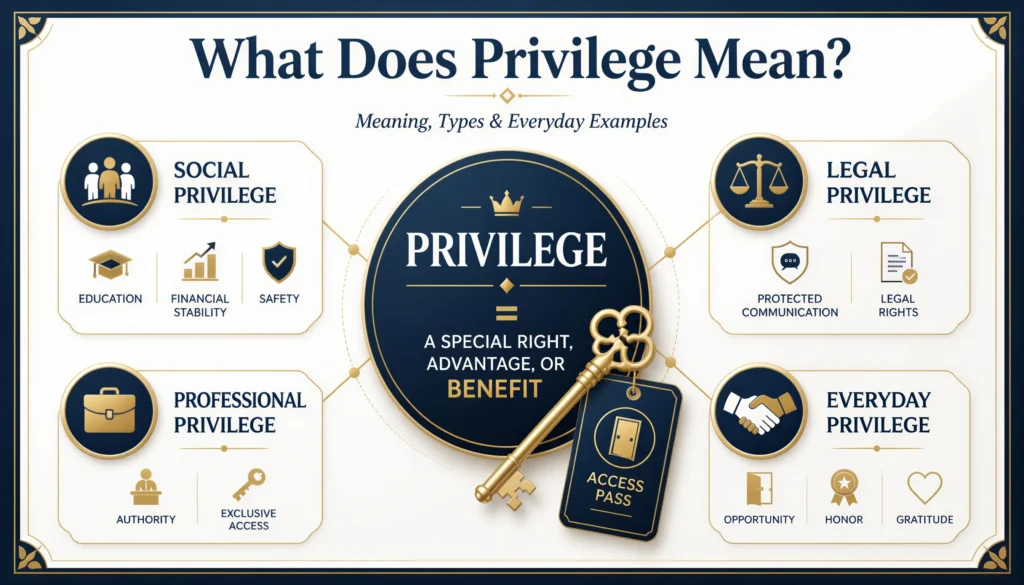
What Does Privilege Mean? A Simple but Deep Explanation
Before worrying about spelling, it helps to understand what the word actually means.
Privilege means:
A special right, advantage, or benefit given to a person or group.
But that definition only scratches the surface. In real life, the word stretches across different areas.
Social privilege
This refers to advantages people have based on circumstances they did not choose.
Examples:
- Access to better education
- Financial stability
- Safer environments
Legal privilege
In law, privilege means protected communication or rights.
Examples:
- Attorney-client privilege
- Doctor-patient confidentiality in some contexts
Professional privilege
This refers to exclusive access or authority in a job or role.
Examples:
- Government officials having certain immunities
- Doctors performing specific procedures
Everyday privilege
This is the casual use of the word.
Examples:
- “It’s a privilege to meet you.”
- “We don’t take this opportunity for granted.”
Read More: Challenge or Challange: Spelling, Meaning, and Usage
Why People Write “Priviledge” Instead of “Privilege”
This mistake is not random. It follows patterns in how people think and type.
Let’s break it down.
1. Sound-based spelling confusion
English pronunciation often tricks the ear.
“Privilege” is pronounced:
- PRIV-uh-lij
That soft ending makes people imagine a hidden “d” sound.
2. Influence of similar words
Your brain compares patterns automatically.
Words like:
- knowledge
- courage
- village
- bridge
All contain a “dge” sound, so your brain tries to apply the same logic.
3. Fast typing errors
When typing quickly:
- fingers anticipate patterns
- autocorrect doesn’t always catch subtle mistakes
So “priviledge” slips through unnoticed.
4. Mislearning from informal writing
On social media, mistakes spread quickly. If you see an incorrect spelling often enough, your brain starts accepting it as normal.
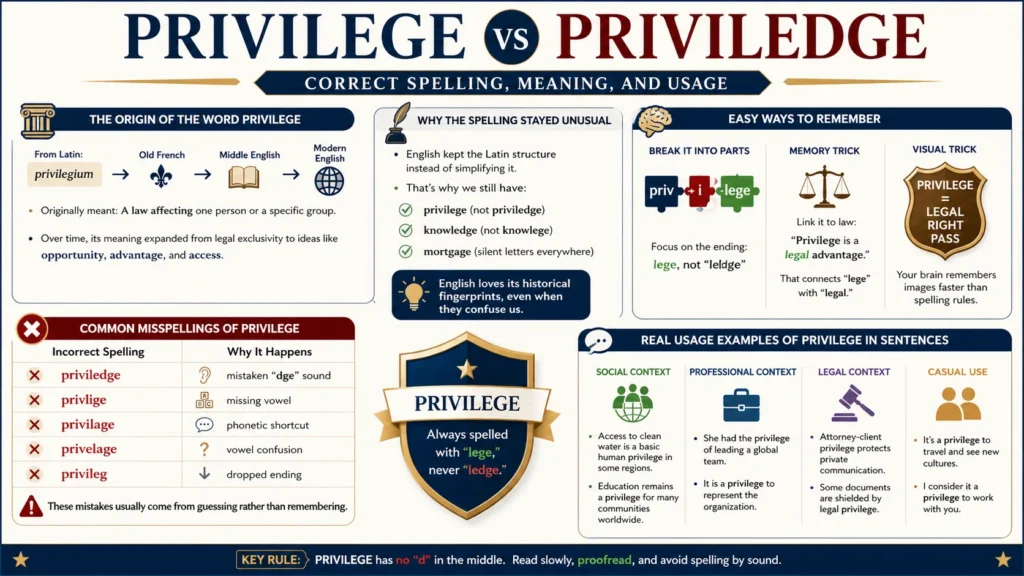
The Origin of the Word Privilege
Understanding history makes spelling easier to remember.
The word privilege comes from Latin:
- privilegium
It originally meant:
A law affecting one person or a specific group
It entered English through Old French before becoming part of Middle English vocabulary.
Over time, its meaning expanded from legal exclusivity to broader ideas like opportunity, advantage, and access.
Why the spelling stayed unusual
English kept the Latin structure instead of simplifying it.
That’s why we still have:
- privilege (not priviledge)
- knowledge (not knowlege)
- mortgage (silent letters everywhere)
English loves its historical fingerprints, even when they confuse us.
Easy Ways to Remember the Correct Spelling of Privilege
Let’s make this simple and sticky.
Break it into parts
Think of it like this:
- priv + i + lege
Now focus on the ending:
- lege, not “ledge”
Memory trick
Link it to law:
“Privilege is a legal advantage.”
That connects “lege” with “legal.”
Visual trick
Picture a badge labeled:
PRIVILEGE = LEGAL RIGHT PASS
Your brain remembers images faster than spelling rules.
Common Misspellings of Privilege
Here are the most frequent errors people make:
| Incorrect spelling | Why it happens |
| priviledge | mistaken “dge” sound |
| privlige | missing vowel |
| privilage | phonetic shortcut |
| privelage | vowel confusion |
| privileg | dropped ending |
These mistakes usually come from guessing rather than remembering.
Real Usage Examples of Privilege in Sentences
Let’s see how the word actually works in real life.
Social context
- Access to clean water is a basic human privilege in some regions.
- Education remains a privilege for many communities worldwide.
Professional context
- She had the privilege of leading a global team.
- It is a privilege to represent the organization.
Legal context
- Attorney-client privilege protects private communication.
- Some documents are shielded by legal privilege.
Casual use
- It’s a privilege to travel and see new cultures.
- I consider it a privilege to work with you.
Privilege vs Right vs Advantage: Clear Comparison
These words often get mixed up, but they are not the same.
| Word | Meaning | Example |
| Privilege | Special benefit not guaranteed to everyone | Access to VIP services |
| Right | Something legally or morally guaranteed | Freedom of speech |
| Advantage | A favorable condition | Being taller in basketball |
Key difference
- A right is guaranteed
- A privilege can be granted or removed
- An advantage depends on situation
This difference matters in law, education, and social discussions.
Why Correct Spelling of Privilege Matters
Spelling might look small, but it affects perception more than people realize.
Professional credibility
Incorrect spelling can:
- reduce trust
- weaken resumes
- make emails look careless
Academic impact
Teachers often mark spelling errors strictly, especially in formal essays.
First impressions
A single word can shape how polished your writing feels.
A Short Case Study: Why One Letter Matters
Imagine two job applications:
Candidate A writes:
“I understand the privilage of working in your company.”
Candidate B writes:
“I understand the privilege of working in your company.”
Even if both candidates are equally skilled, Candidate B immediately looks more careful and professional.
That tiny missing “e” quietly changes perception.
Quick Grammar Tips for Using Privilege Correctly
- Always check the ending: “-lege”
- Don’t rely only on autocorrect
- Read the word slowly when unsure
- Use it in sentences to reinforce memory
- Avoid guessing spelling based on sound
My Personal Experience
Working with written material has taught me that small details can make a noticeable difference. During my editing work, I often encountered terms that looked familiar but were easy to type incorrectly. While working on Privilege vs Priviledge, I became more attentive to pronunciation, spelling patterns, and word structure. This experience helped me understand why certain forms can confuse even careful writers.
Over time, I developed a careful approach to reviewing articles, assignments, and digital content. I learned to check uncertain terms, examine their structure, and consider their meaning before approving them. This strengthened my editing skills, improved my accuracy, and taught me that consistent practice and careful reading are essential for producing polished English.
Key Insights
- The correct spelling is privilege, while priviledge is a common but incorrect variation.
- The main confusion comes from pronunciation, since the spoken form can make an extra d seem natural. English spelling does not always follow sound exactly.
- Privilege describes a special right, advantage, or benefit available to a particular person or group. Its meaning can change slightly depending on social, legal, professional, or everyday use.
- The word has a long linguistic history and comes from the Latin privilegium. Its historical structure helps explain why the modern spelling does not include a d.
- A useful way to remember the spelling is to divide it into priv + i + lege. Pay special attention to lege, rather than imagining an ending based on “ledge.”
- Using privilege accurately matters in academic and professional settings because repeated spelling mistakes can make otherwise strong writing appear less polished.
- The distinction between a right, privilege, and advantage is also important. A right is generally guaranteed, a privilege can be granted or removed, and an advantage depends on the circumstances.
Practice: Privilege vs Priviledge
Choose the Correct Spelling
Fill in each blank with privilege or priviledge:
- It was a ________ to work with the team.
- Education should not be treated as a ________ for only a few people.
- She considers it a ________ to represent her organization.
- The sentence contains the incorrect spelling “________.”
- Access to certain services may be considered a ________.
Correct the Mistakes
Rewrite each sentence using the correct spelling:
- It was a great priviledge to meet the author.
- He enjoyed the priviledge of leading the project.
- The writer accidentally used priviledge in the report.
Quick Memory Check
Remember: privilege = priv + i + lege.
The ending is “lege,” not “ledge.”
Answer Key:
- privilege
- privilege
- privilege
- priviledge
- privilege
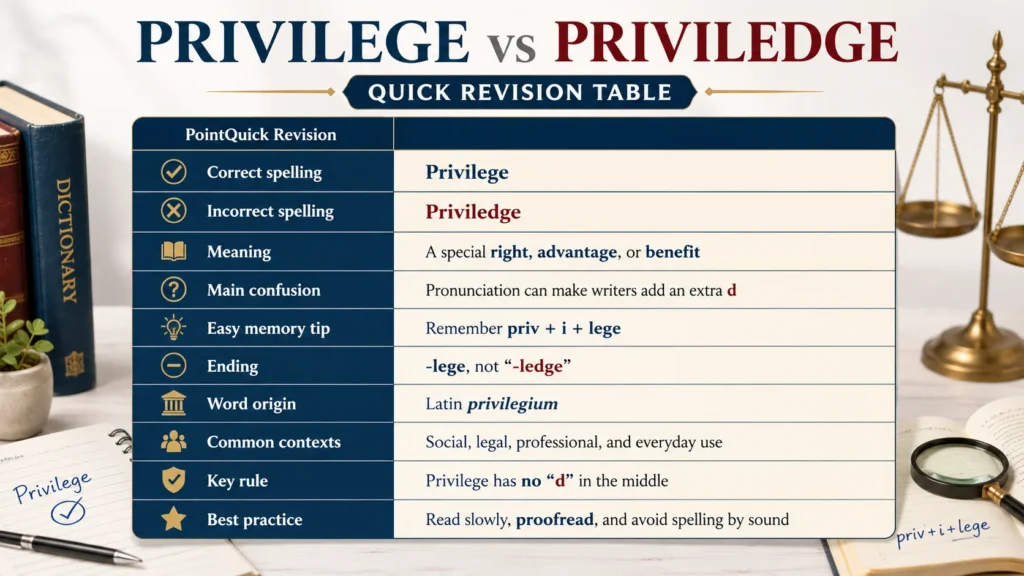
Quick Revision Table
| Point | Quick Revision |
|---|---|
| Correct spelling | Privilege |
| Incorrect spelling | Priviledge |
| Meaning | A special right, advantage, or benefit |
| Main confusion | Pronunciation can make writers add an extra d |
| Easy memory tip | Remember priv + i + lege |
| Ending | -lege, not “-ledge” |
| Word origin | Latin privilegium |
| Common contexts | Social, legal, professional, and everyday use |
| Key rule | Privilege has no “d” in the middle |
| Best practice | Read slowly, proofread, and avoid spelling by sound |
Frequently Asked Questions
1. Is “priviledge” ever correct in English?
No, “priviledge” is never correct. It is a common misspelling. The only accepted spelling in standard English is privilege.
2. Why do so many people add a “d” to privilege?
The confusion happens because of the way the word is spoken phonetically. The last syllable sounds exactly like the English word “ledge,” leading writers to assume it is spelled the same way.
3. What is the actual definition of privilege?
It refers to a special advantage, right, immunity, or benefit given to a specific person, group, or profession that is not available to everyone.
4. Is privilege a noun or a verb?
It can be both. As a noun, it means a special advantage (e.g., “It is a privilege to be here”). As a verb, it means to grant an advantage to someone (e.g., “The system tends to privilege certain groups”).
5. How can I remember not to use the letter “d”?
A simple memory trick is to think of the rule: “Privilege has no d because it is a special right, not a physical ledge.” You can also look at the silent pattern of the two ‘i’s and two ‘e’s (p-r-i-v-i-l-e-g-e).
6. Does this spelling error affect search visibility?
Yes. If you type the incorrect form in important online text, headers, or a search query, it can affect your content’s visibility, search engine rankings, and your professional credibility.
7. Is misspelling common in professional writing?
Unfortunately, yes. This tiny spelling trap frequently catches students, professionals, and even experienced writers off guard in emails, assignments, and business communication.
8. Does the word privilege come from Latin?
Yes. Its underlying semantic history comes from the Latin privilegium, meaning a law applies to a private individual (privus “private” + lex “law”). There is no “d” in its historical root.
9. What are some common synonyms for privilege?
Common synonyms include advantage, benefit, right, immunity, prerogative, and honor.
10. How do I permanently stop making this mistake?
By practicing daily, proofreading your important document drafts carefully, and learning how to remember the spelling using visual cues rather than relying purely on how it sounds phonetically.
Conclusion
Mastering the distinction between privilege and its common misspelling is a small but powerful step toward achieving flawless written communication. Because the English language frequently features a silent pattern that doesn’t quite match how words are spoken phonetically, it is easy for even experienced writers to fall into this tiny spelling trap.
However, by learning how to remember the underlying root of the word and using practical memory tricks, you can ensure this error never hurts your professional credibility again. Taking the time to proofread your important document drafts and practicing daily will help you permanently eliminate the mistake, ensuring your academic work, business emails, and overall writing quality always remain exceptionally sharp.

Amelia Sanders has spent 14 years in Harvard University’s English Department, helping students navigate literary analysis, interpretive theory, and narrative techniques. Her academic pursuits center on 18th-century British prose, romantic poetry, diasporic writing, and digital editing exploring how textual choices influence cultural perspectives. Amelia has spoken at major international meetings and contributed essays to respected academic volumes, demonstrating her dedication to thoughtful scholarship and effective teaching.