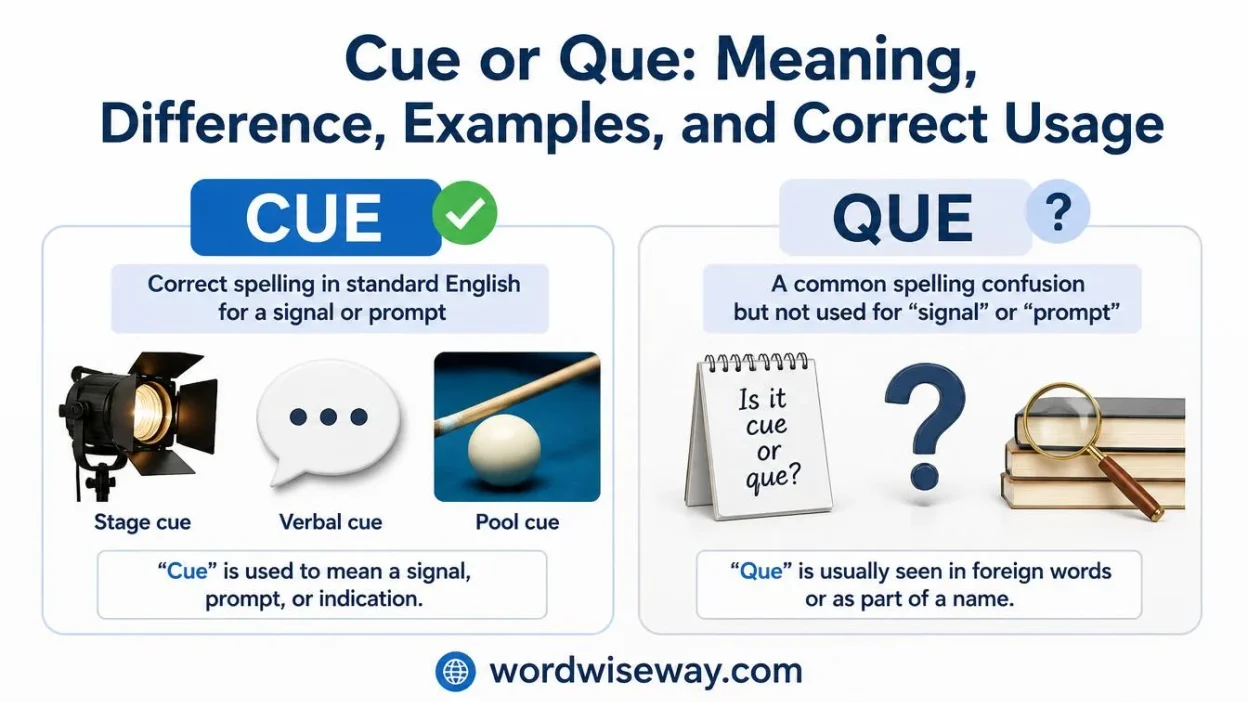
Cue or Que: Meaning, Difference, and Correct Usage can confuse English learners and writers because these words look similar and sound almost the same. Yet their meaning, difference, and uses vary.
A cue is a signal or prompt that guides someone, while a queue means a line or sequence of people waiting their turn. Que is usually the wrong version in standard English usage.
This confusion often appears in conversation, emails, school work, social media posts, and professional writing. Learning the correct usage, appropriate spellings, origins, British usage, and American usage helps prevent common mistakes and spelling errors while improving writing accuracy in everyday communication.
Quick Answer:
Cue is the standard English spelling when you mean a signal, prompt, hint, or billiards stick.
Que isn’t normally the spelling you want for those meanings in standard English. If you mean a line of people or vehicles waiting their turn, the correct word is queue.
| Word | Main meaning | Example |
| Cue | A signal or prompt | The bell was my cue to leave. |
| Cue | A billiards or pool stick | He picked up the cue. |
| Queue | A line or waiting sequence | We joined the queue for tickets. |
| Que | Usually not the intended standard-English spelling | Check whether you mean cue or queue. |
So, when you’re choosing between cue or que, use cue for a signal or prompt. If you’re talking about a waiting line, use queue.
What Does “Cue” Mean?
The word cue has several established meanings, but they share an important idea: something prompts an action or serves a specific function.
As a noun, cue can mean a signal that tells someone when to speak, move, perform, or react. It can also refer to a stick used in games such as pool and billiards. As a verb, cue means to give someone a signal or prepare something to happen at the right moment.
Cue as a Signal or Prompt
A cue is often a signal that tells someone what to do next.
Actors rely on cues throughout performances. A line from another actor, a movement, a sound effect, or a lighting change can signal that it’s time to speak or enter the stage.
However, the word isn’t limited to theater.
You might use cue in ordinary situations when an event gives you a reason or signal to act.
Examples:
- The teacher’s closing the book was our cue to pack up.
- The sudden silence was his cue to stop talking.
- When the lights dimmed, that was my cue to leave.
- Her smile was a cue that everything was going well.
- The final bell gave the students their cue to leave.
In each example, something triggers an action. That’s the central idea behind this meaning of cue.
Cue as a Hint or Sign
A cue can also be a subtle sign that helps you understand what to do or how to respond.
For example, imagine you’re talking to someone and they repeatedly glance at the clock. That behavior might be your cue that the conversation needs to end.
Here, the cue doesn’t have to be an official instruction. It can be a gesture, expression, sound, event, or other signal.
Examples:
- His worried expression was a cue that something had gone wrong.
- The dark clouds were a cue to bring the clothes inside.
- Her hesitation gave me a cue that she wasn’t convinced.
This meaning overlaps with words such as hint, signal, sign, and prompt, although those words aren’t interchangeable in every sentence.
Cue as a Billiards or Pool Stick
In billiards and pool, a cue is the long, tapered stick used to strike the ball.
This meaning has nothing to do with giving someone a signal. It’s simply another established meaning of the same spelling.
Examples:
- He carefully chalked the cue before taking his shot.
- She held the cue steady against the table.
- The player selected a lighter cue for the game.
So if you’re writing about pool, billiards, or a related game, cue is the correct spelling.
What Does “Cue” Mean as a Verb?
Cue also works as a verb. In this form, it means to give someone a signal or prompt them to perform an action.
The verb commonly appears when one person signals another person.
Examples:
- The director cued the actor to enter.
- She cued the musicians to begin.
- The stage manager cued the lights.
- He cued me when it was time to speak.
You can also see cue up, which means to prepare something so it can begin at the appropriate moment.
For example:
Cue up the next song.
In this sentence, the speaker wants the next song prepared for playback.
Cue, Cued, and Cueing
The main forms are:
- Cue: present form
- Cues: third-person singular
- Cued: past tense and past participle
- Cueing: present participle
Examples:
- The director cues the actors.
- She cued the music.
- He is cueing the next performer.
You’ll also encounter cueing and cuing in English usage. Cueing is a particularly clear form because it keeps the connection to the base word visible.
What Does “Que” Mean?
Here’s where the spelling maze gets interesting.
In standard modern English, que generally isn’t the form you should use when you mean a signal, prompt, or billiards stick. Those meanings take cue.
That doesn’t mean the letter sequence que can never appear in written language. You may encounter it in names, borrowed expressions, abbreviations, or words from other languages. Context determines what such an occurrence means.
The important point for an English spelling question is simple:
Don’t use “que” as a casual replacement for “cue.”
For example:
- ❌ The ringing phone was my que to leave.
- ✅ The ringing phone was my cue to leave.
And:
- ❌ The director gave me my que.
- ✅ The director gave me my cue.
The spelling que often appears because writers hear the /kjuː/ sound and choose letters that resemble another familiar spelling. English has plenty of these traps.
Cue vs. Queue: The Bigger Spelling Trap
Although the question is cue or que, many writers actually have a third word in mind: queue.
That’s the word you need when you’re talking about a line of people, vehicles, or things waiting for their turn.
For example:
- We waited in the queue for tickets.
- A long queue formed outside the store.
- Several cars were stuck in the queue.
- The website placed my request in a processing queue.
In American English, line is generally more common for people waiting their turn. Queue remains a valid English word, especially in computing and in contexts influenced by British English.
What Does “Queue” Mean?
A queue is a sequence in which people or things wait for service, processing, access, or another action.
The word has an important technical meaning, too.
In computing, a queue is an ordered collection of items waiting to be processed. Jobs, messages, print requests, or other data can enter a queue and wait until a system handles them.
That gives you another useful distinction:
- Cue = a signal that prompts an action.
- Queue = a line or ordered set waiting for action.
The two words sound alike, but their meanings point in completely different directions.
Cue vs. Queue vs. Que
Putting all three spellings side by side makes the difference much easier to remember.
| Spelling | Standard use | Meaning | Example |
| Cue | Yes | Signal, prompt, hint, or billiards stick | That was my cue to leave. |
| Queue | Yes | Line or sequence waiting its turn | We stood in the queue. |
| Que | Not normally as a substitute for cue | Usually a mistaken spelling in this context | ❌ My que to leave |
There’s a useful mental shortcut here:
Cue tells you what to do. Queue tells you where to wait.
That one distinction solves most everyday confusion.
Common Phrases With “Cue”
The word cue appears in several familiar expressions. Learning these phrases gives you a better feel for its natural usage.
On Cue
On cue means something happens at exactly the expected or appropriate moment.
Example:
The speaker mentioned rain and, right on cue, thunder sounded outside.
The phrase often creates a sense of perfect timing.
Take Your Cue From
To take your cue from someone or something means to observe it and use that behavior or information as guidance for your own action.
Example:
She took her cue from the manager and ended the meeting.
The person doesn’t necessarily receive a spoken command. Instead, they interpret a signal and respond accordingly.
Cue Someone In
To cue someone in means to give them information or let them know what’s happening.
Example:
Please cue me in before the meeting starts.
Here, cue in has developed from the broader idea of giving someone the information or signal needed to respond.
Cue Up
To cue up something means to prepare it so it can start at the appropriate point.
Examples:
- Cue up the presentation.
- She cued up the next track.
- The technician cued up the video before the event.
This expression commonly appears in media, performances, presentations, and everyday technology-related conversations.
Common Mistakes
The easiest way to eliminate these errors is to identify the meaning before choosing the spelling.
Mistake: Writing “Que” for a Signal
Incorrect:
The bell was my que to leave.
Correct:
The bell was my cue to leave.
If something signals an action, choose cue.
Mistake: Writing “Cue” for a Waiting Line
Incorrect:
We stood in the cue for an hour.
Correct:
We stood in the queue for an hour.
In American English, you could also naturally write:
We stood in line for an hour.
Mistake: Assuming Similar Sounds Mean Similar Meanings
Homophones create spelling traps because your ears can’t always distinguish the words.
Cue and queue are pronounced alike in standard English. That means context has to determine the spelling.
This is why proofreading by sound alone doesn’t work well with homophones. You need to ask what the word means in the sentence.
How to Choose the Right Word
When you’re stuck between cue or que, don’t guess from pronunciation. Use the sentence’s meaning.
Follow this quick guide:
- Does it mean a signal or prompt? → Cue
- Does it mean a hint or sign? → Cue
- Does it mean a pool or billiards stick? → Cue
- Does it mean a line of people waiting? → Queue
- Does it mean an ordered set of computer tasks? → Queue
- Are you considering “que” as an alternative spelling? → Usually choose cue or queue, depending on the meaning.
A Simple Memory Trick
Think of cue as something that calls for an action.
A director gives an actor a cue. A bell gives students a cue. A gesture can provide a cue.
Now think of queue as a waiting line.
People wait in a queue. Computer tasks wait in a queue.
The extra letters in queue may look excessive, but they help distinguish the word visually from cue.
Cue or Que in Real-World Sentences
Context becomes especially useful when several similar words appear together.
Theater Example
The actor waited for her cue before walking onto the stage.
Here, cue means a signal to begin an action.
Everyday Example
The empty parking lot was our cue to look for another place.
Again, the word describes a signal that prompted a decision.
Waiting-Line Example
Hundreds of shoppers formed a queue outside the store.
Here, queue describes people waiting their turn.
Computing Example
The print job entered the queue before the printer processed it.
The word describes an ordered set of tasks waiting to be handled.
Billiards Example
He picked up his cue and carefully lined up the shot.
Here, cue means the stick used to strike the ball.
These examples reveal why spelling matters. One small letter pattern can completely redirect the meaning.
Cue or Queue: A Quick Comparison
| Feature | Cue | Queue |
| Pronunciation | /kjuː/ | /kjuː/ |
| Signal or prompt | ✓ | ✗ |
| Hint or sign | ✓ | ✗ |
| Billiards stick | ✓ | ✗ |
| Waiting line | ✗ | ✓ |
| Computer waiting sequence | ✗ | ✓ |
| Common American word for a waiting line | No | Less common than line |
| Verb form | cue someone | queue something or queue up |
The pronunciation is the deceptive part. The meanings are not.
Why Do Cue and Queue Sound the Same?
English spelling carries a long history of words borrowed and reshaped from different languages. Cue and queue eventually developed distinct spellings while retaining the same pronunciation.
The modern spellings therefore don’t behave like a neat phonics exercise. English has many cases where pronunciation alone can’t tell you which written word belongs in a sentence.
That matters when you’re proofreading.
If you hear:
“That’s my cue.”
you can’t determine the spelling from sound alone. The meaning supplies the missing information.
This is why homophone awareness matters in formal writing, schoolwork, business communication, and web content.
Read More: Belive or Believe: Correct Spelling,Meaning, and Usage
FAQs
Is “cue” the correct spelling?
Yes. Cue is the correct spelling when you mean a signal, prompt, or indication that tells someone what to do or say next.
Is “que” a correct English word?
Que is generally not the standard English spelling for cue or queue. Using it in place of either word is usually a spelling mistake.
What is the difference between cue and queue?
A cue is a signal or prompt, while a queue is a line or sequence of people or things waiting for their turn. Their meanings are completely different.
Does “cue” mean a signal?
Yes. A cue can be a signal that prompts someone to act, speak, begin, stop, or respond. For example, an actor may wait for a cue before delivering a line.
Does “queue” mean a line?
Yes. Queue commonly means a line of people waiting for something. It can also describe items or tasks arranged in a particular order.
Why do people confuse cue, que, and queue?
People often confuse these words because cue and queue have the same pronunciation in standard English. When someone hears the word rather than sees it written, choosing the spelling can become tricky.
Is “que” short for “queue”?
No, not in standard English. Queue is the full standard spelling. Writing que as a shortened form can cause confusion and should generally be avoided in formal writing.
Are cue and queue pronounced the same?
Yes. Cue and queue are pronounced the same in standard English, even though their spellings and meanings differ.
Should I use cue or queue in professional writing?
Use cue when you mean a signal or prompt, and queue when you mean a waiting line or ordered sequence. Choosing the right word keeps professional writing clear and accurate.
How can I remember when to use cue or queue?
Think of cue as a signal that tells you what comes next, while queue involves people, tasks, or things waiting in order. This simple distinction can help you avoid the common “que” spelling mistake.
Conclusion
Understanding cue, que, and queue becomes much easier once you separate their meanings instead of relying on how they sound. Cue refers to a signal or prompt, while queue describes a line or an ordered sequence. Que is generally not the standard spelling for either word.
This small spelling difference can matter in emails, school work, professional writing, and everyday communication. Using the correct word makes your writing clearer and helps you avoid common spelling mistakes. When you remember the meaning behind each term, choosing the right spelling becomes far less confusing.
The easiest rule is simple: use cue for a signal and queue for a line or sequence. If you pause for a moment and consider what you actually mean, you’ll usually spot the correct choice immediately. That habit can sharpen your writing accuracy and prevent the same confusion from returning.

Emma Smith has dedicated 14 years to Princeton University’s English Department, mentoring students in textual interpretation, literary movements, and critical frameworks. Her research explores Shakespearean drama, Victorian serial fiction, postcolonial narrative theory, and manuscript studies and probing how literary forms evolve across cultures and centuries. Emma has delivered lectures at international humanities congresses and published findings in distinguished academic journals, underscoring her commitment to scholarly depth and vibrant teaching.