Illinois’s or Illinois’ or Illinoises? Correct Possessive Form depends on grammar rules and style-guide preferences. Illinois is a singular proper noun ending in s. Many style guides accept Illinois’s, while others prefer Illinois’. However, Illinoises isn’t the standard possessive form for the state.
When writing about Illinois’s economy or Illinois’ policies, check your chosen style guide. Both possessive forms can be acceptable, depending on the writing style. Consistency matters in formal writing, academic content, reports, emails, and professional documents.
To choose correctly, identify the noun, review apostrophe placement, and follow the relevant writing conventions. These simple steps improve grammatical correctness, clarity, and writing accuracy. Whether you’re preparing business documents or academic materials, consistent possessive usage makes your writing easier to understand.
Quick Answer:
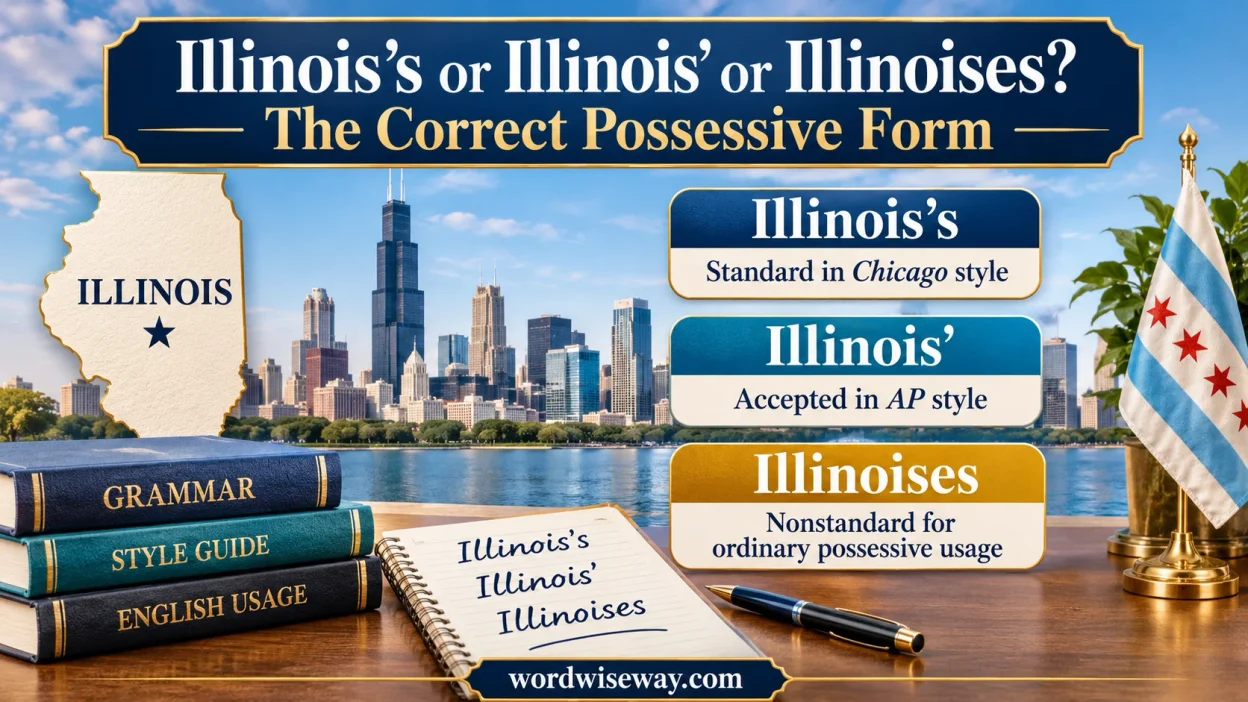
Illinois’s is the standard singular possessive form under the Chicago Manual of Style. Illinois’ is an accepted alternative under conventions such as Associated Press style. Illinoises isn’t the standard possessive form.
| Form | Correct Usage | Explanation |
| Illinois’s | Yes | Standard under Chicago style |
| Illinois’ | Yes, under certain style guides | Accepted under AP-style conventions |
| Illinoises | No, for ordinary possessive usage | Doesn’t form the standard possessive of Illinois |
Examples:
- Illinois’s economy continues to support a diverse range of industries.
- Illinois’ economy continues to support a diverse range of industries.
- Illinoises economy is not the standard construction.
The first two examples express the same general relationship. Choose the form that matches your style requirements and use it consistently.
Is Illinois’s Correct?
Yes. Illinois’s is a grammatically accepted possessive form. Writers use it to show ownership, association, or a relationship involving the state of Illinois.
The name Illinois ends in s, but that final letter doesn’t prevent you from adding ’s. Under the Chicago style convention, singular proper nouns ending in s generally form their possessives by adding an apostrophe and another s.
Consider these examples:
- Illinois’s history reflects centuries of cultural and economic change.
- Illinois’s government operates from the state capital, Springfield.
- Illinois’s agricultural industry plays an important role in its economy.
- Illinois’s transportation network connects major cities across the Midwest.
- Illinois’s universities serve students from communities throughout the state.
Each sentence uses Illinois’s to connect the state with a particular subject.
When to Use Illinois’s
Use Illinois’s when your chosen style guide calls for the apostrophe-plus-s construction. This form works well in general nonfiction, books, academic writing, and many professional documents that follow Chicago style.
For example, imagine you’re writing an article about the state’s education system. You might write:
“Illinois’s public universities serve students from communities across the state.”
The possessive form connects Illinois with its public universities. It doesn’t mean the state literally owns every institution. Possessives can express association, responsibility, origin, and other relationships.
Here are a few more examples:
- Illinois’s population includes people from many cultural backgrounds.
- Illinois’s laws establish requirements for state agencies.
- Illinois’s history includes important developments in transportation.
- Illinois’s economy depends on several industries, including agriculture and manufacturing.
Remember: A singular name ending in s can take ’s. The final letter doesn’t automatically require an apostrophe alone.
Is Illinois’ Correct?
Yes. Illinois’ is an accepted possessive form under style conventions that use only an apostrophe after singular proper names ending in s. AP-style conventions generally follow this approach.
For example:
- Illinois’ economy supports a range of industries.
- Illinois’ government oversees statewide public services.
- Illinois’ agricultural sector contributes to the regional economy.
- Illinois’ history includes important developments in American transportation.
- Illinois’ universities provide educational opportunities across the state.
These examples use Illinois’ to express a relationship between the state and a particular subject.
When to Use Illinois’
Choose Illinois’ when your publication, instructor, or organization follows a style guide that requires the apostrophe-only construction.
This form often appears in journalism and institutional writing that follows AP conventions. However, don’t assume every newspaper, university, or website follows the same rules.
Imagine you’re writing a news report about a new state policy. If your publication uses AP style, Illinois’ new policy may fit its editorial requirements.
The key is consistency. If you begin with Illinois’ economy, don’t switch to Illinois’s economy later without a clear editorial reason.
One important distinction: Illinois’ isn’t automatically a grammatical mistake because it lacks a second s. Its acceptability depends on the style convention you’re following.
Is Illinoises Correct?
No. Illinoises isn’t the standard possessive form of Illinois. Adding -es doesn’t create the ordinary possessive form of this state’s name.
To understand why, separate two grammatical ideas: pluralization and possession.
- Pluralization indicates more than one person, place, or thing.
- Possession indicates ownership, association, or another relationship between nouns.
The name Illinois identifies one US state. In ordinary writing, you don’t add -es to create a plural form when referring to that state.
Illinoises vs. Illinois’s: Examples of Correct Usage
Compare the following sentences to see the difference.
| Incorrect or Nonstandard | Correct Form |
| Illinoises economy is growing. | Illinois’s economy is growing. |
| Illinoises government announced the policy. | Illinois’ government announced the policy. |
| Illinoises history attracts researchers. | Illinois’s history attracts researchers. |
| Illinoises universities serve many students. | Illinois’ universities serve many students. |
The corrected examples use accepted possessive constructions. Choose one according to your style guide.
There’s a small but important detail here: Illinoises could theoretically appear in a specialized discussion involving multiple hypothetical entities with that name. However, that unusual context doesn’t make it a normal possessive form.
For everyday writing about the state, avoid it.
Key Differences
The easiest way to remember these forms is to focus on what each one does in a sentence.
| Form | Grammatical Role | Example | Verdict |
| Illinois’s | Singular possessive | Illinois’s economy | Correct under Chicago style |
| Illinois’ | Singular possessive | Illinois’ economy | Correct under apostrophe-only conventions |
| Illinoises | Not the standard possessive | Illinoises economy | Incorrect for ordinary possessive usage |
Both Illinois’s and Illinois’ communicate the same general relationship. Their main difference lies in editorial style rather than meaning.
Consider these examples:
- Chicago-style convention: Illinois’s transportation system serves communities throughout the state.
- AP-style convention: Illinois’ transportation system serves communities throughout the state.
Both sentences communicate the same idea. The punctuation changes because the style rules differ.
How to Choose the Right Form
Use this simple decision process when editing your writing:
- Check your required style guide. Your instructor, publisher, or employer may already specify a convention.
- Use Illinois’s for Chicago style. This follows the standard rule for singular possessives ending in s.
- Use Illinois’ when your style guide requires it. AP-style conventions generally use the apostrophe alone for singular proper names ending in s.
- Avoid Illinoises as a possessive. It doesn’t follow either standard construction.
- Keep your choice consistent. Apply the same rule throughout your article or document.
When no style guide applies, Illinois’s is a reliable default because it follows the widely used apostrophe-plus-s rule for singular possessives.
How to Make Proper Nouns Ending in S Possessive
Illinois isn’t the only name that raises this question. Writers often encounter the same issue with personal names, state names, cities, and other proper nouns.
The challenge is simple: English style guides don’t always agree on how to form possessives when a singular name already ends in s.
The Apostrophe-Plus-S Rule
Under this convention, add an apostrophe and another s to a singular name ending in s.
Examples include:
- James’s book
- Charles’s office
- Kansas’s history
- Texas’s economy
- Illinois’s government
This approach is common in Chicago-style writing. The original name stays intact, and the added ’s marks the possessive relationship.
For example, James’s book means a book associated with James. Similarly, Kansas’s history refers to the history of Kansas.
This rule can make possessive forms easier to recognize because the added ending clearly signals the relationship between the nouns.
The Apostrophe-Only Rule
The alternative convention adds only an apostrophe after certain singular proper names ending in s.
Examples include:
- James’ book
- Charles’ office
- Kansas’ history
- Texas’ economy
- Illinois’ government
AP-style conventions generally follow this pattern for singular proper names ending in s.
Writers who use this convention don’t necessarily consider the apostrophe-plus-s version wrong. They’re following a different editorial rule.
For this reason, avoid declaring one form universally incorrect. The relevant style guide determines which form fits the document.
Does the Rule Change for Plural Nouns?
Yes. Plural nouns generally follow a different pattern.
When a regular plural noun already ends in s, writers usually add only an apostrophe to make it possessive.
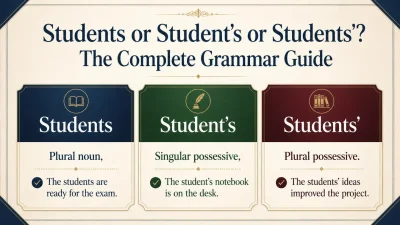
| Singular | Singular Possessive | Plural | Plural Possessive |
| Student | Student’s | Students | Students’ |
| Teacher | Teacher’s | Teachers | Teachers’ |
| School | School’s | Schools | Schools’ |
For example:
- The student’s assignment needs revision.
- The students’ assignments need revision.
The first sentence refers to one student. The second refers to multiple students.
This distinction explains why Illinois’ can resemble a plural possessive even though it refers to one state. In this case, the spelling reflects a style convention for proper names, not the number of states.
Common Mistakes
Even experienced writers can hesitate over apostrophes. Most mistakes happen when people apply one rule without checking the grammatical context.
Confusing Possession With Pluralization
The most common mistake is treating Illinoises as the possessive of Illinois.
Incorrect: Illinoises education system faces several challenges.
Correct: Illinois’s education system faces several challenges.
The apostrophe and s in Illinois’s form the possessive under the Chicago convention. Adding -es doesn’t accomplish the same thing.
Assuming Illinois’ Is Always Wrong
Some writers believe every singular possessive ending in s must include another s after the apostrophe.
That rule isn’t universal. AP-style conventions use an apostrophe alone for singular proper names ending in s. Therefore, Illinois’ can be correct in publications that follow that convention.
The better approach is to check the required style rather than judge the form in isolation.
Switching Between Illinois’s and Illinois’
Inconsistent punctuation can distract readers and make an article look poorly edited.
For example:
“Illinois’s economy is diverse. Illinois’ agricultural industry remains important.”
The sentences aren’t necessarily grammatically incompatible, but switching conventions without a reason creates inconsistency.
Better approach: Select one style before drafting or editing. Then apply it to every relevant possessive form.
Forgetting the Apostrophe
Another mistake is writing Illinoiss economy or Illinois economy when the sentence specifically requires a possessive construction.
The first form is incorrectly punctuated. The second may work as a descriptive phrase in some contexts, but it doesn’t always express the intended relationship clearly.
For example:
- Possessive: Illinois’s economy continues to develop.
- Descriptive: Illinois economic statistics appear in the report.
In the second example, the phrase could be revised to Illinois economic statistics or statistics about Illinois’s economy, depending on the intended meaning.
Treating Every Name Ending in S the Same Way
Not all names and nouns follow identical editorial rules. Some style guides distinguish between singular proper names, regular plural nouns, and names that are plural in form.
For example, Chicago style uses Kansas’s for the singular state name but the United States’ because States is plural in form.
This distinction shows why the final letter alone doesn’t determine every possessive form. Grammar and the chosen style convention both matter.
Practical Examples:
Examples make the rule easier to apply when you’re writing real sentences.
| Context | Chicago-Style Example | Apostrophe-Only Example |
| Economy | Illinois’s economy is diverse. | Illinois’ economy is diverse. |
| Government | Illinois’s government announced the change. | Illinois’ government announced the change. |
| History | Illinois’s history attracts researchers. | Illinois’ history attracts researchers. |
| Agriculture | Illinois’s farms produce many crops. | Illinois’ farms produce many crops. |
| Education | Illinois’s universities serve students statewide. | Illinois’ universities serve students statewide. |
Both columns illustrate the same possessive relationship. The difference is the editorial convention used.
A Short Editing Case Study
Imagine you’re preparing a school essay about Illinois’s role in American agriculture.
Your first draft contains these sentences:
- Illinois’s agricultural industry supports many communities.
- Illinois’ farms produce corn and soybeans.
- Illinoises economy includes several major industries.
The first sentence follows the apostrophe-plus-s convention. The second follows the apostrophe-only convention. The third uses a nonstandard possessive form.
To make the paragraph consistent under Chicago style, revise the second sentence to Illinois’s farms produce corn and soybeans and correct the third to Illinois’s economy includes several major industries.
If your assignment instead requires AP style, you can use Illinois’ consistently in both possessive examples.
The lesson is straightforward: correct the nonstandard form first, then make the remaining forms consistent with your chosen style guide.
Read More: Froze or Frozen: Correct Spelling, Meaning, and Usage
FAQs
1. Is Illinois’s grammatically correct?
Yes, Illinois’s is grammatically correct. Many style guides recommend adding apostrophe + s to singular proper nouns, even when they already end in s.
2. Is Illinois’ also correct?
Yes, Illinois’ is also accepted by some style guides. The choice depends on the writing standard you follow and your preferred editorial convention.
3. Is Illinoises ever correct?
Illinoises is not the standard possessive form of Illinois. It may appear in unusual contexts when someone deliberately treats the name as a plural, but that usage is uncommon.
4. Should I write Illinois’s economy or Illinois’ economy?
Both forms are accepted in different style guides. Choose the version your organization or publication prefers, then use it consistently throughout your writing.
5. Why does Illinois’s have an extra s?
The extra s follows a common rule for singular possessive nouns. Writers add an apostrophe and s to show ownership or association, even when the name ends in s.
6. Does Illinois’ mean the same thing as Illinois’s?
Yes, both forms can express possession or association. For example, Illinois’ economy and Illinois’s economy refer to the economy associated with the state.
7. How do I make Illinois plural?
State names usually aren’t pluralized in ordinary writing. Illinois remains the name of the state, so you generally shouldn’t write Illinoises to refer to the state.
8. Which form should I use in academic writing?
Follow the style guide required by your school, instructor, or publisher. If no guide is specified, choose a widely accepted form and apply it consistently.
9. Do I need an apostrophe when writing Illinois policies?
Not necessarily. Illinois policies can describe policies associated with the state without using a possessive apostrophe. Use Illinois’s policies or Illinois’ policies when your sentence calls for a possessive construction.
10. What is the easiest way to remember the correct form?
Remember that Illinois’s and Illinois’ can both show possession, depending on the style guide. Illinoises is generally incorrect when referring to the state’s ownership or association.
Conclusion
Choosing between Illinois’s, Illinois’, and Illinoises becomes easier when you understand the basic possessive rules. Both Illinois’s and Illinois’ can show possession, although style guides differ in their preferences. Illinoises is not the standard possessive form when referring to the state of Illinois.
When writing about Illinois’s economy, Illinois’ policies, or other state-related topics, check your preferred style guide before making a final choice. This simple habit helps you maintain consistency in academic assignments, business documents, emails, and professional writing. Correct apostrophe placement also makes your sentences clearer and easier to understand.
Ultimately, good grammar comes down to understanding the noun, recognizing possession, and applying the appropriate writing conventions. You don’t need to memorize every style rule at once. Start by learning how singular proper nouns form possessives, then practice using the correct forms in everyday sentences. With consistent practice, you’ll make more confident and accurate writing decisions.

Emma Smith has dedicated 14 years to Princeton University’s English Department, mentoring students in textual interpretation, literary movements, and critical frameworks. Her research explores Shakespearean drama, Victorian serial fiction, postcolonial narrative theory, and manuscript studies and probing how literary forms evolve across cultures and centuries. Emma has delivered lectures at international humanities congresses and published findings in distinguished academic journals, underscoring her commitment to scholarly depth and vibrant teaching.