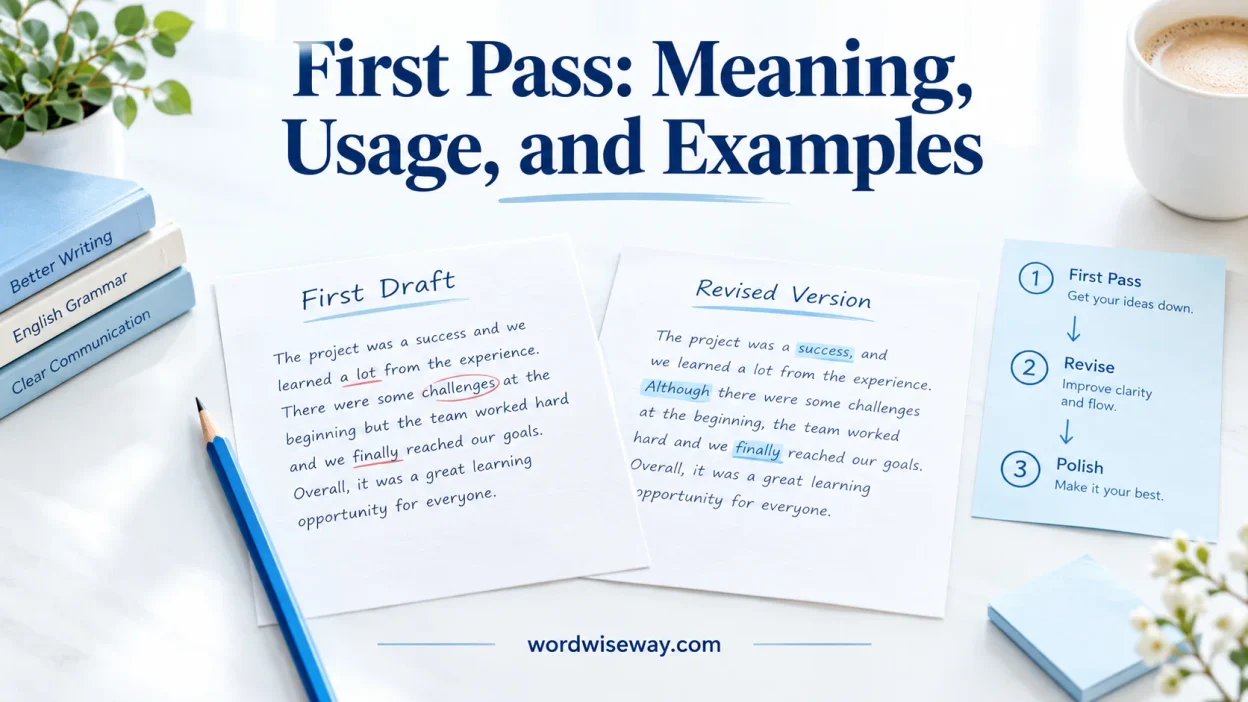
First Pass: Meaning, Usage, and Examples explains how this phrase describes an initial attempt, review, or stage of a process. You may have heard the term before, but do you know its exact meaning? Luckily, the basic concept is fairly easy to understand when you have the right information.
The phrase first pass often refers to the first attempt at completing a task before making improvements. For example, a writer might create a first draft and revise it after reviewing the work. Its meaning can change depending on the subject, context, and surrounding words. Understanding these details helps clarify its practical usage.
Recognizing appropriate contexts makes it easier to understand first pass meaning, first pass usage, and first pass examples. This knowledge also improves your contextual understanding and language usage. By learning the term’s definition, application, and interpretation, you can use the phrase correctly in different situations.
Quick Answer:
First pass means an initial attempt, preliminary review, or first stage of working through something. It usually describes an early version of a task that may need further review, correction, or improvement.
For example:
- “I made a first pass at the article.” This means the writer created an initial draft.
- “Let’s do a first pass through the data.” This means the team will examine the data initially.
- “The first pass looks good.” This means the initial version looks promising, although further changes might follow.
The expression is common in professional and casual English. Depending on the situation, it can refer to creating something, reviewing information, or making an initial decision.
What Does First Pass Mean in Different Contexts?
The phrase keeps the same central idea across different situations: starting with an initial attempt rather than a finished result. However, its precise meaning changes with the task.
First Pass in Writing and Editing
In writing, a first pass usually means the initial attempt at producing or revising a piece of content. A writer might focus on getting the main ideas onto the page before correcting every sentence.
For example, you could write a rough article introduction, organize the main sections, and add supporting examples. Later, you’d improve the wording, correct errors, and strengthen the structure.
Example sentences:
- “I’ll make a first pass at the introduction before lunch.”
- “My first pass at the blog post needs a stronger conclusion.”
- “The editor reviewed the first pass and suggested several changes.”
A first pass doesn’t have to be poor quality. It simply means the work hasn’t necessarily gone through every planned revision.
First Pass in Work and Business
In business, people use “first pass” to describe an initial review, assessment, or attempt to solve a problem.
Imagine a manager reviewing a project proposal. During the first pass, the manager checks its main objectives, budget, and timeline. A more detailed review might follow after the team addresses any major concerns.
Examples:
- “We’ll conduct a first pass on the applications this afternoon.”
- “The first pass identified three possible problems.”
- “Please prepare a first pass of the project plan for Monday.”
In these examples, the phrase signals that the work has begun but may not represent the final decision.
First Pass in Design and Creative Projects
Designers often use “first pass” when discussing an initial layout, illustration, website design, or other creative product.
Suppose you’re designing a homepage. Your first pass might establish the headline, navigation, color palette, and placement of major sections. After receiving feedback, you could adjust spacing, improve readability, and refine the visual hierarchy.
Examples:
- “Here’s my first pass at the homepage design.”
- “The first pass captures the overall concept.”
- “Let’s review the first pass before polishing the details.”
This usage is especially helpful when sharing early work with clients or teammates. It invites feedback without presenting the design as complete.
First Pass in Reading and Research
When reading a long report or studying unfamiliar material, a first pass means an initial examination intended to build a general understanding.
You might skim the headings, identify the main argument, and note important questions. A second review could focus on evidence, details, and difficult passages.
Examples:
- “I did a first pass through the report this morning.”
- “The first pass helped me identify the most important sections.”
- “Let’s make a first pass through the research before discussing the findings.”
Here, the expression emphasizes broad understanding rather than detailed analysis.
First Pass in Programming and Technical Work
In programming, a first pass often describes an initial implementation or preliminary solution. Developers may build a basic version first, then test it and improve its reliability, performance, or design.
For example, a developer creating a search feature might first implement the core search function. Later, the developer could handle unusual inputs, improve response times, and add more extensive tests.
Examples:
- “I’ve completed a first pass at the search function.”
- “The first pass works, but it needs additional testing.”
- “We’ll optimize the code after the initial implementation.”
The phrase doesn’t automatically mean the code is broken or unfinished in every respect. It indicates that the work is at an early stage of development.
How to Use First Pass in a Sentence
You can use “first pass” as a noun phrase in several common sentence patterns. The most natural choice depends on whether you’re creating something, reviewing it, or describing its current quality.
Make a First Pass at Something
Use this structure when describing an initial attempt at a task.
Examples:
- “I’ll make a first pass at the report tonight.”
- “She made a first pass at the new logo.”
- “We need to make a first pass at the budget before Friday.”
The word make emphasizes the act of beginning or attempting the work.
Take a First Pass at Something
This pattern also describes an initial attempt. It often sounds conversational and works well in collaborative settings.
Examples:
- “Can you take a first pass at the presentation?”
- “I’ll take a first pass at the email and send it over.”
- “The team took a first pass at the proposed changes.”
In these sentences, the speaker assigns or accepts an initial round of work. The task might later require another person’s input.
Do a First Pass Through Something
Use this construction when you mean an initial review or examination of material.
Examples:
- “I did a first pass through the spreadsheet.”
- “Let’s do a first pass through the applications.”
- “After a first pass through the notes, I found two missing details.”
The word through emphasizes moving across a collection of information or material.
On the First Pass
This expression describes what happens during an initial attempt or review.
Examples:
- “The answer wasn’t obvious on the first pass.”
- “I caught most of the errors on the first pass.”
- “The design looked promising on the first pass.”
Notice that this construction often describes the result of an initial review rather than the act of creating something.
Examples in Everyday English
The following examples show how the expression works in different situations.
| Context | Example sentence | Meaning |
| Writing | “My first pass at the essay is complete.” | The initial draft is ready. |
| Editing | “The first pass revealed several grammar errors.” | The initial review found mistakes. |
| Business | “We’ll screen the proposals in the first pass.” | The team will conduct an initial assessment. |
| Design | “This first pass needs a clearer headline.” | The initial design needs improvement. |
| Studying | “I understood the main idea on the first pass.” | The first reading provided a general understanding. |
| Programming | “The first pass handles basic user input.” | The initial implementation covers fundamental requirements. |
| Planning | “Let’s create a first pass of the schedule.” | The team will prepare an initial version. |
| Problem-solving | “Our first pass at the solution exposed a missing assumption.” | The initial attempt revealed a problem. |
| Hiring | “The first pass narrowed the applicant pool.” | An initial screening reduced the number of candidates. |
| Conversation | “I’ll give the proposal a first pass tonight.” | The speaker will review it initially. |
These examples share a common idea: the first pass establishes a starting point for further work or evaluation.
Is First Pass One Word or Two?
First pass is written as two words when used as the ordinary noun phrase.
Correct examples:
- “The first pass was successful.”
- “I’ll review the first pass tomorrow.”
- “We completed a first pass at the document.”
The phrase can also appear in the expression first-pass, with a hyphen, when it functions as a compound modifier before a noun. This form is common in technical and professional writing.
Examples:
- “We completed a first-pass review.”
- “The system performs first-pass screening.”
- “The team developed a first-pass estimate.”
A useful rule is to leave the phrase open when it functions as a noun and consider the hyphen when it directly modifies another noun. However, compound-modifier conventions can vary by style guide and context.
First Pass vs. First Draft
Although these expressions overlap, they don’t mean exactly the same thing.
A first draft is an initial written version of something, such as an essay, article, speech, or story. A first pass is broader. It can describe writing, but it can also refer to reviewing, evaluating, designing, or solving something.
| Expression | Main meaning | Example |
| First pass | An initial attempt or review | “I’ll take a first pass at the website layout.” |
| First draft | The initial written version | “I’ve finished the first draft of the article.” |
| Rough draft | An early version that may need substantial changes | “The rough draft still needs better organization.” |
| Final draft | A version prepared after revisions | “The final draft is ready for submission.” |
For example, you might make a first pass through a competitor’s article before writing your own first draft. The first pass is the review, while the first draft is the resulting written work.
First Pass vs. Initial Review
These expressions are closely related, but their emphasis differs.
An initial review specifically highlights an early examination of something. A first pass can describe that examination or the first attempt to create, organize, or solve something.
Consider these examples:
- “The manager completed an initial review of the proposal.” This emphasizes examining the proposal.
- “The manager took a first pass at the proposal.” This could mean reviewing it or preparing an initial version, depending on context.
If you want to be precise in formal writing, choose the expression that best describes the action. Use initial review when examination is the main activity. Use first pass when the work involves a broader initial attempt.
Synonyms
Several expressions can replace “first pass,” but each carries a slightly different emphasis.
| Synonym or alternative | Best use | Example |
| Initial attempt | Starting a task | “My initial attempt produced a workable result.” |
| Preliminary review | Examining something early | “The preliminary review identified missing information.” |
| First draft | Creating written content | “The first draft needs a stronger opening.” |
| Initial version | Describing early work | “The initial version includes the main features.” |
| Rough draft | Describing an early, unpolished text | “The rough draft needs further editing.” |
| Early assessment | Evaluating a situation | “The early assessment suggested a possible delay.” |
| Preliminary effort | Emphasizing an early attempt | “Our preliminary effort revealed several challenges.” |
| Initial screening | Filtering applications or candidates | “The initial screening identified qualified applicants.” |
Choose your synonym according to the task. If you’re discussing a website mockup, initial version may work well. If you’re describing an early examination of evidence, preliminary review might be more precise.
Common Mistakes
The phrase is easy to understand, but a few usage mistakes can make your writing less precise.
Treating Every First Pass as a Finished Product
A first pass is generally an initial attempt, not a guarantee that the work is complete or approved.
Less precise: “The first pass is final, so no changes are possible.”
Better: “The first pass is complete, but we’ll review it before approval.”
A first pass can occasionally meet every requirement. Still, the phrase itself doesn’t guarantee finality.
Using First Pass When You Mean First Draft
A first pass can refer to a draft, but it doesn’t always mean a written document.
Less precise: “The first pass is the final written article.”
Better: “The first draft contains the complete article, although it still needs editing.”
Use first draft when you specifically mean an initial written version.
Confusing First Pass With First Attempt Ever
The expression describes the initial attempt within a particular task or stage. It doesn’t necessarily mean you’ve never performed similar work before.
For example, an experienced designer can create a first pass at a new logo. The phrase refers to that project’s initial version, not the designer’s first experience with design.
Adding Unnecessary Hyphens
In ordinary noun usage, write first pass, not first-pass.
Correct: “The first pass looks promising.”
Correct: “The team completed a first-pass assessment.”
The second example uses a hyphen because the expression modifies assessment. Follow your preferred style guide when it specifies a different convention.
Read More: Fifteen Hundred or One Thousand Five Hundred: Which Is Correct?
FAQs
What does first pass mean?
A first pass is an initial attempt at a task, review, or process. It gives you a starting point before you make changes or improvements.
Is first pass one word or two words?
First pass is written as two separate words. The phrase usually describes an initial effort or review rather than a final result.
How do you use first pass in a sentence?
You can use first pass when describing an early attempt at something. For example, “My first pass at the report helped me identify areas that needed improvement.”
What is an example of a first pass in writing?
A writer’s first pass might involve drafting an article without perfecting every sentence. The writer can then review the draft, correct mistakes, and improve clarity.
Does first pass mean the final version?
No, a first pass usually isn’t the final version. It represents an early stage that may require further review, editing, or adjustments.
What is the difference between a first pass and a final review?
A first pass focuses on initial work or a preliminary assessment. A final review checks the completed work for remaining errors before submission or publication.
Can first pass describe a quick review?
Yes, first pass can describe an initial review of a document, project, or set of information. The depth of that review depends on the situation.
Is first pass used in professional settings?
Yes, professionals use the phrase in writing, software development, research, project management, and other fields. Its precise meaning depends on the task being discussed.
What does first pass mean in programming?
In programming, a first pass can refer to an initial stage of processing code or data. Some systems examine information in multiple passes to complete different operations.
What are some alternatives to the phrase first pass?
Depending on the context, alternatives include initial attempt, first draft, preliminary review, early assessment, and initial version. Choose the expression that best matches your intended meaning.
Conclusion
Understanding the first pass is easier when you consider the situation in which someone uses the phrase. It generally describes an initial attempt, early review, or preliminary stage before further work takes place. Whether you’re writing an article, reviewing a document, or working on a project, a first pass gives you a starting point for improvement.
The phrase doesn’t always mean the same thing in every field. Its interpretation depends on the task, subject, and surrounding words. For example, a writer might use a first pass to organize ideas, while a developer might use it to describe an early stage of processing. Recognizing these differences helps you understand its meaning and use it naturally.
Next time you encounter first pass, pay attention to the context rather than memorizing a single definition. Notice how people use it in everyday conversations and professional settings. With a few practical examples and regular exposure, you’ll find it easier to understand the phrase and apply it confidently in your own writing.

Evelyn Shaw has spent 14 years at Yale University’s English Department, leading students through close readings, genre studies, and interpretive methodologies. Her scholarly interests include Renaissance drama, gothic fiction, feminist literary criticism, and archival research and examining how texts generate meaning across historical periods. Evelyn has presented at major academic conferences and published essays in peer-reviewed journals, reflecting her passion for rigorous analysis and student-centered learning.