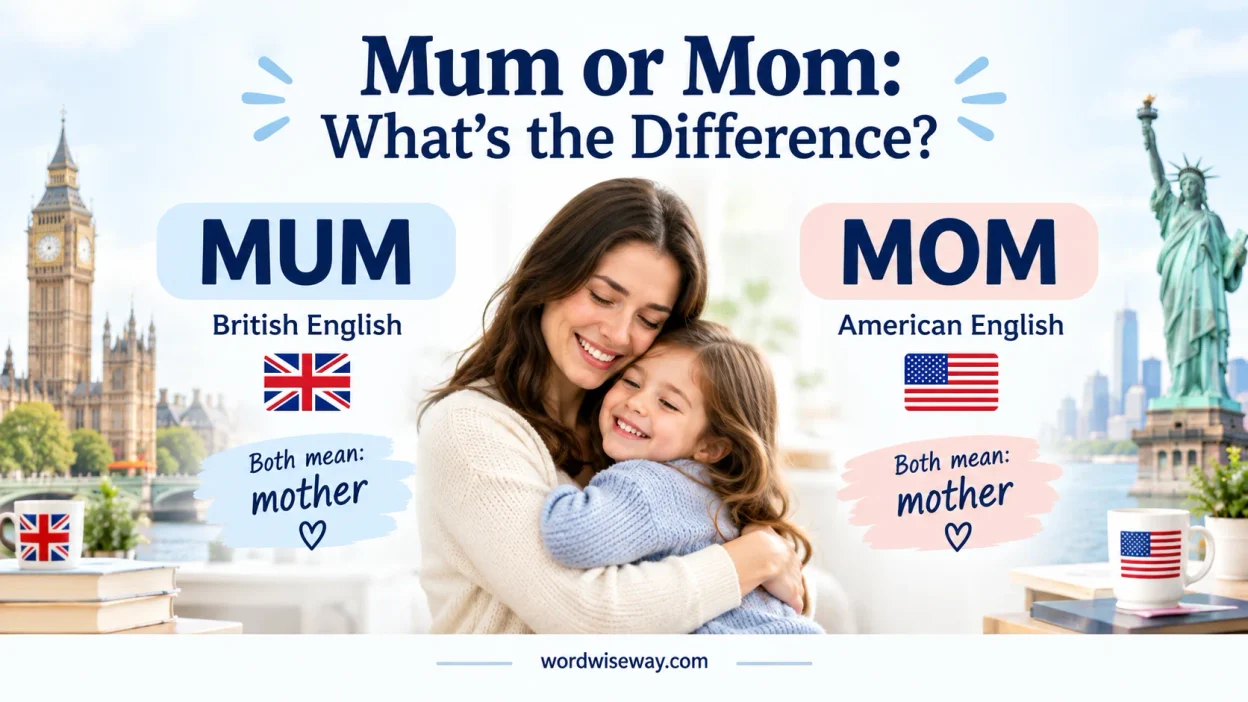
Mum or Mom: What’s the Difference? Both are correct spellings for the same informal word meaning mother, but the difference is regional. Americans usually write mom, while British, Australian, and Commonwealth speakers use mum.
In the United States, Canada, and American English, mom is standard. Mum is common in the UK, Australia, and New Zealand. Both words have identical functions grammatically, acting as nouns or informal address terms when you refer to or call your parent.
Your choice should match your audience and location. English learners can avoid confusion by understanding these regional differences. In international writing, American readers expect mom, while British readers expect mum. This makes your communication feel natural and appropriate.
Quick Answer:
Mom is the standard spelling for mother in American English, while mum is the standard spelling in British English. Both are informal terms for a female parent or a person’s mother.
| Word | Main Variety | Meaning | Example |
| Mom | American English | Mother | My mom called me yesterday. |
| Mum | British English | Mother | My mum called me yesterday. |
| Mother | All major varieties | Female parent | My mother called me yesterday. |
So, if you’re writing for readers in the United States, choose mom. If you’re following British English, choose mum.
The easiest rule is simple: American English uses mom; British English uses mum.
The Key Difference
The central difference between mum and mom is regional spelling and usage. They aren’t two words with different meanings when they refer to someone’s mother.
Cambridge Dictionary labels mom as a US informal term for mother and identifies mum as the UK informal equivalent.
That means a sentence such as:
My mom is coming to pick me up.
sounds natural in American English.
In British English, the corresponding sentence would be:
My mum is coming to pick me up.
The underlying meaning doesn’t change. Only the regional form does.
This is similar to other British-American differences such as color/colour, favorite/favourite, and center/centre. The spelling signals the variety of English being used.
What Does “Mom” Mean?
Mom is an informal American English word meaning mother. People use it in ordinary family conversations, writing, messages, school contexts, and direct address. Cambridge lists mom as a US informal noun meaning mother.
For example:
- My mom made dinner tonight.
- I asked my mom for permission.
- Mom, can you help me?
- My mom’s car is outside.
- Both moms attended the school event.
The word can work both as a common noun and as a form of direct address.
Notice the capitalization difference:
- I called my mom.
- Mom, can you come here?
When you’re using the word as a name or direct form of address, capitalization is normally appropriate.
Examples of “Mom”
Here are several natural examples:
Everyday statement:
My mom is at work today.
Possessive:
My mom’s phone is ringing.
Direct address:
Mom, where did you put my notebook?
Plural:
Several moms volunteered at the event.
General reference:
She became a mom at a young age.
These examples show why mom isn’t restricted to one grammatical pattern. Its function depends on how you use it in the sentence.
What Does “Mum” Mean?
Mum is the usual British English informal word for mother. Cambridge identifies it as the UK equivalent of American mom.
For example:
- My mum is making dinner.
- I called my mum after school.
- Mum, can you help me?
- My mum’s car is outside.
- The children’s mums were waiting nearby.
British English uses mum naturally in everyday family language. It isn’t a shortened form that British speakers use only in casual conversation with close relatives. It’s an established informal word.
Examples of “Mum”
Everyday statement:
My mum works at a local school.
Possessive:
My mum’s keys are on the table.
Direct address:
Mum, can you help me with this?
Plural:
The mums waited outside the classroom.
General reference:
She became a mum when she was young.
The spelling remains mum even though the meaning is the same as American mom.
Mum or Mom in American and British English
The clearest distinction appears when you compare American and British English directly.
American English: Mom
In American English, mom is the normal informal term for mother. Cambridge’s American and general English entries identify it as a US informal word.
American examples include:
- My mom is picking me up.
- I need to ask my mom first.
- Mom, look at this!
- My mom’s birthday is next week.
- Several moms joined the meeting.
Using mum in an otherwise American-English sentence may look unusual because readers generally expect mom.
British English: Mum
British English normally uses mum for the same relationship. Cambridge explicitly gives mum as the UK informal equivalent of mom.
British examples include:
- My mum is picking me up.
- I need to ask my mum first.
- Mum, look at this!
- My mum’s birthday is next week.
- Several mums joined the meeting.
Again, the meaning remains unchanged.
Other Varieties of English
English isn’t divided neatly into only two boxes. Other English-speaking regions can have their own preferences and local speech patterns.
Canada, Australia, and New Zealand, for example, have linguistic conventions that don’t always line up perfectly with either American or British usage. Individual families may also use a particular form because of personal preference, family background, or cultural influence.
For that reason, regional convention is a useful guide rather than an absolute law for every speaker.
Which One Should You Use?
Choose the spelling that matches your intended variety of English.
If you’re writing specifically for an American audience, use mom. If you’re writing in British English, use mum.
For example, an American blog might write:
Many moms look for practical ways to organize their children’s schedules.
A British publication would naturally write:
Many mums look for practical ways to organize their children’s schedules.
Neither sentence needs correction merely because it uses a different regional spelling.
A Simple Rule to Remember
- US English → mom
- UK English → mum
- Formal and neutral English → mother
Consistency matters most when you’re producing longer content. If an article follows American English, switching repeatedly between mom and mum can make the writing look inconsistent.
Mum vs. Mom in Formal Writing
Both mum and mom are informal terms. Mother is the more neutral or formal word.
Cambridge describes mother as the term for a female parent and notes that using mother as a form of address is more formal than using mum.
Consider these three sentences:
| Word | Example | Tone |
| Mother | My mother attended the meeting. | Neutral/formal |
| Mom | My mom attended the meeting. | Informal American |
| Mum | My mum attended the meeting. | Informal British |
The choice depends on the situation.
A personal email might naturally use mom or mum. A legal document, academic paper, or formal report may use mother when referring to a parent.
That doesn’t make mom or mum incorrect. It simply makes mother a better fit for more formal contexts.
Mom, Mum, Mummy, and Mommy: What’s the Difference?
Several English words refer to a mother, but they don’t all carry the same regional or stylistic flavor.
Mom is mainly American English, while mum is mainly British English.
Mommy is a child’s or affectionate American term for mother. Mummy performs a similar role in British English. Cambridge identifies mommy as a US child’s word and mummy as the UK equivalent.
| Word | Main Usage | Typical Context |
| Mother | Broad English | Formal or neutral |
| Mom | American English | Informal |
| Mum | British English | Informal |
| Mommy | American English | Childlike or affectionate |
| Mummy | British English | Childlike or affectionate |
| Momma | American English | Informal variant |
For example, a young American child might say:
I want my mommy.
A British child might say:
I want my mummy.
The distinction isn’t about who is actually a mother. It’s about regional vocabulary, age, tone, and family language.
Pronunciation of Mum and Mom
Although mum and mom share the same basic meaning, their pronunciation can differ.
Cambridge gives mum as /mʌm/ in its UK and US dictionary entries. It gives mom as /mɑːm/ in its US entry and /mɒm/ for the UK pronunciation of the American word.
Accent also matters. English pronunciation changes across regions, so the exact vowel quality can vary from speaker to speaker.
The important point is that the spelling reflects more than pronunciation. Mom and mum have developed as established regional forms.
You shouldn’t automatically assume that one spelling represents a universal pronunciation rule. English has too many regional accents for that shortcut to work reliably.
Plural and Possessive Forms of Mom and Mum
Both words follow ordinary English plural and possessive patterns.
Plural of Mom
The plural is:
moms
Example:
Several moms attended the school event.
Plural of Mum
The plural is:
mums
Example:
Several mums attended the school event.
Possessive Forms
The singular possessive forms are:
- mom’s
- mum’s
Examples:
My mom’s car is new.
My mum’s phone is on the table.
The apostrophe indicates possession.
For plural possessives, the form changes depending on whether the plural ends in s. For example:
The moms’ meeting starts at six.
The mums’ meeting starts at six.
These patterns follow standard English apostrophe rules.
Common Expressions
The family meanings of mom and mum appear in many everyday phrases.
Common American combinations include:
- mom and dad
- my mom
- working mom
- new mom
- single mom
- stay-at-home mom
- mom’s car
British English commonly uses corresponding forms such as:
- mum and dad
- my mum
- working mum
- new mum
- single mum
- stay-at-home mum
- mum’s car
The difference is usually the regional spelling rather than the underlying concept.
Common Expressions
The word mum becomes more interesting because it has meanings unrelated to a mother.
Keep Mum
Keep mum means to remain silent or avoid revealing information. Cambridge defines the expression as saying nothing about a subject.
Example:
The results aren’t official yet, so keep mum.
Here, mum doesn’t mean mother.
Mum’s the Word
Mum’s the word is an idiomatic expression meaning that someone should keep something secret or remain silent.
Example:
I’m planning a surprise, so mum’s the word.
The phrase can confuse learners because the word mum looks exactly like the British word for mother.
Context solves the puzzle.
“Mum” Has More Than One Meaning
Unlike mom, the spelling mum carries several dictionary meanings.
Mum as Mother
This is the British English family term:
My mum is at home.
Mum as a Chrysanthemum
Mum can also be an informal short form of chrysanthemum, the name of a flowering plant. Cambridge lists this as another meaning of mum.
For example:
She planted several mums in the garden.
In this sentence, mums refers to flowers rather than mothers.
Mum Meaning Silent
Mum can also function as an adjective meaning silent, especially in expressions such as keep mum.
For example:
He kept mum about the surprise.
The surrounding words make the intended meaning clear.
Common Mistakes
The most common mistake is treating mum and mom as if one were correct everywhere.
That’s not how regional English works.
Mistake: Assuming “Mum” Is Wrong in American English
In American writing, mom is generally the expected form. However, mum can still appear when a writer is referring to British English, a British person, a quotation, or a proper name.
Mistake: Assuming “Mom” Is Wrong in British English
British English normally uses mum, but mom can appear in American contexts or among people influenced by American English.
Mistake: Mixing Regional Styles
Consider this sentence:
My mum loves her new color sweater.
The sentence mixes British mum with American color.
That combination isn’t automatically impossible because real-world writing can contain mixed forms. However, a deliberately consistent style would usually choose either:
My mum loves her new colour sweater.
or:
My mom loves her new color sweater.
Mistake: Confusing the Other Meanings of Mum
Not every occurrence of mum refers to a mother.
Compare:
My mum bought flowers.
with:
The garden is full of mums.
The first sentence refers to a mother. The second can refer to chrysanthemums.
Examples in Sentences
Side-by-side examples make the regional distinction especially clear.
| American English | British English |
| My mom is cooking dinner. | My mum is cooking dinner. |
| I called my mom yesterday. | I called my mum yesterday. |
| Mom, can you help me? | Mum, can you help me? |
| My mom’s birthday is tomorrow. | My mum’s birthday is tomorrow. |
| Several moms attended. | Several mums attended. |
| She’s a new mom. | She’s a new mum. |
The sentence structure stays almost identical. The principal regional change is the spelling of the informal word for mother.
Mum or Mom in Titles, Names, and Personal Preferences
Personal preference can sometimes override general regional patterns.
A family may use a particular form because of its cultural background, family history, or personal habit. Someone living in the United States may still call their mother Mum. Likewise, someone elsewhere may naturally use Mom.
Names and established expressions deserve particular care.
If a title, quotation, publication name, or personal message uses Mum, changing it to Mom simply to impose American spelling can alter the original wording.
When editing someone else’s writing, preserve the intended regional style unless the purpose specifically calls for localization.
Quick Comparison
| Feature | Mum | Mom |
| Meaning as a family term | Mother | Mother |
| Main variety | British English | American English |
| Register | Informal | Informal |
| Plural | Mums | Moms |
| Singular possessive | Mum’s | Mom’s |
| Plural possessive | Mums’ | Moms’ |
| Child form | Mummy | Mommy |
| Other meanings | Yes | Fewer |
| Example | My mum called. | My mom called. |
The table captures the main distinction: the family meaning is the same, while the regional spelling differs.
Read More: Cryer or Crier: Correct Spelling, Meaning, and Usage
FAQs
Is “Mum” or “Mom” the correct spelling?
Both mum and mom are correct. The spelling depends mainly on the variety of English you’re using and your audience.
Why do Americans say “Mom” instead of “Mum”?
Mom is the standard informal term for mother in American English. It’s also widely used in Canada.
Do British people use “Mum”?
Yes. Mum is the usual informal word for mother in British English and is also common in Australia and New Zealand.
Is “Mum” used in Australia?
Yes. Australians generally use mum when referring to their mother in everyday conversation and writing.
Does “Mom” mean something different from “Mum”?
No. Both words have the same basic meaning and grammatical function. The main difference is regional spelling and usage.
Which spelling should you use in school writing?
Choose the spelling that matches your variety of English and the expectations of your school. If you’re writing for an American audience, mom is usually appropriate.
Is “Mum” more formal than “Mom”?
Neither word is particularly formal. Both are informal terms for mother. In formal writing, mother is generally more appropriate.
Why do “Mum” and “Mom” sound slightly different?
The pronunciation varies by regional accent. American speakers and British speakers use somewhat different vowel sounds, even though the words have the same meaning.
Can I use “Mom” when writing for British readers?
You can, but mum will usually look more natural to a British audience. Matching regional usage can make your writing feel more familiar.
Which one should English learners remember?
English learners should remember both forms and associate them with their regional varieties. Use mom for American English and mum for British and related varieties.
Conclusion
Choosing between mum and mom is mainly about regional English, not correctness. Both words mean mother and are commonly used as informal terms of address. Mom is standard in American English, especially in the United States and Canada, while mum is common in British English and is also widely used in Australia and New Zealand. So, neither spelling is wrong.
When you’re writing, think about your audience and the variety of English you’re using. American readers will generally expect mom, while British, Australian, and Commonwealth readers are more likely to expect mum. Using the familiar regional form can make your writing sound natural and avoid unnecessary confusion.
Ultimately, mum and mom have the same meaning despite their different spellings and pronunciations. Once you understand this regional difference, choosing the right form becomes easy. Consider your audience, location, and writing context, then use the spelling that fits best.

Evelyn Shaw has spent 14 years at Yale University’s English Department, leading students through close readings, genre studies, and interpretive methodologies. Her scholarly interests include Renaissance drama, gothic fiction, feminist literary criticism, and archival research and examining how texts generate meaning across historical periods. Evelyn has presented at major academic conferences and published essays in peer-reviewed journals, reflecting her passion for rigorous analysis and student-centered learning.