Eventhough vs Even Though: Correct Spelling, and Usage explains a common English spelling confusion.
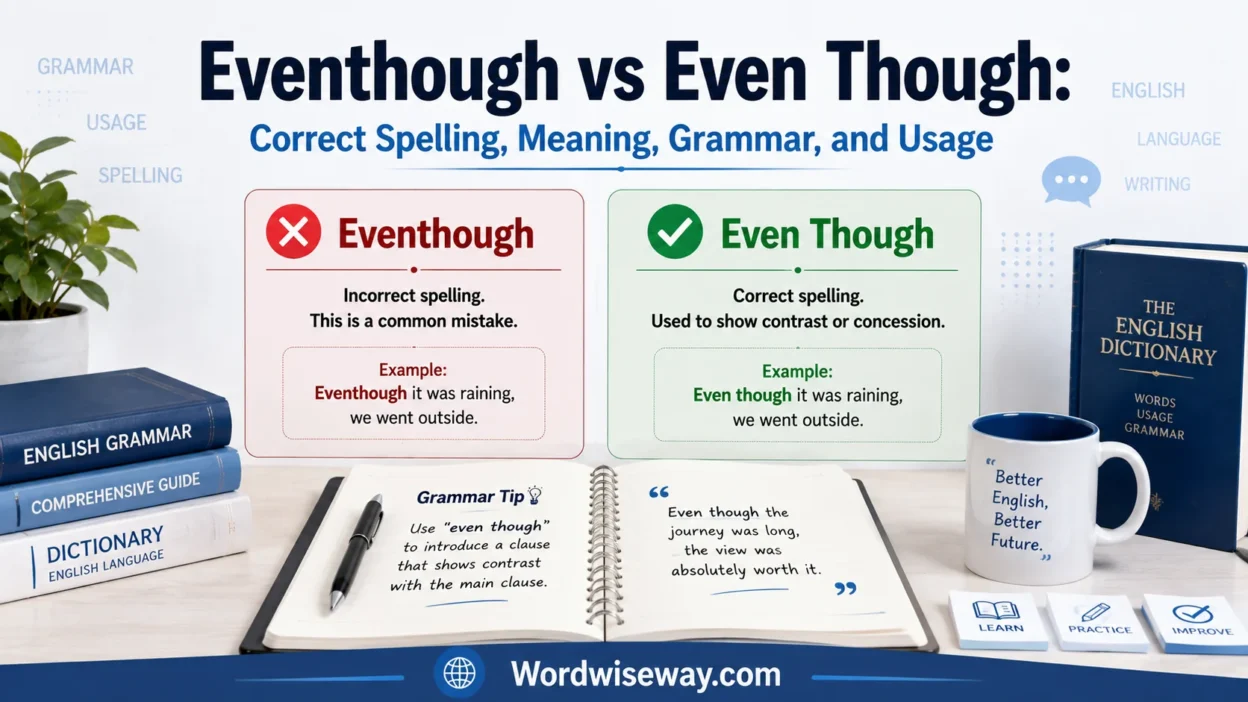
Many learners, writers, and native speakers wonder which form is correct because both words sound similar when spoken. The correct phrase is even though, written as two separate words. It is a standard English conjunction used to introduce contrast and connect opposite ideas in a sentence.
The word eventhough is an incorrect and nonstandard form often seen in informal writing or typographical errors. Understanding grammar rules, proper use, and correct spelling helps improve clarity in academic writing, professional communication, and everyday English. Using even though correctly makes writing more polished and easy to understand.
Quick Answer
Even though is the correct spelling. Eventhough is a misspelling and is not recognized as a standard English word.
Quick examples:
- ✅ Even though it was raining, we went hiking.
- ✅ She smiled even though she was tired.
- ❌ Eventhough I studied, I failed the quiz.
If you’re writing in school, at work, or online, always use even though as two separate words.
Eventhough vs Even Though at a Glance
| Feature | Eventhough | Even Though |
| Correct spelling | ❌ No | ✅ Yes |
| Number of words | One | Two |
| Accepted in dictionaries | ❌ No | ✅ Yes |
| Standard English | ❌ No | ✅ Yes |
| Used in formal writing | ❌ Never | ✅ Always |
| Meaning | Misspelling | Shows contrast between two ideas |
| Example | ❌ Eventhough I tried… | ✅ Even though I tried… |
What Does “Even Though” Mean?
Definition
Even though is a subordinating conjunction that introduces a clause showing contrast. It means despite the fact that or although, but it often gives stronger emphasis.
For example:
- Even though the store was busy, the cashier remained calm.
- Even though he practiced every day, he didn’t win the competition.
In both sentences, the second idea contrasts with what you might expect.
Grammar Function
A subordinating conjunction joins a dependent clause with an independent clause.
Structure:
- Even though + dependent clause + independent clause
- Independent clause + even though + dependent clause
Examples:
- Even though she felt nervous, she gave a great presentation.
- She gave a great presentation even though she felt nervous.
Both structures are grammatically correct.
Why It Is Written as Two Words
English contains many fixed expressions made of separate words. Even though belongs to this group. Each word has its own grammatical role.
- Even adds emphasis.
- Though introduces the contrasting idea.
Together they create a phrase, not a compound word. That’s why combining them into eventhough is incorrect.
Common Sentence Patterns
Here are some common ways to use even though.
| Pattern | Example |
| Even though + clause, main clause | Even though it snowed, school stayed open. |
| Main clause + even though + clause | We finished the project even though time was limited. |
| Even though + subject + verb | Even though they disagreed, they stayed friends. |
These patterns work in both formal and informal writing.
Is “Eventhough” a Correct Word?
Why It Appears Online
You may notice eventhough on blogs, social media posts, forums, or text messages. That doesn’t make it correct.
People often type quickly and accidentally merge two words into one. Others simply copy the mistake after seeing it elsewhere.
Common Typing Mistake
Several factors explain why eventhough appears so often.
- ✅ The phrase is pronounced quickly in conversation.
- ✅ Fast typing causes words to blend together.
- ✅ Some people assume it follows the pattern of words like however or therefore.
- ✅ Proofreading is sometimes skipped.
These habits create the illusion that eventhough is acceptable when it is not.
Why Dictionaries Do Not Accept It
Major English dictionaries recognize even though as the correct expression. They do not list eventhough as a standard word because it doesn’t follow accepted English spelling rules.
When writing for school, work, exams, or publishing, using the correct spelling demonstrates attention to detail and strong language skills.
Should You Ever Use It?
The answer is simple.
❌ Never use eventhough in:
- Academic papers
- Essays
- Business emails
- Professional reports
- News articles
- Books
- Website content
✅ Always write even though as two separate words.
Why People Confuse Eventhough and Even Though
Similar Pronunciation
In everyday conversation, people pronounce even though so smoothly that the boundary between the two words almost disappears.
For example:
“Even though I knew the answer…”
When spoken naturally, it may sound like a single word, leading many writers to spell it incorrectly.
Fast Typing Habits
Modern communication encourages speed.
Whether you’re texting, chatting, or posting online, your fingers often move faster than your brain checks spelling. As a result, eventhough becomes an easy mistake to make.
Influence of Other Compound Words
English includes many compound words.
Examples include:
- however
- therefore
- nevertheless
- moreover
Because these words are written together, many writers mistakenly believe eventhough follows the same pattern. It doesn’t.
AutoCorrect and Informal Writing
AutoCorrect isn’t perfect.
Some devices fail to catch uncommon spelling mistakes. Others learn repeated errors from users. That’s why it’s important to proofread instead of relying entirely on software.
How to Use “Even Though” Correctly
At the Beginning of a Sentence
When even though begins a sentence, the dependent clause comes first.
Examples:
- Even though it was freezing, the children played outside.
- Even though traffic was heavy, we arrived on time.
- Even though she had little experience, she impressed everyone.
Notice the comma separating the introductory clause from the main clause.
In the Middle of a Sentence
You can also place even though after the main clause.
Examples:
- We enjoyed the picnic even though the weather changed.
- She accepted the challenge even though it looked difficult.
- They finished early even though several problems appeared.
In this structure, a comma usually isn’t needed.
With Independent Clauses
Remember that even though introduces a dependent clause. It cannot stand alone as a complete sentence.
Correct:
- Even though he was exhausted, he completed the marathon.
Incorrect:
- ❌ Even though he was exhausted.
The second example leaves the reader waiting for the main idea.
In Formal and Informal Writing
One of the strengths of even though is its flexibility.
You can use it in:
- ✅ Academic essays
- ✅ Research papers
- ✅ Business communication
- ✅ Professional reports
- ✅ Newspaper articles
- ✅ Novels
- ✅ Everyday conversation
It sounds natural in almost every situation.
Examples of “Even Though” in Sentences
Everyday Conversation
Here are examples you’ll hear in daily life.
- Even though I was tired, I cleaned the house.
- Even though the movie was long, everyone enjoyed it.
- Even though we disagreed, we respected each other’s opinions.
- Even though my phone was fully charged, it suddenly turned off.
- Even though dinner was simple, it tasted wonderful.
Academic Writing
In formal writing, even though helps present balanced arguments.
Examples:
- Even though the experiment produced positive results, further testing is necessary.
- Even though the sample size was small, the findings were statistically significant.
- Even though several theories exist, researchers continue to investigate the issue.
Business Communication
Professional writing often uses even though to explain challenges or unexpected outcomes.
Examples:
- Even though sales declined in January, overall annual revenue increased.
- Even though the shipment arrived late, customer satisfaction remained high.
- Even though the deadline changed, the team completed every milestone.
Creative Writing
Authors use even though to build emotion and create contrast.
Examples:
- Even though the stars disappeared behind dark clouds, hope never left her heart.
- Even though the old house stood empty, it still carried memories of happier days.
- Even though the journey seemed impossible, they refused to give up.
Common Mistakes to Avoid
Many writers make the same errors repeatedly. Learning these mistakes now will help you write more confidently.
Writing “Eventhough” as One Word
❌ Eventhough she practiced, she felt nervous.
✅ Even though she practiced, she felt nervous.
This is the most common mistake and the easiest one to fix.
Confusing “Even Though” with “Although”
Both expressions introduce contrast, but even though usually adds stronger emphasis.
Example:
- Although it rained, we continued playing.
- Even though it rained heavily, we continued playing.
The second sentence stresses the unexpected result more clearly.
Confusing “Even Though” with “Despite”
These expressions follow different grammar patterns.
❌ Even though the rain.
✅ Even though it rained.
❌ Despite it rained.
✅ Despite the rain.
Understanding this difference prevents many grammar errors.
Using Incorrect Punctuation
Remember these simple rules.
Use a comma when even though starts the sentence.
Example:
- Even though she apologized, he remained upset.
Usually don’t use a comma when the phrase comes after the main clause.
Example:
- He remained upset even though she apologized.
Creating Sentence Fragments
A dependent clause cannot stand by itself.
Incorrect:
- ❌ Even though they practiced every day.
Correct:
- ✅ Even though they practiced every day, they still lost the final match.
A complete sentence always includes an independent clause.
Even Though vs Although
Both even though and although introduce contrast, but they are not always interchangeable. The main difference is emphasis. Even though highlights a stronger or more surprising contrast, while although often sounds more neutral.
Key Similarities
Both expressions:
- Introduce a dependent clause
- Show contrast between two ideas
- Can appear at the beginning or middle of a sentence
- Are acceptable in formal and informal writing
Examples:
- Although it was cold, we went outside.
- Even though it was cold, we went outside.
Both sentences are correct, but the second one emphasizes the unexpected nature of the action.
Important Differences
| Feature | Even Though | Although |
| Strength of contrast | Strong | Moderate |
| Formal writing | Yes | Yes |
| Everyday conversation | Very common | Common |
| Meaning | Despite the fact that | Although |
When One Sounds Better Than the Other
Choose even though when you want readers to notice a stronger contradiction.
Examples:
- Even though he had never cooked before, he prepared an excellent dinner.
- Even though the road was closed, they found another way home.
Choose although when the contrast is less dramatic.
Examples:
- Although she was busy, she answered my email.
- Although the lesson was difficult, everyone learned something new.
Even Though vs Though
The words though and even though are closely related, but they don’t always create the same level of emphasis.
Difference in Meaning
Though simply introduces contrast.
Even though emphasizes that the contrast is stronger than expected.
Compare these examples:
- Though I was tired, I finished the report.
- Even though I was exhausted, I finished the report.
The second sentence gives greater weight to the obstacle.
Difference in Emphasis
Think of even as adding extra force.
For example:
- Though the weather changed, we continued hiking.
- Even though the weather changed suddenly, we continued hiking.
Both are correct, but even though sounds more emphatic.
Which Is Better in Formal Writing?
Both expressions work well in formal writing. However, use even though when the contrast deserves extra attention.
Even Though vs Despite
This comparison causes confusion because both expressions express contrast. However, they follow different grammar rules.
Different Grammar Rules
Even though is followed by a complete clause.
Despite is followed by a noun, noun phrase, or gerund (-ing form).
Examples:
- Even though it rained, we played soccer.
- Despite the rain, we played soccer.
- Despite raining all morning, we continued the event.
Noun vs Clause
| Expression | What Follows |
| Even though | Subject + verb |
| Despite | Noun or gerund |
Examples:
- Even though she studied hard, she failed.
- Despite her hard work, she failed.
Correct Examples
- Even though the meeting lasted three hours, everyone remained engaged.
- Despite the long meeting, everyone remained engaged.
- Even though the power went out, the presentation continued.
- Despite the power outage, the presentation continued.
Incorrect Examples
❌ Despite it was raining.
✅ Despite the rain.
❌ Even though the rain.
✅ Even though it was raining.
Learning this rule will eliminate many common grammar mistakes.
Grammar Rules You Should Know
Subordinating Conjunction Explained
Even though belongs to a group of words called subordinating conjunctions.
Other common examples include:
- because
- although
- since
- while
- unless
- if
- before
- after
These conjunctions connect a dependent clause to an independent clause.
Clause Structure
A complete sentence with even though contains two parts.
Dependent clause
- Even though she practiced every day
Independent clause
- she still felt nervous before the concert.
Combined:
- Even though she practiced every day, she still felt nervous before the concert.
Comma Rules
Use these punctuation guidelines.
✔ Use a comma when the sentence starts with even though.
Example:
- Even though it was late, they continued working.
✔ Don’t use a comma when even though appears after the main clause.
Example:
- They continued working even though it was late.
Following this simple rule makes your writing smoother and easier to read.
Tense Compatibility
Even though works with every major English tense.
Examples:
Present
- Even though she is busy, she always helps others.
Past
- Even though they arrived late, they enjoyed the concert.
Future
- Even though it will be expensive, we’ll buy the better option.
Present Perfect
- Even though he has traveled widely, he still wants to explore more countries.
Memory Tricks to Remember the Correct Spelling
Remembering the correct spelling is easier than many people think.
Think of Two Separate Words
Imagine a small pause between even and though.
Say it slowly.
Even… though
This simple habit reinforces the correct spelling.
Easy Sentence Test
Replace even though with although.
If the sentence still makes sense, you’ve probably used it correctly.
Example:
- Even though she was tired, she smiled.
- Although she was tired, she smiled.
Visual Memory Technique
Picture two puzzle pieces joining together.
One piece says even.
The other says though.
They fit together perfectly, but they never merge into one word.
Proofreading Tip
Before submitting an essay or email, search your document for eventhough.
If you find it, replace it with even though.
That quick check catches one of the most common spelling mistakes in English.
Real-Life Examples
Books and Literature
Authors frequently use even though to show conflict or unexpected outcomes.
Example:
- Even though the journey seemed endless, hope never faded.
The phrase adds emotional weight and strengthens the contrast.
News Articles
Journalists use even though to explain surprising events.
Example:
- Even though inflation slowed, consumer prices remained high.
The wording helps readers understand two ideas that exist at the same time.
Professional Emails
Business professionals rely on even though when discussing challenges.
Example:
- Even though production was delayed, customer orders were completed on schedule.
The sentence acknowledges a problem while highlighting a positive result.
Everyday Speech
You’ll hear even though naturally in conversation.
Examples:
- Even though I’m busy, I’ll call you tonight.
- Even though the cake burned a little, it still tastes great.
- Even though we lost the game, we had fun.
Case Study: A Student’s Common Mistake
Emma, a high school student, wrote the following sentence in her essay:
Eventhough technology improves every year, people still value face-to-face communication.
Her teacher corrected eventhough to even though and explained that the phrase must always be written as two words.
After learning the rule, Emma reviewed her future assignments and never repeated the mistake. One small correction improved the professionalism of her writing.
Lesson: Small spelling errors can leave a lasting impression. Learning standard forms helps you communicate more clearly.
“Good writing isn’t about using difficult words. It’s about choosing the right ones every time.”
Read More: Cocoon or Cacoon: Correct Spelling, Meaning, and Correct Usage
FAQs
Is eventhough a correct English word?
No, eventhough is not considered a correct English word. The accepted spelling is even though, which should always be written as two separate words.
What is the meaning of even though?
Even though means “despite the fact that” or “although.” It is used to introduce a contrast between two ideas or situations.
How do I use even though in a sentence?
You can use even though before a clause that presents an unexpected or opposite idea. Example: Even though it was raining, we went outside.
Why do people write eventhough instead of even though?
Many people write eventhough because the phrase sounds like one word when spoken. It is usually a spelling mistake caused by combining two separate words.
Is even though a conjunction?
Yes, even though is a subordinating conjunction. It connects a dependent clause with a main clause to show contrast.
Can I use even though in formal writing?
Yes, even though is completely acceptable in formal writing, including essays, reports, emails, and academic work.
What is the difference between eventhough and even though?
The difference is simple: even though is the correct phrase, while eventhough is an incorrect spelling that should not be used.
Are even though and although the same?
Yes, both phrases show contrast and have similar meanings. However, even though can sometimes add stronger emphasis compared to although.
Can even though start a sentence?
Yes, a sentence can begin with even though. Example: Even though he was tired, he completed his work.
How can I remember the correct spelling of even though?
Remember that even though contains two separate words. Think of it as a combination of “even” and “though,” not a single word.
Conclusion
Understanding Eventhough vs Even Though: Correct Spelling, Meaning, and Usage helps writers avoid a common English mistake. While eventhough may look natural because of how the phrase sounds, it is not accepted in standard English. The correct form is always even though, written separately.
Using the right spelling improves the clarity and professionalism of your writing. Whether you are preparing an academic assignment, writing online content, or communicating in daily life, choosing even though instead of eventhough will make your English more accurate and polished.