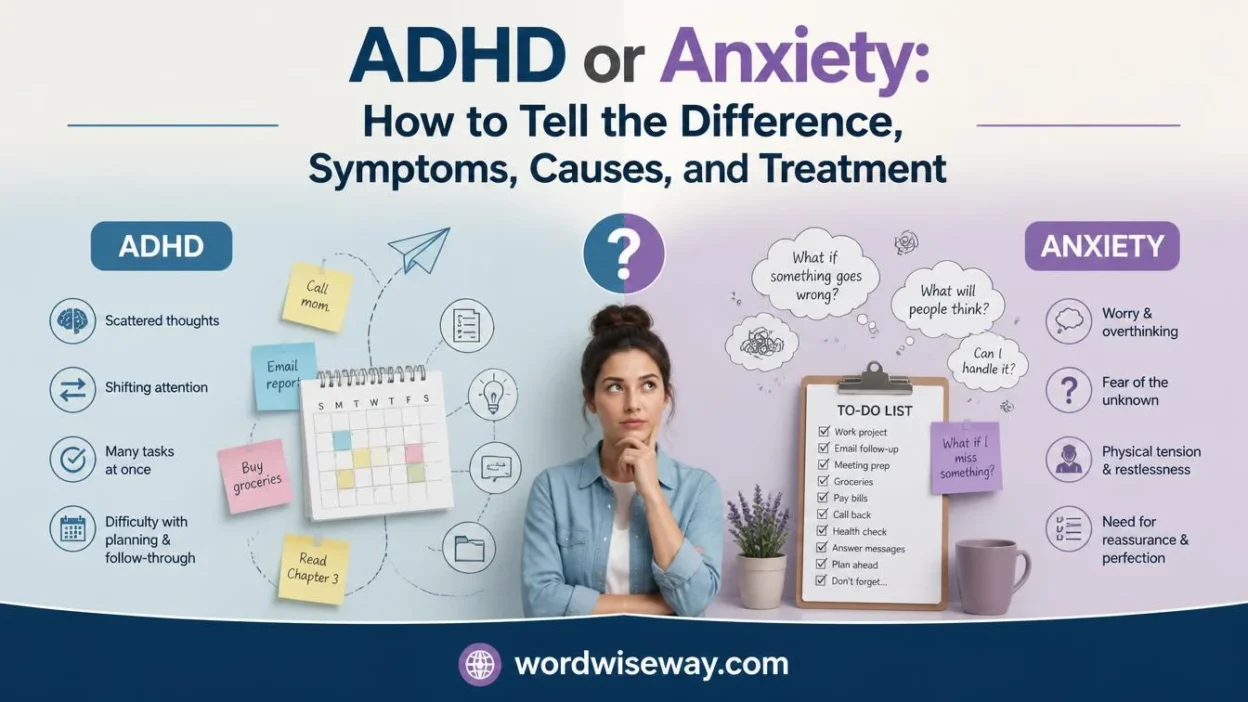
ADHD or Anxiety: Difference, Symptoms, Causes, and Treatment can be easier to understand by comparing their symptoms.
ADHD, or Attention Deficit Hyperactivity Disorder, is a neurodevelopmental disorder linked to inattention, hyperactivity, impulsivity, and restlessness. Anxiety involves excessive fear, worry, or dread. Both can cause difficulty focusing, difficulty concentrating, and sleep problems, so telling them apart can be challenging.
A mental health professional, such as a psychiatrist, can provide a proper diagnosis and recommend suitable treatment options. Misdiagnosis can happen because of overlapping symptoms, but ADHD and anxiety remain distinct conditions.
Understanding their differences, similarities, and possible overlap can help adults communicate their experiences clearly and seek appropriate support.
Quick Answer
ADHD and anxiety are different conditions, but they can share several symptoms. Both can cause difficulty concentrating, restlessness, sleep problems, forgetfulness, and problems completing tasks.
A useful starting point is this:
- ADHD mainly involves persistent difficulties with attention, organization, impulse control, and activity regulation.
- Anxiety mainly involves excessive worry, fear, nervousness, or tension.
- ADHD-related distraction can happen even when you’re not worried about anything.
- Anxiety-related distraction often happens because worrying thoughts compete for your attention.
- Both conditions can occur together.
However, this isn’t a diagnosis. A symptom checklist can’t reliably tell you whether you have ADHD, an anxiety disorder, both, or another explanation for the same difficulties.
“Anxiety disorders involve more than occasional worry or fear.” — National Institute of Mental Health
ADHD or Anxiety at a Glance
| Feature | ADHD | Anxiety |
| Main pattern | Inattention, hyperactivity, and/or impulsivity | Excessive worry, fear, or nervousness |
| Concentration | Attention may drift easily | Worry may consume attention |
| Restlessness | May involve constant movement or a need for stimulation | Often linked with nervous tension |
| Forgetfulness | Can result from attention and organization difficulties | Can happen when worry interferes with concentration |
| Procrastination | May involve difficulty starting, planning, or organizing | May involve fear of mistakes or negative outcomes |
| Racing thoughts | Thoughts may jump rapidly between subjects | Thoughts often circle around worries |
| Childhood history | Symptoms must begin during childhood | Anxiety can begin at different ages |
| Pattern across settings | Symptoms commonly appear in multiple settings | Anxiety may vary according to situations and triggers |
| Co-occurrence | Can occur alongside anxiety | Can occur alongside ADHD |
The table gives you the broad picture, but real symptoms aren’t always this tidy. Human brains don’t follow neat columns.
What Is ADHD?
Attention-deficit/hyperactivity disorder is a developmental disorder characterized by persistent patterns of inattention, hyperactivity, and impulsivity. Some people primarily experience inattentive symptoms. Others mainly experience hyperactive or impulsive symptoms, while some experience both.
ADHD isn’t simply being occasionally distracted or energetic. Everyone loses focus sometimes. The important distinction is frequency, persistence, context, and impact.
For ADHD, symptoms occur often enough and strongly enough to interfere with everyday functioning. They can affect school, work, relationships, routines, and other responsibilities. NIMH notes that ADHD symptoms occur across multiple situations rather than appearing only in one isolated setting.
Common ADHD Symptoms
ADHD symptoms can include:
- Difficulty staying focused on tasks
- Frequently losing or misplacing things
- Forgetting appointments or everyday responsibilities
- Trouble organizing tasks
- Poor time management
- Difficulty following through on instructions
- Procrastination
- Fidgeting or feeling restless
- Talking excessively
- Interrupting others
- Difficulty waiting
- Acting without thinking through consequences
Not everyone with ADHD experiences every symptom. The presentation can also change with age.
For example, obvious physical hyperactivity may become less noticeable during adolescence or adulthood. Internal restlessness, difficulty organizing responsibilities, and problems sustaining attention may become more prominent instead.
The Three ADHD Presentations
ADHD is commonly described through three presentations:
- Predominantly inattentive presentation
- Predominantly hyperactive-impulsive presentation
- Combined presentation
This matters because ADHD doesn’t always look like the stereotypical image of someone who cannot sit still. A person can struggle substantially with attention and organization without appearing physically hyperactive.
When Do ADHD Symptoms Begin?
One of the biggest clues when distinguishing ADHD or anxiety is timing.
ADHD is considered a developmental condition, so symptoms must have begun during childhood. For adults, NIMH notes that symptoms must have been present before age 12. Diagnosis also considers whether symptoms interfere with functioning and appear across relevant situations.
That doesn’t mean someone must have received an ADHD diagnosis as a child. Many people aren’t identified until adolescence or adulthood. Instead, an evaluation looks backward at the person’s developmental history.
What Is Anxiety?
Anxiety itself isn’t automatically a disorder. Feeling nervous before an exam, worrying about an important event, or becoming tense during a difficult situation can be normal.
An anxiety disorder is different. The worry or fear becomes persistent, excessive, difficult to control, or disruptive enough to interfere with everyday life. NIMH identifies several anxiety disorders, including generalized anxiety disorder, panic disorder, social anxiety disorder, and phobia-related disorders.
Common Anxiety Symptoms
Anxiety can involve emotional, mental, behavioral, and physical symptoms.
Common examples include:
- Excessive worrying
- Feeling constantly nervous or on edge
- Difficulty controlling worry
- Restlessness
- Irritability
- Difficulty concentrating
- Sleep problems
- Muscle tension
- Fatigue
- Sweating
- Trembling
- Stomach discomfort
- Feeling short of breath
- Avoiding situations that create fear
The exact symptoms depend on the type of anxiety disorder.
Generalized Anxiety Disorder and ADHD Confusion
Generalized anxiety disorder, or GAD, is particularly relevant when comparing ADHD or anxiety because difficulty concentrating is one of its symptoms.
NIMH describes GAD as excessive anxiety and worry about multiple areas of life that occurs more days than not for at least six months. People with GAD often struggle to control their worry.
That can create an important overlap.
Someone might sit down to study but spend the next hour worrying about failing the test. They may appear distracted, but the underlying problem isn’t necessarily a lack of attention regulation. Their attention has been captured by worry.
ADHD or Anxiety: The Key Differences
The biggest distinction isn’t whether you experience distraction. It’s why the distraction happens.
ADHD or Anxiety and Concentration Problems
Someone with ADHD may struggle to maintain attention even when the subject doesn’t create fear or worry.
For example, imagine you’re reading a chapter for school. Your phone isn’t nearby. Nothing stressful happened. Yet your attention keeps drifting, you reread the same paragraph, and you suddenly find yourself thinking about something unrelated.
That pattern can fit ADHD.
With anxiety, concentration may become difficult because the mind is occupied by worry.
You might read the same paragraph while thinking, What if I fail? What will my teacher think? What happens if I can’t finish this?
The visible behavior is similar. The mental process can be very different.
ADHD or Anxiety and Restlessness
Restlessness can occur with both conditions.
With ADHD, restlessness may reflect hyperactivity or a persistent need for movement and stimulation. A person might fidget, move frequently, struggle with quiet activities, or feel uncomfortable sitting still.
With anxiety, restlessness often appears alongside tension, nervousness, dread, or worry.
So instead of asking only, “Am I restless?”, consider the bigger question: “What seems to be driving the restlessness?”
ADHD or Anxiety and Procrastination
Procrastination deserves special attention because the same behavior can have different roots.
ADHD-related procrastination may involve:
- Difficulty deciding where to start
- Poor time estimation
- Trouble organizing steps
- Low stimulation from the task
- Difficulty shifting attention
- Getting distracted before the task begins
Anxiety-related procrastination may involve:
- Fear of failure
- Fear of criticism
- Perfectionism
- Fear of making the wrong choice
- Avoidance of an uncomfortable situation
Here’s a simple example.
ADHD pattern: “I need to start my assignment, but I can’t seem to organize myself enough to begin.”
Anxiety pattern: “I don’t want to start because I’m terrified I’ll do it badly.”
Those statements aren’t diagnostic. They simply demonstrate how similar behavior can have different underlying patterns.
ADHD or Anxiety and Forgetfulness
Forgetfulness can appear in both conditions.
ADHD may interfere with remembering tasks because attention wasn’t fully engaged when the information appeared. It can also affect organization and working through routines. Adults with ADHD may frequently lose things, miss appointments, forget responsibilities, or struggle to complete large projects.
Anxiety can interfere with memory and concentration when persistent worry occupies mental resources.
Imagine someone receives three instructions while already worrying about an upcoming exam. They may forget one instruction because their attention was divided.
Again, the surface symptom is identical. The underlying pattern matters.
ADHD or Anxiety and Racing Thoughts
“Racing thoughts” can mean different things.
With ADHD, thoughts may shift quickly from one topic to another. One idea can trigger another, which can trigger a third. Maintaining a single mental track may become difficult.
With anxiety, thoughts often revolve around concerns, threats, mistakes, uncertainty, or possible negative outcomes.
The distinction isn’t absolute. People experience these symptoms differently. Still, the content and pattern of the thoughts can provide useful information during an evaluation.
Can ADHD and Anxiety Occur Together?
Yes.
ADHD and anxiety aren’t mutually exclusive. NIMH specifically notes that ADHD can co-occur with anxiety and other conditions.
This explains why choosing between “ADHD” and “anxiety” can sometimes create a false choice.
A person could have longstanding ADHD-related organization difficulties and also develop significant anxiety around school performance. Another person might have anxiety that creates concentration problems without having ADHD.
How ADHD Can Contribute to Anxiety
ADHD-related difficulties can create repeated stressful situations.
For example:
- Assignments may be forgotten.
- Deadlines may be missed.
- Important items may get lost.
- Routines may become difficult to maintain.
- Other people may become frustrated.
- Schoolwork may take longer than expected.
Over time, these experiences can become a source of worry.
That doesn’t mean ADHD automatically causes an anxiety disorder. It simply shows how the two conditions can interact.
How Anxiety Can Affect Attention
Anxiety can also make attention harder.
If your mind constantly scans for problems, part of your attention is already occupied. A difficult task may then feel even more demanding.
Sleep can add another layer. Anxiety can make falling asleep or staying asleep difficult, while poor sleep can make concentration harder the next day. GAD commonly includes sleep and concentration difficulties.
ADHD or Anxiety in Children and Teens
Children and teenagers can experience both ADHD and anxiety. However, occasional restlessness, worry, distraction, or emotional reactions don’t automatically indicate a disorder.
NIMH emphasizes that children can experience temporary difficulties with attention, anxiety, irritability, or sitting still as part of normal development. The broader pattern and impact matter when determining whether professional evaluation is needed.
Signs That May Point Toward ADHD
Potential patterns include:
- Persistent difficulty following routines
- Frequent forgetfulness
- Disorganization
- Difficulty staying focused
- Impulsive behavior
- Trouble completing schoolwork
- Problems across more than one setting
Signs That May Point Toward Anxiety
Potential patterns include:
- Excessive fear or worry
- Avoiding certain situations
- Strong fear of making mistakes
- Repeated reassurance-seeking
- Physical complaints associated with anxiety
- Persistent concerns about school, friendships, performance, or the future
Context is crucial.
A teenager who becomes distracted only before exams may be experiencing anxiety. A teenager who struggles to sustain attention across many ordinary tasks and settings may warrant an ADHD evaluation. Neither pattern can be diagnosed from one example alone.
ADHD or Anxiety in Adults
ADHD doesn’t disappear simply because someone grows older. NIMH notes that adults can experience persistent ADHD symptoms involving attention, organization, time management, restlessness, impulsivity, and task completion.
Adult anxiety can also affect work, relationships, school, finances, health concerns, and everyday responsibilities.
ADHD in Adult Life
An adult with ADHD might repeatedly:
- Miss deadlines
- Forget appointments
- Lose everyday items
- Struggle with planning
- Start many projects without finishing them
- Underestimate how long tasks will take
- Become distracted during routine work
Anxiety in Adult Life
An adult experiencing an anxiety disorder might:
- Worry excessively about everyday situations
- Struggle to control the worry
- Avoid certain situations
- Feel tense or restless
- Have trouble sleeping
- Experience physical symptoms of anxiety
- Find concentration difficult because of persistent worry
The difference can become clearer when you examine what happens before the symptom.
ADHD or Anxiety: An Illustrative Case Study
Consider two fictional students preparing for the same major exam.
Student A has struggled with organization for years. They frequently forget assignments, lose school supplies, underestimate how long tasks will take, and become distracted during routine work. These difficulties occur even when they aren’t especially worried.
Student B usually organizes schoolwork successfully. However, before major exams, they become consumed by thoughts about failing. They repeatedly reread material because they’re worried they missed something. They lose sleep thinking about possible outcomes.
Both students may say, “I can’t concentrate.”
Yet their patterns are different.
Student A’s difficulties may warrant an evaluation for ADHD. Student B’s pattern may point toward anxiety. A qualified professional would need much more information before making any diagnosis.
How ADHD and Anxiety Are Diagnosed
There isn’t a single blood test, brain scan, or quick online quiz that can independently establish ADHD or an anxiety disorder.
A professional evaluation usually considers the person’s symptoms, history, functioning, and other possible explanations.
ADHD Evaluation
An ADHD evaluation may consider:
- When symptoms first appeared
- Childhood behavior and development
- Current symptoms
- Symptoms across different settings
- School or work functioning
- Relationships and daily responsibilities
- Other mental or physical conditions
- Sleep and other factors that can affect attention
For adults, childhood history becomes especially important because ADHD symptoms must have begun before age 12.
Anxiety Evaluation
An anxiety evaluation may examine:
- What the person worries about
- How often the worry occurs
- How difficult it is to control
- Physical symptoms
- Avoidance behaviors
- Sleep
- Duration of symptoms
- Impact on school, work, relationships, or daily activities
For example, GAD involves difficult-to-control worry occurring more days than not for at least six months, along with associated symptoms and functional impact.
Why Professional Assessment Matters
Symptoms such as poor concentration, fatigue, forgetfulness, and sleep problems can have multiple explanations.
That is why self-diagnosing from a social media checklist can lead you down the wrong path. A professional can look at the timeline and pattern rather than one isolated symptom.
ADHD or Anxiety: Questions to Consider
A few questions can help you describe your experience more clearly to a professional:
- Did the attention difficulties exist during childhood?
- Do concentration problems happen even when you’re calm?
- Does worry regularly take over your attention?
- Are you avoiding situations because of fear?
- Do organization and time management create persistent problems?
- Do symptoms occur in more than one setting?
- How long have the symptoms lasted?
- Do they interfere with school, work, relationships, or daily responsibilities?
These questions are useful for reflection. They aren’t a diagnostic test.
Treatment for ADHD and Anxiety
Treatment depends on the specific condition, symptoms, age, overall health, preferences, and individual circumstances.
ADHD Treatment
ADHD treatment may include medication, psychotherapy, behavioral strategies, and practical support for organization and executive-function skills. NIMH notes that common treatments for adults include medication and psychotherapy, including behavioral and cognitive behavioral approaches.
Helpful strategies may include:
- Breaking large tasks into smaller steps
- Using calendars and reminders
- Creating consistent routines
- Reducing unnecessary distractions
- Using written instructions
- Building structured study or work periods
These strategies don’t replace professional treatment. They can complement an individualized plan.
Anxiety Treatment
Anxiety treatment can include psychotherapy, medication, or a combination of both, depending on the disorder and the individual’s situation.
Cognitive behavioral therapy, commonly called CBT, is a well-studied treatment for generalized anxiety disorder. It helps people identify unhelpful thinking patterns and develop healthier responses.
Medication can also be prescribed when appropriate. NIMH notes that several medication classes may be used for anxiety disorders, depending on the condition and clinical circumstances.
Treating Both ADHD and Anxiety
When both conditions are present, treatment doesn’t have to treat them as completely separate worlds.
A clinician may consider how each condition affects the other. For example, improving organization and attention may reduce some everyday stressors, while treating excessive worry may make concentration easier.
The right approach depends on the individual. There isn’t one universal treatment plan.
Common Misconceptions
“Difficulty Concentrating Means ADHD”
Not necessarily.
Concentration can be affected by anxiety, poor sleep, stress, depression, medical conditions, medications, and other factors. ADHD is identified through a broader pattern of persistent symptoms and impairment.
“Anxiety Is Just Being Nervous”
Everyone experiences anxiety sometimes. An anxiety disorder involves a more persistent or excessive pattern that can interfere with everyday functioning.
“You Can’t Have ADHD and Anxiety”
You can.
ADHD and anxiety may occur together, which can make the symptom picture more complicated.
“An Online Quiz Can Diagnose You”
Online questionnaires can sometimes help people recognize patterns worth discussing with a professional. They don’t replace a proper evaluation.
ADHD or Anxiety: How to Remember the Difference
Here’s a simple way to organize the distinction:
ADHD: Attention and self-regulation repeatedly get pulled off course.
Anxiety: Attention gets pulled toward worry, fear, threat, or uncertainty.
The reality can be messier than those two sentences. Someone can have ADHD and anxiety at the same time. Anxiety can interfere with concentration, while ADHD-related difficulties can create stressful situations.
That’s why the most useful clues are timing, triggers, childhood history, symptom patterns, and daily impact.
Read More: Grate or Great: Correct Spelling, Meaning, Difference, and Usage
FAQs
Can ADHD and anxiety occur together?
Yes. A person can have both ADHD and anxiety at the same time. Their symptoms can overlap, which sometimes makes it difficult to identify which condition is causing a particular problem.
A mental health professional can look at the full pattern of symptoms, experiences, and daily difficulties to make a more accurate diagnosis.
What is the main difference between ADHD and anxiety?
ADHD commonly involves inattention, hyperactivity, and impulsivity, while anxiety is more closely connected with excessive fear, worry, or dread.
Both conditions can affect concentration and sleep. The underlying causes and the way symptoms appear can help professionals tell them apart.
Can anxiety look like ADHD?
Yes. Anxiety can sometimes cause difficulty concentrating, restlessness, forgetfulness, and problems staying focused. These symptoms may resemble ADHD.
The key is to consider the broader pattern rather than judging the condition from one symptom alone. A professional assessment can help clarify the difference.
Can ADHD cause anxiety?
ADHD and anxiety are separate conditions, but living with ADHD-related challenges can sometimes be associated with increased stress or worry. Some people may also develop anxiety independently.
Because the two conditions can occur together, it’s important to consider both rather than automatically assuming one explains every symptom.
How are ADHD and anxiety diagnosed?
A qualified mental health professional usually considers symptoms, personal experiences, daily functioning, and how long the difficulties have been present.
There isn’t one single symptom that proves someone has ADHD or anxiety. A careful assessment helps reduce the risk of misdiagnosis.
Can ADHD affect sleep?
Yes. Some people with ADHD experience sleep problems. Difficulties with attention, restlessness, or managing routines may contribute to trouble maintaining healthy sleep habits.
However, sleep difficulties can also occur with anxiety and many other conditions. That’s why sleep problems alone aren’t enough to identify ADHD.
What symptoms do ADHD and anxiety share?
Both may involve difficulty focusing, difficulty concentrating, restlessness, and sleep problems. This overlap can make the two conditions confusing.
Their other symptoms can provide useful clues. ADHD is often associated with inattention, hyperactivity, and impulsivity, while anxiety commonly involves persistent fear or worry.
Can adults have both ADHD and anxiety?
Yes. Adults can experience both conditions simultaneously. In some cases, one condition may have been recognized earlier while the other wasn’t identified until later.
If symptoms continue to affect work, school, relationships, or daily life, speaking with a qualified professional can help determine what support may be appropriate.
What treatments are available for ADHD and anxiety?
Treatment depends on the individual and the diagnosis. ADHD and anxiety can require different approaches, although some people may receive support for both conditions.
A mental health professional can discuss appropriate options after assessing the person’s symptoms and circumstances. It’s better to seek personalized guidance than to choose treatment based on a symptom checklist.
When should I seek professional help for ADHD or anxiety?
Consider talking with a mental health professional when concentration problems, persistent worry, restlessness, or other symptoms regularly interfere with everyday activities.
A psychiatrist or another qualified professional can help evaluate what’s happening and guide you toward appropriate support and treatment.
Conclusion
Understanding ADHD or anxiety starts with recognizing that they are different conditions, even when their symptoms look remarkably similar. ADHD is associated with patterns such as inattention, hyperactivity, and impulsivity, while anxiety commonly involves excessive worry, fear, or dread. Concentration difficulties, restlessness, and sleep problems can appear in both, which explains why telling them apart isn’t always straightforward.
If these symptoms are affecting your daily life, getting a proper assessment can provide a clearer path forward. A qualified mental health professional can consider the complete picture rather than focusing on one symptom. With the right diagnosis and appropriate support, people can better understand their experiences and find treatment that fits their individual needs.