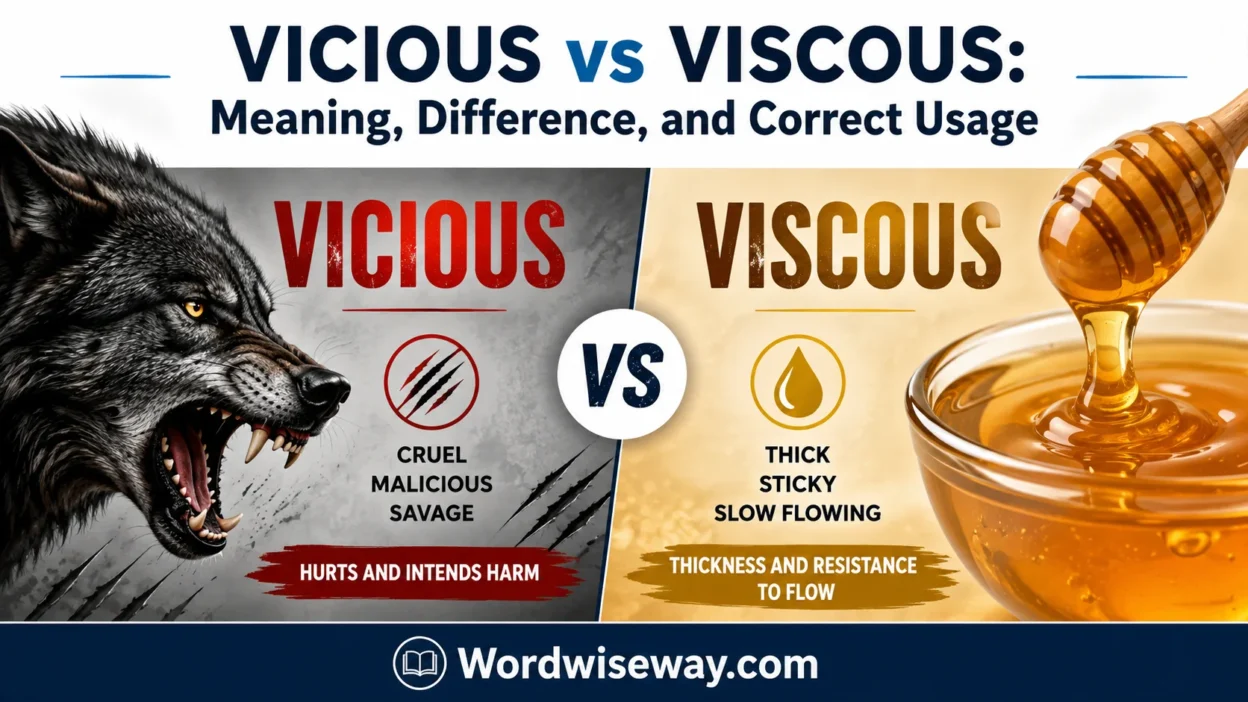
The Vicious vs Viscous: Meaning, Difference, and Correct Usage topic explains why these confused words create problems.
They look similar and sound similar, but their meanings are completely different. Viscous describes a thick, sticky liquid like honey or syrup that flows slowly. Vicious refers to cruel, violent, or harmful behavior. Understanding the difference helps writers choose the correct word in sentences.
These tricky word pairs often appear in writing, speech, and professional work. A simple trick is to remember that viscous relates to texture, while vicious relates to aggression and cruelty. This improves clarity and avoids common mistakes.
Quick Answer
Vicious means cruel, violent, dangerous, or severe.
Viscous means thick, sticky, and slow to flow.
A vicious dog may bite. A viscous sauce may pour slowly. The spelling is close, but the meaning is miles apart.
What Does “Vicious” Mean?
Vicious is an adjective. It describes something harsh, cruel, brutal, or full of danger. People often use it for behavior, attacks, arguments, habits, cycles, or even diseases when they are severe.
Here are the main ideas behind vicious:
- cruel or mean
- violent or dangerous
- severe or intense
- harmful in a repeated way
Common uses of vicious
You will often see vicious in these kinds of sentences:
- a vicious attack
- a vicious rumor
- a vicious dog
- a vicious cycle
- a vicious argument
Example sentences with vicious
- The bully made a vicious remark.
- The storm caused vicious winds across the coast.
- Their friendship ended after a vicious fight.
- Poverty can trap families in a vicious cycle.
- The detective said the crime looked vicious and deliberate.
In each case, the word carries a sharp edge. It suggests harm, intensity, or cruelty.
What Does “Viscous” Mean?
Viscous is also an adjective, but it lives in a very different world. It describes a liquid or substance that is thick and slow to move. Honey, syrup, tar, and some oils can be viscous.
This word belongs to texture, flow, and physical properties. It is common in science, cooking, chemistry, and material descriptions.
Core meaning of viscous
Something viscous:
- is thick
- flows slowly
- resists movement
- often feels sticky or heavy
Example sentences with viscous
- Honey is more viscous than water.
- The engine oil became viscous in the cold.
- The sauce was too viscous to pour easily.
- Scientists measured the liquid’s viscous behavior.
- The mud felt thick and viscous underfoot.
A simple way to think about it: if a liquid moves like molasses, viscous may be the right word.
Vicious vs Viscous: The Key Difference
The difference between vicious and viscous is not just spelling. It is meaning, context, and tone.
| Word | Part of speech | Meaning | Common context | Example |
| Vicious | Adjective | Cruel, violent, severe | People, behavior, attacks, conflict | a vicious rumor |
| Viscous | Adjective | Thick and slow-flowing | Liquids, food, oils, science | viscous honey |
Easy way to remember the difference
- Vicious = violence, harm, cruelty
- Viscous = thickness, flow, texture
That tiny letter change matters. One word can describe a nasty argument. The other can describe pancake syrup.
How to Use “Vicious” Correctly
Use vicious when the sentence involves danger, cruelty, hostility, or severity.
Strong contexts for vicious
- conflicts and arguments
- attacks and injuries
- cruel behavior
- severe criticism
- harmful cycles
Correct examples
- The comment was vicious and unfair.
- A vicious dog scared the neighbors.
- The country faced a vicious cycle of inflation and poverty.
- The critic wrote a vicious review.
- The virus spread in a vicious wave.
Incorrect use
- The soup was vicious.
This sounds wrong unless the soup somehow attacked someone, which would be a very strange dinner.
The correct word for thick soup would usually be viscous.
How to Use “Viscous” Correctly
Use viscous when you are talking about a material or liquid that is thick and slow-moving.
Strong contexts for viscous
- food and sauces
- oils and chemicals
- scientific writing
- liquids with resistance to flow
- sticky or dense textures
Correct examples
- The caramel became viscous as it cooled.
- This engine oil is too viscous for winter use.
- The liquid looked dark and viscous.
- The scientist studied how viscous fluids behave.
- The paint was thick and viscous.
Incorrect use
- He made a viscous insult.
That is wrong. The insult was cruel, so vicious is the correct choice.
Common Mistakes Writers Make
People confuse these words because they sound similar. They also share almost the same spelling. That makes them easy to swap by accident.
Mistake one: using vicious for thick liquids
Wrong: The syrup was vicious.
Right: The syrup was viscous.
Mistake two: using viscous for cruel behavior
Wrong: The player made a viscous tackle.
Right: The player made a vicious tackle.
Mistake three: relying on sound alone
The words can fool your ear. In quick speech, they blur together. That is why context matters more than sound.
Mistake four: forgetting the meaning clue
A good writer does not guess. A good writer asks:
- Is this about harm or cruelty? Use vicious.
- Is this about thickness or flow? Use viscous.
Simple Memory Tips
A tiny memory trick can save you from a spelling stumble.
Trick for vicious
Think of vice, violence, or vile.
Those ideas all lean toward harm and cruelty.
Trick for viscous
Think of viscosity, the science word for thickness and resistance to flow.
If it sounds like chemistry or cooking, viscous is probably the match.
Fast recall method
Ask yourself:
- Does it hurt? Vicious
- Does it flow slowly? Viscous
That quick test works in most situations.
Examples in Sentences
Below are more examples to make the difference stick.
Vicious examples
- The scandal created a vicious media storm.
- She received a vicious message online.
- The animal showed a vicious response when cornered.
- The battle was long and vicious.
- Their rivalry turned vicious over time.
Viscous examples
- Molasses is highly viscous.
- The cream became more viscous after cooling.
- The scientist tested a viscous solution.
- The glue had a viscous texture.
- The oil was too viscous to spread evenly.
Case Study: Choosing the Right Word in Real Editing
Imagine a writer drafts this sentence:
“The chef added a vicious sauce to the pasta.”
That sentence is wrong. The sauce is not cruel or violent. It is probably thick.
A better version is:
“The chef added a viscous sauce to the pasta.”
Now the sentence makes sense. The meaning is clear, and the reader does not stumble.
Here is another example:
“The article was full of viscous criticism.”
That is also wrong. Criticism can be harsh or cruel, so vicious works better.
Correct version:
“The article was full of vicious criticism.”
This kind of editing is small but powerful. One letter can change the whole picture.
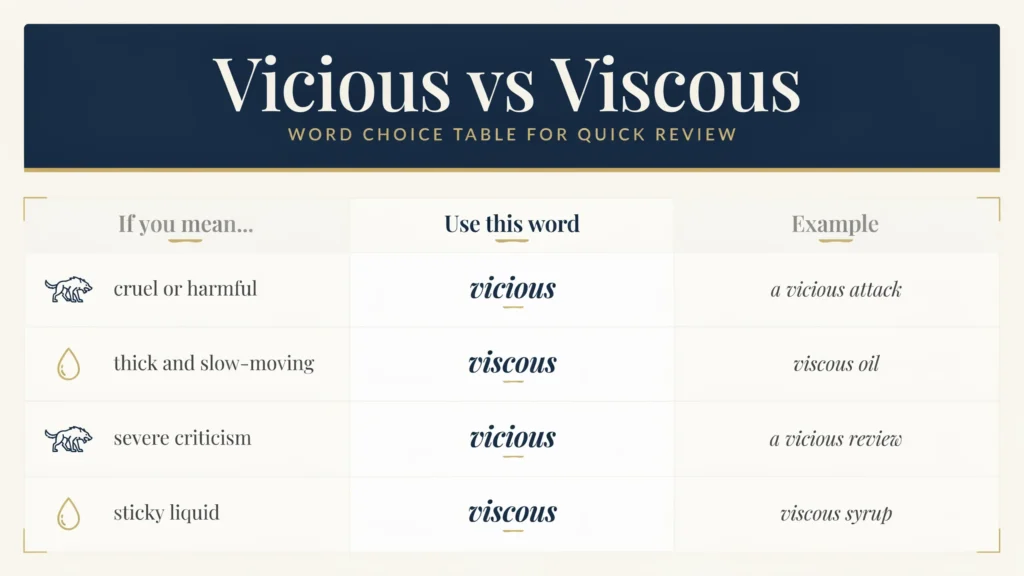
Word Choice Table for Quick Review
| If you mean… | Use this word | Example |
| cruel or harmful | vicious | vicious attack |
| thick and slow-moving | viscous | viscous oil |
| severe criticism | vicious | vicious review |
| sticky liquid | viscous | viscous syrup |
Frequently Confused Contexts
Some sentences are tricky because both words feel possible at first. The context decides.
1. When talking about animals
- Vicious is correct if the animal is aggressive or dangerous.
- Viscous does not fit unless you are describing something physical like a liquid on the animal, which is rare.
2. When talking about food
- Viscous is usually correct for sauces, syrups, soups, and batters.
- Vicious would only work if the food were somehow causing harm in a figurative way.
3. When talking about criticism
- Vicious fits because criticism can be mean or harsh.
- Viscous does not fit because criticism is not a liquid.
4. When talking about science
- Viscous often appears in physics, chemistry, and biology.
- Vicious may appear in science writing only if the topic involves danger, disease severity, or harmful cycles.
Quick Comparison at a Glance
Vicious is a word of force. It hits hard.
Viscous is a word of texture. It moves slowly.
That difference is the whole game.
- Vicious belongs to cruelty, harm, and severity.
- Viscous belongs to thickness, stickiness, and flow.
Read More: Eventhough vs Even Though: Correct Spelling, and Usage
FAQs
What is the meaning of viscous?
Viscous means having a thick consistency that prevents a liquid from flowing easily. It is commonly used in science and everyday descriptions of substances like honey, syrup, glue, and oil.
What is the meaning of vicious?
Vicious means cruel, violent, dangerous, or aggressive. It describes harmful actions, unpleasant behavior, or creatures that may attack or cause damage.
What is the main difference between vicious and viscous?
The main difference is that viscous describes the physical quality of a liquid, while vicious describes behavior, actions, or attitudes related to cruelty or aggression.
How do you pronounce viscous and vicious?
Viscous is pronounced like “VIS-kus,” while vicious is pronounced like “VISH-us.” Their pronunciation is slightly different, which can help identify the correct word.
Can viscous describe a person?
No, viscous is generally used for liquids or materials with thickness. It does not describe someone’s personality, actions, or emotions.
Can vicious describe liquids?
No, vicious cannot describe the thickness or movement of liquids. It is only related to harmful, cruel, or aggressive qualities.
Why do people confuse vicious and viscous?
People confuse these words because they have similar spelling, pronunciation, and appearance. The difference of one letter changes the entire meaning.
What are examples of viscous substances?
Examples of viscous substances include honey, syrup, molasses, oil, and lava because they move slowly due to their thick texture.
What are examples of vicious behavior?
Examples of vicious behavior include cruel actions, violent attacks, harmful intentions, and aggressive treatment toward others.
How can I remember the difference between vicious and viscous?
Remember that viscous has a connection with viscosity, a scientific property of liquids. Vicious relates to violence and cruelty, making the meanings easier to separate.
My Experience about Vicious vs Viscous
Vicious and viscous are easy to mix up because their spellings and pronunciations are similar, but they belong to different contexts. Vicious describes cruelty, aggression, intensity, or harmful behavior, so you might see it in phrases such as vicious attack, vicious criticism, or vicious cycle. Viscous describes a fluid’s resistance to flow, making it useful for substances such as honey, syrup, molasses, and certain oils.
A useful way to separate the two is to focus on meaning rather than spelling. Choose vicious when the subject involves aggression, hostility, or severity. Choose viscous when you’re describing thickness or slow fluid movement. The related noun viscosity can also help you remember the second word because it refers to how strongly a fluid resists flowing.
Conclusion
Understanding the difference between vicious and viscous helps improve vocabulary and prevents embarrassing word mistakes. Although these terms appear nearly identical, they belong to completely different contexts. Viscous belongs to science and describes the flow of thick liquids, while vicious focuses on harmful behavior, cruelty, and aggression.
Using the correct word makes communication clearer in writing, speaking, and professional situations. By remembering the connection between viscous liquids and vicious actions, you can easily identify the right term and use it confidently in everyday sentences.

Emma Smith has dedicated 14 years to Princeton University’s English Department, mentoring students in textual interpretation, literary movements, and critical frameworks. Her research explores Shakespearean drama, Victorian serial fiction, postcolonial narrative theory, and manuscript studies and probing how literary forms evolve across cultures and centuries. Emma has delivered lectures at international humanities congresses and published findings in distinguished academic journals, underscoring her commitment to scholarly depth and vibrant teaching.