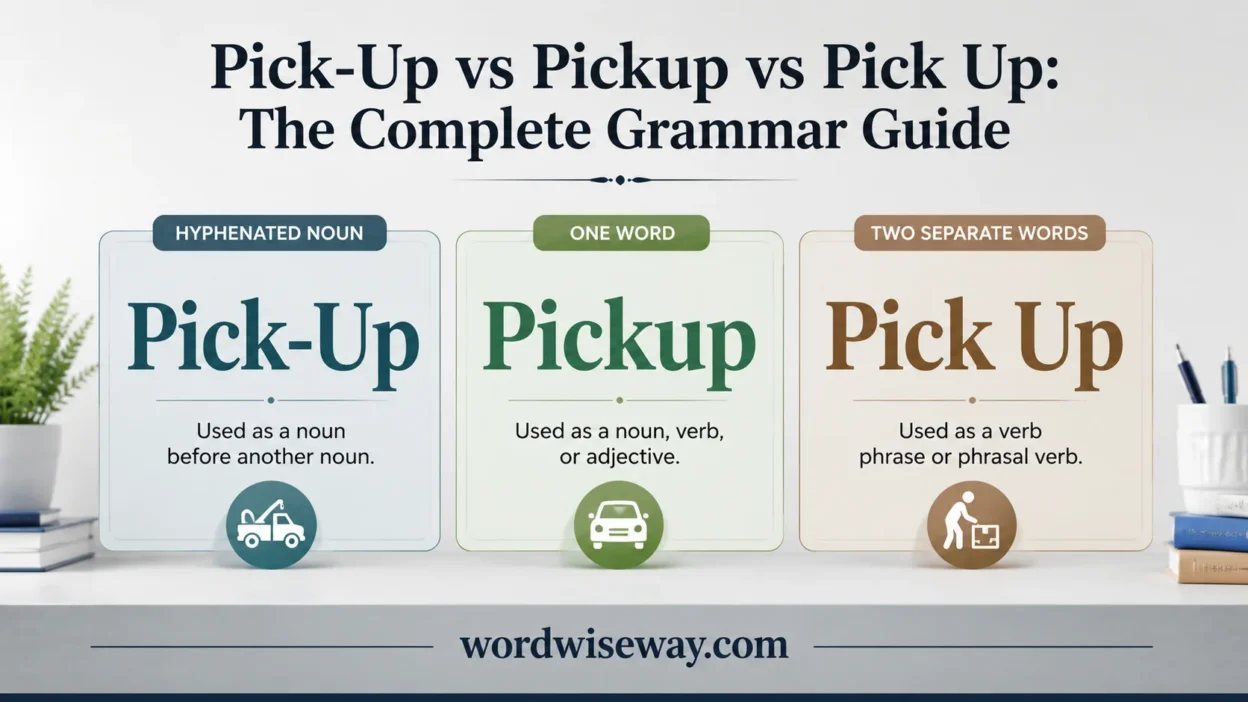
Understanding Pick-Up vs Pickup vs Pick Up: The Spelling, Meaning, and Real Usage serves as a vital foundation for mastering technical syntax. Experienced writers, students, and professionals look at structural rules to ensure accurate communication. The two-word version serves as a verb phrase to describe an action, like when a person answers a phone, builds a skill, or handles a collection.
Conversely, the single-word form acts as nouns or adjectives based on the contexts, such as managing a curbside grocery order, coordinating a logistics shipment.Joining a sports or basketball game, or driving a truck or vehicle requires a strong grasp of everyday descriptive terms. A small shift in spacing completely changes the grammar role and part of speech an item plays in your sentence, affecting overall presentation.
This tiny detail ultimately alters the clarity and professionalism of formal emails, academic essays, corporate reports, or polished professional resumes. Mastering this specific vocabulary eliminates the difference between sloppy text and highly polished, expertly crafted content for any target reader.
Relying on older style guides causes unnecessary confusion because they often suggest the traditional hyphenated noun or adjective layout. However, modern business writing has dropped the hyphen to favor a cleaner, single-word structure across most global industries. Blurring these words creates a dangerous grammar trap that leads to instant misinterpretation in critical instructions or daily business tasks. To help you avoid these mistakes alone, a comprehensive guide featuring interactive FAQs is highly recommended for continuous improvement.
The Quick Meaning Breakdown
Let’s start with the cleanest explanation possible.
- Pickup → noun (modern standard)
- Pick up → verb phrase (action)
- Pick-up → older hyphenated form (mostly outdated)
That’s the core difference. Everything else builds on it.
Here’s a simple comparison table:
| Form | Type | Function | Example |
| pickup | noun | a thing or concept | I bought a pickup truck |
| pick up | verb phrase | action | I pick up my keys |
| pick-up | hyphenated noun/adjective (older usage) | descriptive form | pick-up truck (less common today) |
This looks simple, but the confusion happens because English evolved over time and didn’t update everything evenly.
Pickup Meaning in English: The Modern Standard Form
The word “pickup” is now the dominant form in modern English when used as a noun. You see it everywhere in writing, media, and even technical documentation.
Common meanings of “pickup”
The word carries multiple meanings depending on context:
- A pickup truck (most common usage)
- A music pickup (guitar or bass component)
- A pickup game (informal sports match)
- A pickup of items (collection or retrieval process)
Each meaning shares one idea: something being collected, added, or built into a system.
Why “pickup” became one word
Language tends to simplify itself over time. “Pickup” is a perfect example of linguistic compression.
Here’s what happened:
- Early English used “pick-up” with a hyphen
- Writers gradually dropped the hyphen for efficiency
- Digital writing accelerated the change
- Style guides adopted the simplified form
Today, AP Stylebook prefers “pickup” as a noun, and most modern publishers follow that standard.
Real-world examples of “pickup”
- “He parked his pickup outside the store.”
- “The guitar pickup needs replacement.”
- “We played a quick pickup game after class.”
Notice how natural the word feels when used as a noun. It behaves like a single unit rather than two parts stitched together.
Pick Up Meaning in English: The Action You Perform
Now we switch gears completely.
“Pick up” is not a noun. It is a phrasal verb, which means it combines a verb with a particle to create a new meaning.
Core meanings of “pick up”
This form is incredibly flexible in English. It can mean:
- To lift something
- To collect someone or something
- To learn something naturally
- To increase or improve
- To resume something
That’s a wide range of meanings for just two small words.
Why spacing matters in “pick up”
The space is not cosmetic. It changes grammar entirely.
- “Pick” = action verb
- “Up” = directional or functional particle
Together, they create meaning that cannot be expressed by either word alone.
Examples that show real usage
- “I pick up my brother from school.”
- “She picked up Spanish quickly while living in Mexico.”
- “Business picked up after the holidays.”
- “He picked up the phone without looking.”
Each sentence relies on action. Remove the space, and the meaning collapses.
Pick-Up Meaning: The Hyphenated Form and Why It’s Fading
The hyphenated form “pick-up” once played an important role in English writing. Today, it mostly survives in older texts or specific stylistic choices.
Where “pick-up” still appears
You may still see it in:
- Older books or manuals
- Certain British English publications
- Branding or marketing materials
- Stylistic choices in informal writing
However, even these uses are shrinking.
Why the hyphen is disappearing
Modern English prefers simplicity. Hyphens often slow reading, especially in digital environments.
Key reasons for decline:
- Readability improvements
- SEO and digital formatting preferences
- Style guide updates
- Reader familiarity with “pickup”
In short, language efficiency wins again.
Example of older usage
- “He drives a pick-up truck.”
Today, this would almost always be written as:
- “He drives a pickup truck.”
The meaning is identical, but the modern form looks cleaner and more natural.
Read More: Buses or Busses: Meaning, and Real Usage
How Meaning Changes With Context
This is where things get interesting. The difference isn’t just grammar. It’s meaning control.
Same root, different roles
- pickup → thing (noun)
- pick up → action (verb phrase)
- pick-up → transitional historical form
Even though they come from the same base words, their functions diverge sharply.
Why context matters more than spelling
English is highly context-dependent. The same words can shift meaning depending on structure.
For example:
- “I need a pickup.” → object or service
- “I need to pick up groceries.” → action
- “He owns a pick-up.” → older noun usage
Without context, meaning becomes unclear.
Style Guides and Grammar Standards
Professional writing does not leave this to chance. Style guides standardize usage.
AP Stylebook rules
AP Style generally prefers:
- pickup as a noun
- pick up as a verb phrase
- Avoiding hyphenated “pick-up” unless necessary
This makes writing cleaner and more consistent across journalism.
Chicago Manual of Style approach
Chicago Style follows a similar path:
- Prefers “pickup” for noun forms
- Keeps “pick up” for verbs
- Allows hyphenation only in rare cases or older contexts
What this means for you
If you’re writing for:
- Blogs
- Business content
- Academic writing
Then consistency matters more than personal preference. “Pickup” is your safest choice for nouns.
Common Mistakes
Even experienced writers slip up here. The errors usually come from mixing forms.
Mistake: Mixing forms in one sentence
Incorrect:
- “I pick-up my pickup truck and then pick up groceries.”
Correct:
- “I pick up my groceries and drive my pickup truck.”
The second version separates grammar roles clearly.
Mistake: Overusing hyphens
Old habits die hard. Some writers still insert hyphens where none are needed.
- “Pick-up truck” → outdated in modern usage
- “Pickup truck” → preferred standard
Mistake: Confusing noun and verb roles
Ask yourself:
- Am I describing a thing? → pickup
- Am I describing an action? → pick up
That simple question fixes most errors.
Case Studies:
Let’s see how this plays out in real-world scenarios.
Case Study: Blog writer
A content writer originally used:
- “How to pick-up productivity habits”
After editing:
- “How to pick up productivity habits”
Why it changed:
- “Pick up” expresses action clearly
- Hyphen felt outdated and awkward
Case Study: Automotive article
Original:
- “Best pick-up trucks for 2026”
Revised:
- “Best pickup trucks for 2026”
Why it matters:
- Modern readers expect single-word form
Case Study: Music equipment guide
Original:
- “Guitar pick-up types explained”
Revised:
- “Guitar pickup types explained”
Reason:
- Industry standard already uses “pickup”
- Hyphen created unnecessary friction
Why Confusion Still Exists Today?
Even with clear rules, confusion remains surprisingly common.
Reason 1: Historical writing habits
Older books still influence modern learning. Many learners first see “pick-up,” which sticks in memory.
Reason 2: Inconsistent internet usage
Different websites use different styles. This creates visual inconsistency.
Reason 3: Regional differences
Some regions still prefer hyphenation in specific contexts.
Reason 4: Lack of grammar training in practical writing
Many people learn grammar rules but not real-world usage.
Quick Decision Guide
Here’s the simplest way to decide:
- If it’s an action → pick up
- If it’s a thing → pickup
- If you see “pick-up” → check if it’s required by an old style guide
Think of it like this:
- “Pick up” is something you do
- “Pickup” is something you have
That mental model works almost every time.
FAQs
1. What is the main difference between “pick up” and “pickup”?
Ans: “Pick up” (two words) is a verb phrase used for actions, while “pickup” (one word) functions as a noun or an adjective.
2. When should I use the hyphenated form “pick-up”?
Ans: The hyphenated form is largely optional today and is mostly found in older style guides or specific traditional contexts.
3. Can you give an example of “pick up” used as a verb?
Ans: “Please pick up the phone when it rings.”
4. How do I use “pickup” as a noun?
Ans: “We scheduled a curbside pickup for our groceries.”
5. Is “pickup basketball” one word or two words?
Ans: It is one word because “pickup” acts as an adjective describing the type of game.
6. Why does using the wrong form affect professionalism?
Ans: Mixing them up can cause confusion and weaken writing clarity in official documents like resumes and business reports.
7. How does spacing change the meaning of these words?
Ans: Adding a space creates an action-based verb phrase, while removing the space combines the text into an object or descriptive adjective.
8. Are there any simple memory tips to remember the rule?
Ans: Separate the words for an action (“pick up” an object), and push them together for a single thing (“pickup” truck).
9. What is a common mistake writers make with these terms?
Ans: Using the single-word “pickup” when describing an action, such as writing “I need to pickup my keys.”
10. Do style guides agree on these spelling rules?
Ans: Most modern style guides agree that the two-word form is a verb and the single-word form is a noun or adjective, while dropping the hyphen entirely.
Conclusion
Mastering the distinct roles of “pick up,” “pickup,” and “pick-up” is a simple yet powerful way to elevate your writing clarity and maintain absolute professionalism. By paying attention to spacing and identifying whether you are describing an action or an object, you can confidently eliminate common grammar mistakes in your daily communication. Relying on basic memory tips and keeping modern style preferences in mind will ensure your essays, emails, and reports remain sharp, accurate, and perfectly polished.

Amelia Sanders has spent 14 years in Harvard University’s English Department, helping students navigate literary analysis, interpretive theory, and narrative techniques. Her academic pursuits center on 18th-century British prose, romantic poetry, diasporic writing, and digital editing exploring how textual choices influence cultural perspectives. Amelia has spoken at major international meetings and contributed essays to respected academic volumes, demonstrating her dedication to thoughtful scholarship and effective teaching.