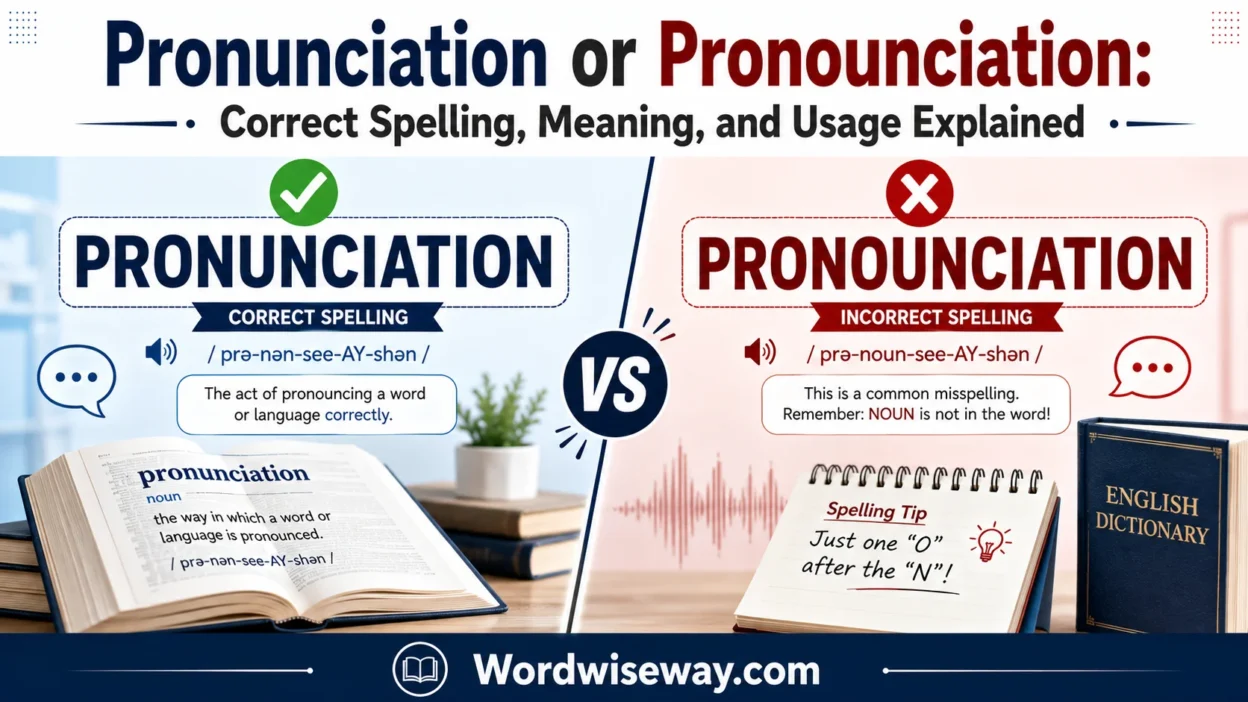
Pronunciation or Pronounciation: Correct Spelling, and Usage explains why Pronunciation is the correct spelling and Pronounciation is a wrong spelling.
Many learners search how to spell pronunciation because this common English spelling mistake creates confusion. Pronunciation is the standard form used in the English language to describe the sound, stress, and articulation of a spoken word.
The confusion happens because pronounce and pronunciation come from the same Latin root. However, their spelling difference and pronunciation difference matter. The verb pronounce uses ou and sounds like prəˈnaʊns, while pronunciation uses u between the two n’s and follows prəˌnʌn.siˈeɪ.ʃən.
This pronunciation guide helps learners avoid common mistakes and improve correct usage.
Quick Answer
Pronunciation is the correct spelling.
Pronounciation is an incorrect spelling and does not appear as a standard English word in dictionaries.
The correct example is:
- ✅ Her pronunciation of English words has improved.
- ❌ Her pronounciation of English words has improved.
The correct spelling removes the extra “o” after “n.” Remember:
Pronounce → Pronunciation
Not:
Pronounce → Pronounciation
What Is the Correct Spelling: Pronunciation or Pronounciation?
Pronunciation Is the Correct English Word
Pronunciation is a noun that describes the way a person says a word, phrase, or language. It includes the sounds, stress patterns, rhythm, and tone used while speaking.
For example:
- “Your pronunciation of difficult words is getting better.”
- “English pronunciation can be challenging for beginners.”
- “The teacher helped students improve their pronunciation.”
When you discuss how something is spoken, pronunciation is the word you need.
The word appears in major English dictionaries and is widely accepted in American English and British English.
Pronounciation Is a Common Spelling Mistake
Pronounciation looks reasonable at first glance, but it is incorrect.
Many people make this mistake because they think the noun should directly follow the spelling of the verb pronounce. The brain often connects the two words and automatically adds the extra “o.”
However, English does not always work that way.
Compare:
| Verb | Noun Form |
| Pronounce | Pronunciation |
| Announce | Announcement |
| Explain | Explanation |
| Decide | Decision |
As you can see, English spelling often changes when a verb becomes a noun.
Meaning of Pronunciation Explained
Definition of Pronunciation
Pronunciation means the way sounds are produced when someone speaks a word or group of words.
It involves several elements:
- Individual sounds: The specific sounds used to create words.
- Syllables: The parts of a word that contain vowel sounds.
- Word stress: The emphasis placed on certain syllables.
- Intonation: The rise and fall of the voice while speaking.
- Rhythm: The natural pattern and timing of speech.
For example, two people may use the same language but have different pronunciation because of their region, accent, or speaking habits.
A person from the United States may pronounce certain words differently from someone from the United Kingdom. Both can still be correct if the pronunciation follows accepted language patterns.
Why Pronunciation Matters in Communication
Good pronunciation does more than make speech sound better. It improves understanding.
Imagine ordering food at a restaurant and saying a word incorrectly. The listener may misunderstand your meaning. Clear pronunciation works like a bridge between your thoughts and another person’s understanding.
Strong pronunciation helps you:
- Communicate ideas clearly.
- Feel more confident while speaking.
- Improve conversations with native speakers.
- Avoid misunderstandings.
- Develop better language skills.
For students learning English, pronunciation is especially important because spelling and sound do not always match perfectly.
For example:
- Enough sounds like “enuff.”
- Colonel sounds like “kernel.”
- Receipt has a silent “p.”
English pronunciation often has hidden surprises.
How to Pronounce Pronunciation Correctly
Pronunciation Breakdown
The word pronunciation contains five syllables:
pro-nun-ci-a-tion
A common American English pronunciation sounds like:
pro-nun-see-AY-shun
The main stress usually falls on the “AY” sound.
pronunciation (pro-nun-see-ay-shun)
Breaking the word into smaller parts makes it easier to remember:
- Pro → first sound
- Nun → middle sound
- Ci → “see” sound
- Ation → ending sound
Practicing the word slowly before saying it naturally can help improve accuracy.
Pronunciation vs Pronounce: Understanding the Difference
Many learners confuse these two words because they share the same root.
However, they have different roles.
| Word | Type | Meaning | Example |
| Pronounce | Verb | To say a word aloud | “Can you pronounce this word?” |
| Pronunciation | Noun | The way a word is spoken | “Your pronunciation is clear.” |
The verb describes an action. The noun describes the result or method of that action.
Think about it this way:
- You pronounce a word.
- You have a pronunciation of that word.
Both words connect, but they are not spelled the same way.
Why Do People Spell Pronunciation as Pronounciation?
The Influence of the Word Pronounce
The biggest reason behind this spelling mistake is the word pronounce.
When people see:
Pronounce
they naturally expect:
Pronounciation
because the spelling seems connected.
However, English borrowed many words from different languages over centuries. Because of this, spelling patterns are not always perfectly predictable.
The change happens because the ending “-ation” creates a different spelling pattern.
The correct transformation is:
Pronounce + ation = Pronunciation
The letter combination changes, and the extra “o” disappears.
Similar English Spelling Changes
Many English words change when they move from verbs to nouns.
Examples:
| Verb | Noun | Change |
| Permit | Permission | “t” changes to “ss” sound |
| Confess | Confession | Spelling adjustment |
| Produce | Production | Ending changes |
| Pronounce | Pronunciation | Extra “o” removed |
These changes may seem strange, but they follow common English patterns.
Pronunciation or Pronounciation: Key Differences
| Feature | Pronunciation | Pronounciation |
| Correct spelling | ✅ Yes | ❌ No |
| Dictionary entry | Available | Not standard |
| Used in formal writing | Yes | No |
| Meaning | Way a word is spoken | No accepted meaning |
| Example | “His pronunciation is clear.” | “His pronounciation is clear.” |
Choosing the correct spelling makes your writing look more professional and accurate.
Common Pronunciation Mistakes English Learners Make
Adding Extra Sounds
Many learners add sounds that do not exist in the original word.
For example:
- Saying extra syllables in words.
- Adding unnecessary vowel sounds.
- Changing silent letters into spoken sounds.
English spelling can be tricky because letters do not always represent sounds directly.
Ignoring Word Stress
Word stress changes how natural your English sounds.
For example:
PREsent can mean a gift.
preSENT can mean to show or give something.
The spelling stays the same, but the stress changes the meaning.
Learning pronunciation requires more than memorizing letters. You also need to understand sound patterns.
Confusing Similar Sounds
Some English sounds are difficult because they do not exist in every language.
Common examples include:
| Word Pair | Difference |
| Ship / Sheep | Short “i” vs long “ee” sound |
| Live / Leave | Different vowel sounds |
| Desert / Dessert | Stress and sound difference |
Regular listening practice helps your ears recognize these differences.
Tips to Improve Your Pronunciation Skills
Improving pronunciation does not happen overnight. It works like building a skill: small daily practice creates noticeable progress over time. You don’t need to copy every sound perfectly at the beginning. The goal is to speak clearly and help others understand you.
Here are practical ways to improve your pronunciation:
Listen and Repeat Native Speech
Your ears play an important role in learning pronunciation. Before your mouth can produce new sounds, your brain needs to recognize them.
Listening helps you notice:
- How native speakers connect words.
- Where they place stress.
- How their voice changes during sentences.
- Which sounds they reduce or skip.
Useful practice sources include:
- Podcasts
- Audiobooks
- Interviews
- Movies and TV shows
- Language-learning videos
A simple technique is the shadowing method:
- Listen to a short sentence.
- Pause the audio.
- Repeat the sentence with the same rhythm.
- Compare your pronunciation with the original.
This method trains both your listening and speaking skills.
Learn Phonetic Symbols
The International Phonetic Alphabet (IPA) helps learners understand how words sound instead of relying only on spelling.
For example, the word pronunciation has a specific sound pattern that dictionaries show using phonetic symbols.
Learning basic IPA symbols can help you:
- Read dictionary pronunciation guides.
- Understand unfamiliar words.
- Identify difficult sounds.
- Practice accurately.
You don’t need to memorize every symbol. Learning the most common sounds is enough for everyday English improvement.
Practice Speaking Regularly
Many learners understand English well but hesitate when speaking because they rarely practice.
Regular speaking practice helps your brain and mouth work together naturally.
You can practice by:
- Reading articles aloud.
- Recording your voice.
- Speaking with language partners.
- Repeating difficult words.
- Having short daily conversations.
Even 10 minutes of focused practice can create improvement.
Examples of Pronunciation Used in Sentences
Seeing pronunciation in real sentences makes the meaning easier to understand.
Examples:
- “The teacher helped me improve my pronunciation of English words.”
- “Clear pronunciation makes conversations easier.”
- “Many English learners struggle with pronunciation because spelling and sounds are different.”
- “Her pronunciation sounds natural because she practices speaking every day.”
- “Correct pronunciation can increase confidence during presentations.”
These examples show that pronunciation usually refers to the way someone speaks rather than the words themselves.
Pronunciation Differences Between American and British English
English pronunciation changes depending on location. American English and British English share the same language, but some sounds, stress patterns, and vocabulary choices differ.
Examples:
| Word | American English | British English |
| Water | Often a softer “t” sound | Clearer “t” sound |
| Advertisement | AD-ver-tise-ment | Ad-VER-tis-ment |
| Schedule | SKED-jool | SHED-jool |
Neither version is automatically better. Both are accepted forms of English.
The important thing is consistency and clarity.
Case Study: How Pronunciation Practice Changes Communication
Consider a student learning English who knows thousands of words but avoids conversations because people often ask them to repeat sentences.
The problem may not be vocabulary. It may be pronunciation.
After practicing:
- Word stress
- Common sounds
- Listening exercises
- Speaking repetition
the student becomes easier to understand.
This shows an important lesson: knowing a language and communicating effectively are two different skills.
Vocabulary gives you the words. Pronunciation helps those words reach another person clearly.
Read More: Fourty or Forty: Correct Spelling, Meaning, and Usage
FAQs
What is the correct spelling: Pronunciation or Pronounciation?
The correct spelling is Pronunciation. The word Pronounciation is a common misspelling and is not accepted in standard English writing. The correct form is used in dictionaries, education, and professional communication.
Why do people spell pronunciation as Pronounciation?
Many people write Pronounciation because it seems to match the spelling pattern of the verb pronounce. Since both words sound related, learners often add “ou” by mistake, but English spelling rules do not always follow sound patterns.
What does pronunciation mean in English?
Pronunciation means the way a word is spoken, including its sounds, stress, and articulation. It helps people communicate clearly and understand spoken language correctly.
How do you pronounce the word pronunciation?
The word pronunciation is pronounced as prəˌnʌn.siˈeɪ.ʃən. It has a short /ʌ/ sound and differs from the pronunciation of the verb pronounce.
Is Pronounciation ever considered correct?
No, Pronounciation is considered an incorrect spelling. Although many people use it in casual writing, it should be avoided in formal English, academic writing, and professional communication.
What is the difference between pronounce and pronunciation?
Pronounce is a verb that means to say a word aloud, while pronunciation is a noun that describes the way a word is spoken. Both come from the same Latin root but have different spellings and uses.
Why is pronunciation difficult for English learners?
Pronunciation can be difficult because English spelling and sounds do not always match. Many words have unusual spelling patterns, which can create confusion for learners.
How can I remember the correct spelling of pronunciation?
A useful memory trick is to remember that pronunciation contains only one “ou” sound pattern with a single “u” between the two n’s. Avoid connecting it directly with pronounce.
Is pronunciation important in communication?
Yes, correct pronunciation improves clarity and helps people express ideas effectively. Good pronunciation supports better speech, listening skills, and professional communication.
Where can I learn correct pronunciation of English words?
You can learn correct pronunciation from dictionaries, language learning resources, pronunciation guides, and regular speaking practice. Listening and repeating words can also improve accuracy.
Conclusion
Understanding the difference between Pronunciation and Pronounciation helps avoid one of the most common English spelling mistakes. Although the incorrect form may look natural because of the word pronounce, only Pronunciation is accepted as the correct spelling. Learning its meaning, sound, and usage makes written and spoken English clearer.
Correct pronunciation is an important part of effective communication. By following spelling rules, checking dictionaries, and practicing speech, learners can improve their vocabulary and confidence. Remembering the correct form of pronunciation will help you write and speak English more accurately.

Amelia Sanders has spent 14 years in Harvard University’s English Department, helping students navigate literary analysis, interpretive theory, and narrative techniques. Her academic pursuits center on 18th-century British prose, romantic poetry, diasporic writing, and digital editing exploring how textual choices influence cultural perspectives. Amelia has spoken at major international meetings and contributed essays to respected academic volumes, demonstrating her dedication to thoughtful scholarship and effective teaching.