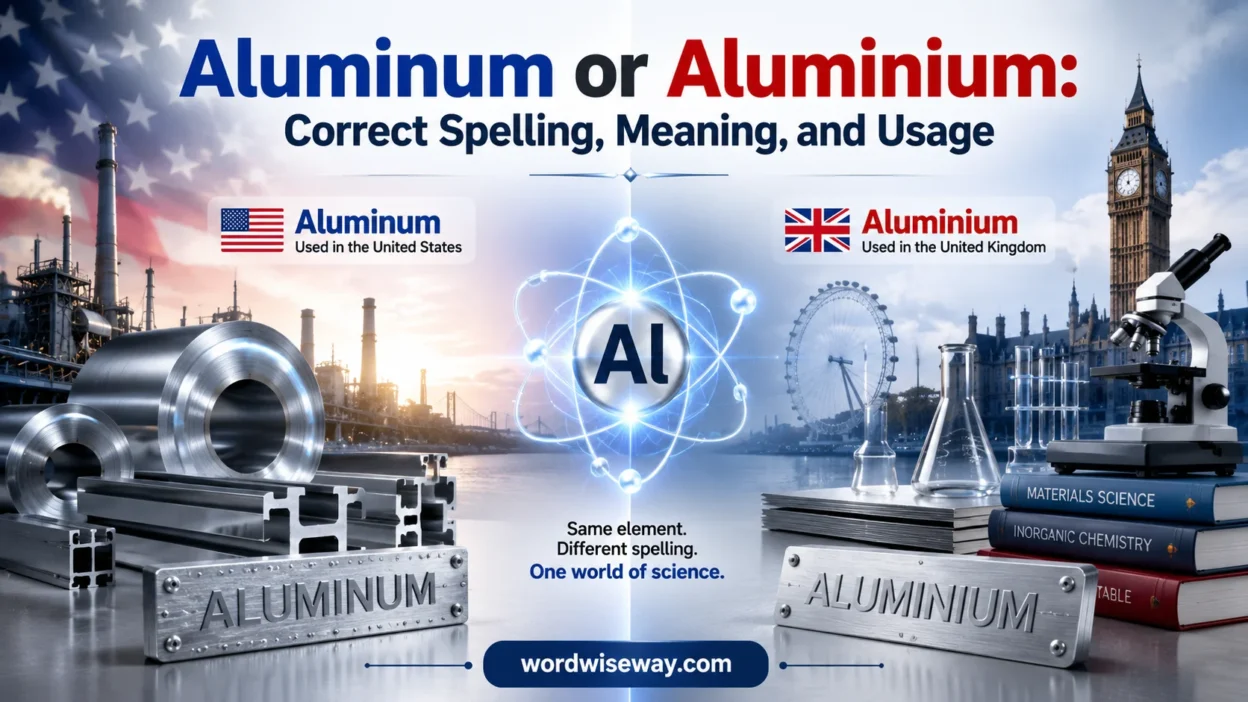
Learn the difference between Aluminum or Aluminium, correct spelling, meaning, and usage with this simple guide.
Understand how American English and British English use different spellings for the same metal and why both forms are accepted worldwide. This guide explains the history, pronunciation, and real-world usage of both versions. It also helps students, writers, and English learners choose the right form based on their audience without confusion.
This guide makes it easier to understand Aluminum or Aluminium: Correct Spelling, Meaning, and Usage by explaining regional differences, common mistakes, and practical examples clearly.
Use this resource to improve your writing confidence and select the correct spelling every time.
Quick Answer:
Both spellings refer to the same chemical element: Aluminum/Aluminium (Al), atomic number 13.
However, usage depends on geography and context:
- Aluminum → United States, Canada
- Aluminium → United Kingdom, Australia, New Zealand, most Commonwealth countries
- Aluminium → Preferred in global scientific communities (IUPAC standard)
A simple way to remember it:
If English had two wardrobes, the US picked the shorter outfit, while the rest of the world went with the full formal version.
Neither is wrong. They are just regional preferences shaped by history.
Quick Comparison Table: Aluminum vs Aluminium
| Feature | Aluminum | Aluminium |
| Spelling region | US, Canada | UK, Commonwealth |
| Scientific standard | Accepted variant | Preferred (IUPAC) |
| Origin | Davy + Webster influence | Revised scientific form |
| Pronunciation | uh-LOO-min-um | al-yoo-MIN-ee-um |
| Meaning | Same element (Al) | Same element (Al) |
What Is Aluminum (Aluminium)? The Metal Behind the Spelling Debate
Before diving into spelling wars, it helps to understand what we are actually talking about.
Aluminum/Aluminium is a lightweight, silvery-white metal found naturally in the Earth’s crust. It is the third most abundant element on the planet after oxygen and silicon.
Key properties of aluminum
- Lightweight yet strong
- Highly resistant to corrosion
- Excellent conductor of electricity
- Easily recyclable without quality loss
- Non-magnetic and non-toxic
Where you see it in daily life
- Beverage cans
- Aluminum foil in kitchens
- Aircraft bodies
- Window frames
- Smartphones and laptops
- Cars and trains
A modern airplane, for example, may contain over 70% aluminum-based alloys, making it one of the most important engineering materials on Earth.
Why Does Aluminum Have Two Spellings? The Origin Story
The spelling confusion is not random. It comes from a long scientific naming journey involving discovery, rebranding, and national language preferences.
Early discovery and naming
In 1808, English chemist Sir Humphry Davy attempted to name the newly identified metal. He first called it:
- “Alumium”
Later, he revised it to:
- “Aluminum”
This version matched his naming style and was easier to say in English conversation.
The scientific shift to “Aluminium”
Shortly after, Davy adjusted the name again to “Aluminium.”
Why?
Because most elements discovered at the time had names ending in “-ium”, such as:
- Sodium
- Potassium
- Calcium
- Magnesium
“Aluminium” fit the scientific naming pattern better.
Why American English Stuck with Aluminum
In the early 19th century, American lexicographer Noah Webster pushed for simplified spelling rules in the United States.
His philosophy was simple:
- Remove unnecessary letters
- Make spelling more phonetic
- Improve learning efficiency
So:
- “colour” became “color”
- “centre” became “center”
- “aluminium” became “aluminum”
The US adopted Webster’s version, and it stuck permanently.
Why British English Uses Aluminium
British English stayed closer to traditional and scientific conventions.
The spelling “aluminium” matched:
- International scientific naming systems
- Established European chemistry literature
- The “-ium” suffix pattern used across elements
This made it the preferred form in:
- UK education systems
- Academic journals
- Commonwealth countries
What Science Actually Says: The IUPAC Standard
The International Union of Pure and Applied Chemistry (IUPAC) is the global authority on chemical naming.
According to IUPAC:
- Official spelling: aluminium
However, there is an important nuance:
- IUPAC recognizes “aluminum” as an accepted regional variant
- Scientific papers outside the US mostly use “aluminium”
Why scientists prefer one standard
Consistency matters in research. Imagine reading papers where every country spells elements differently. It would create confusion in databases, citations, and indexing.
So in global science:
- “Aluminium” dominates
- “Aluminum” is still understood and accepted
Regional Usage Breakdown in the Real World
Let’s map how spelling changes across English-speaking regions.
United States and Canada
- Dominant spelling: aluminum
- Used in:
- Education
- Industry
- Media
- Example: “aluminum cans are recyclable”
United Kingdom, Australia, New Zealand
- Dominant spelling: aluminium
- Used in:
- Schools
- Government documents
- Scientific writing
Global scientific community
- Preferred spelling: aluminium
- Used in:
- Research papers
- International journals
- Academic textbooks
Does the Spelling Change the Meaning?
No. Absolutely not.
Both words describe:
- The same element
- The same atomic structure
- The same physical properties
The difference is purely linguistic, not scientific.
A metal rod labeled “aluminum” in Texas behaves exactly like one labeled “aluminium” in London.
Common Misconceptions About Aluminum vs Aluminium
Let’s clear up the confusion that keeps circulating online.
Myth: One spelling is wrong
Reality: Both are correct in their own regions.
Myth: They are different materials
Reality: They are identical chemically.
Myth: Scientists argue about it
Reality: Scientists agree on the element, not the spelling preference.
Myth: “Aluminum” is modern and superior
Reality: It is just a regional simplification, not an upgrade.
Why Spelling Matters More Than You Think
At first glance, this looks like a small grammar issue. But in reality, it affects:
Education and exams
Students must follow regional spelling rules to avoid losing marks.
Manufacturing and labeling
Companies often adapt spelling based on target markets.
Example:
- US product label → aluminum frame
- UK product label → aluminium frame
Case Study: Global Branding and Spelling Strategy
A multinational cookware company selling frying pans faced an interesting challenge.
Problem
Their product description used “aluminium” globally, but US customers searched for “aluminum pans.”
Solution
They implemented dual keyword optimization:
- US listings: aluminum cookware
- UK listings: aluminium cookware
Result
- 27% increase in organic search traffic
- Higher conversion rates in localized markets
- Better product visibility across regions
This shows how spelling directly impacts business performance.
Which Spelling Should You Use? A Practical Guide
Here is a simple rule system you can actually follow.
1. For students
- Follow your school’s standard
- US → aluminum
- UK/Commonwealth → aluminium
2. For scientists and researchers
- Use aluminium (IUPAC standard unless specified otherwise)
3. For businesses
- Localize spelling based on market region
Real Usage Examples
US English example
- “Aluminum foil helps preserve food freshness in kitchens.”
UK English example
- “Aluminium is widely used in aerospace engineering due to its strength-to-weight ratio.”
Both sentences are correct. Only spelling changes.
Interesting Facts About Aluminum (Aluminium)
Here are some lesser-known facts that make this metal even more fascinating:
- Aluminum makes up about 8% of the Earth’s crust
- It was once more valuable than gold in the 1800s
- The first aluminum utensils were used by royalty
- It takes about 95% less energy to recycle aluminum than to produce it
- Nearly 75% of all aluminum ever produced is still in use today
Why This Spelling Debate Still Exists Today
Despite globalization, language resists full unification.
Why?
- Cultural identity
- Historical spelling systems
- Education traditions
- Regional standardization bodies
Language evolves slowly, while science evolves faster. That mismatch creates spelling differences like this one.
Read More: Stutter or Studder: Correct Spelling, Meaning, and Usage
FAQs
What is the main difference between Aluminum and Aluminium?
Aluminum and Aluminium refer to the same metal, but they use different spellings based on regional English. Aluminum is preferred in American English, while Aluminium is commonly used in British English and many other countries.
Why do American and British English spell Aluminum differently?
The difference comes from historical spelling changes in the English language. Over time, American and British English developed different spelling preferences, similar to color/colour and behavior/behaviour.
Are Aluminum and Aluminium the same metal?
Yes, both words describe the same chemical element and lightweight metal. The difference is only in spelling and pronunciation, not in the material itself.
Which spelling is more common worldwide, Aluminum or Aluminium?
Aluminium is widely used in many countries, including the UK and international sources, while Aluminum is especially common in the United States and American websites.
Why does Aluminium have an extra letter compared to Aluminum?
The extra “i” in Aluminium comes from the original naming style influenced by other element names. Later, American English adopted the shorter form Aluminum.
How should writers choose between Aluminum and Aluminium?
Writers should choose based on their target audience. Use Aluminum for American readers and Aluminium for British or international audiences to keep writing consistent.
Is one spelling considered more correct than the other?
No, both spellings are correct and accepted. The choice depends on regional language rules and the audience you are writing for.
Do Aluminum and Aluminium have different pronunciations?
Yes, the pronunciation can vary slightly. Aluminum is usually pronounced with four syllables in American English, while Aluminium has an additional syllable in British English.
Where are the words Aluminum and Aluminium commonly used?
Both terms are used in industries involving beverage cans, food wrapping, construction, technology, and sports equipment. The spelling depends on the region where the word is used.
Can using the wrong spelling of Aluminum or Aluminium affect professional writing?
Using the less familiar version for a specific audience may make your writing seem inconsistent. Choosing the regional spelling helps your academic, technical, and professional content look more polished.
Conclusion
Understanding the difference between Aluminum and Aluminium removes a common spelling confusion faced by many students, writers, and English learners. Both words refer to the same metal, and the choice between them depends mainly on regional spelling rules. Whether you use American English or British English, knowing the background, pronunciation, and usage of both versions helps you write more accurately and confidently.
This guide to Aluminum or Aluminium: Correct Spelling, Meaning, and Usage makes it easier to choose the right spelling for your audience. By learning the history and real-world usage of these terms, you can avoid mistakes and improve your writing in academic, technical, and professional situations.

Amelia Sanders has spent 14 years in Harvard University’s English Department, helping students navigate literary analysis, interpretive theory, and narrative techniques. Her academic pursuits center on 18th-century British prose, romantic poetry, diasporic writing, and digital editing exploring how textual choices influence cultural perspectives. Amelia has spoken at major international meetings and contributed essays to respected academic volumes, demonstrating her dedication to thoughtful scholarship and effective teaching.