Eczema or Ringworm: Difference, Symptoms, and Causes can be confusing because both skin conditions may cause redness, itchiness, irritation, flaky skin, and a circular rash.
However, their causes, symptoms, and key features are different. Eczema often causes dry skin and scaly skin, while ringworm is a contagious fungal infection. These common rashes may look similar for weeks or months, making it important to tell apart each condition.
A proper diagnosis helps identify and distinguish eczema from ringworm and guides the right treatment. Searching online can add to confusion, especially when someone compares different examples.
Both conditions can occur at the same time, and an eczema child may be prone to skin infections. Knowing the difference can help minimise the risk of choosing the wrong treatment, which may worsen symptoms.
Quick Answer:
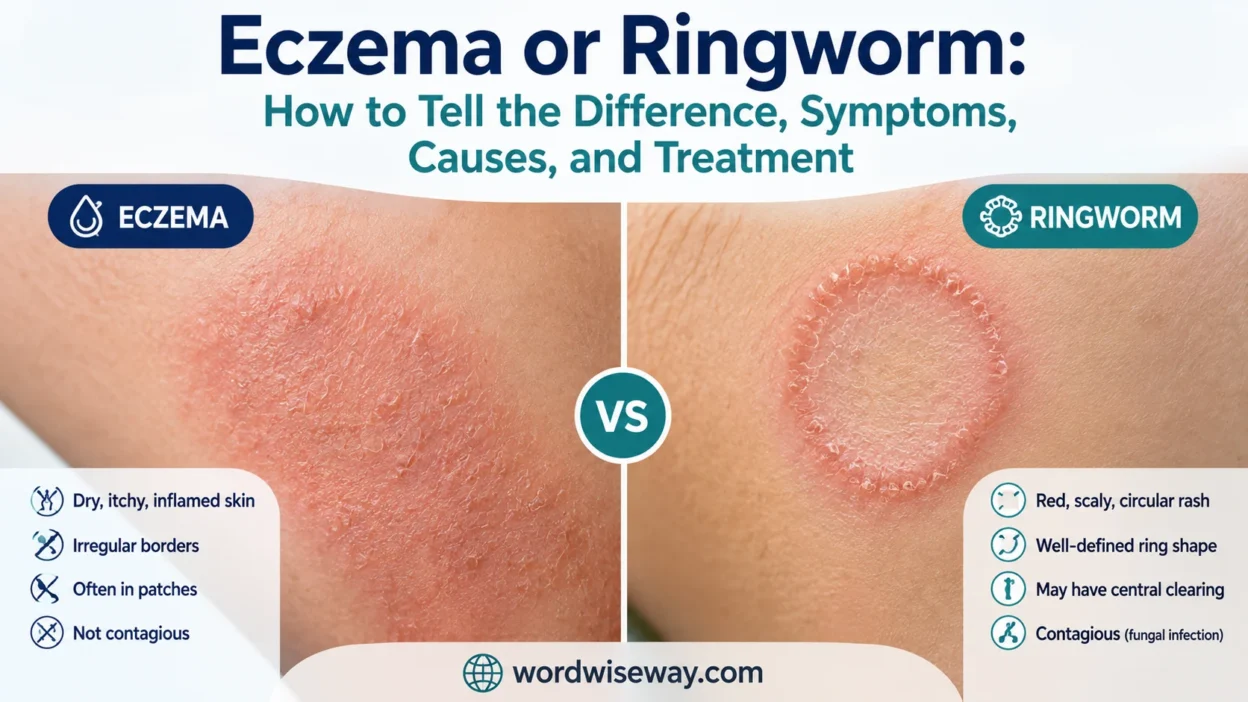
Eczema is more likely when the skin is very dry, intensely itchy, inflamed, and prone to recurring flares. The patches don’t necessarily have a sharply raised border or an expanding ring pattern.
Ringworm is more likely when a scaly patch gradually expands outward and develops a more noticeable border, sometimes leaving a clearer-looking center. It can also spread to other people or parts of the body because it is a fungal infection.
However, there isn’t one visual feature that can reliably distinguish every case.
| Feature | Eczema | Ringworm |
| Main cause | Inflammation and skin-barrier problems | Fungal infection |
| Contagious | No | Yes |
| Itching | Very common | Common |
| Dry or scaly skin | Common | Common |
| Ring-shaped appearance | Possible, especially with nummular eczema | Common but not always perfect |
| Distinct raised border | Less typical | Often present |
| Clearer center | Not typical, although it can occur as eczema improves | Can occur as the rash expands |
| Can spread to other people? | No | Yes |
| Typical treatment | Moisturizers and anti-inflammatory treatment | Antifungal treatment |
| Testing sometimes needed | Yes, depending on the presentation | Yes, especially when uncertain |
The safest rule is simple: don’t diagnose a circular rash by shape alone.
What Is Eczema?
Eczema is a group of inflammatory skin conditions. Atopic dermatitis is one of the best-known forms, but eczema also includes conditions such as contact dermatitis, nummular eczema, dyshidrotic eczema, neurodermatitis, and others.
Atopic dermatitis often begins with intense itching. Scratching then makes the skin more irritated, which creates a troublesome itch-scratch cycle. Symptoms can include dry, scaly skin, discoloration, rough patches, and small bumps. The appearance can vary considerably from one person to another.
Eczema isn’t caused by a fungus. Instead, different forms can involve a combination of skin-barrier dysfunction, immune-system activity, environmental triggers, irritants, and allergies.
Common Types of Eczema
Several forms can produce a rash that looks confusingly similar to ringworm.
- Atopic dermatitis: Often causes itchy, dry, inflamed skin and can affect different parts of the body at different ages.
- Contact dermatitis: Develops after skin contacts an irritating substance or an allergen.
- Nummular eczema: Produces round or coin-shaped itchy patches that can resemble ringworm.
- Dyshidrotic eczema: Usually affects the hands, feet, or both and can cause tiny itchy blisters.
- Neurodermatitis: Often begins as an itchy patch that becomes thicker through repeated scratching.
What Does Eczema Look Like?
Eczema can appear differently depending on the type and the person’s skin tone.
Common signs include:
- Intense itching
- Dryness
- Scaling or flaking
- Inflamed or discolored patches
- Rough or thickened skin
- Cracking
- Small bumps
- Blisters in certain forms
- Oozing or crusting when skin becomes damaged or infected
The color of eczema isn’t always bright red. On darker skin, inflammation may appear brown, purple, grayish, or as a change in the skin’s normal color. That makes internet image comparisons particularly unreliable.
What Is Ringworm?
Despite its name, ringworm has nothing to do with worms.
Ringworm is a fungal infection caused by fungi known as dermatophytes. The infection can affect skin on different parts of the body and can also involve the scalp, feet, groin, and nails. The same broad group of fungi can cause conditions commonly called athlete’s foot and jock itch.
Ringworm can spread through direct contact with an infected person or animal. It can also spread through contaminated objects and surfaces.
What Does Ringworm Look Like?
A typical ringworm rash may begin as a scaly patch and gradually enlarge.
The outer edge can become more noticeable as the infection spreads outward. In some cases, the center looks clearer than the border. That’s where the familiar “ring” appearance comes from.
But here’s the catch: ringworm doesn’t always form a perfect ring.
That matters because many people see a circular patch and immediately assume it must be fungal. Others see a patch without a perfect ring and rule ringworm out. Both assumptions can lead you astray.
The CDC notes that ringworm symptoms can resemble other skin or nail conditions and that testing can help confirm the diagnosis.
Eczema or Ringworm: The Biggest Differences
When comparing eczema vs. ringworm, several clues can help you understand what you’re seeing.
Shape and Pattern
Ringworm often develops an expanding pattern. The outer edge can become scaly and more prominent while the center looks less affected.
Eczema doesn’t usually behave like an advancing fungal border.
Yet nummular eczema is the great wildcard. It produces round or oval patches that may be raised, scaly, intensely itchy, and persistent. According to the American Academy of Dermatology, these patches commonly appear on the legs, forearms, or backs of the hands.
So, a circular shape raises a question. It doesn’t settle the case.
The Border of the Rash
The border can provide another clue.
With ringworm, the edge often becomes scaly and more distinct. The infection can expand outward, giving the rash an advancing appearance.
Eczema may have a less defined border. Its skin can look dry, irritated, rough, or inflamed across the affected area.
Still, appearances overlap. That’s why a clinician may use testing when the diagnosis isn’t obvious.
What Happens in the Center?
A relatively clearer center can occur with ringworm as the lesion expands outward.
That pattern is useful, but it isn’t exclusive to fungal infections. Nummular eczema can flatten as it improves, and the center can clear first.
In other words, a clear center isn’t a fingerprint for ringworm.
How the Rash Changes Over Time
Time can reveal patterns that a single photograph can’t.
Ringworm may gradually enlarge as the fungal infection continues. Eczema often follows a different course, with flares and periods of improvement.
A recurring rash that appears in similar circumstances may point toward an inflammatory condition. A slowly expanding scaly lesion, particularly after fungal exposure, deserves consideration of ringworm.
Eczema vs. Ringworm Symptoms
Itching is one of the biggest sources of confusion because both conditions can itch intensely.
Itching
Eczema can cause severe itching. Atopic dermatitis is sometimes described by dermatologists as an “itch that rashes” because itching can appear before the visible rash.
Ringworm can also be itchy. Therefore, scratching alone can’t tell you which condition you have.
Scaling and Dryness
Both conditions can produce scaling.
Eczema often comes with generally dry or sensitive skin. Ringworm can produce localized scaling, especially around the advancing border.
Think of the distinction this way:
Eczema often makes the skin behave like an irritated barrier. Ringworm creates a localized fungal infection that can expand across the skin.
That isn’t a diagnostic rule, but it helps explain why the two conditions behave differently.
Cracking, Oozing, and Crusting
Eczema can crack when the skin becomes very dry or inflamed. Scratching can also damage the skin and create openings where bacteria may enter.
The American Academy of Dermatology lists yellow or golden crusts, swelling, pus, tenderness, and pain among signs that nummular eczema may have become infected.
A rash that becomes painful, swollen, warm, or increasingly tender needs medical attention rather than endless trial-and-error treatment.
Where Does Eczema or Ringworm Usually Appear?
Location can provide useful context, although it can’t establish a diagnosis by itself.
Common Eczema Locations
Atopic dermatitis can appear in many locations and changes with age. Other eczema types have more specific patterns.
For example:
- Hands are common in contact and hand eczema.
- The face and neck can be affected by several forms of eczema.
- Elbows and knees can be involved in some patterns.
- Nummular eczema commonly affects the legs, forearms, and backs of the hands.
Common Ringworm Locations
Ringworm can affect different areas of the body.
Common forms include:
- Tinea corporis: Ringworm of the body
- Tinea pedis: Athlete’s foot
- Tinea cruris: Jock itch
- Tinea capitis: Ringworm of the scalp
The location matters because some forms require different treatment. For example, scalp ringworm generally needs medical treatment rather than simply applying an over-the-counter cream.
What Causes Eczema?
Eczema has no single cause.
Different forms can involve inherited tendencies, immune responses, skin-barrier problems, allergens, and environmental triggers.
Common triggers may include:
- Fragrances
- Harsh soaps
- Certain chemicals
- Dry air
- Heat
- Sweat
- Rough fabrics
- Allergens
- Skin irritation
Contact dermatitis is a good example. It can develop when the skin encounters something that causes irritation or an allergic reaction. Symptoms may include itching, burning, swelling, dryness, blisters, oozing, and crusting.
How Do You Get Ringworm?
Ringworm is infectious, which makes its causes very different from eczema.
You can acquire ringworm through:
- Direct skin-to-skin contact with an infected person
- Contact with an infected animal
- Shared towels or clothing
- Contaminated bedding
- Contaminated surfaces or objects
- Certain warm, moist environments
Pets can also play a role in transmission. If several people or animals in the same household develop suspicious fungal rashes, that pattern deserves attention.
Unlike eczema, ringworm can move from one person to another. That’s one of the most important practical differences between the two.
Can Eczema Turn Into Ringworm?
No. Eczema doesn’t transform into ringworm.
They are different conditions with different causes.
However, a person who has eczema can also develop a fungal infection. Having one doesn’t provide immunity from the other.
This overlap can make diagnosis tricky. A person may already have irritated, dry skin and then develop a fungal infection in the same area. Alternatively, an eczema patch may simply resemble ringworm.
That’s why persistent or unusual rashes sometimes need examination and testing rather than another round of guessing.
Can Ringworm Be Mistaken for Eczema?
Absolutely.
Ringworm and eczema can both cause:
- Itching
- Scaling
- Dryness
- Discoloration
- Raised patches
- Irritated skin
Nummular eczema creates an especially difficult puzzle because its round patches can closely resemble fungal lesions. The American Academy of Dermatology specifically notes that ringworm and other skin conditions can resemble nummular eczema.
Illustrative Case Study: The Circular Rash That Wasn’t So Simple
Consider an example.
A teenager notices a round, itchy patch on the forearm. It has a slightly raised edge and some scaling. Because it looks like a ring, the first assumption is ringworm.
But the rash doesn’t behave exactly as expected. Similar patches have appeared before, the surrounding skin is very dry, and there has been no obvious exposure to an infected person or animal.
A clinician examines the area and considers nummular eczema among the possibilities.
The lesson isn’t that one set of symptoms proves eczema. The lesson is more useful: visual clues narrow the possibilities, but they don’t always identify the cause.
How Doctors Tell Eczema and Ringworm Apart
A healthcare professional usually starts with the basics.
They’ll examine the rash, consider its shape and location, ask when it started, and ask whether it has changed. Exposure history can also matter.
If ringworm is suspected but the appearance isn’t clear, testing can help.
Fungal Testing
A clinician may take a small skin scraping from the affected area and examine it for evidence of fungal infection. The CDC specifically recommends considering testing because ringworm can resemble other skin conditions.
Testing becomes particularly useful when:
- The rash doesn’t respond as expected.
- The appearance is unusual.
- Eczema and ringworm both seem plausible.
- The infection is recurring.
- Treatment hasn’t produced the expected improvement.
Accurate diagnosis isn’t just about naming the rash. It determines which treatment makes sense.
Eczema Treatment vs. Ringworm Treatment
The treatment difference is where the diagnosis really matters.
How Eczema Is Treated
Eczema treatment depends on the type, severity, location, and individual triggers.
Common approaches include:
- Regular moisturizing
- Gentle skin care
- Avoiding known irritants
- Anti-inflammatory medications when prescribed or recommended
- Other treatments for persistent or severe disease
Moisturizing is especially important because dry skin can worsen itching and contribute to cracks in the skin. The AAD recommends fragrance-free creams or ointments for many people with eczema and emphasizes applying moisturizer to damp skin after bathing.
How Ringworm Is Treated
Ringworm requires antifungal treatment.
Some uncomplicated skin infections can respond to nonprescription topical antifungals. Other infections, particularly certain scalp infections or more extensive cases, may require prescription medication. The treatment depends on the location and severity of the infection.
This is why treating every itchy patch as eczema can backfire.
Why Steroid Creams Can Be a Problem With Ringworm
Steroid creams reduce inflammation. They don’t eliminate the fungus responsible for ringworm.
The CDC specifically warns: “Do not use steroid creams for rashes that could be ringworm.”
A steroid can temporarily make a rash look less inflamed while the fungal infection remains. That can blur the clinical picture and delay the correct treatment.
If a rash might be fungal, it’s better to have the diagnosis clarified rather than repeatedly applying treatments at random.
How to Prevent Ringworm From Spreading
Because ringworm is contagious, prevention focuses on reducing exposure and transmission.
Useful steps include:
- Don’t share towels, clothing, or personal items.
- Wash clothing and bedding regularly.
- Keep affected skin clean and dry.
- Avoid close skin-to-skin contact with an infected area.
- Follow the recommended antifungal treatment.
- Consider whether an infected pet could be the source.
- Have persistent or spreading infections evaluated.
The goal isn’t complicated. Break the transmission chain.
How to Manage Eczema and Reduce Flares
Eczema prevention works differently because you aren’t trying to prevent a contagious fungus.
Instead, the goal is to protect the skin barrier and reduce triggers.
Helpful habits include:
- Moisturize regularly.
- Choose fragrance-free skin-care products.
- Use lukewarm rather than very hot water.
- Avoid harsh cleansers.
- Protect irritated skin from unnecessary friction.
- Identify personal triggers.
- Follow the treatment plan recommended by a healthcare professional.
For nummular eczema, the AAD recommends applying a fragrance-free moisturizer after bathing and using gentle, non-drying skin-care products.
When Should You See a Doctor?
A rash deserves professional evaluation when you can’t confidently identify what’s causing it or when it isn’t improving as expected.
Seek medical advice if:
- The rash keeps spreading.
- The area becomes painful or swollen.
- Pus or significant crusting develops.
- The rash involves the scalp.
- Hair loss develops around a scalp rash.
- The condition repeatedly returns.
- Treatment doesn’t work as expected.
- Several household members develop similar symptoms.
- You aren’t sure whether the rash is eczema or ringworm.
The CDC notes that ringworm can resemble other skin conditions and recommends testing when appropriate.
Eczema or Ringworm: A Simple Decision Guide
A rash may be more suggestive of ringworm when:
- It gradually expands outward.
- The edge is scaly and more defined.
- The center looks less affected.
- Someone else has developed a similar rash.
- There has been contact with an infected person or animal.
A rash may be more suggestive of eczema when:
- The surrounding skin is very dry.
- The condition repeatedly flares.
- Itching is prominent.
- There are known skin-care or environmental triggers.
- The patch doesn’t have a clear advancing border.
- Similar patches have occurred previously.
These are clues, not a home diagnostic test.
Read More: ADHD or Anxiety:Difference, Symptoms, Causes, and Treatment
FAQs
Can eczema look like ringworm?
Yes. Eczema can sometimes create round or circular patches that look similar to ringworm. Both may cause redness, itching, dryness, and scaling, so appearance alone isn’t always enough to tell them apart.
Is ringworm more contagious than eczema?
Yes. Ringworm is a fungal infection that can spread from person to person, animals, or contaminated objects. Eczema itself isn’t contagious, so you can’t catch it from someone else.
What is the main difference between eczema and ringworm?
The biggest difference is their cause. Eczema is an inflammatory skin condition, while ringworm is caused by a type of fungus. Their treatments are therefore different as well.
Does eczema cause a circular rash?
Some forms of eczema can produce round or coin-shaped patches. This can make the rash resemble ringworm, especially when the area is red, dry, itchy, or scaly.
Can you have eczema and ringworm at the same time?
Yes. A person can have eczema and a fungal infection at the same time. This can make the skin changes harder to interpret, so a healthcare professional may need to check the rash carefully.
Does ringworm always form a ring?
No. Despite its name, ringworm doesn’t always create a perfect ring. Its appearance can vary depending on the affected body area and the individual.
Can the wrong treatment make a rash worse?
It can. Eczema and ringworm need different approaches, so treating one condition as though it were the other may not improve the rash and can sometimes make the problem worse.
How can I tell whether a rash is eczema or ringworm?
Look at the overall pattern, symptoms, and how the rash changes over time, but don’t rely on appearance alone. A healthcare professional can provide a more reliable diagnosis when the cause isn’t clear.
Can children get both eczema and ringworm?
Yes. Children can develop eczema and can also get contagious fungal infections such as ringworm. Good skin care and appropriate treatment can help reduce the risk of infection.
When should I get a rash checked?
Consider getting a persistent, spreading, painful, or unexplained rash checked by a healthcare professional. This is especially useful when you aren’t sure whether you’re dealing with eczema, ringworm, or another skin condition.
Conclusion
Eczema and ringworm can share several visible signs, which explains why people often mix them up. Itchy, red, dry, flaky, or circular patches don’t automatically point to one condition. The key distinction is that eczema is an inflammatory skin condition, while ringworm is a contagious fungal infection. Understanding this difference can help you avoid guessing and recognize why the correct diagnosis matters.
When a rash doesn’t look clear-cut, getting appropriate medical advice is a sensible next step. Correctly identifying the condition helps guide suitable treatment and can prevent unnecessary confusion. Whether the problem is eczema, ringworm, or another rash entirely, paying attention to changes in the skin is a better strategy than judging the condition by its appearance alone.