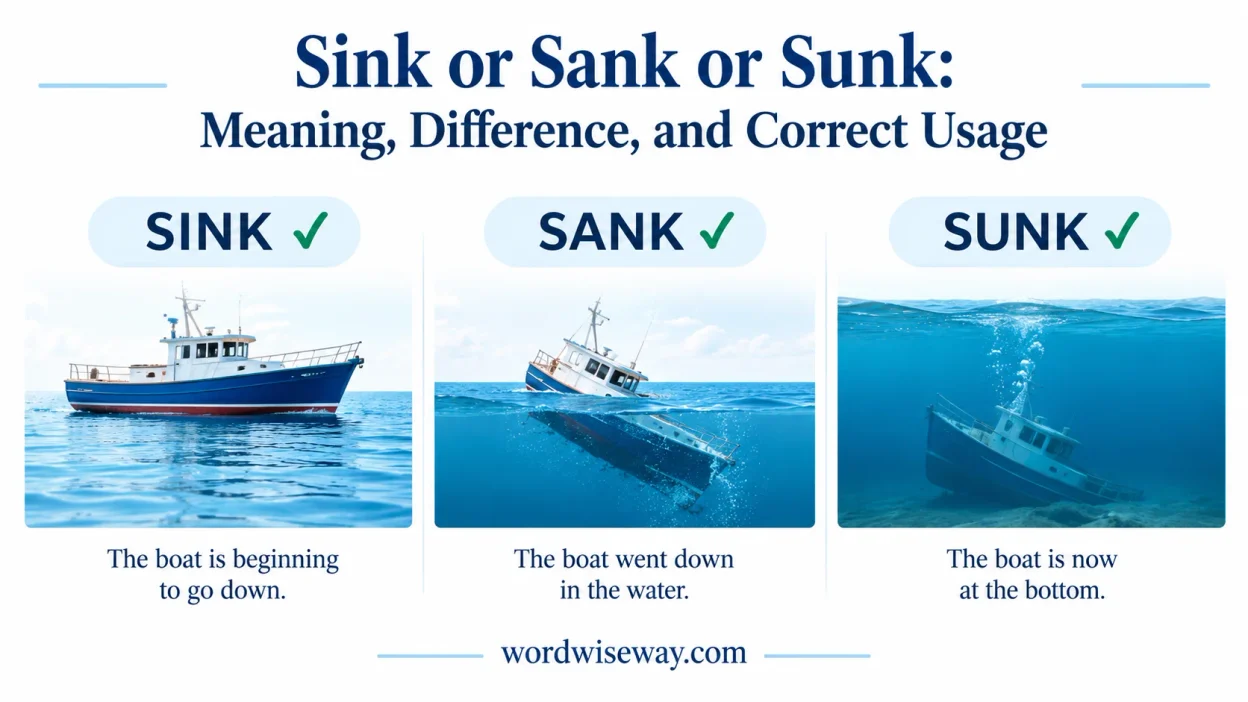
Sink, sank, sunk are forms of the same English verb, but their meaning, tense, and correct usage differ. Sink or Sank or Sunk: Meaning, Difference, and Correct Usage helps English learners understand these confusing words and their forms. The verb sink means to go down, move under water, or drop downward, while sank is the past tense and sunk is the past participle.
This confusion often affects speaking and writing, particularly for students, writers, and professionals trying to avoid grammar mistakes in emails, exams, and formal writing. The keyword is commonly searched because learners mix up these forms. Understanding the basic grammar rules makes their correct usage more natural and easier to remember.
A ship that went below the surface yesterday sank, while sunk usually works with an auxiliary verb. This article explains the origin, spelling differences, usage rules, and common mistakes through real-life examples, comparison tables, and FAQs, giving you a quick answer on how to use each form correctly.
Quick Answer:
Sink is the base form of the verb. It describes an action in the present or appears after words such as can, could, may, might, and will.
Sank is the simple past form. Use it when the action happened in the past and you aren’t using a perfect construction.
Sunk is the past participle. It commonly appears with has, have, or had, and it can also occur in passive constructions.
| Word | Verb form | Main use | Example |
| Sink | Base form / present form | Present actions, infinitives, and modal constructions | The boat may sink. |
| Sank | Simple past | Completed past action | The boat sank yesterday. |
| Sunk | Past participle | Perfect tenses and some passive constructions | The boat has sunk. |
A useful pattern to remember is:
Sink → present or base form
Sank → simple past
Sunk → past participle
What Does “Sink” Mean?
Sink means to move downward, usually below the surface of water or another liquid. It can also describe something moving into a softer material, such as mud or sand.
For example:
- The stone will sink in the water.
- Heavy objects usually sink faster than light ones.
- The roots sink deep into the soil.
- Don’t let the boat sink.
The word also has several figurative meanings. A person’s spirits can sink when they receive disappointing news. Prices can sink during a sharp decline. A person can sink into a chair after a tiring day.
Because sink is the base form, you also use it after modal verbs and certain other structures.
Examples of “Sink” in a Sentence
Here are several natural examples:
- The ship could sink during the storm.
- Rocks usually sink in water.
- The temperature may sink below freezing tonight.
- Her heart seemed to sink when she heard the result.
- The old building began to sink into the soft ground.
- He watched the sun sink below the horizon.
Notice the pattern. When a modal such as could, may, or will comes before the verb, use sink, not sank or sunk.
What Does “Sank” Mean?
Sank is the simple past form of sink. Use it when you describe an action that happened in the past.
For example:
The boat sank during the storm.
The sentence describes a completed event. The action occurred in the past, so sank is the correct form.
You don’t need has, have, or had before sank in a normal simple-past construction. Words such as yesterday, last night, last year, and two hours ago often provide an obvious past-time context.
Examples of “Sank” in a Sentence
- The ship sank near the coast.
- The stone sank to the bottom of the lake.
- His confidence sank after the mistake.
- The sun sank below the horizon.
- The temperature sank rapidly overnight.
- Her spirits sank when she heard the news.
The important clue is the tense. If you simply describe something that happened in the past, sank usually does the job.
What Does “Sunk” Mean?
Sunk is the past participle of sink. It doesn’t normally function as the simple past form in standard English.
You commonly use sunk with auxiliary verbs such as has, have, and had.
Compare these sentences:
- The boat sank yesterday.
- The boat has sunk.
- The boat had sunk before the rescue team arrived.
The first sentence uses the simple past. The second uses the present perfect. The third uses the past perfect.
That small grammatical difference explains most confusion between sank and sunk.
Examples of “Sunk” in a Sentence
- The boat has sunk beneath the waves.
- Several ships have sunk in this area.
- The submarine had sunk before anyone noticed.
- The stone has sunk into the mud.
- Their hopes have sunk considerably.
- The damaged vessel was sunk deliberately.
In each perfect-tense example, sunk works as the past participle.
Verb Forms at a Glance
The three forms become much easier to understand when you place them beside their grammatical roles.
| Form | Grammatical role | Typical construction | Example |
| Sink | Base form | can/may/will + verb | It may sink. |
| Sink | Present tense | I/you/we/they + verb | They sink quickly. |
| Sinks | Present tense, third-person singular | he/she/it + verb | The stone sinks quickly. |
| Sank | Simple past | subject + past verb | The ship sank. |
| Sunk | Past participle | has/have/had + participle | The ship has sunk. |
| Sunk | Passive construction | be + participle | The vessel was sunk. |
| Sinking | Present participle | be + -ing form | The ship is sinking. |
This table reveals an important detail: sink, sank, and sunk aren’t interchangeable versions of the same tense. English changes the verb form according to grammatical function.
Sink vs. Sank vs. Sunk: Key Differences
Sink vs. Sank
The simplest distinction is present/base versus past.
Use sink when the action is current, general, possible, intended, or follows a modal or infinitive construction.
Use sank when the action happened in the past.
Compare:
- The boat may sink.
- The boat sank yesterday.
The first sentence discusses a possible event. The second reports a completed past event.
Sink vs. Sunk
The difference between sink and sunk usually depends on the construction around the verb.
Use sink as the base form:
- The boat could sink.
- They watched the boat sink.
- Some objects sink in water.
Use sunk as a past participle:
- The boat has sunk.
- The boat had sunk already.
- The vessel was sunk during the battle.
A helping verb often gives you the clue. If you see has, have, or had, expect the past participle sunk.
Sank vs. Sunk
This is where most mistakes occur.
Sank is the simple past form.
Sunk is the past participle.
Compare:
| Incorrect or correct? | Sentence | Reason |
| ✓ | The ship sank yesterday. | Simple past |
| ✗ | The ship sunk yesterday. | Simple past requires sank |
| ✓ | The ship has sunk. | Present perfect |
| ✗ | The ship has sank. | Perfect construction requires sunk |
| ✓ | The ship had sunk before dawn. | Past perfect |
| ✗ | The ship had sank before dawn. | Past perfect requires sunk |
Think of sank as a standalone past-tense form. Think of sunk as the form that usually works with a helping verb.
When Should You Use “Sink”?
Use sink when you need the base form of the verb.
Several common situations call for it.
After Modal Verbs
Modal verbs take the base form:
- The boat will sink.
- The object may sink.
- The stone could sink.
- The vessel might sink.
- The ship should sink only under extreme conditions.
Don’t change sink to sank after these modal verbs.
In Infinitive Constructions
The infinitive uses to + base verb:
- The ship is likely to sink.
- They expected the boat to sink.
- Nobody wanted the vessel to sink.
Here, to sank and to sunk don’t work in standard English.
For Present-Time or General Statements
Use sink for general facts involving plural subjects:
- Heavy rocks sink in water.
- Some materials sink quickly.
- Boats don’t usually sink without a cause.
With a singular third-person subject, use sinks:
- The stone sinks quickly.
- The boat sinks when too much water enters it.
When Should You Use “Sank”?
Use sank for a completed action in the simple past.
This form works especially well with clear past-time expressions.
Examples include:
- The boat sank last night.
- The temperature sank below zero.
- The aircraft sank into the clouds.
- His confidence sank after the criticism.
A useful test is to remove any helping verb and look at the time of the action. If you’re reporting a completed past event, sank is often the form you need.
When Should You Use “Sunk”?
Use sunk when sink functions as a past participle.
The present perfect uses has/have + sunk:
- The ship has sunk.
- Several boats have sunk.
- The water level has sunk.
The past perfect uses had + sunk:
- The ship had sunk before help arrived.
- The object had sunk beneath the surface.
You can also encounter sunk in passive constructions:
- The vessel was sunk intentionally.
- The old ship was sunk during the exercise.
The exact meaning depends on the sentence structure. The grammatical role remains the key.
Common Mistakes
“The Boat Has Sank”
This mistake happens because sank sounds like the obvious past form. However, has creates a perfect construction.
The correct sentence is:
The boat has sunk.
Here, has is the auxiliary verb and sunk is the past participle.
“The Boat Sunk Yesterday”
This sentence uses sunk where simple past requires sank.
The correct version is:
The boat sank yesterday.
The word yesterday strongly signals a completed past event. No perfect auxiliary appears, so sank fits the construction.
“The Boat Had Sank”
Again, had requires the past participle.
Correct:
The boat had sunk before the storm ended.
Incorrect:
The boat had sank before the storm ended.
The pattern is worth memorizing:
has/have/had + sunk
Using “Sink” for a Completed Past Action
Consider this sentence:
The ship sink yesterday.
It’s incorrect because the simple past requires the past-tense form.
Correct:
The ship sank yesterday.
However, sink becomes correct when a modal or infinitive structure changes the grammar:
The ship could sink.
The surrounding words determine the form.
Sink, Sank, and Sunk in Different Tenses
Understanding the broader tense system makes the three forms easier to remember.
| Tense or construction | Correct form | Example |
| Present simple | sink/sinks | Boats sink when they lose enough buoyancy. |
| Simple past | sank | The boat sank yesterday. |
| Present perfect | has/have sunk | The boat has sunk. |
| Past perfect | had sunk | The boat had sunk before rescue arrived. |
| Future | will sink | The boat will sink without repairs. |
| Modal | can/could sink | The vessel could sink. |
| Present progressive | is/are sinking | The boat is sinking. |
| Past progressive | was/were sinking | The boat was sinking rapidly. |
This comparison exposes a useful principle: English doesn’t simply add a standard ending to sink. Instead, the verb changes internally.
That pattern is called an irregular verb pattern. You can’t reliably create the past tense by adding -ed. The forms must be learned as a set.
Is “Sunk” Ever Used Without a Helping Verb?
Yes. Although sunk commonly appears with has, have, or had, it can occur without those words in certain constructions.
For example:
The sunk ship remained underwater for decades.
Here, sunk functions in a descriptive, adjective-like way.
You may also encounter phrases such as:
- sunk costs
- a sunk ship
- sunk foundations
In these expressions, sunk doesn’t operate as the simple past tense. Its role depends on the surrounding grammar.
The phrase sunk cost is especially common. It describes money, time, or effort that has already been spent and generally can’t be recovered.
Is “Sank” Ever Used With “Has” or “Have”?
In standard modern English, has sank and have sank are generally considered incorrect.
Use the past participle instead:
- The ship has sunk.
- Several ships have sunk.
The confusion comes from the fact that sank is genuinely the past form of sink. The mistake isn’t about knowing the verb. It’s about matching the verb form to the construction.
A simple memory rule helps:
Simple past → sank
Has/have/had → sunk
Pronunciation
The three forms also sound different.
- Sink begins with the vowel sound commonly heard in sit.
- Sank uses the vowel sound commonly heard in cat.
- Sunk uses the vowel sound commonly heard in cup.
The consonant sounds also remain important, especially the final /ŋk/ sound.
If you say the words aloud, their vowel changes become a useful memory cue. Grammar and pronunciation reinforce each other here.
Literal and Figurative Uses of Sink
Physical Movement
The most familiar meaning involves downward movement.
A stone can sink into water. A boat can sink below the surface. Sand can sink beneath your feet.
Examples:
- The anchor sank into the seabed.
- The boat has sunk beneath the surface.
- The heavy object may sink into the mud.
Emotional or Psychological Meaning
English often uses sink metaphorically for emotional states.
Your heart can sink when something disappointing happens. Your spirits can sink after bad news. Confidence can sink following repeated failures.
For example:
Her spirits sank when she realized she had missed the deadline.
Here, nothing physically moves downward. The verb creates an image of emotional decline.
Decline or Failure
Sink can also describe a downward trend.
A company’s profits may sink. A reputation may sink after a serious mistake. A market can sink during a period of severe decline.
These figurative uses follow the same grammatical rules as the literal meaning:
- Profits may sink.
- Profits sank last quarter.
- Profits have sunk considerably.
The meaning changes with context, but the verb forms don’t.
Sink, Sank, and Sunk Example Sentences
The quickest way to see the distinction is through parallel examples.
| Context | Example |
| Present | The boat may sink. |
| General fact | Heavy objects often sink. |
| Simple past | The boat sank during the storm. |
| Present perfect | The boat has sunk. |
| Past perfect | The boat had sunk before help arrived. |
| Future | The boat will sink without repairs. |
| Emotional | Her confidence sank after the failure. |
| Perfect emotional use | His confidence has sunk considerably. |
| Figurative present | Profits could sink this year. |
| Progressive | The vessel is sinking quickly. |
These examples show why memorizing isolated words isn’t enough. You need to recognize the grammatical environment around the verb.
A Simple Trick to Remember Sink, Sank, and Sunk
Use the three-step sequence:
Sink → Sank → Sunk
Then attach a tense to each word:
Sink = base/present
Sank = simple past
Sunk = past participle
A boat makes the pattern easy to remember:
- The boat may sink.
- The boat sank yesterday.
- The boat has sunk.
That’s the entire core rule in three sentences.
When you see has, have, or had, your grammatical alarm should point toward sunk. When you see a straightforward past-time statement without a perfect auxiliary, sank is usually the right choice.
Which One Is Correct?
Use the surrounding sentence to identify the correct form.
Example: The ship ___ yesterday.
The answer is sank.
The ship sank yesterday.
The word yesterday identifies a completed past action, so the simple past form fits.
Example: The ship has ___.
The answer is sunk.
The ship has sunk.
The auxiliary has requires the past participle.
Example: The ship may ___.
The answer is sink.
The ship may sink.
The modal may takes the base form.
Example: The ship had ___ before dawn.
The answer is sunk.
The ship had sunk before dawn.
The word had signals the past perfect, which requires the past participle.
Read More: Drink or Dare: Meaning, Rules, Questions, and How to Play
Common Patterns Worth Memorizing
A few sentence patterns cover most everyday uses.
| Pattern | Correct example |
| Subject + sink | Some objects sink. |
| Subject + sinks | The stone sinks. |
| Subject + sank | The boat sank. |
| Has/have + sunk | The boat has sunk. |
| Had + sunk | The boat had sunk. |
| Modal + sink | The boat could sink. |
| To + sink | They expected it to sink. |
| Be + sinking | The boat is sinking. |
Once these patterns become familiar, you won’t need to stop and mentally debate every sentence.
FAQs
Is “Sank” the Past Tense of “Sink”?
Yes. Sank is the simple past tense of sink. Use it when the action happened in the past. For example, “The boat sank during the storm.”
Is “Sunk” the Past Tense of “Sink”?
No. Sunk is the past participle of sink, not the simple past. It usually appears with an auxiliary verb such as has, have, had, or be.
Should I Say “The Ship Sank” or “The Ship Sunk”?
Say “The ship sank” when describing a completed past event. Sunk would need an auxiliary verb, as in “The ship has sunk.”
What Is the Present Form of Sink?
Sink is the present form. You can use it for something happening now, regularly, or as a general fact. For example, “Heavy objects sink in water.”
When Should I Use “Sank” in a Sentence?
Use sank when an action occurred in the past. For example, “The stone sank quickly.” You don’t need an auxiliary verb before sank in a normal simple past sentence.
When Should I Use “Sunk” in a Sentence?
Use sunk as the past participle. It commonly follows has, have, or had, such as “The boat has sunk” or “The object had sunk.”
Why Do English Learners Confuse Sink, Sank, and Sunk?
The three forms belong to the same irregular verb, but they don’t follow the regular pattern of adding -ed. Their different forms can therefore cause confusion in both speaking and writing.
Is “Sunk” Ever Used Without “Has,” “Have,” or “Had”?
Yes. Sunk can also appear in passive constructions, such as “The ship was sunk.” Here, was helps form the passive structure, while sunk remains the past participle.
What Is the Difference Between Sink and Sank?
Sink is the base or present form, while sank is the simple past form. Compare “The boat may sink” with “The boat sank yesterday.”
What Is the Easiest Way to Remember Sink, Sank, and Sunk?
Think of the pattern as sink → sank → sunk. Use sink for the base or present form, sank for a simple past event, and sunk when the sentence requires a past participle.
Conclusion
Understanding sink, sank, and sunk becomes much easier once you separate their grammatical roles. Sink is the base form, sank describes a completed past action, and sunk works as the past participle. Although these forms may seem confusing at first, recognizing the tense and sentence structure usually tells you which one belongs in your sentence.
The easiest pattern to remember is sink → sank → sunk. Use sank when you can place the action directly in the past, such as when describing something that went beneath the surface yesterday. Use sunk when another verb, such as has, have, had, or was, supports the sentence.
With regular practice, you won’t need to pause every time you encounter these forms. Pay attention to the verb surrounding the word, read examples in context, and notice how native English speakers use them. That small habit can help you avoid common grammar mistakes and make your writing sound more natural.

Evelyn Shaw has spent 14 years at Yale University’s English Department, leading students through close readings, genre studies, and interpretive methodologies. Her scholarly interests include Renaissance drama, gothic fiction, feminist literary criticism, and archival research and examining how texts generate meaning across historical periods. Evelyn has presented at major academic conferences and published essays in peer-reviewed journals, reflecting her passion for rigorous analysis and student-centered learning.