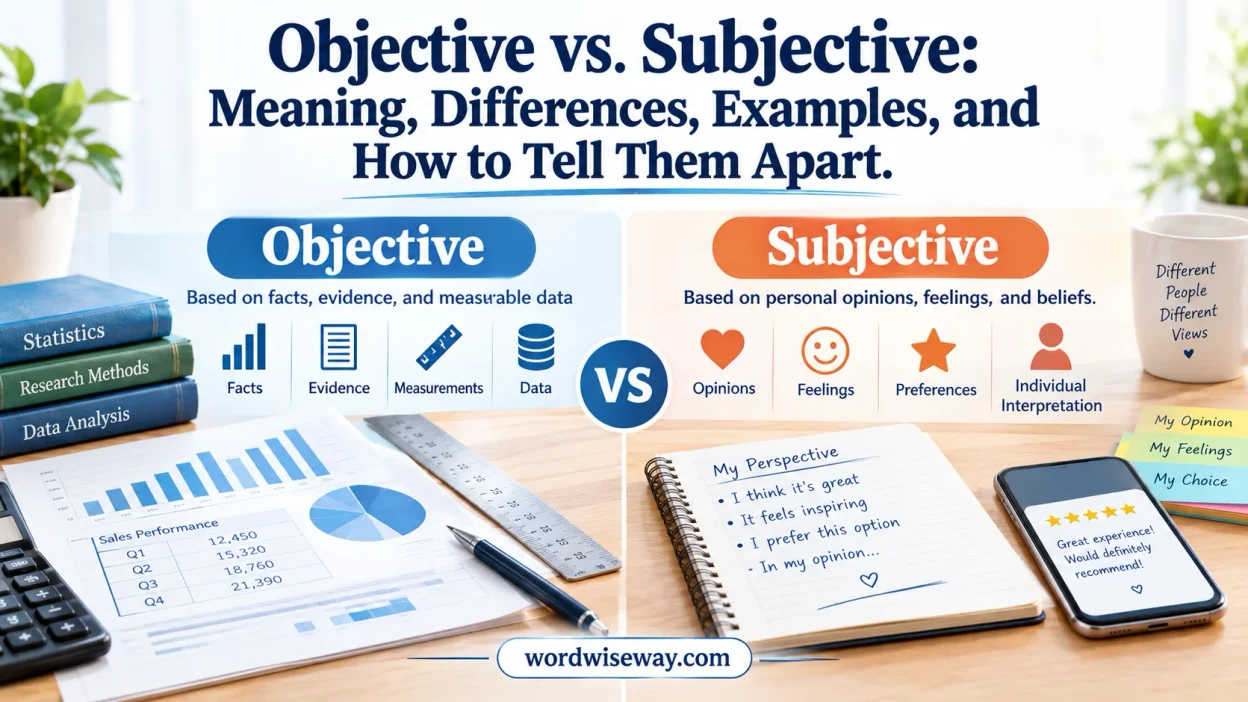
Objective vs. Subjective: Meaning, Differences, and Examples helps you understand how facts and opinions work in language.
subjective and Objective are adjectives with opposite meanings. Objective language presents information based on fact or evidence, while subjective language reflects opinion or viewpoint. This difference matters when you need precise writing.
In language use, facts and opinions can become blurred, especially in mass media and disagreement. Ability to distinguish facts from opinions makes arguments easier to evaluate. Objective statements can be checked, while subjective statements often express feelings, preferences, beliefs, or judgments. Context helps you recognize meaning.
Both terms have multiple senses, including grammatical senses. In writing, their use can change depending on the sentence and context. Understanding objectivity and subjectivity gives you an approach to arguments, observations, value judgments, and interpretation.
Quick Answer:
Objective information relies on facts, evidence, measurements, or observable details that don’t primarily depend on personal feelings.
Subjective information reflects someone’s personal thoughts, preferences, experiences, emotions, or judgments.
The easiest distinction is this:
Objective information focuses on what can be supported or verified. Subjective information focuses on how someone personally sees or experiences something.
For example:
- Objective: The library closes at 8 p.m.
- Subjective: The library closes too early.
- Objective: The book contains 12 chapters.
- Subjective: The book has an excellent story.
- Objective: The temperature reached 35°C.
- Subjective: The weather feels unbearably hot.
| Objective | Subjective |
| Relies on evidence or observable information | Relies on personal perspective |
| Can often be independently verified | May differ from person to person |
| Usually avoids personal judgment | Often includes opinions or evaluations |
| Uses measurable or factual details | Often uses feelings and preferences |
| Common in reports and research | Common in reviews and personal writing |
Neither category automatically means true or false. An objective claim can be inaccurate, while a subjective statement can accurately describe someone’s genuine experience.
What Does Objective Mean?
Objective Definition
Objective means based on facts, evidence, observations, measurements, or information that doesn’t depend primarily on someone’s personal feelings.
An objective statement generally makes a claim that another person can investigate independently. The person checking it doesn’t need to share the original speaker’s preferences.
Consider this sentence:
“The Pacific Ocean is larger than the Atlantic Ocean.”
This isn’t based on whether someone likes one ocean more than another. Geographic measurements and established data support the comparison.
Objectivity doesn’t require a person to have no emotions. Instead, it means the information itself doesn’t depend on those emotions.
What Makes Information Objective?
Several characteristics can make a statement more objective:
- Measurable information: “The box weighs 5 kilograms.”
- Observable events: “The meeting began at 10 a.m.”
- Documented information: “The company was founded in 1998.”
- Recorded data: “The survey received 2,000 responses.”
- Verifiable claims: “Water freezes at 0°C under standard atmospheric pressure.”
- Direct observations: “The door is open.”
Evidence plays an important role here. If another person can examine the relevant evidence and reach the same conclusion, the statement has a stronger objective basis.
Objective Examples
Here are several examples from everyday situations:
- “The train arrived at 7:15 a.m.”
- “The package weighs 2 kilograms.”
- “The class has 30 students.”
- “The meeting lasted 45 minutes.”
- “The novel has 320 pages.”
- “The store closes at 9 p.m.”
Each statement contains information that can potentially be checked.
That doesn’t mean every source reporting these facts is automatically correct. A website could list the wrong closing time. A scale could malfunction. A person could record the wrong arrival time.
Objectivity concerns the basis of the claim, not a magical guarantee of accuracy.
Objective Sentences in Writing
Objective writing usually emphasizes specific information rather than emotional judgment.
Compare these sentences:
Objective:
“The apartment has three bedrooms and two bathrooms.”
Subjective:
“The apartment is spacious and beautiful.”
The first sentence gives details that you can inspect or measure. The second evaluates those details according to someone’s perception.
A strong writer often uses objective details to support a later interpretation.
For example:
Objective: “The apartment has 1,800 square feet of living space.”
Subjective: “That size makes the apartment feel spacious.”
The first statement supplies evidence. The second explains a personal impression.
What Does Subjective Mean?
Subjective Definition
It means influenced by personal thoughts, feelings, experiences, preferences, or interpretations.
Subjective statements can vary between people because people don’t experience everything in the same way.
Take food as an example.
One person might say:
“This curry is delicious.”
Another person might say:
“This curry is too spicy.”
Neither statement works like a simple measurement. Each reflects an individual’s experience.
Subjectivity often enters language through evaluation. Words such as beautiful, boring, delicious, terrible, exciting, comfortable, annoying, best, and worst frequently signal personal judgment.
However, context still matters.
Subjective Examples
Common subjective statements include:
- “Chocolate ice cream tastes better than vanilla.”
- “That movie was boring.”
- “This is the most beautiful painting here.”
- “The new design looks fantastic.”
- “That was an exciting match.”
- “The restaurant serves delicious food.”
- “Winter is the best season.”
These statements communicate perspectives rather than simple measurements.
A subjective statement can still be meaningful. In fact, subjective information becomes essential when discussing experiences, preferences, emotions, and creative work.
Subjective Language in Reviews
Reviews provide an excellent example of subjectivity.
Suppose someone reviews a movie and writes:
“The movie runs for 142 minutes.”
That’s an objective detail.
Now consider:
“The movie feels far too long.”
That’s subjective.
The reviewer may support the second opinion by explaining the pacing, story structure, or repetitive scenes. Evidence can make an opinion more convincing, but it doesn’t automatically turn the opinion into an objective fact.
This distinction matters because a good review often combines both types of information.
Key Differences
Facts vs. Opinions
The most familiar distinction is fact versus opinion.
A fact makes a claim that evidence can support or challenge. An opinion expresses a person’s judgment, preference, or belief.
For example:
- Fact: The museum opened in 2010.
- Opinion: The museum has the best exhibits in the city.
The first statement concerns a historical detail. The second depends on someone’s evaluation.
Still, don’t assume every sentence containing an opinion is completely unsupported. An opinion can rely on substantial evidence while remaining an opinion.
Verifiable vs. Personal
Ask a simple question:
“Can someone independently check this claim?”
If the answer is yes, the statement may have an objective basis.
For example:
“The table is two meters long.”
You can measure it.
Now consider:
“The table is too large for the room.”
The room and table can be measured objectively, but the word “too” introduces judgment. Whether the size is acceptable may depend on the person’s needs and preferences.
Evidence vs. Personal Experience
Personal experience can provide valuable information, but it doesn’t automatically establish a universal fact.
Suppose someone says:
“I felt sick after eating at that restaurant.”
That is an objective statement about the person’s reported experience if the person genuinely experienced those symptoms. However, it doesn’t prove:
“The restaurant’s food makes everyone sick.”
The second claim extends one experience into a broad conclusion.
This is one of the most important distinctions when evaluating online claims.
Neutral Description vs. Personal Judgment
Objective language often describes what happened. Subjective language often evaluates what happened.
Compare:
| Description | Judgment |
| The room contains four chairs. | The room feels cramped. |
| The book has 250 pages. | The book is too long. |
| The phone weighs 180 grams. | The phone feels heavy. |
| The film lasts two hours. | The film is painfully long. |
| The meal contains chili peppers. | The meal is extremely spicy. |
The descriptive statements give information. The judgments interpret that information through someone’s perspective.
Comparison
The difference becomes easier to remember when you examine several characteristics together.
| Feature | Objective | Subjective |
| Main basis | Facts, evidence, observations | Feelings, preferences, interpretations |
| Verification | Usually independently checkable | Often depends on personal perspective |
| Personal preference | Usually limited | Often central |
| Agreement | Evidence may produce broad agreement | Reasonable disagreement is common |
| Typical wording | Specific and descriptive | Evaluative or emotional |
| Common uses | Research, reports, factual records | Reviews, opinions, personal essays |
| Measurement | Often possible | Usually not directly measurable |
| Perspective | Less dependent on the speaker | Strongly connected to the speaker |
A useful rule is simple:
If the statement depends on what happened or what can be demonstrated, it leans objective. If it depends on how someone feels or evaluates it, it leans subjective.
Examples of Objective and Subjective Statements
Everyday Life
Everyday conversations constantly mix objective and subjective information.
Objective: “The coffee contains two teaspoons of sugar.”
Subjective: “The coffee tastes too sweet.”
Objective: “The shirt costs $25.”
Subjective: “The shirt is overpriced.”
Notice how the second sentence in each pair adds personal evaluation.
The price can be checked. Whether $25 feels expensive depends on the person’s expectations and circumstances.
School and Education
Students encounter both forms in nearly every subject.
Objective: “The experiment produced a temperature increase of 5°C.”
Subjective: “The experiment produced an impressive result.”
The first statement communicates measurable data. The second evaluates the significance of that result.
Academic writing often asks students to distinguish evidence from interpretation. Doing so makes an argument easier to follow and defend.
Workplace Communication
Workplace writing benefits greatly from separating measurable performance from personal impressions.
Consider these two statements:
Subjective: “Maria is an excellent employee.”
More objective: “Maria completed 96% of assigned projects before their deadlines during the quarter.”
The second statement provides evidence that readers can examine.
It doesn’t necessarily prove that Maria is an “excellent employee.” However, it gives readers something concrete on which to base their own evaluation.
News and Journalism
Journalistic writing generally separates reported facts from commentary.
Consider:
Objective: “The city council approved the proposal on Tuesday.”
Subjective: “The council made a terrible decision.”
The first sentence reports an event. The second expresses an evaluation.
News reporting can contain interpretation as well, especially in analysis pieces. Good journalism makes the distinction clear rather than disguising opinion as established fact.
Science and Research
Science places substantial value on observations, measurements, reproducible methods, and evidence.
For example:
Objective observation: “The solution changed from clear to blue.”
Interpretation: “The color change indicates a chemical reaction.”
The second statement may still have strong scientific support. Yet it represents an interpretation of an observation rather than the observation itself.
This distinction helps researchers avoid confusing what they observed with what they think the observation means.
Reviews and Recommendations
Reviews naturally contain subjective judgments.
A restaurant reviewer might write:
Objective: “The restaurant offers 40 menu items.”
Subjective: “The menu is impressively varied.”
The reviewer can support the second judgment with evidence, but the conclusion still reflects an evaluation.
That’s perfectly appropriate for a review. Readers expect reviewers to explain their experiences and opinions.
Can a Statement Be Both Objective and Subjective?
Yes. Some statements contain both factual information and personal interpretation.
Consider:
“The hike covers eight miles and is exhausting.”
The first part gives a measurable distance. The second part describes an experience or judgment.
Another example:
“The phone weighs 210 grams, so it feels heavy.”
The weight can be measured. Whether that weight feels heavy depends on the user.
This combination appears everywhere because people naturally interpret facts.
How to Separate the Two
When a sentence mixes objective and subjective elements, break it into smaller claims.
For example:
Mixed statement:
“The new restaurant is expensive but has incredible food.”
Separate it into:
- The restaurant’s prices can be compared with specific prices.
- The food quality can be described using measurable characteristics.
- “Incredible” expresses the reviewer’s personal judgment.
This technique creates clearer writing and helps readers understand exactly where evidence ends and interpretation begins.
How to Identify Objective vs. Subjective Statements
Ask Whether the Claim Can Be Verified
Start with evidence.
Can you check the statement using measurements, records, observations, reliable sources, or other evidence?
If yes, the statement likely has an objective component.
Look for Personal Judgment
Words expressing evaluation often signal subjectivity.
Watch for terms such as:
- Best
- Worst
- Beautiful
- Ugly
- Delicious
- Boring
- Amazing
- Terrible
- Comfortable
- Expensive
- Exciting
- Annoying
These words aren’t automatically subjective in every possible context. Their meaning depends on how the speaker uses them.
Look for Measurable Information
Numbers often provide clues.
Examples include:
- Dates
- Distances
- Prices
- Temperatures
- Weights
- Ages
- Quantities
- Time durations
- Percentages
- Test scores
However, numbers don’t automatically make an entire statement objective.
For example:
“The phone costs $1,000, which is ridiculously expensive.”
The price is objective. “Ridiculously expensive” is subjective.
Consider the Speaker’s Perspective
Ask whether the statement depends on someone’s personal experience.
Compare:
“The room temperature is 28°C.”
with:
“The room feels hot.”
The first statement uses a measurement. The second describes an individual’s perception.
Both can communicate useful information. They simply communicate different kinds of information.
Don’t Judge by One Word Alone
Context can change everything.
For example, “expensive” usually expresses a judgment. Yet a financial report might define a specific price threshold and classify products according to that established criterion.
Likewise, “large” can be subjective in ordinary conversation. In a technical setting, it may refer to a defined measurement range.
Always examine the complete statement rather than labeling it from one word.
Objective vs. Subjective in Writing
When to Use Objective Language
Objective language works particularly well when accuracy and verification matter.
Common examples include:
- Academic reports
- Scientific research
- Business reports
- News reporting
- Technical documentation
- Instructions
- Statistical summaries
- Historical records
- Legal documents
In these settings, unsupported personal judgments can weaken the writing.
When Subjective Language Is Appropriate
Subjective language has an important place too.
Use it naturally in:
- Movie reviews
- Restaurant reviews
- Personal essays
- Opinion articles
- Creative writing
- Personal reflections
- Recommendations
- Discussions about preferences
Trying to remove every subjective statement from these forms of writing would make them strangely lifeless.
A movie review without any opinion isn’t much of a review.
How to Make Writing More Objective
If you need a more objective tone, replace broad judgments with specific evidence.
Instead of:
“The product has terrible battery life.”
Write:
“The battery lasted approximately six hours during continuous video playback.”
Instead of:
“The lecture was incredibly long.”
Write:
“The lecture lasted two hours and fifteen minutes.”
The second versions give readers information they can evaluate themselves.
Objective vs. Subjective in Different Contexts
Objective vs. Subjective in Research
Research often separates data, observations, interpretations, and conclusions.
For example:
- A researcher records a measurement.
- The measurement becomes part of the data.
- The researcher analyzes the pattern.
- The researcher develops an interpretation.
- The researcher draws a conclusion.
The measurement represents the strongest objective component. The interpretation and conclusion require reasoning and may involve uncertainty.
That doesn’t make scientific conclusions mere opinions. Well-supported conclusions can rest on rigorous evidence while still remaining open to revision when better evidence appears.
Objective vs. Subjective in History
Historical study provides another useful example.
Objective historical information may include dates, documents, treaties, census records, photographs, and other surviving evidence.
Historical interpretation asks what those events meant, why they happened, or how different groups experienced them.
For example, the date of a documented event may be relatively straightforward. Explaining its causes can involve competing interpretations of evidence.
History therefore requires both evidence and interpretation.
Objective vs. Subjective in Law
Legal decisions rely heavily on evidence, records, testimony, statutes, and established legal rules.
However, lawyers and courts may interpret how those materials apply to a particular case.
A document may objectively contain certain words. Whether those words satisfy a legal requirement can involve interpretation.
This distinction is useful because evidence and interpretation aren’t interchangeable.
Objective vs. Subjective in Psychology
Psychology can involve both observable behavior and personal experience.
For example:
Objective-oriented information: A participant completed a task in 42 seconds.
Subjective information: The participant reported feeling anxious during the task.
The reported feeling remains important even though researchers can’t measure anxiety simply by looking at the statement itself.
Modern research often combines behavioral measurements with self-reported experiences to build a fuller picture.
Case Study: Is a Restaurant “The Best”?
Imagine two friends visit the same restaurant.
One says:
“This is the best restaurant in the city.”
The other says:
“The food was disappointing.”
They disagree, but that doesn’t mean one person must be lying.
Now separate the available information:
| Information | Type |
| The restaurant opened at 6 p.m. | Objective |
| The meal cost $30 | Objective |
| The restaurant has 80 seats | Objective |
| The food was delicious | Subjective |
| The restaurant was overpriced | Subjective |
| The service was the best in town | Subjective |
The objective details can help explain the disagreement without settling it.
Perhaps one friend values portion size while the other cares more about flavor. Their different experiences produce different evaluations.
This is why subjective disagreement doesn’t automatically mean someone is wrong.
Objective vs. Subjective vs. Opinion vs. Fact
These terms overlap, but they aren’t identical.
Objective and subjective describe how information relates to perspective and evidence.
Fact and opinion describe different types of claims.
| Term | Meaning |
| Objective | Based mainly on evidence, observation, or measurable information |
| Subjective | Influenced by personal perspective or experience |
| Fact | A claim that can be supported by reliable evidence |
| Opinion | A belief, judgment, preference, or interpretation |
For example:
“The restaurant opened in 2020.”
This is an objective factual claim.
“The restaurant has the best food in town.”
This is a subjective opinion.
The distinction becomes especially useful when reading persuasive content. A writer may present an opinion with confident language, making it sound like an established fact.
Strong readers don’t simply ask, “Do I agree?”
They also ask:
“What evidence supports this claim?”
Common Mistakes
Assuming Every Opinion Is False
Subjective doesn’t mean false.
If someone says, “I don’t like spicy food,” that statement describes a personal preference. There’s no reason to treat it as false simply because another person loves spicy food.
Assuming Every Fact Is Completely Unbiased
A fact can be objective while the selection or presentation of facts involves human judgment.
For example, a report may contain accurate statistics but emphasize only the figures supporting one side of an argument.
The individual numbers can remain factual even when the overall presentation creates a particular impression.
Treating Personal Experience as Universal Evidence
Personal experiences matter, but they have limits.
Someone saying, “This method worked for me,” doesn’t automatically prove that it works for everyone.
The difference between an individual experience and a general claim is crucial.
Confusing Objective With Neutral
Objective and neutral aren’t perfect synonyms.
Objective concerns the basis of information.
Neutral often concerns the absence of obvious favoritism, emotional language, or advocacy.
A statement can contain objective facts while appearing in a strongly persuasive context.
Calling Something Subjective Simply Because People Disagree
Disagreement doesn’t automatically make a statement subjective.
People can disagree about an objective claim because they have different information, misunderstand the evidence, or make different factual errors.
The existence of disagreement isn’t the deciding test.
Easy Memory Trick
Use this simple association:
Objective → Object → information outside personal preference.
Subjective → Subject → the individual person’s perspective.
Then ask one question:
“Does this statement depend mainly on evidence or personal interpretation?”
If evidence drives the claim, it leans objective.
If personal perspective drives the claim, it leans subjective.
Practice:
Test your understanding with these statements.
- The Earth completes an orbit around the Sun.
- Summer is the best season.
- The store closes at 9 p.m.
- That restaurant serves delicious food.
- The package weighs three kilograms.
- This painting is beautiful.
- The movie lasts 120 minutes.
- The movie is too long.
- The school has 25 classrooms.
- This is the most interesting subject.
Answers and Explanations
- Objective: The orbital relationship can be supported by scientific evidence.
- Subjective: “Best” depends on personal preference.
- Objective: The closing time can be verified.
- Subjective: Taste and enjoyment differ between people.
- Objective: Weight can be measured.
- Subjective: Beauty involves personal judgment.
- Objective: Duration can be measured.
- Subjective: Whether something is too long depends on perception.
- Objective: The number of classrooms can be counted.
- Subjective: Interest varies among individuals.
Key Takeaways
- Objective information relies on evidence, observation, measurement, or verifiable details.
- Subjective information reflects personal feelings, preferences, experiences, or judgments.
- Objective doesn’t automatically mean correct.
- Subjective doesn’t automatically mean false.
- Facts and opinions can appear together in the same sentence.
- Personal experience can provide useful information without proving a universal claim.
- Numbers often support objective statements, but numerical information can still appear alongside subjective judgments.
- Good writing separates evidence from interpretation when clarity matters.
- Reviews and personal writing naturally allow more subjective language.
- Research, reports, and factual communication generally benefit from stronger objectivity.
Read More: Discrete vs Continuous: What’s the Difference?
FAQs
1. What is the main difference between objective and subjective?
Objective refers to information based on facts, evidence, or something that can be verified. Subjective refers to personal feelings, opinions, preferences, or interpretations. The easiest way to remember the difference is to ask whether the statement can be checked independently or mainly reflects someone’s viewpoint.
2. What does objective mean in simple English?
Objective means presenting information without relying on personal feelings or preferences. An objective statement usually focuses on facts that can be supported by reliable evidence. For example, saying that water freezes at a certain temperature under standard conditions is an objective claim.
3. What does subjective mean in simple English?
Subjective means something influenced by personal thoughts, feelings, preferences, or opinions. A subjective statement can vary from one person to another because people may interpret the same situation differently. Saying that a particular movie is enjoyable is usually subjective.
4. Are objective and subjective antonyms?
Yes, objective and subjective are commonly treated as antonyms because they represent contrasting approaches to information. Objective language emphasizes facts and evidence, while subjective language emphasizes personal interpretation. However, the exact meaning can depend on the context in which each word appears.
5. How can you identify an objective statement?
Look for information that can be verified through evidence, observation, measurement, or reliable records. Objective statements often describe events, quantities, dates, or other information that doesn’t depend on someone’s personal preference. Still, a statement should be examined carefully because confident wording doesn’t automatically make it factual.
6. How can you identify a subjective statement?
Look for words or ideas that express feelings, preferences, beliefs, judgments, or personal interpretations. Statements such as “I think,” “I prefer,” or “this is beautiful” often signal subjectivity. However, subjective meaning can sometimes appear without obvious opinion words, so context remains important.
7. Can a sentence contain both objective and subjective information?
Yes, a sentence can combine factual information with a personal interpretation. For example, someone might mention a measurable event and then describe that event as exciting or disappointing. The first part may be objective, while the second part expresses a subjective response.
8. Why is it important to distinguish facts from opinions?
Distinguishing facts from opinions helps you evaluate arguments more carefully. It becomes especially useful when you encounter information in news reports, advertisements, social media, or heated discussions. Recognizing the difference allows you to consider evidence separately from personal interpretation.
9. Are objective and subjective used differently in grammar?
They can have grammatical uses that differ from their meanings in discussions about facts and opinions. In grammar, objective and subjective may describe roles or forms connected with sentence structure. Therefore, you should consider the context instead of assuming that these words always refer to fact and opinion.
10. Can subjective opinions still be valuable?
Absolutely. A subjective opinion can provide personal experience, emotional insight, or a perspective that objective facts alone cannot express. The important point is to recognize it as an opinion rather than presenting it as an independently verified fact.
Conclusion
Understanding objective and subjective language gives you a practical way to separate evidence from personal interpretation. Objective statements generally rely on facts, observations, and information that can be checked, while subjective statements express feelings, preferences, beliefs, and judgments. Knowing this basic distinction can make your reading and writing more precise.
The difference becomes especially useful when you evaluate arguments or encounter conflicting information. A statement may sound convincing while still reflecting someone’s personal viewpoint. By asking whether a claim depends on evidence or interpretation, you can better recognize its nature. This habit also helps you communicate your own ideas more clearly without confusing opinions with established facts.
Neither objective nor subjective language is automatically better. Each serves a different purpose depending on the situation. Facts can establish what happened, while personal perspectives can explain how someone understands or experiences it. Once you recognize the difference, you can choose the right form of language and make your writing clearer, more balanced, and easier to understand.