Compliment or Complement: Difference, and Correct Usage is easier to understand when you know their meanings.
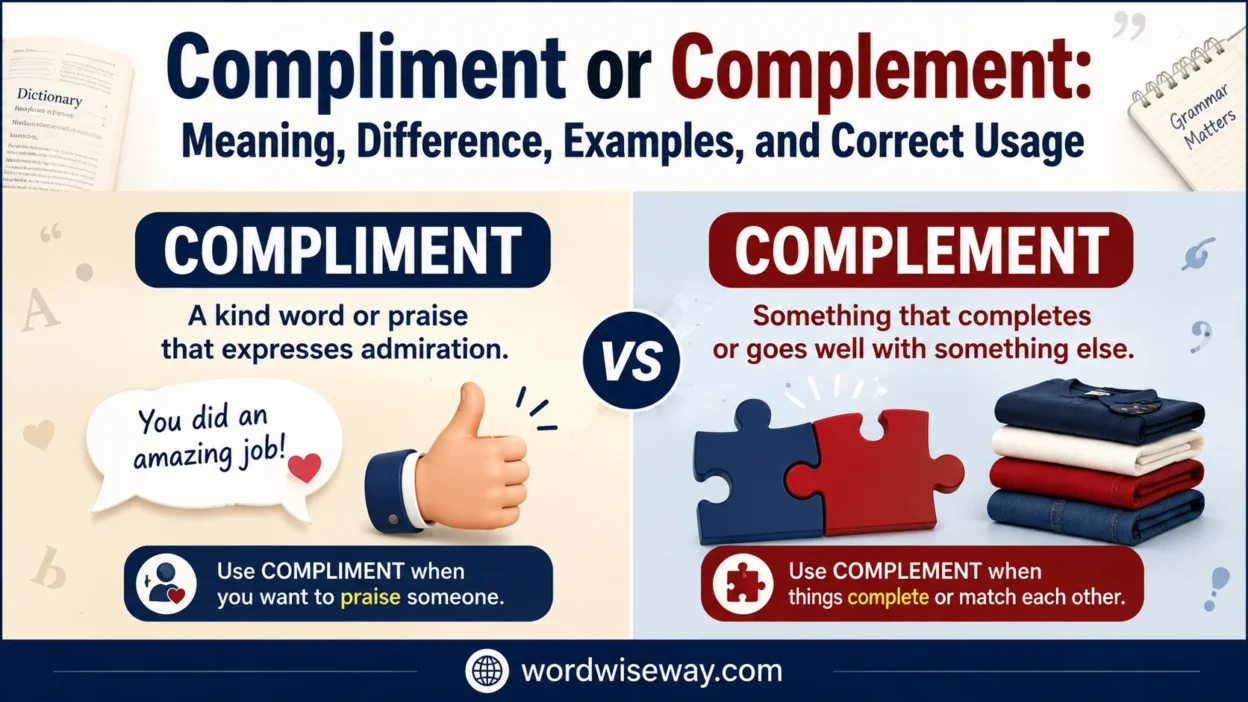
A compliment expresses praise, admiration, or encouragement, while a complement means something that completes, enhances, or improves another thing. Although they sound alike, their meanings are different. Using the correct word matters in emails, social media, school assignments, and professional writing.
For example, “Thank you for the wonderful compliment” refers to praise, while two colors can complement each other. Knowing this difference helps you write clearly and avoid confusion.
The main spelling difference is one letter: compliment uses i, while complement uses e. This small change can completely change the meaning. A simple memory trick is to connect compliment with praise and complement with completing. Learning through practical examples makes the difference easier to remember and prevents common mistakes.
Quick Answer:
The difference between compliment and complement is simple:
| Word | Meaning | Example |
| Compliment | A statement of praise, admiration, or approval | “She complimented me on my writing.” |
| Complement | Something that completes, improves, or matches something else | “This sauce complements the dish perfectly.” |
A quick memory trick:
- Compliment with an “i” means “I like it” → praise or admiration.
- Complement with an “e” means it completes something → adds value or creates balance.
If you are praising someone, use compliment. If something fits well with another thing, use complement.
Compliment or Complement: Understanding the Main Difference
Although compliment and complement have different meanings, many people confuse them because they sound identical. These words are homophones, which means they have the same pronunciation but different spellings and meanings.
The easiest way to separate them is to focus on the purpose behind the word.
A compliment comes from appreciation. It tells someone that you admire something about them, their work, their personality, or their achievements.
A complement describes a relationship between two things. One thing adds to another thing, improves it, or makes it feel complete.
Consider these examples:
- “Your artwork is beautiful.” → This is a compliment because it expresses praise.
- “The frame complements your artwork.” → This is a complement because the frame improves the artwork.
The first sentence focuses on admiration. The second focuses on how two things work together.
What Does Compliment Mean?
A compliment is a positive comment that shows approval, respect, or admiration. People use compliments to make others feel appreciated and recognized.
Compliments appear everywhere:
- Personal conversations
- Workplaces
- Schools
- Social media
- Customer service
- Professional communication
A thoughtful compliment can strengthen relationships because it shows that someone noticed effort, talent, or kindness.
Compliment as a Noun
As a noun, compliment means a kind or positive statement.
Examples:
- “She received many compliments after her speech.”
- “His teacher gave him a compliment for his improvement.”
- “Your feedback was the best compliment I could receive.”
In these sentences, a compliment is something someone gives through words.
A compliment does not have to describe appearance. Many people think compliments only involve looks, but they can recognize many qualities:
- Intelligence
- Creativity
- Hard work
- Problem-solving ability
- Personality
- Achievements
- Kindness
For example:
- “You explained that topic really clearly.”
- “Your dedication helped the entire team succeed.”
Both sentences are compliments because they express appreciation.
Compliment as a Verb
When used as a verb, compliment means to praise someone or something.
Common patterns include:
- Compliment someone on something
- Compliment someone’s work
- Compliment someone’s ability
Examples:
- “The manager complimented the employee on her excellent performance.”
- “My friend complimented me on my presentation.”
- “Customers complimented the restaurant’s service.”
The verb form changes depending on the sentence:
| Form | Example |
| Compliment | I compliment her writing. |
| Compliments | He compliments everyone’s efforts. |
| Complimented | They complimented the design. |
| Complimenting | She is complimenting the team. |
Types of Compliments
Compliments can focus on different areas.
| Type | Example |
| Personal compliment | “You are very thoughtful.” |
| Skill-based compliment | “You solve problems creatively.” |
| Professional compliment | “Your report was detailed and helpful.” |
| Achievement compliment | “You worked hard for this success.” |
| Appearance compliment | “That jacket looks great on you.” |
A good compliment feels genuine. Empty praise often sounds forced, while specific appreciation feels meaningful.
What Does Complement Mean?
A complement refers to something that completes, enhances, balances, or matches something else.
Unlike a compliment, it does not involve praise through words. Instead, it describes a connection between things.
For example:
- “The blue curtains complement the room.”
- “Her experience complements his technical knowledge.”
The curtains are not praising the room. They improve the room’s appearance. Her experience is not giving praise. It adds another useful quality.
Complement as a Noun
As a noun, complement means something that completes or improves another thing.
Examples:
- “The lemon was the perfect complement to the seafood.”
- “The necklace was a beautiful complement to her outfit.”
- “The new software is a useful complement to the existing system.”
A complement creates harmony between different elements.
You can find complements in many areas:
- Food combinations
- Fashion choices
- Interior design
- Business partnerships
- Technology systems
Complement as a Verb
As a verb, complement means to add something that improves another thing.
Examples:
- “The colors complement each other.”
- “Her leadership skills complement his technical knowledge.”
- “The new features complement the original design.”
When two things complement each other, they usually work better together than separately.
Compliment vs Complement Examples in Sentences
Seeing both words side by side makes the difference easier to remember.
| Sentence | Correct Word | Reason |
| She gave me a nice comment about my article. | Compliment | She praised the article. |
| The images complement the article. | Complement | The images improve the article. |
| He complimented her presentation skills. | Compliment | He expressed admiration. |
| The furniture complements the room. | Complement | The furniture matches the room. |
| The chef received compliments for the meal. | Compliment | People praised the chef. |
| The spices complement the flavor. | Complement | The spices enhance the flavor. |
Common Mistakes When Using Compliment and Complement
Because these words sound the same, writers often choose the wrong spelling. Here are the most common mistakes.
Using Compliment Instead of Complement
Incorrect:
- “The shoes compliment the dress.”
Correct:
- “The shoes complement the dress.”
Why?
The shoes are not praising the dress. They match or improve its appearance.
Using Complement Instead of Compliment
Incorrect:
- “She complemented him on his achievement.”
Correct:
- “She complimented him on his achievement.”
Why?
She praised him. She did not complete or improve him.
Confusing Complimentary and Complementary
These two related words create another common problem.
Complimentary usually means free or expressing praise.
Examples:
- “The hotel offered complimentary breakfast.”
- “The review was complimentary.”
Complementary means completing or matching.
Examples:
- “The colors are complementary.”
- “Their skills are complementary.”
Remember:
- Complimentary = free or praising.
- Complementary = working well together.
Compliment and Complement in Different Contexts
Compliment vs Complement in Relationships
Compliments help people feel valued. A simple statement such as “You handled that situation well” can show appreciation.
Complements describe how people or qualities work together.
Example:
- “Her creativity complements his organization skills.”
The two ideas connect but serve different purposes.
Compliment vs Complement in Business
Businesses use both words frequently.
Compliments:
- Customers compliment employees for great service.
- Managers compliment workers for achievements.
Complements:
- Products complement each other.
- Different skills complement a team.
Example:
A marketing expert and a graphic designer may have different abilities, but their skills complement each other because they create a stronger result together.
Compliment vs Complement in Writing
Writers often need to choose carefully between these words.
Compare:
- “The introduction compliments the article.”
- “The introduction complements the article.”
The second sentence is correct because the introduction supports and improves the article.
Easy Ways to Remember Compliment vs Complement
Here are simple memory tricks:
Remember the “I” in Compliment
The word compliment contains “i.”
Think:
I appreciate you.
That connects with praise.
Example:
- “I compliment your effort.”
Remember the “E” in Complement
The word complement contains “e.”
Think:
It completes or enhances something.
Example:
- “The colors complement each other.”
Ask Yourself One Question
Before choosing the word, ask:
Am I praising something or completing something?
- Praising → Compliment
- Completing or matching → Complement
Read More: Possible or Posible: Correct Spelling, Meaning, and Correct Usage
FAQs
1. What is the difference between compliment and complement?
A compliment is an expression of praise or admiration. A complement is something that completes, improves, or matches another thing.
2. Is compliment used for praise?
Yes. Compliment is used when you praise someone or say something positive about them.
3. What does complement mean?
Complement means something that completes, enhances, or works well with something else.
4. How can I remember the spelling?
Remember compliment with i for an expression of praise. Complement with e relates to completing or enhancing something.
5. Do compliment and complement sound the same?
Yes. They are pronounced alike in standard English, but their meanings and spellings are different.
6. Can complement be a verb?
Yes. As a verb, complement means to complete, improve, or enhance something.
7. Can compliment be a verb?
Yes. As a verb, compliment means to praise or express admiration toward someone.
8. Which word is correct for colors?
Use complement when colors work well together or enhance each other. For example, two colors can complement each other.
9. Is “Thank you for the wonderful complement” correct?
No, if you mean praise, the correct sentence is “Thank you for the wonderful compliment.”
10. Why are compliment and complement confusing?
They are confusing because they have almost identical spelling and pronunciation. The single-letter difference also changes their meanings.
Conclusion
Understanding compliment and complement becomes much easier once you connect each word with its purpose. Use compliment when you are talking about praise, admiration, or something positive said about a person. Use complement when something completes, improves, or matches another thing. Although these words sound alike, their meanings are clearly different.
A useful way to avoid mistakes is to remember the i in compliment as being connected with praise, while complement with e relates to completing something. With regular practice and simple examples, you can confidently choose the right word in conversations, emails, assignments, and everyday writing.