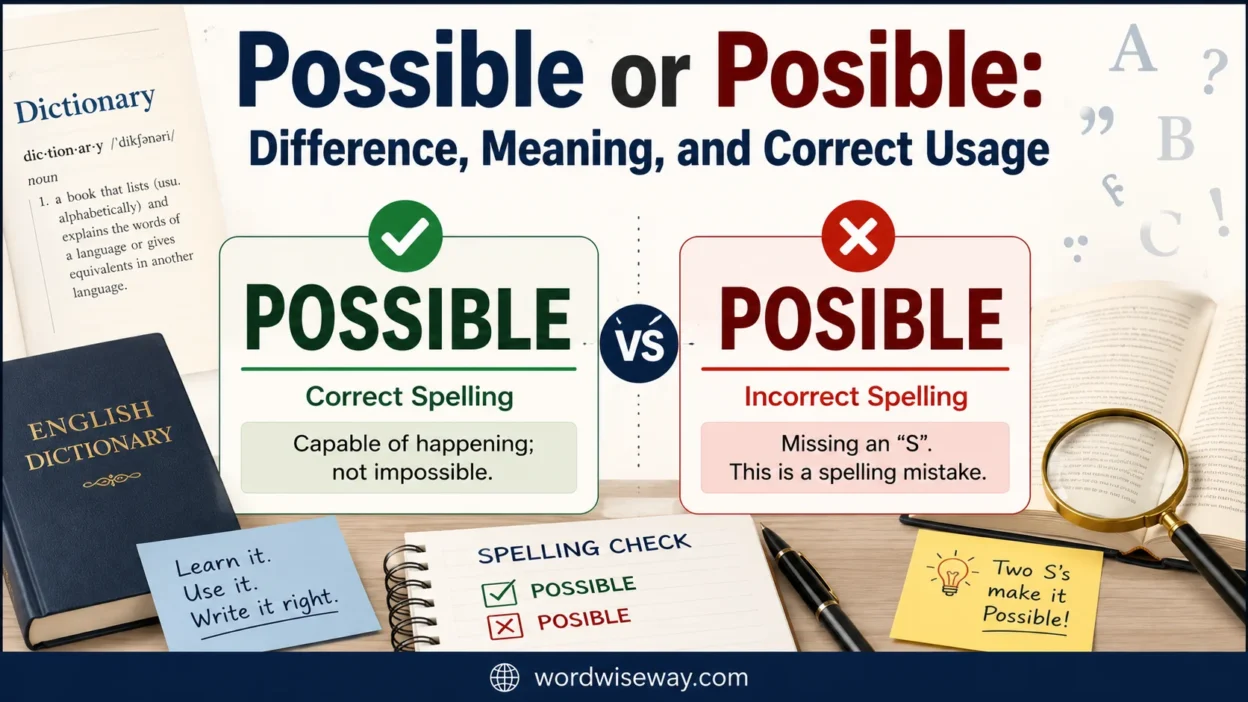
Possible or Posible: Correct Spelling, Meaning, and Correct Usage has one clear answer: possible is the correct English spelling, while Posible is an incorrect misspelling.
Possible means something can happen, exist, be done, or be achieved. It is an adjective with a double s, written p-o-s-s-i-b-l-e. A missing second s can happen during fast typing, so careful writing improves clarity and confidence.
The confusion between possible or posible is common among English learners because both words sound almost identical when spoken. Spanish uses posible, which may cause confusion.
English spelling rules require possible in both American and British spelling. When reviewing emails or an important document, checking the spelling can catch this error. Remember: possible is correct, while posible should be avoided in standard English.
Quick Answer
Possible is the correct spelling in standard English. Posible is a misspelling.
The word possible is an adjective that can describe something that can happen, exist, or be achieved. It can also describe something that might be true without saying that it definitely is true. Cambridge Dictionary gives both of these major meanings and lists impossible as its opposite.
| Word | Correct spelling? | Meaning | Example |
| Possible | ✅ Yes | Able to happen, exist, or be done | It is possible to finish today. |
| Posible | ❌ No | Misspelling of possible | Please write possible, not posible. |
So, when you’re choosing between possible or posible, the answer is simple: use possible.
Quick Comparison
| Question | Answer |
| Which spelling is correct? | Possible |
| Is “posible” standard English? | No |
| What part of speech is possible? | Adjective |
| What does possible mean? | Able to happen, exist, or be done |
| Can possible express uncertainty? | Yes |
| What is its opposite? | Impossible |
| Does possible mean probable? | No |
| How many S’s does possible have? | Two |
| Common phrase | As soon as possible |
| Example | It is possible to finish today. |
Possible or Posible: Which Spelling Is Correct?
Possible is the correct English spelling.
It contains two s letters:
P-O-S-S-I-B-L-E
The incorrect form drops one of those letters:
P-O-S-I-B-L-E
That missing s changes the spelling enough to make the word incorrect in standard English.
For example:
- Correct: Is it possible to change the appointment?
- Incorrect: Is it posible to change the appointment?
- Correct: We need to find every possible solution.
- Incorrect: We need to find every posible solution.
A useful way to remember the spelling is to think of the middle as “poss”, not “pos.”
Why Do People Write Posible?
The mistake usually comes from spelling by sound. When people pronounce possible, the two s letters don’t sound like two separate sounds. English spelling often contains letters that aren’t obvious from pronunciation, so hearing a word isn’t always enough to spell it correctly.
The same problem appears with many other English words. A familiar word can sound simple while its spelling contains a pattern that you need to memorize.
With possible, the easiest solution is straightforward: remember poss + ible.
Possible: Meaning and Definition
Possible mainly describes something that can happen, can exist, or can be done.
For example:
It is possible to complete the project by Friday.
Here, the sentence says that completing the project by Friday can happen. It doesn’t guarantee that the project will be finished. It simply says the outcome is achievable.
Cambridge Dictionary also defines possible as something that might or might not happen or exist.
Consider these examples:
- It is possible to solve the problem.
- A delay is possible because of the weather.
- We need to consider every possible option.
- Is it possible to arrive earlier?
- There are several possible explanations.
In each case, possible leaves room for uncertainty or opportunity.
Possible Can Mean “Able to Be Done”
One common use focuses on whether an action can happen.
For example:
- Is it possible to finish this today?
- It isn’t possible to travel there in one hour.
- We did everything that was possible.
- A quick solution may still be possible.
Here, possible relates to ability, circumstances, time, resources, or practical limits.
Possible Can Mean “Might Happen”
The word can also describe an uncertain event.
For example:
- It is possible that the train will be late.
- Rain is possible this afternoon.
- There are several possible reasons for the error.
- It’s possible that she forgot the appointment.
Notice the difference between possible and certain.
If something is possible, it may happen. That doesn’t mean it definitely will happen.
Posible: Meaning and Correct Usage
In standard English, posible is not the correct spelling of the adjective possible.
If you write posible in an English sentence, readers will generally understand what you intended. However, the spelling is still incorrect.
For example:
Incorrect:
The answer is posible.
Correct:
The answer is possible.
Incorrect:
Is it posible to change the date?
Correct:
Is it possible to change the date?
The problem isn’t the meaning of the sentence. The problem is the spelling of the word.
Is Posible Ever Correct?
In English, use possible, not posible, when you mean something that can happen or be done.
It’s worth remembering that spelling can differ between languages. A word that looks like posible may appear in another language, but that doesn’t make posible the correct English spelling.
For English writing, the standard form is possible.
Possible vs. Posible: Key Difference
The difference between these two forms is mainly spelling.
| Feature | Possible | Posible |
| Standard English spelling | ✅ Yes | ❌ No |
| Part of speech | Adjective | Not the standard English form |
| Meaning | Can happen, exist, or be done | No standard English meaning as this spelling |
| Correct in formal writing | ✅ Yes | ❌ No |
| Example | It is possible. | It is posible. |
The most important detail is the double s.
Possible = correct
Posible = incorrect
That single extra letter is small on the page but important in correct English.
How to Use Possible in a Sentence
The word possible works naturally in many sentence patterns. Once you understand its basic meaning, you’ll notice it everywhere.
Possible as an Adjective
Possible is primarily an adjective. It describes a noun or gives information about whether something can happen, exist, or be achieved.
Examples include:
- We discussed several possible solutions.
- That is the best possible answer.
- They considered every possible outcome.
- There may be possible risks.
- She suggested a possible explanation.
In possible solution, the adjective describes the noun solution.
In possible outcome, it describes the noun outcome.
Possible With “To”
A common structure is:
possible + to + verb
Examples:
- Is it possible to reschedule the meeting?
- It isn’t possible to finish everything today.
- We hope it will be possible to attend.
- Would it be possible to speak with the manager?
This pattern is especially common when asking whether an action can happen.
Possible With “That”
Another useful structure is:
It is possible that + clause
Examples:
- It is possible that the store is closed.
- It is possible that they missed the message.
- It’s possible that the results will change.
- It is possible that we misunderstood the instructions.
This construction usually introduces uncertainty.
Common Expressions With Possible
The word possible appears in several fixed and highly useful expressions.
As Soon as Possible
As soon as possible means at the earliest practical time.
Examples:
- Please reply as soon as possible.
- I’ll finish the work as soon as possible.
- Contact the office as soon as possible.
This phrase doesn’t necessarily mean “immediately.” It means without unnecessary delay.
If Possible
If possible means when circumstances allow something to happen.
Examples:
- Please arrive early, if possible.
- I’d like to finish today, if possible.
- Call me tonight, if possible.
The phrase leaves room for circumstances that might prevent the action.
Where Possible
Where possible means whenever circumstances make something feasible.
Examples:
- Use digital documents where possible.
- Choose local suppliers where possible.
- Avoid unnecessary delays where possible.
This expression often appears in instructions and formal writing.
The Best Possible
This phrase means the best option or result that can reasonably be achieved.
Examples:
- We want to find the best possible solution.
- She gave the best possible answer.
- They worked toward the best possible outcome.
The same pattern works with other superlatives:
- the fastest possible route
- the shortest possible time
- the lowest possible price
- the highest possible score
Possible in Different Contexts
Possible in Everyday English
In everyday conversation, possible often appears when discussing plans, choices, or uncertainty.
For example:
Is it possible to meet tomorrow?
The speaker isn’t saying the meeting will happen. They’re asking whether circumstances allow it.
Another example:
It’s possible that I’ll be late.
This tells the listener that being late could happen, but it isn’t certain.
Possible in Academic Writing
Academic writing often uses possible to avoid presenting uncertain claims as facts.
For example:
One possible explanation is a change in temperature.
This wording doesn’t claim that the explanation is definitely correct. Instead, it identifies one explanation worth considering.
That distinction matters in careful writing. Good academic language separates what is known from what might be true.
Possible in Formal Communication
You can also use possible when making polite requests.
For example:
Would it be possible to move the meeting to Friday?
This sounds more indirect and polite than simply demanding a change.
Cambridge Dictionary also recognizes Would it be possible…? as a common polite request pattern.
Possible vs. Probable: Don’t Confuse Them
One of the most important meaning differences involves possible and probable.
Something can be possible without being probable.
Possible means that something can happen or might be true.
Probable suggests that something is likely to happen or be true.
Consider this example:
It is possible that it will snow tomorrow.
This means snow could happen.
Now compare:
It is probable that it will snow tomorrow.
This suggests that snow is considered likely.
The distinction can be summarized like this:
| Word | Main idea | Example |
| Possible | It can happen | It is possible that she’ll come. |
| Probable | It is likely to happen | It is probable that she’ll come. |
| Certain | It will happen or is definitely true | She is certain to come. |
| Impossible | It cannot happen | It is impossible for that to happen. |
This is why replacing possible with probable can change the strength of a statement.
Possible vs. Impossible
Impossible is the opposite of possible.
If something is possible, it can happen or be done. If something is impossible, it cannot happen or be done under the stated conditions.
Examples:
- It is possible to solve this problem.
- It is impossible to solve this problem without the required information.
- A refund is possible under the policy.
- A refund is impossible after the stated deadline.
The prefix im- changes the meaning of the adjective.
This gives you a useful vocabulary pair:
possible → impossible
Learning words in related pairs can make their meanings easier to remember.
Possible Synonyms and Related Words
Several words can overlap with possible, but they don’t always mean exactly the same thing.
Feasible
Feasible usually means practical or realistically achievable.
The plan is feasible with the available resources.
Achievable
Achievable focuses on whether something can realistically be accomplished.
The target is achievable with enough preparation.
Potential
Potential often describes something that may develop into a particular result.
The idea has potential.
Probable
Probable means likely to happen or be true.
A delay is probable.
Likely
Likely suggests that something has a good chance of happening.
She is likely to arrive early.
These words overlap with possible, but they aren’t interchangeable in every sentence.
Possible: Common Grammar Patterns
Learning a few sentence patterns can make possible much easier to use.
| Pattern | Example |
| possible + noun | We need a possible solution. |
| It is possible to + verb | It is possible to change the date. |
| It is possible that + clause | It is possible that he forgot. |
| as + adverb + as possible | Finish as quickly as possible. |
| the + superlative + possible | Choose the best possible option. |
| if possible | Come early, if possible. |
These structures cover a large share of everyday uses.
“As … As Possible”
This construction deserves special attention because it appears frequently in English.
Examples include:
- as soon as possible
- as quickly as possible
- as carefully as possible
- as clearly as possible
- as early as possible
- as much as possible
The pattern expresses the maximum degree that circumstances allow. Cambridge specifically lists constructions such as as soon as possible and as quickly as possible.
Common Mistakes With Possible
Spelling isn’t the only issue. Writers sometimes misunderstand the meaning of possible too.
Mistake: Writing Posible
Incorrect:
It isn’t posible to attend.
Correct:
It isn’t possible to attend.
Remember the double s.
Mistake: Treating Possible as Certain
Incorrect idea:
“If something is possible, it will happen.”
That’s not what possible means.
Something possible may happen, but it may never happen.
For example:
It is possible that the package will arrive tomorrow.
The sentence doesn’t promise delivery tomorrow. It only identifies one potential outcome.
Mistake: Treating Possible as Probable
Possible and probable have different levels of certainty.
Something may be possible while remaining unlikely.
For example, winning a difficult competition may be possible without being probable.
That distinction helps you communicate more precisely.
Case Study: Possible vs. Probable in a Real Sentence
Imagine that a school plans an outdoor event.
A weather report suggests rain could occur, but the forecast isn’t confident.
A careful sentence might say:
Rain is possible during the event.
That statement doesn’t exaggerate the evidence.
If later forecasts show a strong likelihood of rain, the wording might change:
Rain is probable during the event.
The facts haven’t simply changed the spelling of a word. They’ve changed the level of certainty being communicated.
That’s why choosing the right word matters.
Easy Memory Trick for Possible
Here’s a simple spelling trick:
Possible has two S’s: poSSible.
Picture the two s letters standing together in the middle:
po + SS + ible
When you’re unsure whether to write possible or posible, remember:
Possible needs two S’s.
Then check the word before submitting your writing.
Read More: Canon or Cannon: Correct Spelling, Meaning, and Difference
FAQs
Is “possible” the correct spelling?
Yes. Possible is the correct spelling in standard English. Posible is a misspelling because it is missing the second s.
What does “possible” mean?
Possible describes something that can happen, be done, exist, or be true. For example, “A solution is possible” means a solution can exist or happen.
Why is “posible” incorrect?
Posible is incorrect because English spells the word with two s letters. The correct spelling is possible.
Is “possible” an adjective?
Yes. Possible is an adjective because it describes something that may happen, exist, or be true.
Why do people write “posible”?
People may write posible because they type quickly, forget the second s, or are influenced by another language where a similar spelling is used.
Is “posible” a word in Spanish?
Yes. Posible is the Spanish spelling of a similar word. However, it is not the correct spelling in standard English.
How do you spell possible correctly?
The correct spelling is p-o-s-s-i-b-l-e. Remember that the word contains a double s.
Is possible spelled the same in American and British English?
Yes. Possible has the same spelling in both American English and British English.
What is an example of possible?
A simple example is: “It is possible to learn a new skill with regular practice.” Here, possible means that the action can happen.
How can I remember the spelling of possible?
Remember the two s letters in possible. You can also break it into pos-sible while learning the spelling until it becomes familiar.
Conclusion
Knowing the difference between possible and posible is simple once you notice the missing letter. Possible is the correct English spelling and works when describing something that can happen, exist, or be achieved. Posible may look familiar, especially to people who know Spanish, but it should not be used in standard English writing.
A useful way to remember the correct form is to focus on the double s in possible. Checking your spelling while writing emails, schoolwork, documents, or online posts can prevent this small mistake. Once the correct pattern becomes familiar, choosing possible over posible becomes almost automatic.

Evelyn Shaw has spent 14 years at Yale University’s English Department, leading students through close readings, genre studies, and interpretive methodologies. Her scholarly interests include Renaissance drama, gothic fiction, feminist literary criticism, and archival research and examining how texts generate meaning across historical periods. Evelyn has presented at major academic conferences and published essays in peer-reviewed journals, reflecting her passion for rigorous analysis and student-centered learning.