Passed or Past: Correct Tense and Difference confuse many English learners and native speakers because they sound alike, but their meanings and functions are different.
Passed is a verb and the past tense of pass, while past can be an adjective, noun, or preposition. Understanding this difference helps you choose the correct word in writing, emails, essays, and formal writing.
A useful tip is to check the context, grammar, and sentence structure. Passed often shows an action or movement, while past can describe time, position, or something earlier. Their spelling is different, even though their pronunciation is the same. Learning their correct usage makes your writing clearer.
Quick Answer
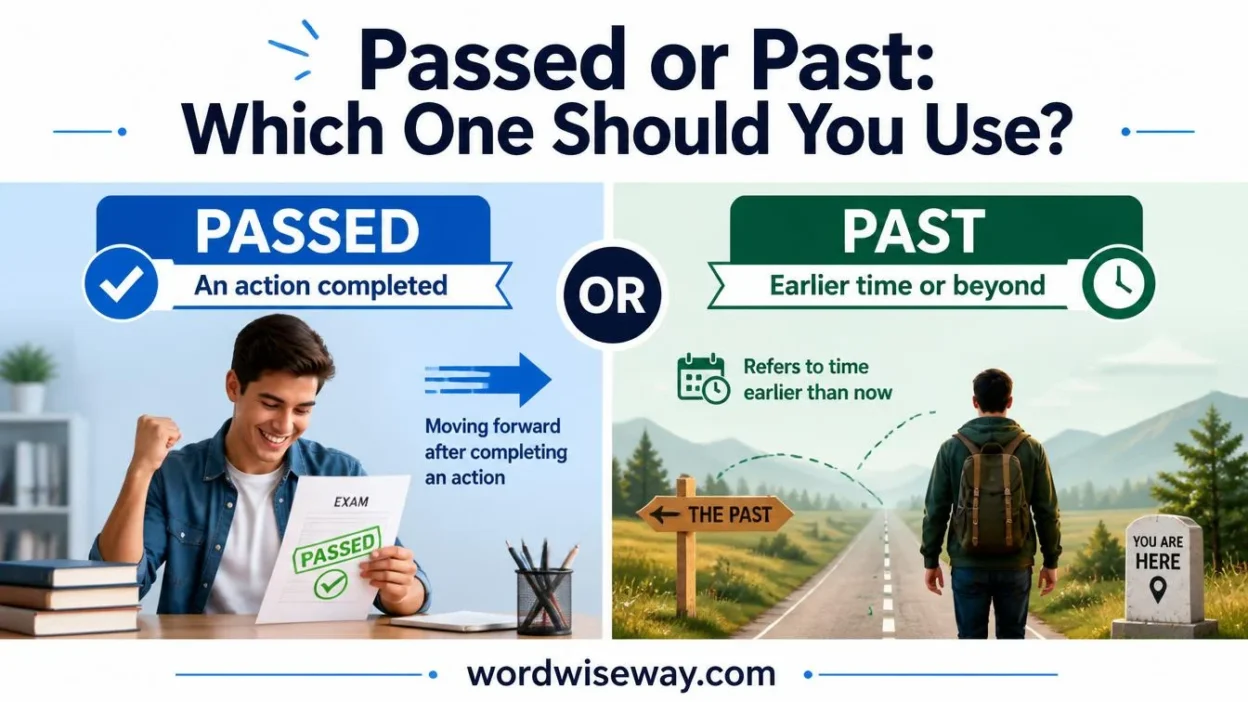
Use passed when you need the past tense or past participle of the verb pass.
Use past when you mean a previous time, something earlier, or movement beyond a particular point.
| Word | Main Function | Example |
| Passed | Verb | She passed the exam. |
| Past | Noun | We learned from the past. |
| Past | Adjective | His past experiences shaped him. |
| Past | Preposition | We walked past the library. |
| Past | Adverb | The car drove past. |
A useful memory trick is simple: passed = an action involving pass; past = earlier or beyond.
What Does Passed Mean?
It is the past tense and past participle of the verb pass. It describes something that happened, was completed, or moved from one place or person to another.
The word can have several meanings depending on the sentence. Someone can pass a test, pass an object, pass another vehicle, or pass through a doorway.
Passed as the Past Tense of Pass
When passed describes an action that happened in the past, it’s functioning as a verb.
For example:
- Maya passed her driving test.
- The teacher passed the papers around the classroom.
- The runner passed two competitors.
- We passed the old bridge on our way home.
- He passed the ball to his teammate.
In each example, passed describes something that happened.
You can test the word by changing it back to the base verb pass. If the sentence makes sense with the verb pass in another tense, passed is likely the correct form.
Present: She passes the test.
Past: She passed the test.
Future: She will pass the test.
Passed for Successfully Completing Something
One of the most common uses of passed appears when someone successfully completes an examination, test, course, or similar requirement.
Examples include:
- I passed my final exam.
- Daniel passed his driving test.
- She passed the certification exam.
- They passed the course.
Here, passed means successfully met the required standard.
That’s why this sentence is correct:
I passed the exam.
The word past would not work because the sentence needs a verb.
Passed for Moving Beyond Something
Passed can also describe the action of moving beyond someone or something.
For example:
- The cyclist passed the bus.
- We passed several houses.
- The train passed the station.
- She passed me on the stairs.
In these sentences, passed is the action. The subject actively moves beyond another person or object.
This distinction becomes especially important when comparing passed with past.
What Does Past Mean?
Unlike passed, past isn’t the past-tense form of pass. It can function as a noun, adjective, adverb, or preposition.
Its meaning usually connects to something that happened before now or something located beyond a particular point.
Past as a Noun
As a noun, past refers to a period or events that have already happened.
Examples:
- We can’t change the past.
- She often talks about her past.
- The past can teach us valuable lessons.
- His past is very different from his present.
In these examples, past represents an earlier period of time.
Consider this sentence:
The past can influence the future.
Here, past isn’t describing an action. It refers to everything that has already happened.
Past as an Adjective
Past can also describe something connected with an earlier time.
For example:
- We discussed past mistakes.
- Her past experiences helped her make the decision.
- Several past presidents attended the event.
- The company learned from its past failures.
The word modifies a noun in each example.
Compare:
1.past experiences
2.past mistakes
3.past events
The adjective past tells you that these experiences, mistakes, or events happened earlier.
Past as a Preposition
One particularly important use of past describes movement beyond a person, place, or point.
Examples:
- We walked past the school.
- She drove past the supermarket.
- He ran past me.
- The dog raced past the gate.
Here, past means approximately beyond.
That’s why this sentence is correct:
We walked past the library.
The word past doesn’t describe the walking action. Walked already does that. Instead, past tells you where the movement went.
Past as an Adverb
Past can also work as an adverb when it describes movement beyond something.
Examples:
- The car went past.
- She walked past without stopping.
- The runner sped past.
In these sentences, past doesn’t directly introduce a noun. It modifies the movement described by the verb.
Passed vs. Past: The Key Difference
The easiest way to understand passed vs. past is to focus on grammar rather than pronunciation.
Passed is connected to the verb pass.
Past usually describes previous time or something beyond a point.
| Passed | Past |
| Verb form of pass | Noun, adjective, preposition, or adverb |
| Describes an action | Describes time, position, or direction |
| Can mean successfully completed | Can mean earlier or previous |
| Can mean moved beyond something | Can mean beyond something |
| She passed the test. | She walked past the test center. |
| He passed me. | He walked past me. |
The tricky part is that both words can appear in sentences involving movement. That’s where many writers get caught.
Passed or Past in Similar Sentences
Passed the Store vs. Walked Past the Store
Both forms can be correct, but they emphasize different grammatical structures.
I passed the store.
Here, passed is the main verb. It means I moved beyond the store.
I walked past the store.
Here, walked is the main verb. Past tells you where I walked.
The distinction is subtle but important.
In the first sentence, passed carries the action. In the second, walked carries the action and past describes the direction.
Passed the Exam vs. Past the Exam
Only one word works when you mean successfully completing an exam:
She passed the exam.
Here, passed means she successfully completed it.
The sentence She past the exam is incorrect because past isn’t the required verb.
However, past the exam could appear in a completely different sentence:
We walked past the exam room.
Now past means beyond the exam room.
Passed Me vs. Past Me
Both expressions can be correct.
He passed me on the road.
Here, passed is the verb describing the action.
He walked past me.
Here, walked is the verb, while past means beyond my position.
The easiest question to ask is: What word is doing the action?
If you need the verb pass, choose passed.
If another verb already describes the movement and you mean “beyond,” choose past.
Passed Away vs. Past
Passed away is an established expression meaning that someone died.
For example:
Her grandfather passed away several years ago.
You can’t replace passed with past in this expression.
Past away is incorrect.
How to Know Whether to Use Passed or Past
When you’re unsure about passed or past, don’t rely on how the word sounds. Use the meaning and grammar of the sentence.
Use the “Pass” Test
Ask yourself whether the sentence needs a form of the verb pass.
For example:
I ___ the ball to James.
The correct answer is passed:
I passed the ball to James.
The sentence describes an action, and pass is the verb.
Try another:
She ___ her driving test.
Again, passed is correct because the sentence means she successfully completed the test.
Use the “Earlier Time” Test
If the sentence refers to something that happened before now, past may be correct.
For example:
We learned from the past.
Here, past refers to an earlier period.
You can also use it with nouns:
- past events
- past mistakes
- past experiences
- past decisions
- past relationships
Use the “Beyond” Test
If past means beyond, it’s usually the right choice.
For example:
The dog ran past the gate.
You could mentally replace past with beyond:
The dog ran beyond the gate.
The meaning remains clear.
That test makes the distinction much easier.
Common Mistakes With Passed and Past
Because the words sound alike, spelling mistakes are common. Here are several errors worth watching for.
Mistake: “I past my exam.”
Incorrect:
I past my exam.
Correct:
I passed my exam.
Why? Passed is the verb meaning successfully completed.
Mistake: “We walked passed the house.”
Incorrect:
We walked passed the house.
Correct:
We walked past the house.
Why? Walked is already the verb. Past means beyond the house.
Mistake: “She drove passed me.”
Incorrect:
She drove passed me.
Correct:
She drove past me.
Again, drove provides the action. Past describes movement beyond your position.
Mistake: “In the passed”
Incorrect:
In the passed, people communicated differently.
Correct:
In the past, people communicated differently.
Here, past refers to an earlier period.
Everyday Examples
Seeing the words in realistic situations can make the rule stick.
| Incorrect | Correct | Reason |
| I past my test. | I passed my test. | Passed is the verb. |
| We walked passed the store. | We walked past the store. | Past means beyond. |
| He past me on the highway. | He passed me on the highway. | Passed is the action. |
| We learned from the passed. | We learned from the past. | Past means earlier time. |
| She drove passed the school. | She drove past the school. | Past describes direction. |
| They passed their old mistakes. | They learned from their past mistakes. | Past describes earlier mistakes. |
Passed or Past: Real-World Contexts
At School
School conversations often use passed because students take tests and exams.
- I passed my math exam.
- She passed the final test.
- He passed the course.
But past can also appear naturally:
- We talked about past exams.
- She remembered her past teachers.
The difference comes from the sentence’s meaning.
While Traveling
Travel descriptions frequently use passed and past together.
- We passed three villages.
- We drove past the airport.
- The train passed another train.
- We walked past several restaurants.
Notice that both words can describe movement. The grammatical structure determines which one belongs.
When Talking About Time
When the subject concerns previous events, past is usually the natural choice.
- In the past, people traveled differently.
- Her past experiences influenced her decision.
- We shouldn’t repeat the mistakes of the past.
Here, passed wouldn’t work because no action involving the verb pass is being described.
Passed or Past: A Simple Decision Guide
Use this quick process whenever you’re stuck.
1: Identify the action in the sentence.
2: Ask whether you need a form of the verb pass.
3: If yes, use passed when referring to a completed past action.
4: If not, ask whether past means an earlier time or something beyond a point.
5: Read the complete sentence again. If it sounds awkward, check which word is actually performing the grammatical job.
Quick Decision Table
| If you mean… | Use |
| Successfully completed a test | Passed |
| Handed something to someone | Passed |
| Moved beyond something as an action | Passed |
| An earlier period | Past |
| Previous experiences | Past |
| Beyond a person or place | Past |
| A previous event | Past |
A Useful Memory Trick for Passed and Past
Here’s a compact rule worth remembering:
Passed has “pass” inside it.
If you can connect the sentence to the verb pass, passed may be correct.
I passed the ball.
Past is connected to ideas such as before and beyond.
We walked past the house.
So remember:
Passed = action.
Past = earlier or beyond.
This isn’t a rule for every possible use of the words, but it works remarkably well for everyday writing.
Passed or Past: Practice Examples
Try choosing the correct word before checking the answers.
- I ___ my English exam.
- We walked ___ the museum.
- She ___ the message to her brother.
- He has learned from his ___.
- The car drove ___ our house.
- They ___ several buildings during the journey.
- His ___ experiences helped him make a better decision.
- The runner ___ me near the finish line.
Answers
- passed
- past
- passed
- past
- past
- passed
- past
- passed
The pattern becomes clearer once you identify the grammatical role of each word.
Read More: Fair vs. Fare: Correct Spelling, Difference, and Usage
FAQs
1. What is the difference between passed and past?
Passed is the past tense of the verb pass, while past can function as a noun, adjective, or preposition. Their meanings and grammatical roles are different.
2. Is passed a verb or an adjective?
Passed is a verb. It describes an action that happened before now, such as passing someone, passing an exam, or moving beyond something.
3. Is past always related to time?
Not always. Past can refer to an earlier time, but it can also describe movement, position, or something that has already happened.
4. Can passed and past sound the same?
Yes. Passed and past are homophones, so they have different spellings and meanings but the same pronunciation.
5. How can I remember when to use passed?
Try replacing passed with another form of pass. If the sentence describes an action, passed may be the correct choice.
6. How can I remember when to use past?
Think about past as something connected with an earlier time, position, or point. For example, you can walk past a building.
7. Is “I walked passed the school” correct?
No. The correct sentence is “I walked past the school.” Here, past shows movement beyond the school.
8. Is “She passed the store” correct?
Yes. Passed is correct when you mean that she moved beyond or went by the store. The exact meaning depends on the sentence context.
9. Which is correct: passed time or past time?
Usually, past time is correct when referring to time that has already gone by. Passed would be correct when it describes an action.
10. Why do people confuse passed and past?
People often confuse them because they sound identical. Checking the grammar, meaning, and role of the word in the sentence can help you choose correctly.
Conclusion
Choosing between passed and past becomes much easier once you focus on what the word is doing in the sentence. Passed is the past tense of pass and usually describes an action, while past can refer to earlier time, movement, position, or something that happened before. Since both words sound the same, checking the sentence’s meaning and grammar is the safest way to make the right choice.
The next time you pause over passed or past, don’t rely on sound alone. Look at the context and ask whether you need an action or a word describing time, position, or something earlier. With a little practice, this small spelling difference will become much easier to spot, helping your emails, essays, and everyday writing stay clear and accurate.

Amelia Sanders has spent 14 years in Harvard University’s English Department, helping students navigate literary analysis, interpretive theory, and narrative techniques. Her academic pursuits center on 18th-century British prose, romantic poetry, diasporic writing, and digital editing exploring how textual choices influence cultural perspectives. Amelia has spoken at major international meetings and contributed essays to respected academic volumes, demonstrating her dedication to thoughtful scholarship and effective teaching.