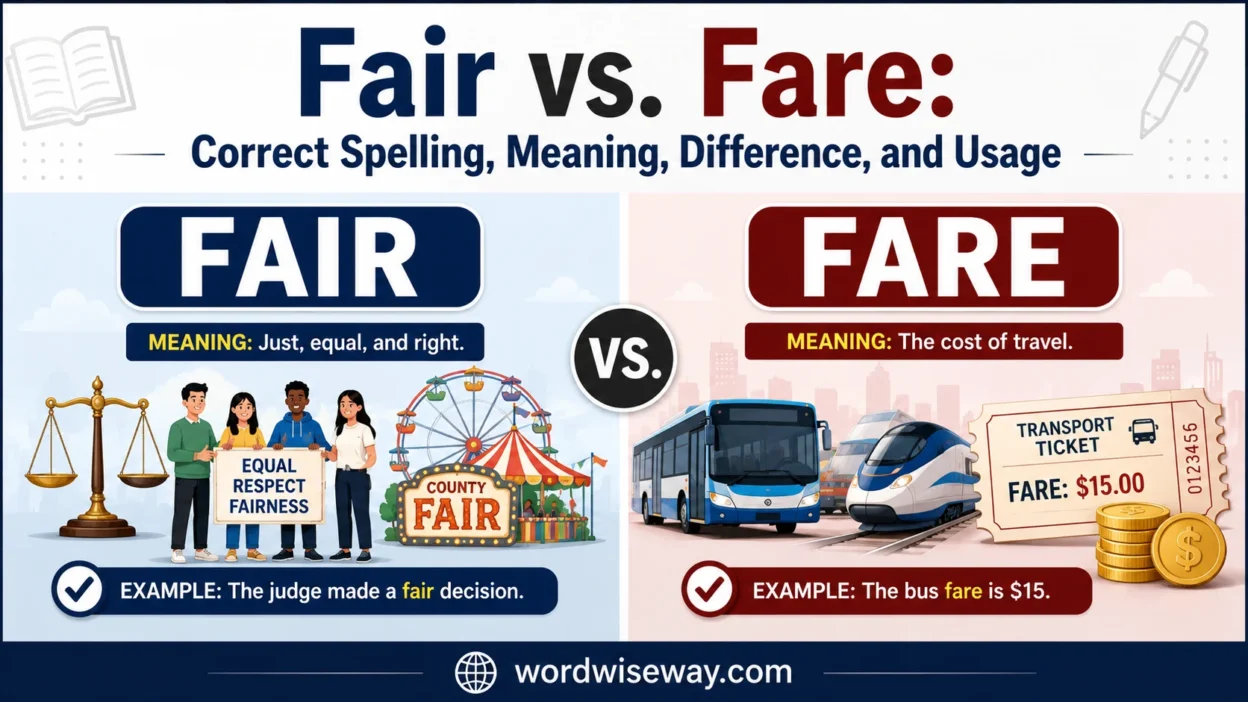
Fair vs. Fare: Correct Spelling, Difference, and Usage can be confusing because fair and fare sound exactly alike but have different meanings.
Fair can mean just, reasonable, or light colored, while fare usually means a price, food, or travel cost. These homophones are spelled differently, so choosing the correct word matters when writing.
A simple way to remember the difference is to connect fare with travel, prices, and how someone is going, while fair often describes something reasonable or just. Common mistakes such as bus fair instead of bus fare can change the meaning. Regular practicing makes the distinction easier to remember.
Quick Answer
Fair usually means just, reasonable, equal, acceptable, or an event where people gather. It can work as an adjective, noun, adverb, and in some uses, a verb.
Fare usually means the price paid for transportation. As a verb, it means to perform, progress, or experience a particular result.
| Word | Main Meaning | Example |
| Fair | Just or reasonable | Everyone deserves a fair chance. |
| Fair | Public event | We visited the county fair. |
| Fair | Pleasant weather | We had fair weather all weekend. |
| Fare | Transportation cost | The bus fare increased this year. |
| Fare | Perform or progress | How did you fare on the test? |
A useful memory trick is simple: fair is connected with fairness, while fare is connected with travel costs and performance.
Are Fair and Fare Homophones?
Yes. Fair and fare are homophones in standard American English. Homophones are words that sound alike but have different spellings and meanings.
In US English, both are commonly pronounced /fer/.
That identical sound explains the confusion. When you hear someone say, “The fare was expensive,” you can’t determine the spelling from sound alone. You need to understand the sentence.
For example:
- The train fare was expensive. → The price of the journey was high.
- The train station had a fair entrance. → This would require a completely different meaning and context.
The pronunciation gives you no spelling clue. Meaning does the heavy lifting.
What Does “Fair” Mean?
The word fair has several established meanings. Its most common use describes something that is just, reasonable, or impartial.
Cambridge Dictionary defines this sense as treating people in a reasonable or equal way without allowing personal opinions to influence judgment.
Fair as an Adjective
As an adjective, fair often describes something reasonable, equal, or impartial.
Consider these examples:
- The teacher gave every student a fair chance.
- We reached a fair agreement.
- Everyone deserves fair treatment.
- The referee made a fair decision.
- The customer received a fair price.
Here, fair suggests that something isn’t biased, unreasonable, or excessive.
It can also describe something that meets an acceptable standard.
For example:
The movie received fair reviews from critics.
In this context, fair doesn’t mean excellent. It can mean acceptable or somewhere between poor and good.
Fair for Weather
Fair can also describe pleasant, dry weather.
For example:
- The forecast calls for fair weather tomorrow.
- We waited for fair conditions before starting the trip.
- The afternoon remained fair and dry.
This meaning appears frequently in weather-related writing, although everyday speakers may choose words such as sunny, clear, or pleasant instead.
Fair for Hair or Skin
Another meaning of fair describes light-colored hair or pale skin.
Examples include:
- She has fair hair.
- He has fair skin.
- The character has fair hair and light eyes.
This meaning differs completely from the justice-related meaning. Context tells you which definition applies.
Fair as a Noun
As a noun, fair can mean a public event where people gather to buy or sell goods, enjoy entertainment, play games, or take part in activities.
Examples include:
- We went to the county fair.
- The school hosted a spring fair.
- She found handmade jewelry at the craft fair.
- The company attended a technology fair.
A fair can also refer to an industry event where businesses display products and services.
For example:
The company introduced its new product at a trade fair.
The word fair therefore has nothing to do with transportation costs in this context.
Fair as an Adverb
You may also see fair used as an adverb in expressions such as play fair.
For example:
- You need to play fair.
- They agreed to compete and play fair.
- If everyone plays fair, the game will be more enjoyable.
In play fair, the word means behaving honestly and following the rules.
What Does “Fare” Mean?
The word fare has two major uses. It can refer to a transportation cost, or it can function as a verb meaning to perform or progress.
Fare as a Noun
The most common noun meaning of fare is the amount of money paid for transportation.
Cambridge Dictionary defines this meaning as money paid for a journey in a vehicle such as a bus or train.
Examples include:
- The bus fare is $2.
- I need enough money for the train fare.
- The taxi fare was higher than expected.
- Airline fares can change depending on demand.
- The city recently increased its public transportation fares.
Notice the pattern. Whenever you’re talking about the cost of getting from one place to another, fare is usually the correct word.
Fare as a Verb
The verb fare means to perform, progress, or experience a particular outcome.
For example:
- How did you fare on the exam?
- The new business fared well during its first year.
- The team fared better than expected.
- How will the project fare under the new plan?
Cambridge gives examples such as fare well and fare badly to show this meaning.
This use can sound slightly formal in everyday conversation. Instead of saying, “How did you fare on the test?” someone might simply ask, “How did you do on the test?”
Still, fare remains perfectly correct.
Fair vs. Fare: The Key Difference
The central distinction becomes much easier when you group their meanings.
Fair focuses on ideas such as:
- Justice
- Equality
- Reasonableness
- Acceptable quality
- Pleasant weather
- Light hair or skin
- Public events
Fare focuses mainly on:
- Transportation costs
- Performance or progress
Here’s the difference in action:
| Sentence | Correct Word | Why? |
| Everyone deserves a ___ chance. | fair | It means reasonable or equal. |
| What is the bus ___? | fare | It means transportation cost. |
| How did you ___ in the competition? | fare | It means perform or progress. |
| We visited the county ___. | fair | It means a public event. |
| The weather should remain ___. | fair | It means pleasant and dry. |
| The airline reduced its ___. | fares | It means transportation prices. |
| The judge made a ___ decision. | fair | It means impartial or reasonable. |
The quickest test is to replace the word mentally.
If you can replace it with just, reasonable, or equal, choose fair.
If you can replace it with ticket price, transportation cost, or perform, choose fare.
Fair vs. Fare Examples
Seeing the words in realistic sentences makes the distinction much easier to remember.
Examples With Fair
- The teacher gave everyone a fair opportunity.
- That seems like a fair price for the service.
- We had fair weather during the trip.
- The students organized a charity fair.
- The referee made a fair decision.
- Everyone should receive a fair share.
- The competition was fair and well organized.
- She has fair hair.
- The company promised fair treatment for its workers.
- They decided to play fair.
Examples With Fare
- The bus fare costs $2.
- We couldn’t afford the train fare.
- The airline increased its fares.
- What is the taxi fare to downtown?
- How did you fare in the interview?
- The team fared well during the tournament.
- The smaller company fared better than expected.
- How will the plan fare next year?
- We checked the subway fare before leaving.
- The business fared poorly during the difficult period.
Fair and Fare in the Same Sentence
Sometimes both words appear naturally in the same sentence. These examples can make the distinction stick.
- We visited the fair after paying the train fare.
- The fair offered free games, but the bus fare was expensive.
- After attending the job fair, she checked the return train fare.
- The school fair was crowded, so we took a taxi despite the high fare.
Here’s another useful example:
The fair was fun, but the fare was expensive.
The first fair refers to an event. The second fare refers to transportation cost.
One small spelling change creates a completely different meaning.
Common Phrases With “Fair”
Learning common combinations can help you recognize fair immediately.
Fair Chance
A fair chance means a reasonable opportunity.
Everyone deserves a fair chance to succeed.
Fair Price
A fair price means an amount considered reasonable for something.
The seller offered a fair price for the used laptop.
Fair Share
A fair share means an equal or reasonable portion.
Everyone should contribute their fair share.
Fair Treatment
Fair treatment means treating someone reasonably and without unfair bias.
Employees expect fair treatment at work.
Fair Play
Fair play means following rules and behaving honestly in a competition.
The coach emphasized fair play throughout the tournament.
Fair Enough
Fair enough is an informal expression used when you accept or understand someone’s point.
“I need more time to finish it.”
“Fair enough.”
These phrases all connect fair with the idea of reasonableness, equality, or acceptable behavior.
Common Phrases With “Fare”
The word fare appears in several common transportation expressions.
Bus Fare
Bus fare means the amount charged for traveling by bus.
I need some cash for the bus fare.
Train Fare
Train fare means the price of a train journey.
The train fare was cheaper when we booked early.
Taxi Fare
Taxi fare means the amount charged for a taxi ride.
The taxi fare depends partly on the distance traveled.
Airfare
1. Airfare means the price paid for an airline ticket.
2. Airfare can vary depending on the route and travel date.
Fare Well
As a verb, fare well means to perform or progress successfully.
The company fared well after launching its new service.
The expression fare well is especially useful because learners sometimes confuse it with farewell. They aren’t the same grammatical structure.
Fare well means to do well.
Farewell is a noun or interjection associated with saying goodbye.
Common Mistakes
Because these words sound alike, spelling mistakes often appear in writing.
Mistake: Using Fair for Transportation Costs
Incorrect: The bus fair increased this month.
Correct: The bus fare increased this month.
The word refers to money paid for transportation. Therefore, fare is correct.
Mistake: Using Fare for Justice
Incorrect: That’s not fare.
Correct: That’s not fair.
The speaker means something isn’t just or reasonable.
Mistake: Using Fair When Talking About Performance
Incorrect: How did you fair on your exam?
Correct: How did you fare on your exam?
Here, fare means “perform” or “do.”
Mistake: Using Fare for an Event
Incorrect: We went to the school fare.
Correct: We went to the school fair.
The word refers to a public event.
A Simple Case Study: Choosing Fair or Fare
Imagine that Maya is traveling to a city for a school event.
She writes:
“I went to the science fare, but the train fair was expensive.”
Both spellings are wrong in this sentence.
The correct version is:
“I went to the science fair, but the train fare was expensive.”
Why?
Science fair refers to an event where students display projects.
Train fare refers to the money paid for the train journey.
Now consider a second sentence:
“I hope I fair well in the competition.”
Again, one letter causes the problem.
The correct sentence is:
“I hope I fare well in the competition.”
Here, fare acts as a verb meaning perform or do.
This small example shows why context matters more than sound.
Fair vs. Fare: An Easy Memory Trick
Try connecting each word to a familiar idea.
Remember “Fair” With Fairness
Think:
fair → fairness → equal treatment
If the sentence concerns justice, equality, reasonableness, or an event, fair may be the right choice.
Remember “Fare” With Travel
Think:
fare → transportation price
If you’re paying for a bus, train, taxi, or plane journey, you’re paying a fare.
Then remember the second verb meaning:
fare → perform
If you’re asking how someone did, you can use fare.
For example:
- Was the decision fair?
- What was the train fare?
- How did you fare?
Three different meanings. Two spellings. One pronunciation.
Fair vs. Fare in American English
In American English, fair and fare are pronounced alike in most standard speech. Cambridge lists the US pronunciation of both as /fer/.
That means American speakers generally can’t rely on pronunciation to choose the spelling.
Instead, look at the sentence’s meaning.
If the sentence says:
“The price was reasonable.”
You probably need fair.
If it says:
“The price of the journey was expensive.”
You need fare.
If it says:
“She performed well.”
You can use fared well.
This meaning-first approach works much better than trying to hear a spelling difference that isn’t there.
Fair vs. Fare vs. “Fayre”
You may occasionally encounter fayre, especially in names of traditional events or deliberately old-fashioned writing.
Fayre isn’t the standard everyday spelling you should choose when you mean fair or fare. Cambridge describes fayre as an old-fashioned spelling used for either fare in the sense of food or fair in the sense of an event.
For normal modern American English, stick with:
- fair for justice, reasonable treatment, or an event
- fare for transportation costs or performance
Using an unusual spelling can make ordinary writing look unnecessarily archaic.
Fair vs. Fare: Comparison Table
| Feature | Fair | Fare |
| Pronunciation in US English | /fer/ | /fer/ |
| Homophone | Yes | Yes |
| Means just or reasonable | Yes | No |
| Means an event | Yes | No |
| Means transportation cost | No | Yes |
| Means perform or progress | No | Yes |
| Describes pleasant weather | Yes | No |
| Can describe light hair or skin | Yes | No |
| Common phrase | fair chance | bus fare |
| Another common phrase | fair price | fare well |
| Main memory clue | fairness | travel cost/performance |
How to Choose the Correct Word Quickly
When you’re unsure, don’t stare at the spelling. Ask what the sentence means.
Use this quick checklist:
- Does it mean just or reasonable? → fair
- Does it describe equal treatment? → fair
- Does it refer to an event? → fair
- Does it describe pleasant weather? → fair
- Does it describe light hair or skin? → fair
- Does it mean transportation cost? → fare
- Does it mean perform or progress? → fare
For example:
“The ___ was expensive.”
Ask: What was expensive?
If the answer is the bus trip’s price, use fare.
“The teacher gave us a ___ chance.”
Ask: What kind of chance?
If the answer is reasonable and equal, use fair.
This simple habit can prevent most fair-versus-fare mistakes.
Read More: Compliment or Complement: Difference, and Correct Usage
FAQs
Is it fair or fare?
Both words are correct, but they have different meanings. Use fair for ideas such as justice, reasonableness, equality, or an event. Use fare for transportation costs or the verb meaning perform or progress.
What is the difference between fair and fare?
Fair commonly means just, reasonable, equal, or an event. Fare commonly means the price of transportation or how someone performs in a particular situation.
Are fair and fare homophones?
Yes. In standard American English, fair and fare are homophones because they normally have the same pronunciation while having different spellings and meanings.
Is fare the same as a ticket price?
Usually, fare means the amount charged for a journey. For example, a train fare is the cost of traveling by train. A ticket can represent that purchase, but fare specifically focuses on the transportation charge.
What does “fare well” mean?
Fare well means to perform or progress successfully. For example, “The team fared well in the tournament” means the team performed successfully.
What does fair mean in a sentence?
The meaning depends on context. In “She received a fair chance,” fair means reasonable or equal. In “We visited the county fair,” fair means a public event.
Is airfare spelled fair or fare?
The correct spelling is airfare. It refers to the price charged for air travel. The word contains fare, not fair.
Is fair a noun or an adjective?
Fair can function as an adjective and a noun. It can also appear as an adverb in expressions such as play fair. Its grammatical role depends on how the word functions in the sentence.
Can fair and fare appear in the same sentence?
Yes. For example: “The fair was crowded, but the train fare was reasonable.” The first word refers to an event, while the second refers to transportation cost.
What is an easy way to remember fair vs. fare?
Connect fair with fairness and fare with travel costs. Then remember that fare can also mean perform, as in “How did you fare?”
Conclusion
Fair and fare may sound identical, but their meanings take them in completely different directions. Once you connect fair with ideas such as justice and reasonableness, and fare with travel costs or performance, the distinction becomes much easier to remember.
The best way to master these words is to notice them in real sentences and use them yourself. A quick mental check before writing can prevent small spelling mistakes, especially in phrases such as bus fare and fare well.

Emma Smith has dedicated 14 years to Princeton University’s English Department, mentoring students in textual interpretation, literary movements, and critical frameworks. Her research explores Shakespearean drama, Victorian serial fiction, postcolonial narrative theory, and manuscript studies and probing how literary forms evolve across cultures and centuries. Emma has delivered lectures at international humanities congresses and published findings in distinguished academic journals, underscoring her commitment to scholarly depth and vibrant teaching.