Text or Die: How to Play, Answers, Strategies, and Tips explains this mobile game and its basic gameplay.
On Google Play, TikTok, and gaming videos, players can see the character rise higher after giving an answer to each question. This exciting challenge makes gamers compete through vocabulary, quick thinking, and general knowledge.
To play, you type words while following the rules and game rules. New players and every beginner can learn how the game works before using strategies. Choosing better answers may help you survive, survive longer, avoid fall behind, and win
. Unlike traditional action games, this game emphasizes typing, word choices, and speed.Its origin, features, and popularity explain why it remains popular in gaming culture. Users search the keyword from curiosity, seeking a guide, frequently asked questions, and ways to improve performance.
The name, warning, phrase, meaning, spelling, spelling differences, English, usage, contexts, confusion, article, content writing, common mistakes, real-life examples, conversation, and correctly using terms can all matter. An experienced player can make longer answers, recognizing patterns, and maintain steady progress.
Quick Answer:
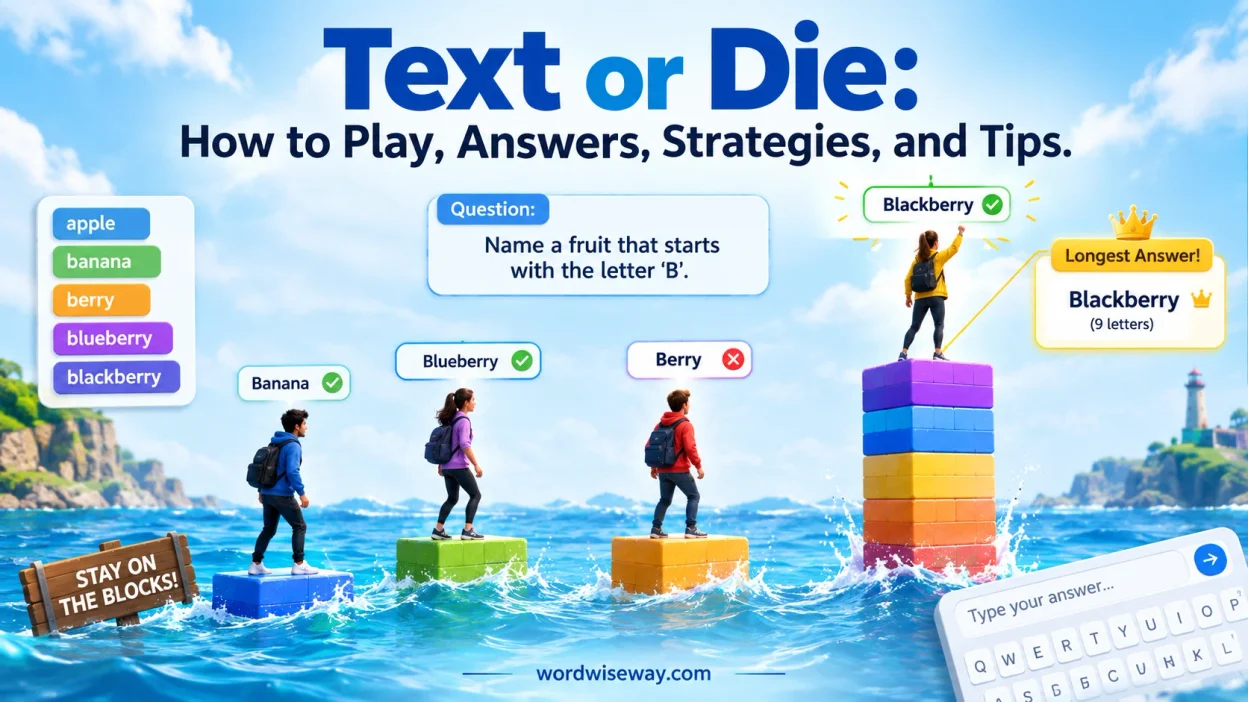
Text or Die is a word and trivia game developed by Rollic Games. The main objective is to answer questions with long answers, build the highest possible tower, and survive as the water rises. The official app listings describe it as a typing game where longer answers create higher blocks and help you outlast opponents.
The game is available on iPhone and iPad, while the current Google Play listing also lists Android and Windows availability. The App Store currently gives it a 13+ age rating, while Google Play lists it with an Everyone 10+ content rating.
| Game element | How it works |
| Questions | You receive prompts that require a suitable word or answer |
| Answers | Longer valid answers generally provide more height |
| Tower | Your answer contributes blocks that raise your character |
| Rising water | The water creates the survival pressure |
| Goal | Stay alive longer than the other players |
| Rewards | The game offers characters, items, blocks, hints, and other progression features |
The Google Play listing reports 10M+ downloads and about 285K reviews, showing that the game has developed a substantial mobile audience.
How to Play Text or Die
The controls aren’t complicated. The real challenge comes from deciding what to type before time and rising water work against you.
Understand the Question First
Every round begins with a prompt. Your first job isn’t to type immediately. Instead, identify exactly what the question asks.
For example, a prompt asking you to name an animal gives you many possibilities. A short answer might work, but a longer valid animal name can provide a stronger position.
That distinction matters throughout Text or Die. Correctness comes first, but length can give you a larger survival margin.
Type a Strong Answer
Once you understand the category, enter an answer that fits it. The game’s central mechanic rewards longer responses because they help create more blocks and increase your tower’s height.
You shouldn’t blindly choose the longest word you can imagine. A strange word that the game doesn’t recognize won’t help much. A familiar, relevant answer that the game accepts is usually a better choice.
Think of each response as a trade-off:
Relevance + acceptance + length + speed = a stronger play
Build Your Tower
Your answers aren’t merely points on a screen. They directly affect your position in the survival race.
Earlier guides describe the mechanic as giving players a block for each letter in an accepted answer.
That means answer length has a practical purpose. A longer response can place your character farther above the danger level.
For instance, if a prompt allows both a short everyday word and a longer specific term, the longer valid option can create more breathing room.
Survive the Rising Water
The rising water is what turns a vocabulary quiz into a survival game. The water gradually catches up with players whose towers aren’t tall enough. The official game description specifically presents escaping the rising waters as the central challenge.
This creates a useful rhythm:
Read → Think → Type → Build → Survive
One weak answer may not eliminate you immediately. Several weak answers, however, can leave your character dangerously low.
Game Mechanics
The game’s appeal comes from a handful of mechanics working together rather than from complicated controls.
Answer Length and Tower Height
The most important relationship is straightforward: longer accepted answers can produce more height.
That makes vocabulary unusually valuable. Knowing a rare animal, a specific food, or a lengthy place name can sometimes give you an advantage over someone who remembers only a short response.
However, length isn’t everything. A useful answer needs to match the prompt and pass the game’s recognition system.
Opponents and Competition
Text or Die isn’t designed as a relaxed vocabulary exercise. You’re constantly comparing your position with other players.
If several opponents stand much higher than you, a short answer may not be enough to recover. When you’re already comfortably above the danger level, however, you don’t necessarily need to chase an obscure word.
This creates two different strategies:
| Situation | Better approach |
| Your tower is low | Look for a longer reliable answer |
| You’re comfortably ahead | Favor a valid answer you know |
| The question is unfamiliar | Choose a safe relevant answer |
| You recognize a long category-specific term | Use it quickly |
| You’re unsure about spelling | Avoid risky guesses |
Rounds and Questions
The questions provide the game’s intellectual challenge. They can test ordinary vocabulary, categories, general knowledge, and memory.
Some prompts are broad enough to produce many possible answers. Others narrow the field considerably.
That means your performance depends partly on category recognition. Once you identify the type of question, your brain can search the right mental shelf instead of scanning your entire vocabulary.
Rewards and Progression
Text or Die includes more than its basic survival loop. The Google Play listing mentions characters, items, blocks, hints, tournaments, pirates, and a bonus level among its features.
The App Store listing also confirms that the game is free with in-app purchases.
These additions give players reasons to continue beyond simply winning individual rounds.
How to Find Strong Responses
Knowing how to choose answers is more useful than memorizing random words.
Think About Answer Categories
When a prompt appears, immediately identify its category.
Useful mental categories include:
- Animals
- Foods
- Countries
- Cities
- Professions
- Household objects
- Clothing
- Sports
- Games
- Technology
- Transportation
- Entertainment
Once you recognize the category, start searching for long but familiar examples.
Look for Specific Answers
Specific answers often contain more letters than broad ones.
Imagine a prompt asks you to name a type of vehicle. You could choose a short common term. You might also remember a longer vehicle name that clearly belongs to the same category.
The second option may create more height if the game accepts it.
Specificity can therefore become a useful vocabulary tool.
Use Familiar Long Words
There’s little value in selecting a complicated word that you’re unsure about.
A reliable strategy is to build a mental collection of long words that you already know. You don’t need hundreds of obscure terms. A strong collection of familiar category-based answers can be surprisingly useful.
For example, remember long names from several broad categories rather than memorizing unrelated vocabulary.
Don’t Assume the Longest Answer Always Wins
The phrase “longest answer wins” captures the game’s central idea, but you still need an answer that fits the question and is recognized by the game. The official description emphasizes entering long answers, while player guides also note the importance of answering according to the prompt.
A huge word that doesn’t match the category is worthless.
A slightly shorter answer that clearly fits can keep you alive.
Best Strategies
Strong play comes from combining vocabulary with decision-making.
Choose Long Answers You Know
Start with answers you can spell confidently. Then consider whether you know an even longer valid option.
This approach prevents a common mistake: sacrificing a safe answer while searching for something unnecessarily complicated.
Reliable length beats reckless length.
Think by Category
Train your brain to switch categories quickly.
If the question concerns animals, search your animal vocabulary. If it asks about food, move toward dishes, ingredients, or food types.
This mental sorting process reduces hesitation.
Over time, recurring categories become easier because your brain learns where to look first.
Use Specific Answers When Appropriate
Specific terms can offer more letters than generic ones. The trick is making sure the answer remains accurate.
If a question asks for a type of food, don’t invent a description and hope the game accepts it. Choose an actual food name that belongs clearly within the category.
The best responses aren’t merely long. They’re precise, recognizable, and relevant.
Watch Your Relative Position
Your tower provides useful information. If you’re already high above several opponents, you don’t necessarily need to panic.
Conversely, if you’re near the danger level, the next answer becomes more important.
Think of your tower as a changing safety buffer. A larger buffer gives you more room for mistakes.
Don’t Sacrifice Accuracy for Length
One of the easiest ways to play poorly is to focus so heavily on length that you forget the question.
Suppose the prompt asks for a specific type of object. A long word from an unrelated category doesn’t become correct simply because it has more letters.
Always apply this order:
- Does it answer the question?
- Will the game recognize it?
- Can you spell it correctly?
- Is there a longer reliable answer?
That sequence keeps your decisions practical.
Manage Time Under Pressure
Speed matters because every round gives you limited time to think and type.
If you spend too long searching for the perfect answer, you may submit nothing useful.
A better habit is to generate two or three possibilities quickly. Then choose the strongest one.
Fast thinking doesn’t mean rushing blindly. It means reducing wasted thought.
Common Mistakes
Even players with good vocabulary can make avoidable errors.
Giving Very Short Answers
A tiny answer may technically satisfy the prompt. However, it can leave you with less height than competitors who choose longer responses.
Short answers are sometimes unavoidable. They shouldn’t become your default strategy.
Choosing an Answer That Doesn’t Match
Length cannot rescue an irrelevant answer.
Read the wording carefully. A question may seem broad while actually asking for a specific type of response.
The difference between “name a fruit” and “name a tropical fruit” can completely change your best choices.
Using Difficult or Uncertain Words
Obscure vocabulary can look tempting. Yet uncertainty creates two problems: spelling and recognition.
If you aren’t confident about the word, choose a familiar alternative unless the situation makes a risky answer worthwhile.
Waiting Too Long
Hesitation wastes one of your most valuable resources: time.
If you have a valid answer that gives you reasonable height, entering it can be smarter than staring at the prompt while searching for perfection.
Copying Another Player
Another player’s answer can show you what the category allows. It doesn’t guarantee that copying the same approach is your best move.
Your goal is to find a strong valid answer, not merely imitate someone else.
Tips for Better Scores
A few habits can make your gameplay more consistent.
- Build a mental list of long words from common categories.
- Learn several possible answers instead of relying on one.
- Read the entire prompt before typing.
- Favor answers you can spell confidently.
- Think about specificity when the category allows it.
- Watch your tower relative to the other players.
- Don’t waste too much time searching for obscure vocabulary.
- Use hints when the game’s available features make them useful.
- Remember successful answers from previous rounds.
- Practice switching between categories quickly.
- Keep accuracy ahead of unnecessary complexity.
- When you’re already safe, avoid making an elaborate guess simply for a few extra letters.
Text or Die Answer Categories
Different question types call for different mental strategies.
Animals
Animal prompts can produce a wide range of answers. Instead of stopping at the first familiar animal, consider whether you know a longer species or animal name that clearly fits.
Your strongest choices should still be words you’re confident the game recognizes.
Food and Drinks
Food prompts can be especially useful because dishes and ingredients often have longer names.
Think beyond basic everyday terms. Consider established dish names, ingredients, and specific food types when they match the prompt.
Places
Places can offer lengthy names. Countries, cities, landmarks, and geographic locations may provide useful options when the question allows them.
However, don’t force a place name into a category where it doesn’t belong.
Jobs and Professions
Profession prompts reward vocabulary knowledge. Longer professional titles can sometimes provide more height than simple job labels.
Again, relevance matters more than merely adding letters.
Objects and Everyday Items
Household objects, technology, clothing, and transportation can all appear as broad vocabulary categories.
Build your mental list gradually. You don’t need to memorize a dictionary.
Sports and Entertainment
Sports, games, movies, characters, and entertainment-related prompts can draw on cultural knowledge as well as vocabulary.
The best answer depends heavily on the exact wording of the question.
Is Text or Die Easy to Play?
Yes, the basic controls are easy to understand. The challenge comes from making good decisions quickly.
The official mobile listing describes a straightforward loop: join a tournament, type answers, build blocks, and survive the rising water.
That simplicity makes the game accessible while leaving room for strategy. You don’t need complicated controls. You need vocabulary, category recognition, spelling accuracy, and quick decisions.
In that sense, Text or Die turns language into a small tactical battlefield. Every answer becomes part of your defense.
Is Text or Die Safe and Appropriate for Kids?
Text or Die is a general trivia and typing game rather than a game centered on combat. The current App Store listing gives it a 13+ age rating, while Google Play lists it as Everyone 10+.
The Google Play listing also identifies ads and in-app purchases.
Because ratings and app features can change, parents and younger players should check the current store listing and device settings before playing.
Text or Die on Different Devices
Playing on Mobile
The game was designed around mobile typing and touch controls. The App Store lists it for iPhone and iPad, while Google Play currently lists Android and Windows availability.
Mobile play makes the game easy to pick up for short sessions. The main challenge is entering answers quickly enough while still thinking about length and accuracy.
Playing on PC
A larger keyboard can make typing easier for some players. Faster physical typing may also reduce the time spent entering an answer.
However, typing speed alone doesn’t solve the game. You still need to identify a strong response before you type it.
Read More: Malamute vs Husky: Complete Comparison Guide
FAQs
What is Text or Die?
Text or Die is a word-based mobile game where you answer questions by typing words. Your character rises as you give answers, making the game a mix of vocabulary, speed, and quick thinking.
How do you play Text or Die?
You receive a question and type an answer that matches it. The goal is to choose useful answers, build height, and stay ahead of other players as the round continues.
How do answers work in Text or Die?
Answers determine how much your character can progress. In many questions, longer valid answers provide more letters and can help you build a taller platform.
How can you find better Text or Die answers?
Think about the question carefully and consider common words that contain many letters. Learning categories and recognizing recurring questions can also make your choices faster.
Can beginners easily learn Text or Die?
Yes. The basic controls are simple, so new players can understand the gameplay quickly. The bigger challenge comes from learning which answers give you an advantage.
What strategies can help you survive longer?
Focus on understanding each question before typing. Build a mental list of longer words for familiar categories, and avoid rushing when a stronger answer comes to mind.
Is Text or Die a vocabulary game?
Vocabulary plays an important role, but the game also involves general knowledge, pattern recognition, and quick decision-making. You don’t need advanced language skills to start playing.
Why has Text or Die become popular?
Its simple question-and-answer format makes it easy to understand while creating competitive moments between players. Gaming videos and social platforms have also helped more people discover it.
Is Text or Die free to play?
The game can be downloaded and played without paying for the basic experience, although mobile games may include optional purchases or other monetization features.
Where can you find Text or Die answers and tips?
You can find gameplay guides, answer lists, and strategy discussions online. However, it’s useful to check whether information is current because questions and game features can change over time.
Conclusion
Text or Die turns simple questions into a fast-paced word challenge. Instead of relying on action controls, you use vocabulary, general knowledge, and quick thinking to choose answers while your character rises higher.
The key to making progress is understanding how the game works before chasing complicated strategies. Pay attention to question patterns, think of longer valid answers, and learn from mistakes. With practice, you can respond faster and make more confident choices.
Whether you’re a beginner or an experienced player, Text or Die gives you plenty of opportunities to test your knowledge. Exploring its gameplay, answers, strategies, and tips can make each round easier to understand and more enjoyable.