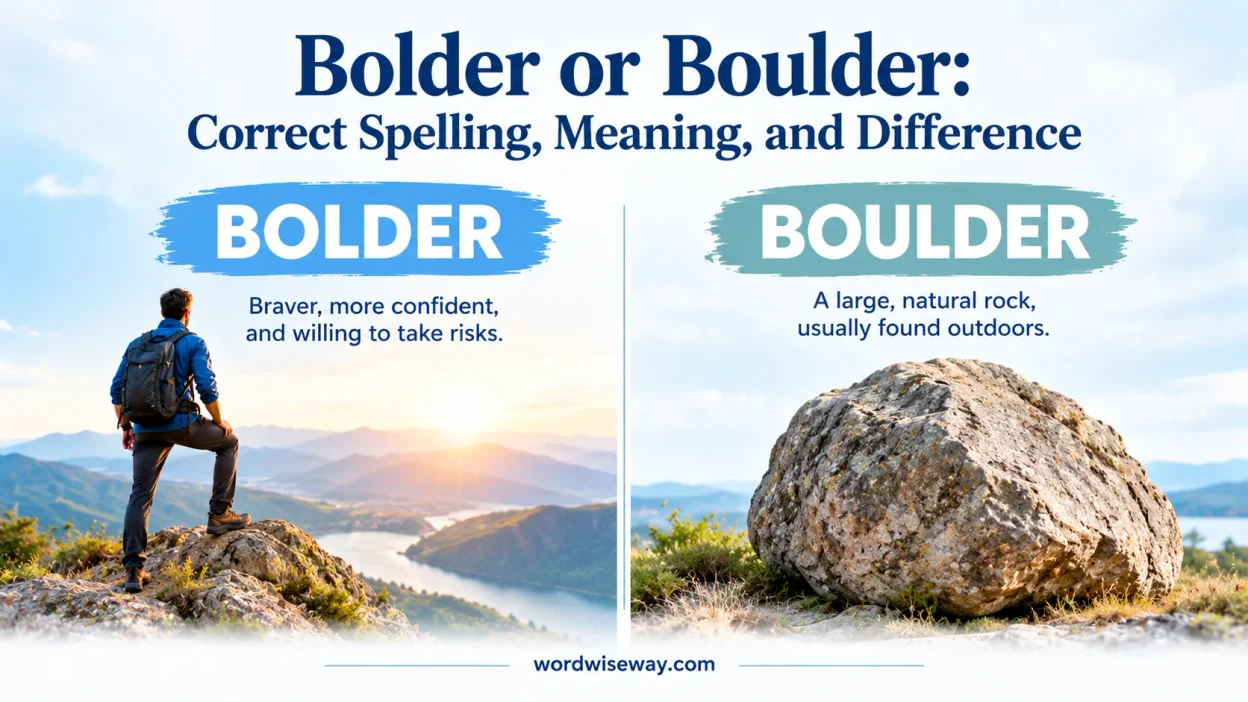
If you search for Bolder or Boulder: Correct Spelling, Meaning, and Difference, you’ll find that these similar words have very different meanings.
Bolder describes someone with more courage or confidence, while boulder means a large rock. Their spelling differs by one letter, so you may accidentally choose the wrong word in emails, school work, blog posts, or social media. Even spell-check tools can miss this mistake because both are real words.
This guide uses simple language to explain their meaning, origin, difference, and usage. You’ll find examples, comparison tables, FAQs, and practical advice to help English learners distinguish these terms. The same basic spelling difference applies in American English, US English, British English, and UK English.
Whether you’re writing essays, professional writing, or content writing, context helps you use the correct word. Students, bloggers, and other people often search when they’re confused. Learning the correct meaning prevents common mistakes and makes everyday English easier to handle, especially in grammar tests, posts, and real life.
Quick Answer:
Use bolder when you mean more bold, courageous, confident, daring, or striking. It is the comparative form of the adjective bold.
Use boulder when you mean a large rock, especially one that sits naturally on the ground, in a river, on a mountain, or in another outdoor setting.
| Word | Meaning | Part of Speech | Example |
| Bolder | More bold, daring, confident, or noticeable | Adjective | She made a bolder choice this time. |
| Boulder | A large rock | Noun | We climbed over a huge boulder. |
A quick memory trick works well: bolder contains “bold,” so it means more bold. Boulder is the rock.
What Does Bolder Mean?
Bolder means more bold. It compares one person, action, idea, design, statement, or quality with another.
The word comes from bold, an adjective that can describe someone or something as confident, courageous, daring, striking, or willing to take risks.
For example, if someone becomes more willing to speak in public, you might say they have become bolder. If a designer chooses a stronger color combination, you could also describe the design as bolder.
The exact meaning depends on context.
Bolder as a Comparative Adjective
Bolder is the comparative form of bold:
- Bold = having a strong or daring quality
- Bolder = more bold
- Boldest = most bold
You use bolder when comparing two things or describing a change.
Consider these examples:
- Maria became bolder after gaining more experience.
- The company took a bolder approach to its new product.
- This headline looks bolder than the previous version.
- He made a bolder decision than his teammates.
- The artist used bolder colors in the second painting.
Notice that bolder doesn’t have to describe physical courage. It can describe appearance, language, creativity, decisions, or behavior.
What Can Bolder Describe?
The word bolder has a surprisingly broad range of uses.
You can use it for:
- People: She became bolder with age.
- Decisions: They made a bolder investment decision.
- Ideas: His proposal offers a bolder solution.
- Writing: The article uses a bolder tone.
- Design: The new logo has bolder lettering.
- Colors: The poster uses bolder colors.
- Actions: The team took a bolder step.
- Statements: She made a bolder claim.
This flexibility comes from the broad meaning of bold itself.
What Does Boulder Mean?
A boulder is a large rock. Unlike a small stone or pebble, a boulder is substantial enough to form a noticeable natural feature or create an obstacle.
You might find a boulder on a hillside, beside a river, along a trail, or among other rocks in a mountainous area.
For example:
The hikers stopped beside a large boulder to rest.
Here, boulder identifies a physical object. It doesn’t describe someone as courageous or daring.
Boulder as a Noun
Boulder normally functions as a noun because it names a thing.
Its plural form is boulders.
Examples include:
- A massive boulder blocked the trail.
- Several boulders lined the riverbank.
- The climber sat on a flat boulder.
- Rainwater flowed around the boulder.
- The landscape contained dozens of scattered boulders.
The word can also appear in specialized contexts such as geology, landscaping, construction, and outdoor recreation.
Boulder in Nature and Outdoor Activities
Boulders can form through different geological processes. Weathering and erosion can break larger rock formations into substantial pieces. Glaciers can also transport and leave behind large rocks, creating isolated boulders far from their original source.
In everyday English, however, you don’t need a geology textbook to use the word correctly. If you’re describing a large natural rock, boulder is usually the appropriate word.
The term also appears frequently in outdoor activities. For instance, bouldering is a form of rock climbing performed on relatively short rock surfaces without the long climbing routes associated with traditional climbing.
That gives you a useful word family:
- Boulder = a large rock
- Boulders = more than one large rock
- Bouldering = a type of rock climbing
Key Differences
The easiest way to understand bolder vs. boulder is to compare their meanings and grammatical roles.
| Feature | Bolder | Boulder |
| Basic meaning | More bold | A large rock |
| Word type | Adjective | Noun |
| Base word | Bold | Boulder |
| Comparative form | Yes | No |
| Refers to | A quality or characteristic | A physical object |
| Common context | Confidence, courage, design, choices | Hiking, geology, climbing, landscapes |
| Example | She became bolder. | We saw a huge boulder. |
The spelling difference is small, but the semantic gap is enormous.
One word describes a quality. The other names a rock.
Difference in Meaning
The central distinction is simple:
Bolder = more bold.
Boulder = large rock.
If you can replace the word with more confident, more daring, or more striking, you’re probably looking for bolder.
If you can replace it with large rock, you need boulder.
For example:
- The speaker gave a bolder answer.
→ The speaker gave a more confident answer. - The hikers climbed around a boulder.
→ The hikers climbed around a large rock.
That substitution test can settle the spelling quickly.
Difference in Part of Speech
Grammar provides another strong clue.
Bolder works as an adjective:
The new design is bolder.
Boulder works as a noun:
The boulder blocked the path.
You wouldn’t normally use boulder to mean “more bold,” and you wouldn’t use bolder to name a rock.
Difference in Word Formation
Bolder has a transparent relationship with bold. English adds the comparative ending -er to form a word meaning “more bold.”
The progression is:
bold → bolder → boldest
Boulder, meanwhile, isn’t the comparative form of anything. It’s a separate noun that refers to a large rock.
This difference in word formation is one of the best ways to avoid confusing the two.
Examples
Seeing the words in real sentences makes the distinction much clearer.
Examples Using Bolder
Here are several natural examples:
- She took a bolder approach to solving the problem.
- His second presentation sounded bolder and more confident.
- The designer chose bolder colors for the new website.
- We need a bolder idea if we want to stand out.
- Her latest decision was bolder than her previous one.
- The company adopted a bolder marketing strategy.
- He became bolder after practicing his public-speaking skills.
In every example, bolder means that something has become more bold or possesses a stronger bold quality.
Examples Using Boulder
Now look at boulder:
- A giant boulder sat beside the hiking trail.
- The river flowed around a smooth boulder.
- They stopped to rest near a large boulder.
- Several boulders covered the mountain slope.
- The climber carefully moved around the boulder.
- A fallen boulder partially blocked the path.
- The children watched the stream flow around the boulder.
Here, the word always points to a physical rock.
Side-by-Side Examples
| Bolder | Boulder |
| She became bolder after gaining experience. | The hikers rested beside a boulder. |
| The artist used bolder colors. | A huge boulder stood near the trail. |
| He made a bolder proposal. | Water rushed around the boulder. |
| We need a bolder strategy. | The boulder blocked the narrow path. |
| Her voice sounded bolder today. | They climbed over several boulders. |
The surrounding words usually make the intended meaning obvious.
Why Do People Confuse Bolder and Boulder?
The confusion mainly comes from their similar appearance and pronunciation.
Both words begin with bol-/boul- sounds, and the difference isn’t always obvious when someone says either word quickly. Written English creates an additional trap because the words look remarkably similar.
There is also a familiar spelling pattern behind bolder. English speakers already know words such as older, colder, and holder, which can make the spelling feel predictable. Boulder, however, contains an extra vowel that changes its written form.
The best solution isn’t to memorize two isolated spellings. Instead, connect each word to its meaning.
Think:
BOLD → BOLDER
versus:
ROCK → BOULDER
That tiny mental bridge can prevent a surprisingly common spelling mistake.
Bolder or Boulder in a Sentence: How to Choose
When you’re unsure which word to use, don’t stare at the spelling. Look at the meaning of the sentence.
Ask yourself what you’re describing.
If You Mean “More Bold,” Use Bolder
Try replacing the word with more confident, more daring, or more striking.
For example:
The new design is bolder than the old one.
You could say:
The new design is more striking than the old one.
The meaning still works, so bolder is correct.
If You Mean “Large Rock,” Use Boulder
Try replacing the word with large rock.
For example:
We walked around the boulder.
The sentence becomes:
We walked around the large rock.
The meaning remains intact, so boulder is correct.
This context test is faster than relying on pronunciation.
Pronunciation:
In standard US English, bolder and boulder have similar but distinguishable vowel patterns.
Bolder follows the pronunciation of bold with the comparative ending.
Boulder has a two-syllable pronunciation, with the first syllable carrying the main stress.
The words can sound especially similar during fast conversation. That similarity explains why listeners sometimes need context to determine which word a speaker means.
However, their written meanings remain completely separate. If you’re writing rather than speaking, the surrounding sentence provides a reliable clue.
Common Mistakes
Using Boulder When You Mean More Bold
A common mistake is writing boulder when the sentence needs the comparative adjective.
Incorrect:
Her second idea was boulder than the first.
Correct:
Her second idea was bolder than the first.
The sentence compares two ideas, so it needs the comparative adjective bolder.
Using Bolder for a Rock
Another mistake happens when someone writes bolder while describing a large rock.
Incorrect:
We climbed over a huge bolder.
Correct:
We climbed over a huge boulder.
The sentence names a physical object, so boulder is the correct noun.
Assuming Similar Pronunciation Means Similar Meaning
Words can sound alike or nearly alike without sharing a definition.
English contains many such traps. In this case, bolder belongs to the word family of bold, while boulder identifies a type of rock.
When pronunciation creates doubt, let the sentence’s meaning decide.
Word Forms and Related Words
Understanding related words gives you another way to remember the distinction.
Word Family of Bolder
The main forms connected with bolder include:
- Bold: confident, daring, strong, or striking
- Bolder: more bold
- Boldest: most bold
- Boldly: in a bold manner
- Boldness: the quality of being bold
For example:
Her boldness helped her make a bolder decision.
The shared bold element makes the relationship easy to spot.
Related Forms of Boulder
The main related forms include:
- Boulder: one large rock
- Boulders: more than one large rock
- Bouldering: a form of rock climbing
For example:
The climbers practiced bouldering around several large boulders.
This relationship gives you a useful visual clue. When you see bouldering, think rocks, climbing, and outdoor terrain.
Read More: Hope or Dope: Meaning, Difference, and Correct Usage
Easy Memory Trick
Here’s the simplest memory rule:
Bolder has “bold” inside it.
If something is more bold, choose bolder.
Boulder is the rock.
You can also remember the two with a quick mental picture:
BOLDER → BOLD PERSON
BOULDER → BIG ROCK
The first describes a characteristic. The second names an object.
Once that connection sticks, the spelling stops being a coin toss.
Quick Reference
| Question | Correct Word |
| More courageous? | Bolder |
| More confident? | Bolder |
| More daring? | Bolder |
| More striking? | Bolder |
| A large natural rock? | Boulder |
| Several large rocks? | Boulders |
| A type of short rock climbing? | Bouldering |
FAQs
Is bolder a correct English word?
Yes, bolder is a correct English word. It’s the comparative form of bold and describes someone or something that shows more confidence, courage, or willingness to take risks.
Is boulder a correct English word?
Yes, boulder is also a correct English word. It refers to a large, rounded rock, usually one that’s found outdoors in a natural landscape.
What is the main difference between bolder and boulder?
The main difference is their meaning. Bolder relates to being more bold or confident, while boulder refers to a large rock. They also have different spellings.
Why do bolder and boulder cause confusion?
These words are easy to confuse because they look and sound very similar. The extra u in boulder can be easy to overlook when you’re writing quickly.
How do you use bolder in a sentence?
Use bolder when comparing someone or something with an earlier level of boldness. For example, you might describe a new design as bolder than the previous version.
How do you use boulder in a sentence?
Use boulder when you’re talking about a large rock. For example, a hiker might need to walk around a boulder blocking part of a trail.
Is bolder the comparative form of bold?
Yes. Bolder is the standard comparative form of bold. It means having a greater degree of boldness, confidence, or courage than something or someone else.
Does boulder have anything to do with courage?
No. Boulder refers to a large rock and has no meaning related to courage or confidence. If you’re describing someone becoming more courageous, bolder is the appropriate word.
Are bolder and boulder pronounced the same?
In many varieties of English, bolder and boulder sound very similar or may be pronounced alike. Their meanings and spellings still distinguish them in writing.
How can I remember whether to use bolder or boulder?
Think about the context. If you’re talking about confidence or courage, choose bolder. If you’re talking about a large rock, choose boulder. Focusing on the meaning makes the spelling easier to remember.
Conclusion
Choosing between bolder and boulder becomes easy once you focus on meaning. Bolder describes greater confidence, courage, or boldness, while boulder means a large rock. Their similar spelling can cause confusion, but their meanings are completely different.
When you’re writing an essay, blog post, email, or everyday sentence, check the context before choosing the word. If you’re talking about someone becoming more confident or an idea becoming more daring, use bolder. If you’re describing a large rock in a natural setting, use boulder.
Remembering this small distinction can prevent common spelling mistakes and make your writing clearer. Once you connect bolder with boldness and boulder with a rock, you’ll have a simple way to choose the correct word whenever this pair causes confusion.

Emma Smith has dedicated 14 years to Princeton University’s English Department, mentoring students in textual interpretation, literary movements, and critical frameworks. Her research explores Shakespearean drama, Victorian serial fiction, postcolonial narrative theory, and manuscript studies and probing how literary forms evolve across cultures and centuries. Emma has delivered lectures at international humanities congresses and published findings in distinguished academic journals, underscoring her commitment to scholarly depth and vibrant teaching.