Princesses or Princess’s or Princess’? Correct Usage Explained helps you understand English grammar and possessive apostrophe rules. The singular noun princess usually takes princess’s to show ownership or possession. For example, “The princess’s crown sparkled.” Adding an apostrophe and S makes the possessive form clear.
The correct possessive form depends on the grammatical context and style guide. Some guides accept princess’, while others prefer princess’s. Both forms can show possession, depending on the style followed. However, a following word that begins with S does not automatically require princess’.
Understanding singular possessive nouns improves spelling, punctuation, and word usage. For example, “The princess’s silver shoes” follows the common rule, although silver begins with S. These simple examples make English punctuation and possessive form rules easier to remember and apply correctly.
Quick Answer:
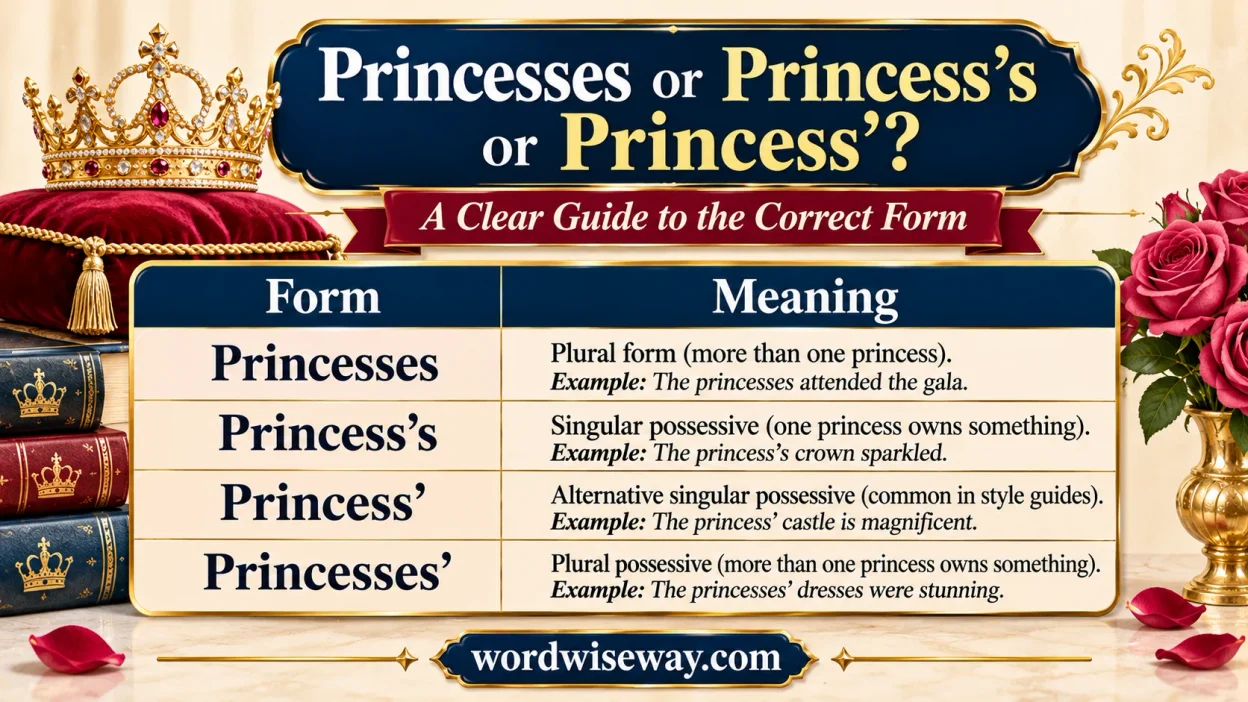
The correct form depends on what you want your sentence to mean. Use this table to identify the right spelling at a glance.
| Form | Meaning | Example |
| Princesses | More than one princess | The princesses attended the royal ceremony. |
| Princess’s | Something belonging to one princess | The princess’s crown sparkled in the sunlight. |
| Princess’ | An alternative singular possessive form used by some style conventions | The princess’ crown sparkled in the sunlight. |
| Princesses’ | Something belonging to multiple princesses | The princesses’ crowns were displayed together. |
For general American English writing, princesses is the plural form and princess’s is the standard singular possessive form. Some style guides accept princess’ as an alternative. When several princesses own something, use princesses’.
Here’s the easiest way to remember the difference:
- Princesses means more than one princess.
- Princess’s means something belongs to one princess.
- Princesses’ means something belongs to multiple princesses.
- Princess’ is an alternative singular possessive spelling permitted by certain style conventions.
The apostrophe might look like a tiny detail, but it can change the grammatical meaning of an entire sentence.
What Does Princesses Mean?
The word princesses is the plural form of princess. Use it when referring to two or more princesses rather than one person.
In English, most nouns form their plurals by adding -s or -es. Nouns ending in certain sounds, including the final s in princess, generally take -es to form the plural.
For example:
- One princess becomes two princesses.
- One actress becomes two actresses.
- One class becomes two classes.
- One dress becomes two dresses.
Notice that princess already ends in the letter s. Adding -es creates the plural form princesses.
When to Use Princesses in a Sentence
Use princesses whenever the sentence refers to multiple people or characters who are princesses. The word doesn’t indicate ownership by itself.
Consider these examples:
- The princesses arrived at the palace before sunset.
- Three princesses attended the royal celebration.
- The princesses practiced their speeches for the ceremony.
- Both princesses received invitations to the event.
- The story follows two princesses who discover an ancient kingdom.
Each sentence describes more than one princess. None requires an apostrophe because the word communicates number rather than possession.
Grammar tip: If you can replace princesses with “more than one princess” without changing the intended meaning, the plural form is probably correct.
Common Mistakes With Princesses
One frequent mistake is using princess’s when the writer simply means several princesses.
Incorrect: The princess’s attended the ceremony.
Correct: The princesses attended the ceremony.
The incorrect version suggests possession rather than plurality. In the corrected sentence, princesses acts as the plural subject of the verb attended.
Another mistake involves adding an unnecessary apostrophe to ordinary plurals.
Incorrect: Two princess’s entered the ballroom.
Correct: Two princesses entered the ballroom.
Remember that apostrophes don’t normally create plurals in English. They usually indicate possession or mark certain contractions.
What Does Princess’s Mean?
The form princess’s is the singular possessive form of princess. Use it when something belongs to, relates to, or is associated with one princess.
To create this form, keep the singular noun and add an apostrophe followed by s.
Princess + ’s = princess’s
This pattern applies to most singular nouns in standard American English, including nouns that already end in s. The Chicago Manual of Style, for example, generally recommends adding ’s to form the possessive of singular nouns ending in s.
Examples of Princess’s in Sentences
The following sentences demonstrate how princess’s expresses a relationship between one princess and something else.
- The princess’s crown rested on a velvet cushion.
- Everyone admired the princess’s elegant dress.
- The princess’s horse waited outside the palace.
- The princess’s room overlooked the royal gardens.
- The princess’s decision changed the kingdom’s future.
- The princess’s family gathered for the celebration.
In each example, the sentence focuses on one princess.
The crown belongs to one princess. The room is associated with one princess. The decision was made by one princess.
Possession doesn’t always mean legal ownership, either. In English, a possessive can describe relationships, responsibilities, characteristics, and personal associations.
For instance, the princess’s responsibilities refers to duties associated with her role. It doesn’t mean those responsibilities are physical objects she owns.
When Should You Use Princess’s?
Choose princess’s when the noun refers to one princess and you need to express possession or association.
Compare these examples:
- The princess wore a blue gown.
- The princess’s gown was blue.
The first sentence identifies the person wearing the gown. The second emphasizes the gown associated with that person.
Here are a few more comparisons:
| Sentence | What It Means |
| The princess opened the door. | One princess performed the action. |
| The princess’s door was locked. | The door belongs to or is associated with one princess. |
| The princess read a letter. | One princess read a letter. |
| The princess’s letter contained important news. | The letter belonged to or was written by one princess. |
The apostrophe helps readers understand the relationship between the nouns. Without it, the sentence may communicate a different meaning or sound less natural.
What Does Princess’ Mean?
The form princess’ is an alternative singular possessive spelling that appears in some English writing conventions. Like princess’s, it can indicate that something belongs to or is associated with one princess.
For example:
- The princess’ crown was decorated with pearls.
- The princess’ dress matched the royal decorations.
- The princess’ decision surprised the entire court.
These sentences use the apostrophe after the final s without adding another s.
However, princess’s is the more broadly applicable choice for general American English writing.
Is Princess’ Grammatically Correct?
Yes, princess’ can be grammatically acceptable when a particular style convention permits the apostrophe-only form for singular nouns ending in s.
However, it isn’t the plural form of princess. If you’re talking about multiple princesses, write princesses. If you’re showing possession by several princesses, write princesses’.
Compare these sentences:
- Singular possessive: The princess’s necklace was missing.
- Alternative singular possessive: The princess’ necklace was missing.
- Plural: The princesses arrived late.
- Plural possessive: The princesses’ necklaces were missing.
The key difference is grammatical function, not simply apostrophe placement.
When Should You Use Princess’?
Use princess’ when you’re following a style guide that specifically allows or requires that form. Certain traditional editorial conventions use an apostrophe alone for some singular nouns ending in s. Other guides favor ’s.
If you’re writing a school assignment, follow your teacher’s instructions. If you’re preparing an article for publication, follow the publication’s style guide.
When no specific rule applies, choose princess’s for singular possession in American English. It follows a widely used modern convention and keeps your writing consistent.
Princess’s vs. Princess’: What Is the Difference?
The main difference between princess’s and princess’ is the possessive style you follow.
Both forms can express singular possession, but they don’t have identical acceptance across every style guide. The spelling princess’s follows the common American English rule of adding ’s to a singular noun, even when the noun already ends in s.
The spelling princess’ follows an alternative convention that omits the additional s.
A Side-by-Side Comparison
| Feature | Princess’s | Princess’ |
| Grammatical function | Singular possessive | Singular possessive under certain styles |
| Refers to | One princess and something associated with her | One princess and something associated with her |
| Common in modern American English | Yes | Depends on the style guide |
| Example | The princess’s crown | The princess’ crown |
Both examples can communicate the same basic meaning. The difference comes from the spelling convention used by the writer or publication.
How Style Guides Affect Princess’s vs. Princess’
English doesn’t have a single editorial rule that every publisher follows for every possessive. Different style guides make different decisions about nouns and names ending in s.
For example, the Chicago Manual of Style generally adds ’s to singular nouns ending in s. Other established conventions may use an apostrophe alone in particular cases.
This variation explains why you might encounter both forms in books, newspapers, and online articles.
The best approach is straightforward:
- Use princess’s for general American English writing.
- Use princess’ if your required style guide specifies that form.
- Avoid switching between conventions without a clear reason.
- Keep the chosen spelling consistent throughout your document.
Consistency helps readers focus on your message instead of wondering whether two spellings have different meanings.
Princesses vs. Princess’s: Plural or Possessive?
The distinction between princesses and princess’s is easier to understand when you focus on the question each word answers.
Princesses answers the question “How many princesses?”
Princess’s answers the question “Whose?” or “What is associated with one princess?”
These forms aren’t interchangeable because they perform different grammatical jobs.
How to Identify a Plural Noun
A plural noun identifies more than one person, place, animal, or thing. In this case, princesses refers to multiple princesses.
Consider these examples:
- The princesses visited the neighboring kingdom.
- Several princesses participated in the ceremony.
- The princesses discussed their plans.
- Two princesses appeared in the final scene.
Each sentence describes multiple princesses performing an action or participating in an event.
The verb can also provide a helpful clue. A plural subject generally takes a plural verb in the present tense.
For example:
- The princess dances at the celebration.
- The princesses dance at the celebration.
The subject changes from singular to plural, so the verb changes from dances to dance.
How to Identify a Possessive Noun
A possessive noun expresses ownership, association, or a relationship. The form princess’s typically identifies something connected to one princess.
Consider these examples:
- The princess’s necklace glittered under the lights.
- The princess’s parents arrived early.
- The princess’s invitation included a handwritten note.
Each sentence identifies something associated with one princess.
A useful test is to replace the possessive phrase with a longer expression.
For example, the princess’s necklace means “the necklace belonging to the princess.” If that interpretation fits your intended meaning, the singular possessive form is appropriate.
Compare the Forms in Complete Sentences
| Example | Grammatical Meaning |
| The princesses wore matching gowns. | Multiple princesses wore gowns. |
| The princess’s gown was blue. | One princess’s gown was blue. |
| The princess’ gown was blue. | Alternative singular possessive spelling. |
| The princesses’ gowns were blue. | Multiple princesses had gowns that were blue. |
Notice the final example. The plural noun princesses already ends in s, so its possessive form takes an apostrophe after that final letter.
That brings us to another important distinction.
How to Make Princesses Possessive
When multiple princesses own or share something, the correct plural possessive form is princesses’.
This form begins with the plural noun princesses. You then add an apostrophe after the final s.
Princesses + ’ = princesses’
For example:
- The princesses’ dresses hung in the wardrobe.
- The princesses’ horses waited near the stable.
- The princesses’ invitations arrived together.
- The princesses’ rooms overlooked the gardens.
Each example refers to something associated with more than one princess.
Singular Possession: Princess’s
Use princess’s when one princess possesses or is associated with something.
Example: The princess’s shoes were beside the bed.
This sentence refers to one princess and the shoes associated with her.
Plural Possession: Princesses’
Use princesses’ when multiple princesses possess or are associated with something.
Example: The princesses’ shoes were beside the beds.
Here, the possessive noun refers to multiple princesses.
The distinction becomes easier when you identify the number before adding the apostrophe.
| Meaning | Correct Form | Example |
| One princess | Princess | The princess smiled. |
| Multiple princesses | Princesses | The princesses smiled. |
| Something associated with one princess | Princess’s | The princess’s smile was charming. |
| Something associated with multiple princesses | Princesses’ | The princesses’ smiles were photographed. |
Shared Possession vs. Individual Possession
Context also helps readers understand whether several people share something or have separate items.
Consider these examples:
- The princesses’ castle stood on a hill.
- The princesses’ dresses were hanging in separate rooms.
In the first sentence, the context suggests a castle associated with several princesses. In the second, the dresses may belong individually to different princesses.
The apostrophe alone doesn’t tell readers whether ownership is shared or separate. The surrounding sentence supplies that information.
Common Mistakes
Small punctuation mistakes can change a sentence’s meaning. Fortunately, most errors involving these forms come from confusing plurality with possession.
Here are the most common mistakes and their corrections.
| Incorrect or Confusing Form | Correct Form | Explanation |
| The princess’s arrived. | The princesses arrived. | The sentence needs a plural subject. |
| The princesses crown was gold. | The princess’s crown was gold. | One princess’s crown requires a singular possessive. |
| The princesses’ attended the event. | The princesses attended the event. | The sentence describes multiple princesses, not possession. |
| The princesses dresses were ready. | The princesses’ dresses were ready. | The plural possessive needs an apostrophe. |
| The princesss crown sparkled. | The princess’s crown sparkled. | The singular possessive needs an apostrophe and s. |
Mistake: Using an Apostrophe to Form a Plural
Incorrect: The princess’s attended the ball.
Correct: The princesses attended the ball.
The incorrect sentence uses a possessive form where the sentence needs a plural noun. Remember that ordinary plural nouns don’t require apostrophes.
Mistake: Forgetting the Apostrophe
Incorrect: The princesses dresses were beautiful.
Correct: The princesses’ dresses were beautiful.
The corrected sentence identifies dresses associated with multiple princesses. The apostrophe belongs after the final s in princesses.
Mistake: Mixing Possessive Styles
Imagine writing the princess’s crown in one paragraph and the princess’ dress in the next, with no reason for the change.
Both forms can express singular possession under different conventions. However, switching between them can make a document look inconsistent.
Choose one style and apply it throughout your writing.
Easy Ways to Remember the Difference
You don’t need to memorize every apostrophe rule to use these forms correctly. A few simple checks can help you make the right choice.
Use the Multiple-People Test
Ask yourself whether you’re talking about one princess or several.
If you’re describing more than one, use princesses.
Example: The princesses entered the garden.
The sentence describes multiple people, so the plural form works.
Use the Ownership Test
Ask whether something belongs to or is associated with one princess.
If it does, use princess’s under the standard American English convention.
Example: The princess’s necklace was missing.
The possessive form connects the necklace to one princess.
Use the Plural-Possession Test
If something belongs to or is associated with several princesses, use princesses’.
Example: The princesses’ necklaces were displayed in a glass case.
The plural noun identifies multiple princesses, and the apostrophe indicates possession.
Use the Style-Guide Test
If an editor, teacher, or publisher requests princess’, follow that instruction.
Otherwise, princess’s is a practical default for singular possession in American English. Consistent punctuation makes your writing easier to read and edit.
Practice Examples
Practice helps turn grammar rules into habits. Try choosing the correct form in each sentence before checking the answers.
Fill in the Blanks
Choose from princesses, princess’s, princess’, or princesses’.
- The two ______ attended the royal dinner.
- The ______ crown was made of gold.
- The ______ dresses were displayed in the museum.
- The ______ horse stood beside the palace.
- Several ______ appeared in the story.
- The ______ decision surprised everyone.
- The ______ rooms were prepared for their guests.
- The ______ invitation arrived yesterday.
Answers and Explanations
- Princesses: The sentence refers to two people.
- Princess’s: One princess possesses or is associated with the crown.
- Princesses’: The dresses are associated with multiple princesses.
- Princess’s: The horse is associated with one princess.
- Princesses: The sentence describes several characters.
- Princess’s: One princess made the decision.
- Princesses’: The rooms are associated with multiple princesses.
- Princess’s: The invitation is associated with one princess.
For sentences using princess’s, an approved style guide may permit princess’ instead. The intended singular possessive meaning remains the same.
Correct the Grammar Mistakes
Try correcting these sentences:
- The princess’s were waiting outside.
- The princesses crown was decorated with diamonds.
- The princesses’ was invited to the ceremony.
- The princesses gowns were ready.
Corrected versions:
- The princesses were waiting outside.
- The princess’s crown was decorated with diamonds.
- The princess was invited to the ceremony.
- The princesses’ gowns were ready.
The third correction changes the sentence to a singular subject because the original sentence needs to describe one princess. If the intended meaning involves multiple princesses, write “The princesses were invited to the ceremony.”
Read More: Campuses or Campus’s or Campus’? Correct Possessive Forms
FAQs
1. Is Princess’s or Princess’ correct?
Both forms can be correct, depending on the style guide. Princess’s is the usual choice in many modern style guides because it adds apostrophe plus S to a singular noun.
2. What is the plural of princess?
The plural of princess is princesses. Use it when talking about two or more princesses, such as “The princesses attended the royal ceremony.”
3. When should I use princess’s in a sentence?
Use princess’s to show that something belongs to one princess. For example, “The princess’s dress was beautiful.”
4. Can I write princess’ instead of princess’s?
Yes, some style guides accept princess’ as a singular possessive form. However, princess’s is widely preferred, so follow your chosen style guide consistently.
5. Does a word beginning with S change princess’s to princess’?
No. The first letter of the following word does not determine the possessive form. For example, “The princess’s silver necklace” is correct.
6. What is the difference between princesses and princess’s?
Princesses is the plural form of princess, while princess’s usually shows ownership by one princess. For example, “The princesses arrived” and “The princess’s crown sparkled.”
7. Is princess’s grammatically correct?
Yes. Princess’s is a grammatically correct singular possessive form in many standard English style guides. It shows that something belongs to one princess.
8. How do I show that something belongs to several princesses?
Use princesses’ to show possession by multiple princesses. For example, “The princesses’ gowns matched.” The apostrophe comes after the S because the plural noun already ends in S.
9. What are common mistakes when using princess’s?
Common mistakes include confusing princess’s with princesses and princesses’. Remember that the first shows singular possession, the second means more than one princess, and the third shows plural possession.
10. How can I remember the correct possessive form of princess?
Start by identifying whether you mean one princess or several. Use princess’s for singular possession, princesses for the plural, and princesses’ for possession by multiple princesses.
Conclusion:
Choosing between princesses, princess’s, and princess’ becomes easier when you understand what each form means. Use princesses when talking about more than one princess. Use princess’s to show that something belongs to one princess, such as “The princess’s crown sparkled.” This form follows the common rule for singular possessive nouns.
The form princess’ is also accepted by some English style guides, although many prefer princess’s. The important thing is to follow your chosen style guide consistently. Remember that a word beginning with S, such as silver, does not change the possessive form. You can write “The princess’s silver shoes” without breaking any grammatical rules.
When you write, pause and consider whether you mean one princess, several princesses, or something owned by multiple princesses. This simple habit helps you avoid common apostrophe mistakes. With regular practice and clear examples, you can improve your English grammar, punctuation, and confidence in choosing the correct possessive form.

Amelia Sanders has spent 14 years in Harvard University’s English Department, helping students navigate literary analysis, interpretive theory, and narrative techniques. Her academic pursuits center on 18th-century British prose, romantic poetry, diasporic writing, and digital editing exploring how textual choices influence cultural perspectives. Amelia has spoken at major international meetings and contributed essays to respected academic volumes, demonstrating her dedication to thoughtful scholarship and effective teaching.