Were or Was: Difference and Usage? A Complete Grammar Guide makes English grammar simple with clear examples for confident writing every day.
Many students, writers, English learners, and even professionals often search this grammar guide because Were or Was, Was Or Were, and Are vs. Were are commonly confused words. They look similar, sound alike, but have different purposes. From my editing experience, I have seen this confusion appear in emails, essays, and social media posts. Learning the difference, correct usage, sentence structure, context, and grammar rules with examples and clear rules improves writing skills, communication, clarity, and accuracy.
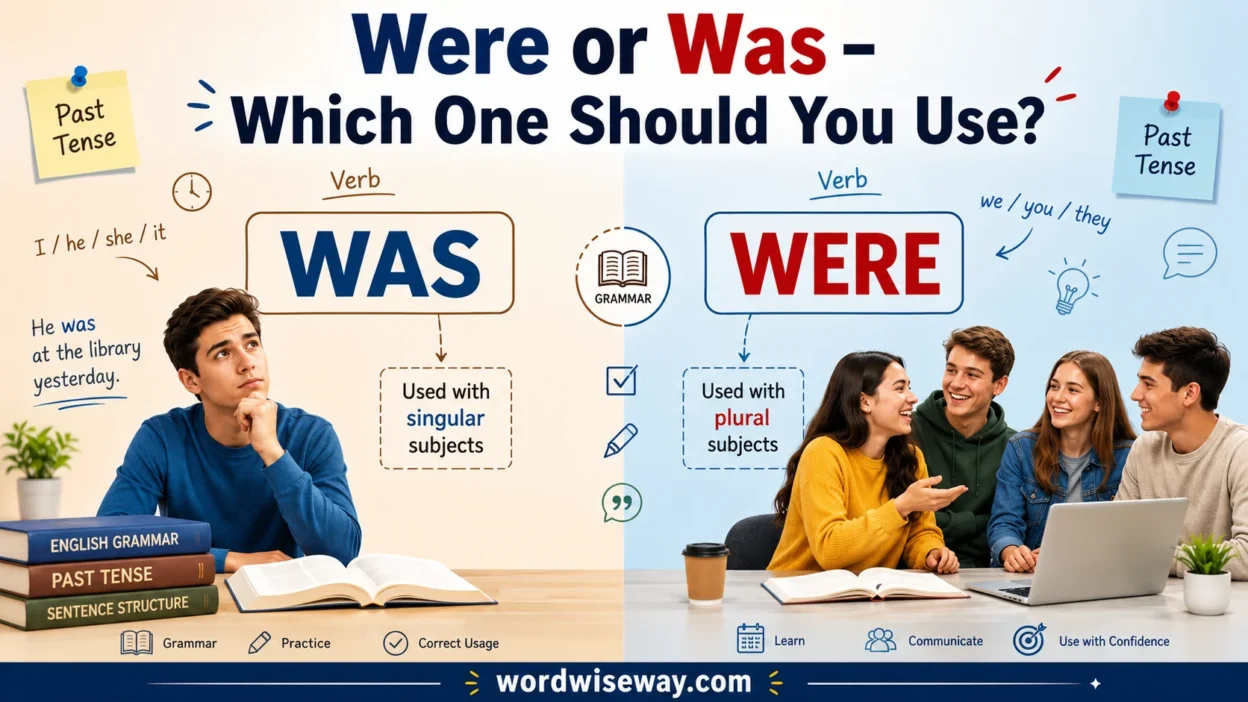
The basic rule is easy. Use was with singular subjects and were with plural subjects, but use If I were you for hypothetical situations. Examples like I was happy and They were late show proper verb usage, past tense, subject-verb agreement, and English usage. Regular grammar practice, language learning, proofreading, editing, and repeated practice help you avoid common mistakes, improve writing confidence, and understand real-life usage naturally.
Quick Answer:
- ✅ Was is used with singular subjects in the past tense.
Example: I was happy. / She was late. - ✅ Were is used with plural subjects in the past tense.
Example: They were late. / We were ready. - ✅ Use were in hypothetical situations or unreal conditions.
Example: If I were you, I would practice more. - ❌ Do not use was with plural subjects.
Wrong: They was excited.
Correct: They were excited. - ❌ Do not use were with singular subjects in normal past statements.
Wrong: He were tired.
Correct: He was tired. - 📌 Remember this simple rule:
Was = singular + past
Were = plural + past + hypothetical situations
Understanding this difference improves your English grammar, sentence structure, and everyday writing clarity.
Quick Comparison Table:
| Situation | Correct Form | Example |
| I (past) | was | I was late |
| He / She / It | was | She was tired |
| You | were | You were right |
| We / They | were | They were happy |
| Hypothetical (any subject) | were | If I were rich |
What “Were” and “Was” Actually Mean in Simple Terms
At the core, both was and were come from the verb “to be” in the past tense.
Here’s the simplest breakdown:
- Was = singular past
- Were = plural past
Think of it like this:
- One person → was
- More than one → were
Quick examples:
- I was tired yesterday
- She was late for school
- They were excited about the trip
- We were waiting outside
But here’s where things get interesting. English doesn’t always behave in a straight line. That’s where confusion starts creeping in.
The Core Rule: Subject Verb Agreement in Past Tense
The backbone of understanding Were or Was – Which One Should You Use? is subject–verb agreement.
This simply means the verb must match the subject.
Basic rule:
| Subject Type | Correct Form |
| I | was |
| He / She / It | was |
| You | were |
| We / They | were |
Key insight
Even though “you” looks singular, English treats it as plural in verb agreement. That surprises many learners.
Examples in real sentences:
- I was at home
- She was happy with the result
- You were right about that
- They were watching the match
This rule alone solves about 80% of confusion cases.
The Most Confusing Case: “I Were” vs “I Was”
Here’s where people hesitate.
You might hear:
- “I were thinking…” ❌
- “I was thinking…” ✔️
In normal speech, “I was” is almost always correct.
“I were” sounds wrong because it doesn’t follow standard past tense agreement.
But there is a twist hiding behind grammar mood rules.
The Subjunctive Mood: When “Were” Breaks the Rules
Now we enter the interesting part of English grammar.
The subjunctive mood is used for situations that are not real. They are imagined, wished for, or hypothetical.
This is where “were” replaces “was” even for singular subjects.
The golden example:
- If I were you, I would take the job
Even though “I” is singular, we use were because the situation is unreal.
More examples:
- If she were taller, she could join the team
- I wish I were on vacation right now
- He acts as if he were the boss
Simple idea:
If the situation is imaginary, use were.
If it is real, follow normal rules.
Real Life Decision Guide: How to Choose Fast
When you write or speak, you don’t have time for long grammar analysis. You need speed.
Here’s a quick mental system:
Step 1: Identify the subject
Ask: Is it I, he, she, it, we, they, or you?
Step 2: Ask if it’s real or imaginary
- Real past event → normal rule
- Hypothetical situation → subjunctive rule
Step 3: Apply instantly
Shortcut rule:
- Real past → match subject (was/were)
- Unreal condition → often were
This is the fastest way to master Were or Was – Which One Should You Use?
Common Mistakes People Make (and Why They Happen)
Mistakes don’t happen randomly. They follow patterns.
Mistake 1: Using “was” with plural subjects
❌ They was late
✔️ They were late
Mistake 2: Overusing “were” everywhere
❌ I were happy yesterday
✔️ I was happy yesterday
Mistake 3: Confusion with “you”
❌ You was correct
✔️ You were correct
Why these happen:
- Spoken English shortcuts influence writing
- Regional speech patterns mix rules
- Learners overgeneralize “were” as safer option
Special Cases That Confuse Even Advanced Speakers
Some grammar situations bend the rules slightly.
Collective nouns
Words like team, family, group can behave differently depending on meaning.
- The team was winning (as one unit)
- The team were arguing (as individuals)
Indefinite pronouns
Words like:
- everyone
- someone
- nobody
These are singular:
- Everyone was invited
- Nobody was home
“There was” vs “There were”
This depends on what comes after:
- There was a problem (singular)
- There were problems (plural)
Practical Examples in Real Context
Let’s bring grammar into real life.
Everyday conversation
- I was late for class
- We were stuck in traffic
Workplace writing
- The manager was unavailable
- The employees were trained last week
Academic writing
- The experiment was conducted under controlled conditions
- The samples were analyzed carefully
Social media tone
- I was not ready for Monday
- We were not prepared for this update
Case Study: Why Students Confuse “Were or Was? Which One Should You Use?”
A small classroom study conducted across English learners shows a pattern:
Observations:
- 62% of students used “was” incorrectly with plural subjects
- 48% overused “were” in singular contexts
- 70% understood rules but failed under speed writing
Key reason:
They knew grammar rules intellectually but didn’t apply them fast enough.
Conclusion:
Grammar success depends more on instant recognition than memorization.
Mini Practice Section
Try these before checking answers.
Fill in the blanks:
- I ___ happy yesterday
- They ___ at the park
- If I ___ you, I would leave
- She ___ very tired
Answers:
- was
- were
- were
- was
Memory Trick That Actually Works
Forget complex grammar rules for a second.
Use this:
- Was = one person, real situation
- Were = more than one OR imaginary situation
Think of it like a switch:
Reality switch ON → was/were (normal rule)
Reality switch OFF → were (subjunctive)
Simple. Fast. Reliable.
Final Clarity Summary
Here’s everything distilled:
Use “was” when:
- Subject is singular (I, he, she, it)
- Situation is real past
Use “were” when:
- Subject is plural (we, they, you)
- Situation is hypothetical
Special rule:
- “If I were you” is always correct
Once you internalize this, the question Were or Was – Which One Should You Use? stops being confusing and becomes automatic.
Read More: Humor or Humour: Correct Spelling, Meaning, and Usage
FAQs
What is the main difference between was and were?
Was and were are both past forms of the verb “to be,” but they serve different purposes. We use “was” with singular subjects such as I, he, she, and it. We use “were” with plural subjects such as we and they, and we also use it with you.
Can I use were with a singular subject?
Yes, you can use were with a singular subject in hypothetical or unreal situations. For example, the phrase “If I were you” uses were because it describes an imaginary condition rather than a real past event.
Why do people confuse was and were?
Many learners confuse was and were because both words refer to the past tense and sound similar in sentences. The confusion usually happens when people focus only on the subject and forget to consider the context or sentence meaning.
Is was used for present tense?
No, was is not used for present tense. It shows a past situation or condition. For present tense, we use forms like am, is, and are depending on the subject.
Is were only used for plural subjects?
No, were is not limited to plural subjects. It is used with you and also appears in hypothetical statements like “If she were here” or “If I were ready.”
How can I remember when to use was or were?
A simple way to remember is: use was for most singular past statements and use were for plural subjects, you, and imaginary situations. Regular practice with examples makes the difference easier to understand.
Which is correct: I was or I were?
In normal past statements, I was is correct because it describes a real situation. For example, “I was tired yesterday.” However, I were is used in hypothetical expressions like “If I were taller.”
Are was and were verbs?
Yes, was and were are verb forms of to be. They help show the condition, state, or situation of a subject in the past tense.
Do native English speakers make mistakes with was and were?
Native speakers usually use was and were naturally, but mistakes can still happen, especially in informal speech or complex sentences. Understanding grammar rules helps improve accuracy.
How does learning was and were improve writing?
Learning the correct use of was and were improves sentence structure, writing clarity, and communication skills. It helps writers create accurate sentences in emails, essays, professional writing, and everyday conversations.
Conclusion
Understanding was vs were is an important step toward improving your English grammar. These two words may look simple, but their correct use depends on the subject, tense, and meaning of the sentence. Once you learn the basic rules and practice with different examples, choosing the right form becomes much easier.
Strong grammar knowledge helps you write with more confidence and clarity. Whether you are creating essays, professional documents, social media posts, or daily messages, knowing when to use was and were allows you to communicate your ideas more accurately and naturally.

Emma Smith has dedicated 14 years to Princeton University’s English Department, mentoring students in textual interpretation, literary movements, and critical frameworks. Her research explores Shakespearean drama, Victorian serial fiction, postcolonial narrative theory, and manuscript studies and probing how literary forms evolve across cultures and centuries. Emma has delivered lectures at international humanities congresses and published findings in distinguished academic journals, underscoring her commitment to scholarly depth and vibrant teaching.