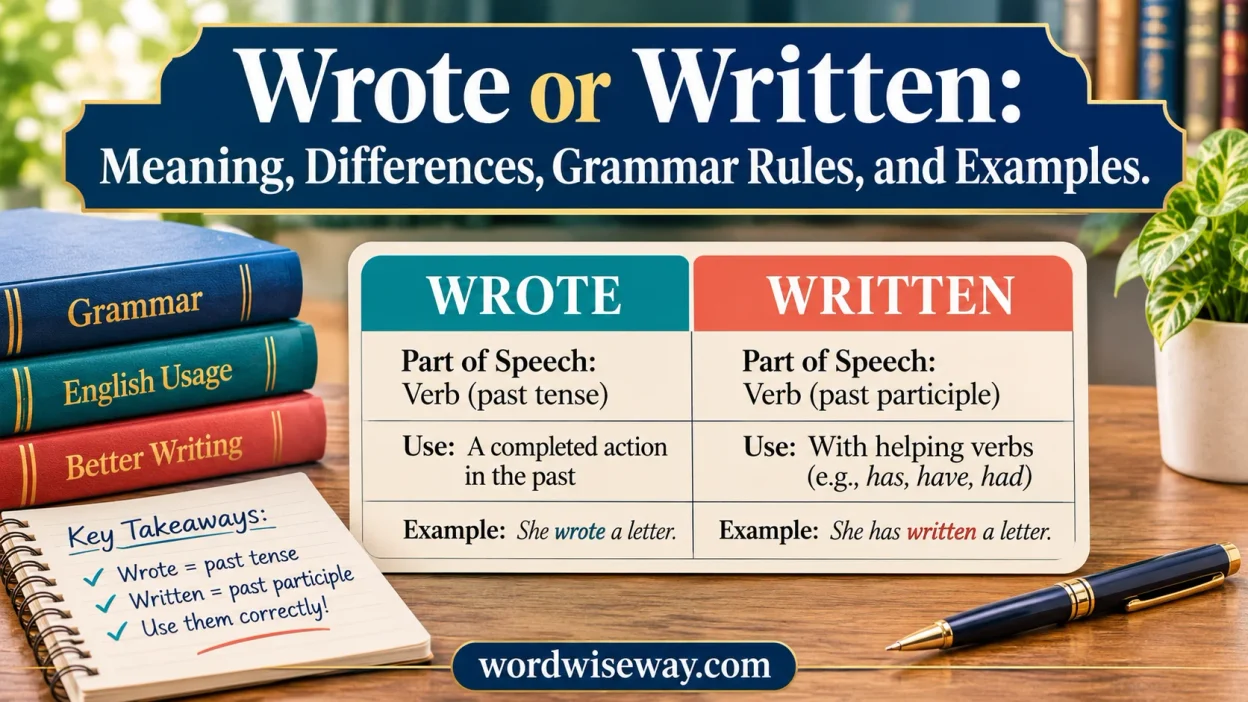
Wrote or Written: Meaning, Differences, Grammar, and Examples explains how these irregular verb forms work in English grammar. Both come from the verb write, but each serves a different purpose in sentences.
Wrote is the simple past tense used for completed past actions. For example, “I wrote a letter yesterday.” Written is the past participle, which works with helping verbs such as has, have, and had. For example, “I have written a letter.” These grammatical rules help you understand their differences and use both forms correctly.
Compare these examples: “She wrote a story last night” and “She has written a story.” The first describes a completed past action, while the second uses the past participle. Learning these verb forms improves your writing, strengthens language learning, and makes correct verb usage easier in everyday sentences.
Quick Answer
Wrote is the simple past tense of write, while written is its past participle. Use wrote to describe a completed past action in a simple past sentence. Use written with helping verbs such as has, have, and had, or in passive constructions such as was written.
| Word | Verb form | Correct example |
| Wrote | Simple past tense | She wrote a letter yesterday. |
| Written | Past participle | She has written a letter. |
| Written | Past participle in passive voice | The letter was written yesterday. |
| Written | Part of an adjective phrase | Please read the written instructions. |
The easiest rule to remember: You wrote something, but you have written something.
For example:
- ✅ I wrote an email this morning.
- ✅ I have written an email this morning.
- ❌ I have wrote an email this morning.
- ❌ I written an email this morning.
The second correct sentence uses the present perfect tense. Depending on the intended meaning and context, the simple past may sound more natural when the speaker treats the morning as a finished period.
What Does Wrote Mean?
The word wrote describes an action that happened in the past. It’s the simple past tense of write, which means to form words, record information, or create written content.
You use wrote when you want to tell someone what a person did earlier. The sentence doesn’t normally need a helping verb to express the past action.
When to Use Wrote
Use wrote when describing a completed action in the past. The sentence may include a specific time, but it doesn’t have to.
Consider these examples:
- Sarah wrote a story for her English class.
- I wrote three emails yesterday.
- They wrote a report about climate change.
- He wrote his name on the application.
- We wrote a letter to our teacher last week.
Each sentence describes an action that occurred in the past. The verb wrote tells readers when the writing happened without requiring another verb to establish the past tense.
However, the word can also appear in negative sentences and questions when the sentence follows the correct grammatical pattern.
| Sentence type | Correct example |
| Affirmative | She wrote a poem. |
| Negative | She did not write a poem. |
| Question | Did she write a poem? |
| Negative question | Didn’t she write a poem? |
Notice an important detail: Use the base form write after did or didn’t. The helping verb already marks the past tense, so wrote isn’t needed.
Wrote in Everyday Sentences
The word wrote appears in conversations, school assignments, workplace communication, and personal stories.
For example, imagine you’re telling a friend about a job application you completed yesterday. You might say, “I wrote my cover letter last night.”
Now imagine you’re discussing a school project. You could say, “Our group wrote a detailed report about renewable energy.”
Both examples use wrote because the speaker presents the writing as a past action.
What Does Written Mean?
Written is the past participle of write. Unlike wrote, it usually needs a helping verb when it forms a verb phrase in a sentence.
You’ll often find written after has, have, or had. It also appears in passive constructions and in adjective phrases describing something expressed through writing.
When to Use Written
The correct use of written depends on the grammatical structure of your sentence. Here are its main uses.
Present perfect tense
Use has written or have written to connect a past action with the present. This tense often describes experience, progress, or a completed action that matters now.
Examples:
- Maya has written two chapters of her novel.
- I have written several emails today.
- They have written a guide for new employees.
Past perfect tense
Use had written when one past action happened before another past event.
Examples:
- She had written the report before the meeting began.
- I had written the invitation before the venue changed.
- They had written the first draft before receiving feedback.
Passive voice
Use forms of be with written when the sentence focuses on what someone wrote rather than who performed the action.
Examples:
- The letter was written by my grandfather.
- The instructions are written in simple English.
- The final report will be written tomorrow.
Adjective use
The word written can also describe a noun. In phrases such as written permission and written instructions, it identifies something expressed in written form.
Examples:
- You need written permission to use the photograph.
- Please follow the written instructions carefully.
- The company provided written confirmation of the appointment.
Written in Everyday Sentences
Imagine you’ve finished a book and want to tell a friend about it. You might say, “I’ve written a review of the book.”
If you’re discussing a historical document, you could say, “The letter was written more than a century ago.”
In the first sentence, written forms part of the present perfect tense. In the second, it forms part of a passive verb phrase.
The word stays the same, but the sentence structure changes its grammatical role.
Key Differences
Although wrote and written come from the same verb, you can’t usually swap them without changing the grammatical correctness of a sentence.
The distinction becomes easier to understand when you compare their roles directly.
| Feature | Wrote | Written |
| Verb form | Simple past | Past participle |
| Common pattern | Subject + wrote | Subject + has/have/had + written |
| Example | He wrote a book. | He has written a book. |
| Passive construction | Not used alone to form the passive | The book was written by him. |
| After did | Use write, not wrote | Not used after did in this structure |
| Adjective use | Not normally used this way | Written instructions |
Here’s another way to remember the difference:
- Wrote tells you what someone did.
- Written usually works with another verb or describes something in written form.
For example, “Daniel wrote a letter” is correct because wrote expresses the past action. “Daniel has written a letter” is correct because has combines with the past participle.
However, “Daniel has wrote a letter” uses the wrong verb form after has.
Wrote vs. Written in Different Verb Tenses
Understanding verb tenses helps you choose between these words more accurately. The following patterns cover many situations you’ll encounter in everyday English.
Simple Past Tense: Wrote
The simple past describes an action that happened at an earlier time.
Structure: Subject + wrote + object.
Examples:
- Olivia wrote a thank-you note yesterday.
- The student wrote an excellent essay.
- My brother wrote a message last night.
You can use the simple past without mentioning an exact date. For example, “She wrote a novel” is grammatically correct even when the sentence doesn’t specify when she wrote it.
Present Perfect Tense: Has or Have Written
The present perfect connects a past action to the present in some way.
Structure: Subject + has/have + written + object.
Use has with third-person singular subjects such as he, she, and it. Use have with I, you, we, and they.
Examples:
- She has written five articles.
- I have written my assignment.
- They have written several research papers.
Compare these sentences:
- “I wrote three articles last week.”
- “I have written three articles this week.”
The first sentence places the action in a completed past period. The second describes work completed during the current week, which may still be ongoing.
In standard American English, the simple past is generally preferred with finished time expressions such as yesterday and last year. The present perfect typically connects the past action to the present rather than locating it within a finished period.
Past Perfect Tense: Had Written
The past perfect helps readers understand the order of two past events.
Structure: Subject + had + written + object.
Examples:
- She had written the email before her computer crashed.
- We had written the report before the deadline changed.
- He had written the invitation before the guests arrived.
In the first example, writing happened before the computer crashed. The past perfect makes that sequence clear.
You don’t need to use the past perfect whenever a sentence mentions two past actions. Use it when you need to emphasize that one action occurred before another.
Passive Voice: Was Written, Is Written, and Will Be Written
Passive voice shifts attention toward the person or thing affected by an action.
Compare these sentences:
- Active: The journalist wrote the article.
- Passive: The article was written by the journalist.
Both sentences describe the same event. However, the active sentence emphasizes the journalist, while the passive sentence emphasizes the article.
Here are three common passive patterns:
| Tense | Structure | Example |
| Simple past | Was/were + written | The letter was written yesterday. |
| Simple present | Is/are + written | The policy is written in plain language. |
| Simple future | Will be + written | The announcement will be written tomorrow. |
In these examples, written remains the past participle. The helping verb changes to express the intended tense.
Negative Sentences and Questions
Negative sentences and questions often confuse learners because they require a different verb form after certain helping verbs.
Compare these examples:
- Correct: I did not write the letter.
- Incorrect: I did not wrote the letter.
- Correct: Have you written the letter?
- Incorrect: Have you wrote the letter?
- Correct: Had she written the report?
- Incorrect: Had she wrote the report?
The rule is straightforward. After did, use the base form write. After has, have, or had, use the past participle written.
Once you recognize the helping verb, choosing the right form becomes much easier.
Wrote vs. Written: Common Grammar Mistakes
Even confident English speakers sometimes mix up irregular verbs. Fortunately, most mistakes involving wrote and written follow a few predictable patterns.
Using Written Without the Correct Verb Structure
A sentence such as “I written a letter yesterday” is incorrect in standard English when written is intended as the main verb in the simple past.
The correct sentence is “I wrote a letter yesterday.”
Compare these examples:
- ❌ She written a beautiful poem.
- ✅ She wrote a beautiful poem.
- ❌ We written the report last week.
- ✅ We wrote the report last week.
Why does this happen? English uses different forms of irregular verbs for different grammatical purposes. You can’t replace the simple past with the past participle whenever you’re talking about the past.
However, written can appear without a helping verb when it functions as an adjective. For example, “The written agreement contains three conditions” is correct.
Using Wrote After Has, Have, or Had
The words has, have, and had require the past participle when they form perfect tenses.
For this reason, use written rather than wrote in these constructions.
| Incorrect sentence | Correct sentence |
| She has wrote a letter. | She has written a letter. |
| I have wrote my essay. | I have written my essay. |
| They had wrote the report. | They had written the report. |
| He has wrote several books. | He has written several books. |
Think of has written as a grammatical partnership. The helping verb establishes the perfect tense while written supplies the main verb’s participle form.
Using Wrote After Did
Another common mistake occurs when people use wrote after did.
For example, “Did you wrote the email?” is incorrect because did already marks the past tense.
The correct version is “Did you write the email?”
Remember these patterns:
- Did you write the letter?
- I didn’t write the letter.
- Why did she write the report?
- Did they write their assignments?
The same rule applies to other verbs. Once did appears in a question or negative statement, use the base form of the main verb.
Confusing Active and Passive Voice
Active and passive sentences can describe the same event, but they organize information differently.
Consider the following examples:
- Active: The teacher wrote the instructions.
- Passive: The instructions were written by the teacher.
Both sentences are correct. The active version emphasizes who performed the action, while the passive version emphasizes the instructions.
The problem arises when writers combine the two patterns incorrectly. For instance, “The instructions were wrote by the teacher” is incorrect in standard English.
Use were written because passive constructions require the past participle.
Confusing Written as a Verb Form and an Adjective
The word written can function as part of a verb phrase or modify a noun.
Compare these examples:
- Verb phrase: The contract was written yesterday.
- Adjective: Please read the written contract.
- Verb phrase: She has written the instructions.
- Adjective: We need written approval.
In the first and third examples, written participates in a verb construction. In the second and fourth examples, it describes a noun.
Understanding the surrounding words helps you identify the role written plays in each sentence.
Everyday American English
In American English, wrote and written follow the same standard grammatical rules used in other major varieties of English. Neither word represents a regional spelling difference.
You’ll encounter both forms in schoolwork, business documents, personal messages, and published writing.
Consider these practical situations.
At school: “I wrote my essay last night” describes a completed past action. “I have written my introduction” emphasizes the work completed so far.
At work: “The manager wrote the meeting notes” focuses on the manager’s action. “The meeting notes were written by the manager” emphasizes the notes themselves.
In everyday conversation: “Have you written to your cousin?” asks whether the person has completed that action. “Did you write to your cousin?” asks about the past action using the simple past.
Both questions are grammatically correct, but their tense choices frame the action differently.
Other Forms of the Verb Write
Learning the other forms of write can help you understand why wrote and written aren’t interchangeable.
| Verb form | Example sentence |
| Base form | I write every evening. |
| Third-person singular | She writes every evening. |
| Simple past | She wrote yesterday. |
| Past participle | She has written a novel. |
| Present participle | She is writing a novel. |
Each form serves a particular grammatical purpose.
- Write: Use the base form in patterns such as I write and did write.
- Writes: Use it with third-person singular subjects in the simple present.
- Wrote: Use it for the simple past.
- Written: Use it in perfect tenses and passive constructions that require a past participle.
- Writing: Use it in continuous tenses and certain other grammatical structures.
These forms belong to one verb, but their jobs differ. Recognizing those jobs will help you avoid errors beyond this particular pair.
Read More: Why Does an Alarm “Go Off” and Not “Go On”? Meaning Explained
FAQs
1. Is it wrote or written?
Both are correct, but they serve different purposes. Wrote is the simple past tense, while written is the past participle used with helping verbs.
2. What is the past tense of write?
The past tense of write is wrote. For example, “She wrote a letter to her friend yesterday.”
3. When should you use written instead of wrote?
Use written with helping verbs such as has, have, or had. For example, “I have written my assignment.”
4. Is written a past tense verb?
Written is the past participle of write, not the simple past tense. It usually appears with a helping verb to complete the sentence.
5. Can I say, “I have wrote a letter”?
No, that sentence is grammatically incorrect. The correct sentence is “I have written a letter” because have requires the past participle.
6. What are the three forms of write?
The three main forms are write, wrote, and written. They represent the base form, simple past tense, and past participle, respectively.
7. Is wrote a regular or irregular verb form?
Wrote belongs to an irregular verb. The verb changes from write to wrote instead of following the regular pattern of adding -ed.
8. Which is correct: had wrote or had written?
Had written is correct because had takes the past participle. For example, “She had written the report before the meeting began.”
9. How can I remember the difference between wrote and written?
Remember this simple pattern: write, wrote, written. Use wrote for a simple past action and written with helping verbs such as has, have, and had.
10. Can written be used without a helping verb?
Yes, written can appear without a helping verb in certain sentence structures, especially as an adjective or in reduced clauses. For example, “The written instructions were clear.”
Conclusion
Understanding the difference between wrote and written makes English grammar easier to master. Both words come from the verb write, but they serve different purposes. Wrote describes a completed past action, while written is the past participle used with helping verbs such as has, have, and had.
The easiest way to remember these verb forms is to practice them in everyday sentences. For example, “I wrote a story yesterday” uses the simple past tense, whereas “I have written a story” uses the past participle. Comparing examples like these helps you recognize grammatical patterns and avoid common mistakes.
With regular practice, choosing between wrote and written becomes more natural. Pay attention to helping verbs, sentence structure, and the action you want to describe. These small steps can strengthen your writing skills, improve your understanding of English grammar, and help you use both forms correctly.