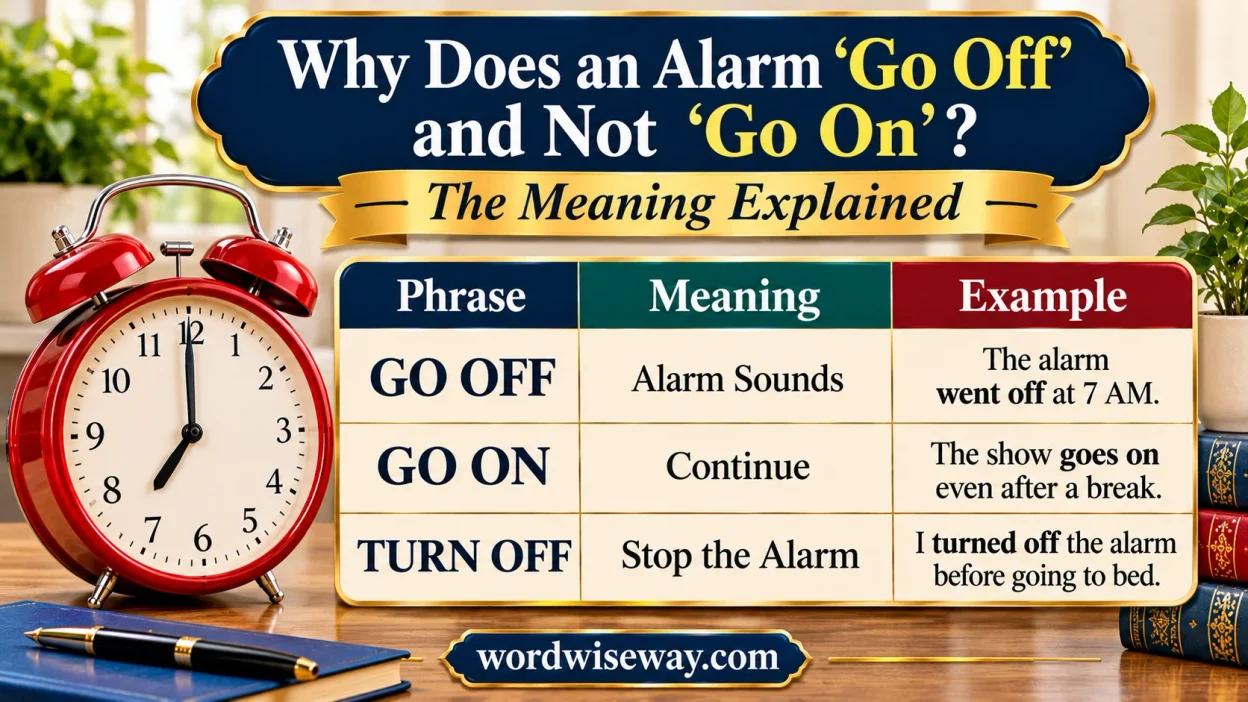
Why Does an Alarm “Go Off” and Not “Go On”? Meaning Explained explores why English uses different prepositions when an alarm starts ringing. The phrase “go off” describes an alarm beginning to make noise, while “go on” often suggests continuing.
For example, you might say, “My alarm went off at seven.” Here, “went off” means the alarm started sounding. This everyday expression shows how English prepositions can change a phrase’s meaning. Learning these common phrasal verbs makes English grammar easier to understand.
When you sound an alarm, its sound begins, so you can say the alarm is going off. Saying it is going on may suggest that the sound continues. Context matters because “go off” and “go on” have different meanings in everyday English, in clear everyday conversations and writing.
Quick Answer:
An alarm “goes off” because “go off” is an established English phrasal verb meaning to sound, activate, or be triggered suddenly. In this expression, off doesn’t mean that someone has switched the alarm off.
For example:
- My alarm goes off at 6:00 AM. The alarm sounds at that time.
- The fire alarm went off during the drill. The warning system activated.
- Her phone alarm has already gone off. The alarm has sounded.
- I turned off my alarm. I stopped the alarm from sounding.
The key difference is simple: “go off” describes an alarm sounding, while “turn off” describes stopping its operation.
By contrast, go on often means to continue, proceed, or begin operating, depending on the situation. Although it may describe something starting in certain contexts, it isn’t the conventional expression for an alarm sounding.
What Does “Go Off” Mean When Talking About an Alarm?
The phrase go off has several meanings in English. When people use it with alarms, however, the meaning is quite specific.
“Go Off” Means to Sound or Activate
When an alarm goes off, it produces a warning sound or activates its alert function. The phrase describes the event that draws your attention to something.
For example, imagine setting your phone alarm before bed. At the scheduled time, your phone begins playing a sound. You might say, “My alarm went off at seven.”
The phrase doesn’t tell you whether you heard the sound immediately, whether you pressed snooze, or whether you eventually turned the alarm off. It simply tells you that the alarm activated.
This distinction matters because setting an alarm and having an alarm go off are two different events.
- Setting an alarm: You choose when it should activate.
- An alarm going off: The alarm sounds or triggers its alert.
- Turning off an alarm: You stop the alarm from continuing to sound.
These expressions describe separate stages of the same everyday process.
Does “Go Off” Mean the Alarm Turns Itself Off?
Not in this context. Although off can mean that something isn’t operating, the complete expression go off has a different meaning when used with an alarm.
Consider these two sentences:
- “The alarm went off at midnight.”
- “The alarm was turned off at midnight.”
The first sentence tells you that the alarm sounded at midnight. The second tells you that someone or something stopped the alarm at that time.
The difference comes from the verb phrases, not simply from the word off. In the first sentence, went off means that the alarm activated. In the second, was turned off means that its operation ended.
English contains many expressions like this. For instance, give up means to stop trying, while take off can mean to remove something or leave the ground. You can’t reliably determine their meanings by translating each word separately.
Examples of “Go Off” in Everyday English
The expression appears in many situations involving warnings, signals, and sudden events.
| Example sentence | Meaning |
| My alarm goes off at six every morning. | The alarm sounds at six. |
| The smoke detector went off while I was cooking. | The detector activated its warning. |
| The kitchen timer has gone off. | The timer has signaled that its countdown ended. |
| The security alarm went off overnight. | The security system activated its alert. |
| The car alarm went off in the parking lot. | The vehicle’s alarm began sounding. |
| The alarm went off before I woke up. | The alarm sounded before the person woke up. |
Notice that the subject changes from one sentence to another, but the central meaning stays similar. Something triggers an alert, produces a signal, or begins sounding.
One important detail: an alarm going off doesn’t always mean danger exists. A smoke detector may respond to cooking smoke, while a security alarm might activate because of a faulty sensor. The phrase describes the alarm’s activation, not necessarily the cause or seriousness of the event.
Why Doesn’t an Alarm “Go On” Instead?
The natural question is straightforward: if an alarm starts making noise, why don’t we say it “goes on”?
The answer lies in how English uses phrasal verbs. Go on and go off are both correct expressions, but they don’t serve the same purpose in everyday speech.
“Go On” Has Different Established Meanings
The phrasal verb go on commonly means to continue, proceed, or happen. In some contexts, it can also describe something starting to operate.
Here are a few examples:
- The meeting went on for two hours. The meeting continued.
- The show must go on. The show must continue despite difficulties.
- The lights went on. The lights began shining.
- She went on talking. She continued speaking.
- What’s going on? What is happening?
These sentences demonstrate why go on doesn’t automatically replace go off.
When you say, “The meeting went on,” you’re describing its continuation. When you say, “The lights went on,” you’re describing the lights beginning to shine. Neither example establishes go on as the usual expression for an alarm sounding.
For that situation, English speakers conventionally use go off.
English Doesn’t Always Use Opposites Literally
Words such as on and off often express opposite states. A lamp can be on or off, and you can turn a television on or off.
However, phrasal verbs don’t always follow this neat pattern.
Consider these expressions:
| Expression | Meaning | Example |
| Give up | Stop trying | She didn’t give up. |
| Put off | Postpone | We put off the meeting. |
| Take off | Remove something or leave the ground | The plane took off. |
| Break down | Stop functioning or become emotionally overwhelmed | My car broke down. |
| Go out | Stop burning or shining; leave a place | The lights went out. |
| Go off | Sound, activate, explode, or change in another context-specific way | The alarm went off. |
The individual words offer clues, but they don’t always reveal the complete meaning.
Think of a phrasal verb as a small team. Each word contributes something, yet the team develops a meaning that you must learn as a whole.
That’s why memorizing common expressions through complete sentences often works better than translating each word separately.
What Would “The Alarm Went On” Mean?
“The alarm went on” is not the usual way to say that an alarm started sounding. Depending on the context, it might suggest that an alarm began operating or that its activity continued.
However, more natural alternatives usually communicate the intended meaning more clearly.
Compare these examples:
- The alarm went off. The alarm sounded or activated.
- The alarm came on. The alarm began operating or became active.
- The alarm kept going. The alarm continued sounding or operating.
- The alarm went on for ten minutes. The alarm continued for ten minutes, although this wording can sound less natural than “The alarm kept ringing for ten minutes.”
- The alarm was turned off. Someone or something stopped the alarm.
The distinction is especially useful when you’re describing events in sequence.
For example, “The alarm went off, kept ringing for five minutes, and was finally turned off” clearly describes three different stages.
What Is the Difference Between “Go Off,” “Go On,” and “Turn Off”?
These expressions may look similar, but each communicates a different idea. Learning their meanings side by side makes them easier to remember.
| Expression | Main meaning | Example |
| Go off | An alarm sounds or activates | My alarm went off at seven. |
| Go on | Something continues or proceeds | The meeting went on all afternoon. |
| Turn off | Stop a device or its operation | I turned off my alarm. |
| Go out | A light stops shining or a fire stops burning | The lights went out. |
| Keep going | Continue operating or making noise | The alarm kept going until I silenced it. |
| Come on | Start operating or become active | The warning light came on. |
These definitions describe common uses. Context can give the same expression a different meaning.
“The Alarm Went Off” vs. “The Alarm Turned Off”
This is one of the most important distinctions to understand.
When an alarm goes off, it sounds or activates. When you turn off an alarm, you stop it from sounding.
Imagine waking up to your phone alarm.
First, the alarm goes off at 6:00 AM. You reach for your phone and press the stop button. Then, the alarm turns off.
You might describe the sequence like this:
- “My alarm went off at six.”
- “I turned it off immediately.”
- “It didn’t go off again until the following morning.”
Each sentence uses the same basic expression differently because the verb phrase and context change.
Also notice the grammatical difference between went off and turned off. The first describes the alarm activating. The second describes the action that stops it.
“The Alarm Went Off” vs. “The Alarm Came On”
Both expressions can describe a change from an inactive state to an active one, but they emphasize different things.
Went off is the conventional choice when an alarm sounds or triggers its warning. Came on emphasizes that a device or system started operating.
For example:
- “The burglar alarm went off when someone opened the door.”
- “The alarm system came on after the power returned.”
- “The warning light came on when the engine overheated.”
In the first sentence, the alarm produces a warning. second, the system starts operating. In the third, an indicator light begins shining.
The phrases can overlap in some situations, but they aren’t interchangeable in every sentence. Choose the expression that best describes the event.
Where Did the Expression “Go Off” Come From?
Understanding modern usage is relatively easy. Explaining the phrase’s precise historical development requires more care.
The word off has long expressed ideas such as separation, movement away, and departure. Modern English uses it in many combinations, including take off, break off, and set off. However, those meanings don’t establish the exact origin of every expression containing the word.
The Historical Meaning of “Off”
In everyday English, off can describe separation from something or a state in which something isn’t operating.
For example:
- “Take your shoes off” means remove your shoes.
- “The power is off” means the power supply isn’t operating.
- “The plane took off” means the aircraft left the ground.
- “The lights went off” means the lights stopped shining.
These examples show that off carries several related meanings. Nevertheless, modern expressions also have their own established uses.
When an alarm goes off, speakers understand the phrase as a complete unit. They don’t normally interpret it as the alarm separating from something or becoming inactive.
The modern meaning of a phrase is not always predictable from the oldest or most familiar meaning of each word.
How “Go Off” Developed Its Different Meanings
English speakers use go off in several distinct contexts.
- Alarms: The warning sounds or activates.
- Explosives: An explosive device detonates.
- Food: Food spoils, particularly in varieties of English that commonly use this expression.
- A person speaking: Someone may go off on a tangent or suddenly express strong feelings.
For example, “The alarm went off” and “The milk has gone off” use the same phrasal verb, but their meanings differ.
The first sentence describes an alarm activating. The second means that the milk has spoiled.
These uses demonstrate why context matters so much. The subject of the sentence helps identify the intended meaning.
A precise historical explanation would require dated dictionary entries and historical examples showing how the alarm-related meaning developed. Without that evidence, it’s better to explain the established modern meaning than to invent a neat but unverified origin story.
Is “Go Off” British English or American English?
Go off is used in both British and American English to describe an alarm sounding.
For example, an American speaker might say, “My alarm went off at seven.” A British speaker can use exactly the same sentence with the same basic meaning.
There may be regional differences in how frequently speakers choose certain expressions in particular situations. However, the alarm-related use of go off isn’t exclusive to either variety.
If you’re learning American English, you can confidently use these sentences:
- “My alarm goes off at six.”
- “The fire alarm went off.”
- “The timer has gone off.”
- “I need to turn off my alarm.”
These are natural ways to describe common situations.
Why Does English Have So Many Confusing Phrasal Verbs?
English phrasal verbs can frustrate learners because their meanings don’t always follow the rules they expect. Even familiar words become confusing when they appear together in a new combination.
The Meaning Often Belongs to the Whole Phrase
A phrasal verb combines a verb with a particle, such as on, off, up, or out. The resulting expression may have a literal meaning, an idiomatic meaning, or several meanings.
Consider the verb set:
- Set up: Arrange or establish something.
- Set off: Trigger something or begin a journey.
- Set aside: Reserve something for a particular purpose.
- Set out: Begin a journey or explain something systematically.
The verb stays the same, but changing the particle changes the meaning.
The same principle applies to go off and go on. Both expressions are grammatical, yet each has its own conventional uses.
This is why learning phrasal verbs through examples can be more effective than relying on word-for-word translation.
One Phrasal Verb Can Have Several Meanings
The phrase go off is especially interesting because its meaning changes with the subject and context.
| Sentence | Meaning |
| My alarm went off. | The alarm sounded. |
| The bomb went off. | The bomb exploded. |
| The milk went off. | The milk spoiled. |
| He went off on a tangent. | He moved away from the main topic. |
| She went off on him. | She reacted angrily toward him. |
These sentences share the same phrasal verb, but they describe different events.
For instance, you wouldn’t interpret the milk went off as meaning that the milk started ringing. The subject makes the intended meaning clear.
This flexibility is common in English. Many phrasal verbs have multiple meanings, so learners need to consider the whole sentence rather than one isolated word.
How Context Makes the Meaning Clear
Context helps you work out which meaning a speaker intends. Three clues are particularly useful:
- The subject: Is the sentence about an alarm, food, a person, or a machine?
- The situation: Is something sounding, spoiling, exploding, or continuing?
- The surrounding words: Do other words suggest a warning, a reaction, or an ongoing activity?
For example, compare these sentences:
“The alarm went off while I was sleeping.”
“The milk went off while it sat in the refrigerator.”
The first describes an alarm sounding. The second describes food spoiling.
If you’re learning English, keep a notebook of complete phrases with example sentences. Recording the alarm went off is more useful than memorizing only the word off.
Over time, these patterns become easier to recognize and use naturally.
Common Questions
Is “The Alarm Went Off” Grammatically Correct?
Yes. “The alarm went off” is grammatically correct and standard English. The phrase means that the alarm sounded or activated.
For example, “The alarm went off at five, so I woke up earlier than expected.”
Does “The Alarm Went Off” Mean It Started or Stopped?
It means that the alarm sounded or activated. It doesn’t mean that someone stopped it.
To describe stopping the alarm, say, “I turned off the alarm” or “I silenced the alarm.”
Can You Say “My Alarm Went On”?
You can construct the sentence grammatically, but it’s not the usual expression for an alarm starting to sound.
Instead, say, “My alarm went off” or “My alarm started ringing.”
If you want to describe an alarm continuing to sound, use “My alarm kept ringing” or “My alarm kept going.”
What Is the Difference Between “An Alarm Goes Off” and “An Alarm Rings”?
Both expressions can describe an alarm producing a sound.
However, go off often emphasizes that the alarm activates or is triggered. Ring focuses on the sound itself.
For example:
- “My alarm went off at six.” The alarm activated.
- “My alarm rang for five minutes.” The sentence emphasizes the duration of the sound.
You can also say, “The alarm started ringing.” This makes the beginning of the sound explicit.
Why Does a Bomb “Go Off”?
When an explosive device goes off, it explodes or detonates. This is another established meaning of the phrasal verb go off.
The meaning differs from the alarm-related use, but both describe a sudden event.
For example, “The alarm went off” means the warning sounded, while “The bomb went off” means the bomb exploded.
The subject determines which meaning applies.
Does “Go Off” Mean the Same Thing in British and American English?
Yes. In both British and American English, go off commonly means that an alarm sounds or activates.
You can use the expression confidently in ordinary conversation, schoolwork, and everyday writing.
What Is the Past Tense of “Go Off”?
The simple past is went off, and the past participle is gone off.
| Verb form | Example |
| Present | My alarm goes off at six. |
| Simple past | My alarm went off yesterday. |
| Present perfect | My alarm has gone off twice today. |
| Past perfect | My alarm had gone off before I woke up. |
Remember that go is irregular. Its simple past is went, not goed.
Is “The Alarm Has Gone Off” Correct?
Yes. This sentence uses the present perfect tense.
It often describes an event that happened before the present moment and remains relevant now.
For example, “The alarm has gone off, so we need to check the building.”
The sentence is especially natural when the speaker wants to emphasize the event’s present importance rather than specify exactly when it happened.
What Should You Say When You Stop an Alarm?
The best expression depends on what you actually do.
- Turn off the alarm: Stop its operation.
- Silence the alarm: Stop its sound, potentially without disabling the entire system.
- Stop the alarm: A general expression for ending the alarm’s activity.
For example, pressing the stop button on your phone usually means you turned off or silenced the alarm. Disabling a building’s entire security system may require a different action.
These phrases overlap, but silence can emphasize stopping the sound without necessarily switching off the whole system.
What Are Some Other English Expressions That Seem Backward?
Several familiar expressions can confuse learners when interpreted literally.
| Expression | Meaning | Example |
| Sleep in | Wake up later than usual | I slept in on Sunday. |
| Give up | Stop trying | She refused to give up. |
| Take off | Remove something or leave the ground | The plane took off. |
| Run out | Have none left | We ran out of milk. |
| Break down | Stop functioning | The computer broke down. |
| Put off | Postpone | They put off the meeting. |
The lesson is simple: learn what each complete expression means and notice how speakers use it in context.
Read More:Princesses or Princess’s or Princess’? Correct Usage Explained
FAQs
1. Why Does an Alarm “Go Off” Instead of “Go On”?
An alarm “goes off” when it starts making noise. The phrase is a common English expression that describes an alarm being activated.
2. What Does “Go Off” Mean in English?
“Go off” has several meanings, depending on the context. For an alarm, it means to start ringing or making a warning sound.
3. Is “The Alarm Went On” Grammatically Correct?
Yes, it can be grammatically correct in certain contexts. However, it usually suggests that something continued rather than that an alarm started ringing.
4. What Is the Difference Between “Go Off” and “Go On”?
“Go off” can describe an alarm starting to sound. “Go on” usually means to continue, proceed, or begin doing something in a particular context.
5. Why Do English Speakers Say “My Alarm Went Off”?
English speakers use this expression because “go off” is the established phrase for an alarm beginning to sound. It is natural and widely understood in everyday conversation.
6. Is “Go Off” a Phrasal Verb?
Yes, “go off” is a phrasal verb. It combines the verb “go” with the particle “off” to create a meaning that differs from the individual words.
7. Can “Go Off” Have Other Meanings?
Yes, “go off” can mean different things depending on the situation. It may describe an alarm ringing, food becoming spoiled, or an event taking place.
8. Why Are Prepositions Difficult in English?
Prepositions can be challenging because their meanings often change when combined with verbs. Learning common phrases in context helps you understand how native speakers use them.
9. Should I Say “The Alarm Is Going Off” or “The Alarm Is Going On”?
Say “The alarm is going off” when the alarm is ringing. Use “going on” when you mean that an activity or process is continuing, if the context supports that meaning.
10. How Can I Remember the Correct Phrase?
Learn “the alarm goes off” as one complete expression. Practice it in everyday sentences, such as “My alarm went off early,” to make the phrase easier to remember.
Conclusion:
The phrase “go off” might sound confusing at first, especially when you wonder why an alarm doesn’t “go on.” However, English often gives familiar words different meanings when they work together. When an alarm starts ringing, we naturally say it goes off. This expression is a regular part of everyday English, not a rule you need to memorize word by word.
Understanding the difference between “go off” and “go on” becomes easier when you learn how people use these phrases in real conversations. Remember that “go off” describes an alarm starting to sound, while “go on” often refers to something continuing. The meaning depends on the situation, so always consider the context before choosing a phrase.
If you’re learning English, don’t worry about finding every expression logical. Some phrases simply develop through common usage over time. Read examples, practice speaking, and notice how these expressions appear in everyday conversations. With regular practice, you’ll use “go off” naturally without stopping to question why English works this way.

Emma Smith has dedicated 14 years to Princeton University’s English Department, mentoring students in textual interpretation, literary movements, and critical frameworks. Her research explores Shakespearean drama, Victorian serial fiction, postcolonial narrative theory, and manuscript studies and probing how literary forms evolve across cultures and centuries. Emma has delivered lectures at international humanities congresses and published findings in distinguished academic journals, underscoring her commitment to scholarly depth and vibrant teaching.