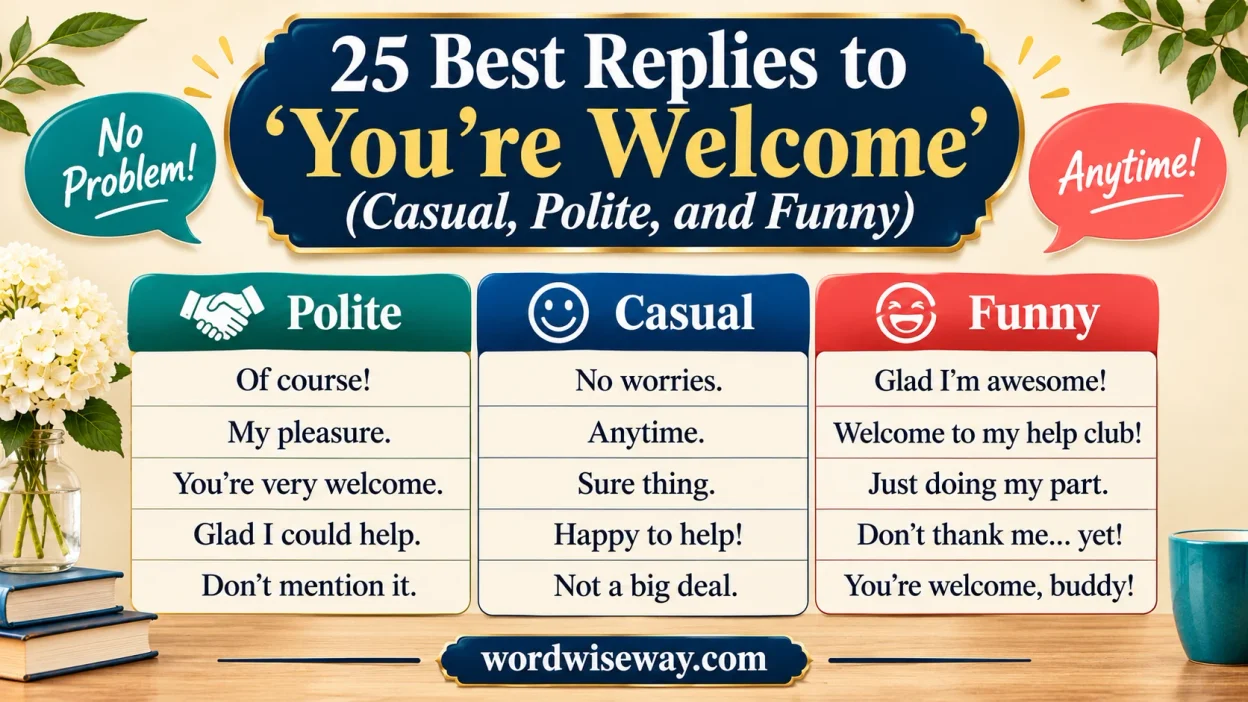
Finding other ways to say you are most welcome can improve your English tone, clarity, and vocabulary. 25 Best Replies to “You’re Welcome”: Polite and Funny offers useful expressions for everyday conversations, emails, and social media. These alternatives help you sound natural and friendly.
For English learners, varied expressions build confidence and fluency. Bloggers, content writers, and professionals can also improve reader engagement and communication skills. Instead of repeating the same polite reply after “Thank You,” try friendly phrases, witty responses, or lighthearted humor. A small change in wording can make conversations warmer.
Choose your response according to the situation. Friends may appreciate funny replies, while colleagues and customers may prefer respectful, professional expressions. Practicing these alternatives strengthens your English vocabulary, improves writing skills, and helps you express genuine appreciation naturally.
Quick Answer
You can say “Thanks again,” “I really appreciate it,” or “That means a lot” when you want to express additional gratitude. For casual conversations, “You’re the best!” or a lighthearted joke may fit. In professional settings, “I appreciate your assistance” sounds respectful.
However, you don’t always need to respond after someone says “You’re welcome.” The phrase often completes the exchange.
For example:
Person A: “Thanks for helping me with my assignment.”
Person B: “You’re welcome!”
Person A: “I really appreciate it.”
That response makes sense when the help mattered to you. If you’re simply thanking a cashier for handing you a receipt, a smile or nod may be enough.
Polite and Respectful Replies to “You’re Welcome”
Polite responses work well when someone has taken time to help you, answered an important question, or done something thoughtful. They’re especially useful when you want to express sincere appreciation without sounding overly familiar.
“Thanks Again!”
This is one of the easiest ways to acknowledge someone’s kindness a second time. It works when you genuinely want to reinforce your appreciation without extending the conversation.
Example:
“You’re welcome! I’m glad I could help.”
“Thanks again. I really appreciate your time.”
Use this response after receiving useful advice, borrowing something, or getting assistance with a task. It’s friendly enough for everyday conversations and appropriate for many workplace interactions.
“I Really Appreciate It.”
This response communicates that someone’s help mattered to you. It feels sincere because it emphasizes the value of their effort rather than simply repeating a general thank-you.
Example:
You: “Thanks for explaining that difficult question.”
Friend: “You’re welcome.”
You: “I really appreciate it. Now I understand the solution.”
Use this phrase when someone has explained a concept, solved a problem, or given you useful guidance. Adding a specific detail makes your gratitude feel more personal.
“That Means a Lot.”
Choose this response when someone’s kindness has emotional significance. It works particularly well when a friend, relative, teacher, or colleague has supported you during a challenging moment.
Example:
“I’m glad I could help you prepare for the presentation.”
“That means a lot. Thank you for taking the time.”
This phrase sounds warmer than a routine acknowledgment. Save it for situations where the assistance genuinely means something to you, rather than using it automatically after every small favor.
“I’m Grateful for Your Help.”
This is a thoughtful way to acknowledge meaningful assistance. It suits conversations where someone has invested time, effort, or patience to help you achieve something.
Example:
“Your welcome! Let me know if you need anything else.”
“I’m grateful for your help. Your explanation made the whole process easier.”
This response can work in academic, personal, and professional settings. In casual conversations, “I really appreciate your help” may sound slightly more conversational.
“I Appreciate You Taking the Time.”
Sometimes the most valuable part of someone’s help is the time they spent giving it. This response recognizes that effort directly.
Example:
Colleague: “You’re welcome. I was happy to review your presentation.”
You: “I appreciate you taking the time to look through it.”
Use this phrase when someone reviews your work, explains a complicated process, or makes time for your questions. It acknowledges the person’s effort without exaggerating the situation.
Casual and Friendly Replies to “You’re Welcome”
When you’re talking with friends, family members, classmates, or familiar coworkers, you can use more relaxed language. These responses keep conversations comfortable and let your personality come through.
“Thanks!”
A simple “Thanks!” can be enough when you want to acknowledge the person’s response. However, it isn’t always necessary because you’ve probably already thanked them.
Example:
“Here are the notes you missed.”
“Thank you!”
“No problem.”
“Thanks!”
This exchange sounds natural when the person has done something useful. If you’ve already expressed gratitude and the conversation feels complete, you can also move on without another acknowledgment.
“Thanks, I Owe You One.”
This phrase playfully suggests that you’d be willing to return the favor someday. It’s useful when someone has done something helpful and you want to recognize their effort.
Example:
“Don’t worry about the notes. I’ll send you the complete set.”
“Thanks, I owe you one!”
Use it with people you know reasonably well. Remember that it’s an expression of appreciation, not a promise to repay every favor with an equally valuable action.
“You’re the Best!”
This enthusiastic response works when someone has made your day easier or helped you solve a problem. It communicates appreciation in a friendly, informal way.
Example:
“Here, I brought the book you were looking for.”
“Thanks! You’re the best!”
It’s particularly suitable for close friends and family members. In a formal email to a manager or client, a more restrained response will usually fit better.
“I Appreciate You!”
This phrase focuses on the person rather than only the favor. It sounds warm and personal, making it useful when someone regularly supports you or has gone out of their way to help.
Example:
“Don’t worry about it. I’m happy to help.”
“I appreciate you! You made everything much easier.”
Use it when the relationship feels comfortable enough for personal warmth. If the situation is formal, “I appreciate your help” communicates a similar message with a more professional tone.
“Thanks, That Was Really Helpful.”
This response is especially useful when you want the person to know that their assistance made a difference. It combines gratitude with specific feedback.
Example:
“That’s how you can organize the information for your presentation.”
“Thanks, that was really helpful. I know how to approach it now.”
Specific appreciation often sounds more genuine than a vague compliment. It also lets the other person know that their effort achieved its purpose.
Short Replies to “You’re Welcome”
Sometimes a conversation doesn’t need another full sentence. These brief expressions work when you want to acknowledge the moment without making it feel bigger than it is.
| Reply | Best situation |
| “Of course!” | A casual favor or friendly conversation |
| “Absolutely!” | An enthusiastic, informal exchange |
| “Anytime!” | When you’re happy to help again |
| “Sure thing!” | An everyday request or small favor |
| “Much appreciated.” | A concise, slightly more formal acknowledgment |
“Of Course!”
“Of course!” communicates warmth and willingness. It can reassure someone that helping them wasn’t a burden.
Example:
“Thanks for saving me a seat.”
“Of course!”
This response is particularly natural when someone thanks you for a small favor. After someone says “You’re welcome,” you can use it as a brief acknowledgment, although it may not be necessary if the exchange has already ended.
“Absolutely!”
“Absolutely!” adds enthusiasm to an otherwise ordinary exchange. It’s a good choice when the conversation is upbeat and you want to keep the tone positive.
Example:
“Thanks for helping me organize everything.”
“Absolutely! Glad I could help.”
This expression often works better as a response to a request or an offer of help than as a direct reply to “You’re welcome.” Context matters, so don’t force it into every conversation.
“Anytime!”
“Anytime!” tells the other person that you’d be happy to help again. It’s a natural response when the favor was something you genuinely didn’t mind doing.
Example:
“Thanks for explaining the instructions.”
“Anytime!”
This phrase is friendly and reassuring. Use it with friends, relatives, or coworkers when you really mean it. You don’t need to offer unlimited help if you aren’t comfortable doing so.
“Sure Thing!”
“Sure thing!” sounds relaxed and approachable. It’s commonly used to acknowledge requests or agree to help, but it can also fit a friendly exchange after someone thanks you.
Example:
“Thanks for sending me those notes.”
“Sure thing! Hope they help.”
It’s a good option when you want to sound easygoing without adding a long explanation. For formal correspondence, “You’re welcome” or “Happy to help” may be more suitable.
“Much Appreciated.”
This concise expression communicates gratitude without requiring a lengthy reply. It works particularly well in brief workplace conversations and written messages.
Example:
“Your document is ready.”
“Much appreciated. I’ll review it this afternoon.”
The phrase is more natural when acknowledging someone’s work or assistance than when responding mechanically to every “You’re welcome.” Use it when you have a genuine reason to express additional thanks.
Funny Replies to “You’re Welcome”
Humor can make a friendly conversation more memorable, especially when both people enjoy playful exchanges. The trick is to keep the joke appropriate to your relationship and the situation.
“I’ll Try Not to Let It Go to My Head.”
This playful response works when someone compliments you or jokingly celebrates helping you.
Example:
“You’re welcome. I know I’m incredibly helpful.”
“I’ll try not to let it go to my head.”
The humor comes from pretending that a small moment deserves an exaggerated reaction. Use it with someone who understands your sense of humor.
“I Knew You’d Come Through!”
This response playfully recognizes someone’s reliability. It works best when the person has helped you with something you were struggling to finish.
Example:
“Here’s the file you needed.”
“Thanks! I knew you’d come through!”
Although this phrase is more commonly a response to receiving help than to hearing “You’re welcome,” it fits naturally into the same exchange. Keep your tone appreciative rather than demanding.
“Your Kindness Will Be Remembered.”
This mock-dramatic response makes an ordinary favor sound like a historic achievement. It’s best for friends who enjoy exaggerated humor.
Example:
“You’re welcome. I saved you the last cookie.”
“Your kindness will be remembered.”
The joke works because the response is much more formal and dramatic than the situation requires. Avoid it when someone has helped with a serious or sensitive problem.
“I Shall Repay You in Snacks.”
This playful line turns gratitude into a pretend reward. It’s particularly suitable for friends who enjoy sharing food or joking about small favors.
Example:
“Don’t worry. I sent you the class notes.”
“Thank you! I shall repay you in snacks.”
Use it when the situation is lighthearted. If you genuinely want to thank someone for significant help, combine the joke with a sincere acknowledgment.
“And the Award for Being Awesome Goes to You!”
This exaggerated compliment turns a simple exchange into a pretend award ceremony. It works well when a friend has done something especially helpful.
Example:
“You’re welcome. I knew you’d need an extra hand.”
“And the award for being awesome goes to you!”
The line is intentionally dramatic, so it may feel awkward in a formal environment. A quick laugh or playful tone helps make the intention clear.
Professional Replies to “You’re Welcome”
Workplace conversations often benefit from clear, concise language. You don’t need to make every acknowledgment formal, but choosing the right wording can help you communicate appreciation respectfully.
“Thank You for Your Support.”
This phrase recognizes assistance that contributed to a task, project, or decision. It works when someone has offered guidance or helped you overcome a workplace challenge.
Example:
Colleague: “You’re welcome. I’m glad the presentation came together.”
You: “Thank you for your support. I appreciate your input.”
Use this response when you want to acknowledge a person’s contribution. If you’ve already thanked them and nothing else needs to be said, you can simply move to the next topic.
“I Appreciate Your Assistance.”
This is a professional way to acknowledge someone’s help. It fits emails, formal conversations, and situations where you want to maintain a respectful tone.
Example:
“Your access issue should be resolved now.”
“I appreciate your assistance. I’ll check that everything is working.”
The phrase is clear and courteous without being overly emotional. In everyday conversation with a familiar coworker, “Thanks for your help” may sound more natural.
“Thanks for Taking Care of That.”
Use this response when someone has completed a task or handled a problem for you. It recognizes the action rather than offering a general compliment.
Example:
“I’ve updated the spreadsheet and shared the revised version.”
“Thanks for taking care of that. I’ll review it before the meeting.”
This reply works particularly well when you need to acknowledge a completed task and explain what happens next. It keeps the conversation focused on useful information.
“I Appreciate Your Time and Help.”
This response recognizes both the assistance provided and the time someone invested. It’s suitable when a colleague has answered several questions or reviewed something in detail.
Example:
“Let me know if you need anything else.”
“I appreciate your time and help. Your feedback clarified the next steps.”
It’s more substantial than a quick “Thanks,” so save it for situations where someone has made a meaningful contribution. You can also shorten it to “I appreciate your help” when the context is straightforward.
“Thanks Again for Your Help With This.”
This phrase is useful when you want to close a professional exchange politely while acknowledging the assistance once more.
Example:
Colleague: “You’re welcome. I’ve attached the final document.”
You: “Thanks again for your help with this. I’ll take it from here.”
The final sentence gives the conversation a clear next step. In an email thread, however, you don’t need to send another message solely to repeat your thanks if the discussion has already concluded.
How to Choose the Right Reply to “You’re Welcome”
The best response isn’t necessarily the funniest, longest, or most formal. It’s the one that fits the situation and sounds natural when you say it.
Consider Your Relationship With the Person
Your relationship affects how your words might be understood. A close friend may appreciate a playful response, while a manager may prefer a brief, professional acknowledgment.
| Situation | Suitable response |
| Talking with a close friend | “You’re the best!” |
| Thanking a family member | “I really appreciate you.” |
| Speaking with a teacher | “Thank you again for your help.” |
| Talking with a coworker | “Thanks for taking care of that.” |
| Communicating with a client | “I appreciate your assistance.” |
These are useful starting points, not strict rules. Some workplaces have a relaxed communication style, and some friendships call for more serious language.
Match the Tone of the Conversation
Pay attention to how the other person communicates. If they’re warm and enthusiastic, a friendly response may feel appropriate. If they’re brief and professional, keeping your reply concise usually works well.
For example, imagine that a classmate shares notes with you before an exam. You could say, “Thanks again! Those notes will really help.”
Now imagine a colleague has sent a document you requested. “Much appreciated. I’ll review it today” communicates gratitude while keeping the conversation focused.
A useful rule: Match the tone without feeling pressured to copy the other person’s exact wording.
Know When You Don’t Need to Reply
One of the most useful conversational skills is recognizing when an exchange has ended.
Consider this conversation:
You: “Thank you for holding the door.”
Stranger: “You’re welcome.”
At this point, a smile or nod is enough. Adding another sentence could make a simple interaction feel unnecessarily complicated.
The same principle applies to text messages and emails. If someone says “You’re welcome” after a completed exchange, you can leave the conversation there. Respond when you have something meaningful to add, such as a useful update, a follow-up question, or another expression of genuine appreciation.
Examples of Natural Conversations After “You’re Welcome”
Seeing these replies in context makes it easier to understand when they sound natural. Here are three realistic examples from everyday life.
Everyday Conversation With a Friend
Alex: “Thanks for helping me understand that question.”
Jordan: “You’re welcome! It wasn’t that difficult once we broke it down.”
Alex: “I really appreciate it. I was stuck on that for ages.”
Why it works: Alex explains why the help mattered. The response adds genuine appreciation instead of repeating a generic thank-you without context.
Professional Conversation With a Coworker
Maya: “Thanks for updating the report.”
Chris: “You’re welcome. I’ve also corrected the figures in the final section.”
Maya: “Thanks for taking care of that. I’ll review the updated version this afternoon.”
Why it works: Maya acknowledges the work and communicates the next step. The conversation stays polite and productive without unnecessary repetition.
Funny Conversation Between Friends
Sam: “Thanks for bringing me my notebook.”
Riley: “You’re welcome. I expect a statue in my honor.”
Sam: “Fine. I’ll repay you in snacks.”
Why it works: Both friends build on the same joke. This kind of playful exchange works when the people involved are comfortable joking with each other.
Common Mistakes
Choosing a response becomes easier when you know what can make an otherwise polite exchange feel awkward.
Overexplaining a Simple Interaction
A small favor usually doesn’t require a long speech. If someone hands you a pen and says “You’re welcome” after you thank them, a smile or brief acknowledgment is enough.
Save longer expressions of gratitude for situations where someone has genuinely invested time, effort, or care.
Repeating Thank-Yous Too Many Times
Gratitude is valuable, but you don’t need to keep repeating it after the other person has acknowledged it.
For example:
“Thank you!”
“You’re welcome.”
“Thanks again!”
“No problem.”
“Really, thank you!”
This exchange may be perfectly understandable, but it can become repetitive. A single additional acknowledgment is usually enough when you want to express more appreciation.
Using Humor in the Wrong Setting
A funny reply can make a conversation enjoyable, but it may not fit every situation.
“You shall be rewarded with snacks” could make a friend laugh after a small favor. It might sound unprofessional in a formal meeting with a client.
Before making a joke, consider the relationship, the setting, and whether the other person seems comfortable with humor.
Choosing Overly Formal Words for Casual Conversations
Phrases such as “I am profoundly grateful for your assistance” can sound stiff when you’re talking with a close friend about something ordinary.
You could simply say, “Thanks, I really appreciate it.”
Formal language isn’t inherently wrong. The goal is to make your response fit the situation rather than making every conversation sound like an official letter.
Feeling Obligated to Have the Last Word
You don’t have to produce another reply simply because someone has sent the last message.
If “You’re welcome” naturally closes the exchange, leaving it there is completely reasonable. A conversation doesn’t become rude or incomplete just because nobody sends another message.
Read More: 15 Best Replies to “You’re Mine” for Every Situation
FAQs
1. What Can I Say Instead of “You’re Welcome”?
You can say “No problem,” “My pleasure,” “Anytime,” or “Happy to help.” These expressions sound natural and suit different everyday situations.
2. How Do You Reply to “You’re Welcome” Politely?
You can respond with “I really appreciate your help” or “That’s very kind of you.” Both replies show warmth and respect.
3. What Is a Funny Reply to “You’re Welcome”?
Try saying “I accept payment in snacks!” or “Just doing my superhero duties.” These playful replies work well with friends who enjoy your humor.
4. Is It Rude to Say “No Problem” Instead of “You’re Welcome”?
No, “No problem” is generally friendly and acceptable in casual conversations. However, a more formal expression may suit professional situations better.
5. How Do You Respond to “You’re Welcome” in a Professional Email?
You can say “I appreciate your support” or “Thank you for your kindness.” These phrases maintain a respectful tone without sounding overly formal.
6. Can I Reply With “Anytime” After Someone Thanks Me?
Yes, “Anytime” is a friendly way to show that you’re happy to help again. It works particularly well with friends, family, and familiar colleagues.
7. What Is the Difference Between “My Pleasure” and “No Problem”?
“My pleasure” emphasizes that helping was enjoyable, while “No problem” suggests that helping wasn’t an inconvenience. Both are polite, but their tones differ slightly.
8. How Can I Make My Reply to “You’re Welcome” Sound More Genuine?
Choose words that reflect how you feel. A simple “I’m glad I could help” often sounds more sincere than using a phrase that doesn’t fit the situation.
9. What Should I Say When a Friend Thanks Me for a Small Favor?
You could say “I’ve got your back,” “That’s what friends are for,” or “Don’t mention it.” These responses keep the conversation relaxed and friendly.
10. Should I Use Funny or Formal Replies to “You’re Welcome”?
Consider your relationship with the other person and the setting. Funny replies suit relaxed conversations, while polite, professional expressions work better in workplaces and formal situations.
Conclusion
Choosing the right reply to “You’re Welcome” can make everyday conversations feel warmer and more natural. Whether you prefer a polite phrase like “My pleasure” or a funny response like “I accept payment in snacks,” the best choice depends on your personality and the situation. Even a small change in wording can leave a positive impression.
You don’t need to memorize every expression to communicate well. Start with a few alternatives that feel comfortable, then practice using them with friends, colleagues, or customers. As your English vocabulary grows, you’ll find it easier to express gratitude, respond confidently, and avoid repeating the same phrases in every conversation.
Remember, good communication isn’t about finding the fanciest words. It’s about making the other person feel respected and appreciated. Use friendly replies when the moment calls for warmth, professional expressions when the setting demands respect, and humor when you know it’ll be welcomed. A little thoughtfulness can turn an ordinary exchange into a pleasant interaction.

Evelyn Shaw has spent 14 years at Yale University’s English Department, leading students through close readings, genre studies, and interpretive methodologies. Her scholarly interests include Renaissance drama, gothic fiction, feminist literary criticism, and archival research and examining how texts generate meaning across historical periods. Evelyn has presented at major academic conferences and published essays in peer-reviewed journals, reflecting her passion for rigorous analysis and student-centered learning.