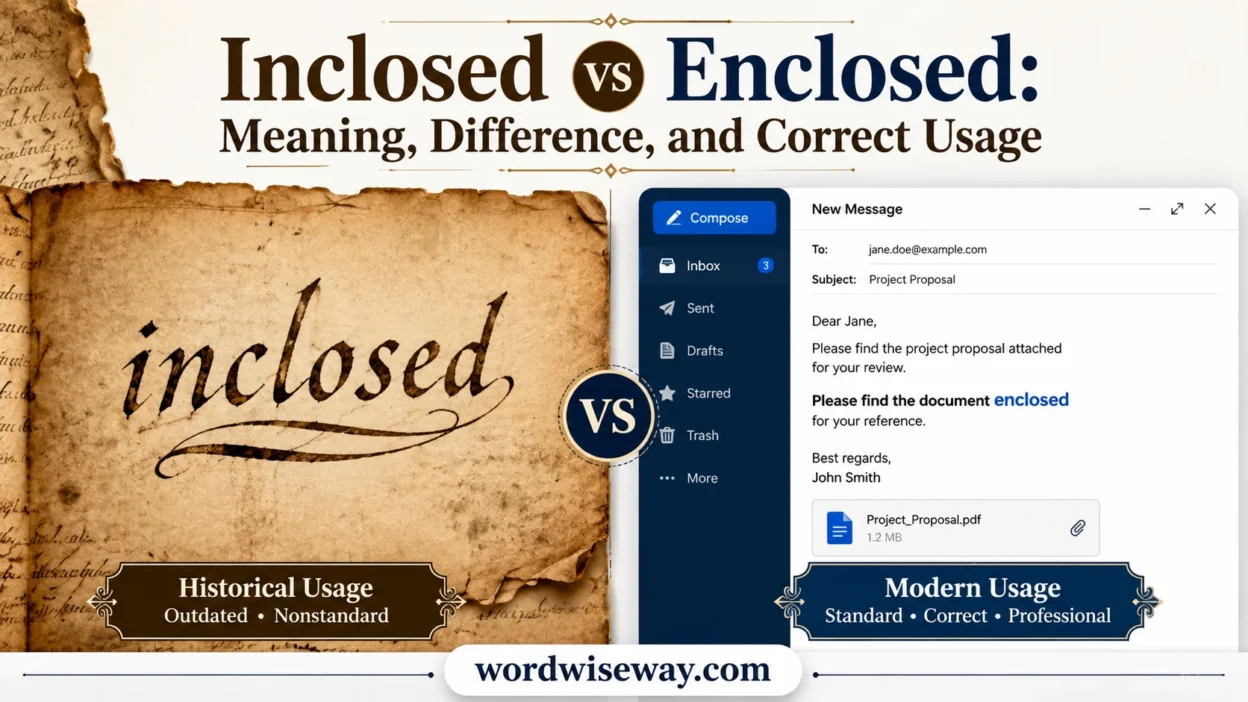
Inclosed vs Enclosed: Meaning, Difference, Usage, and Rules appears in writing letters, business correspondence, and academic papers, where writers often face confusion, correct use, and common mistakes while handling enclosed or inclosed in formal correspondence. Across English-language books, published essays, ngram graphs, and the span of 1800 to 2000, usage shows a steadily declined pattern for Inclose, inclosed, and its variants, while enclosed became the preferred verb.
This shift reflects historical origins, similar meanings, and changing contexts. Modern writers use enclosed for actions such as inserting, shutting in, surrounding, enveloping, sending a mailed package, and referring to an enclosure. Older forms such as inclosed mainly appear in poetic writing and reflect faded usage traditions. Writers can avoid confusion, reduce mistakes, and keep their modern writing polished, credible, and clear by understanding these differences and studying practical examples.
In real-world writing, choose enclosed for letters, essays, legal papers, academic correspondence, and mailed packages to keep your language polished, credible, and modern. Use inclosed mainly when you discuss archaic, historical, or poetic contexts. By reviewing word meanings, origins, examples, and practical usage tips, writers can strengthen their word choices and avoid second-guessing themselves in everyday writing.
Finally, checking dictionaries and today’s dictionaries confirms both spellings, but highlights enclosed as the widely accepted form in modern usage. This improves readability, builds trustworthy, and credible communication that reflects knowledge, expertise, and strong communication-skill across emails, papers, and contracts, ensuring writers consistently maintain clarity and precision in every written form.
Search Intent Behind “Inclosed vs Enclosed”
Before diving into definitions, it helps to understand why people search this phrase.
Most users are trying to:
- Fix grammar in emails or letters
- Check if both spellings are acceptable
- Understand whether “inclosed” is a typo
- Learn professional writing standards
- Avoid sounding outdated in formal communication
In short, this is not just a vocabulary question. It is a professional clarity issue.
Quick Answer
If you are in a hurry, here is the clean answer:
- Enclosed = correct modern English spelling
- Inclosed = old and outdated spelling of the same word
- In writing, only enclosed is acceptable
That is the entire rule in one glance.
But understanding why this is the rule makes it easier to remember forever.
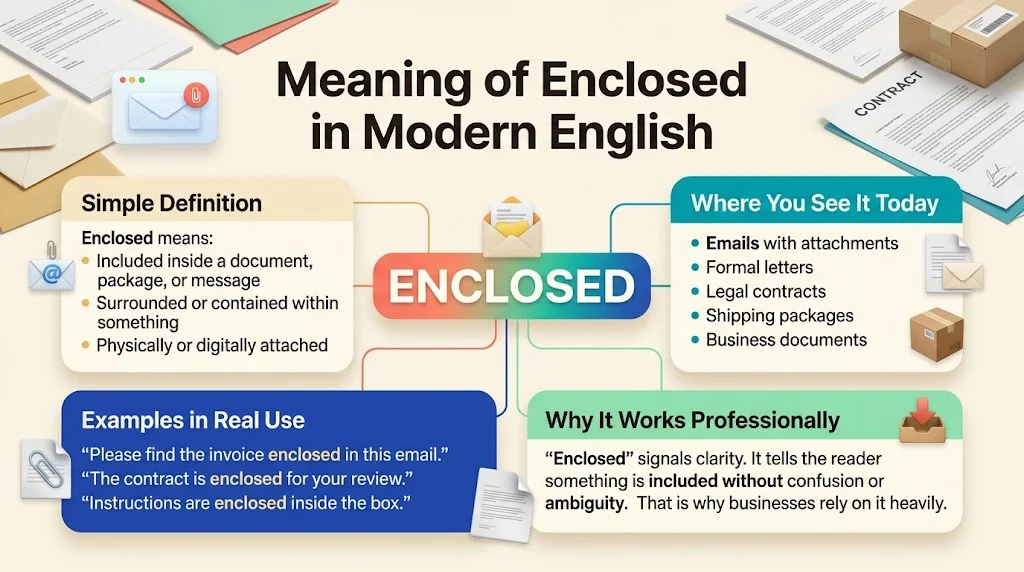
Meaning of Enclosed in Modern English
The word enclosed is the standard form used in modern communication. It means that someone includes something inside or attaches it to something else.
Simple Definition
Enclosed means:
- Included inside a document, package, or message
- Surrounded or contained within something
- Physically or digitally attached
Where You See It Today
- Emails with attachments
- Formal letters
- Legal contracts
- Shipping packages
- Business documents
Examples in Real Use
- Please find the invoice enclosed in this email.
- The contract is enclosed for your review.
- Instructions are enclosed inside the box.
Why It Works Professionally
“Enclosed” signals clarity. It tells the reader something is included without confusion or ambiguity. That is why businesses rely on it heavily.
Meaning of Inclosed and Why It Feels Familiar
Now let’s talk about inclosed.
Definition
“Inclosed” carries the same meaning as “enclosed,” but it is an archaic spelling.
It once meant:
- Included inside something
- Surrounded or contained
Why It Still Appears
You might still see “inclosed” in:
- Old books
- Historical letters
- Reprinted manuscripts
- Archival legal documents
Example from Older Writing Style
- The letter was inclosed with the report.
Today, this would be corrected to:
- The letter was enclosed with the report.
Modern Status
In 2026 English:
- It is not accepted in formal writing
- It is flagged as incorrect by grammar tools
- It can make writing look outdated
Think of it like an old spelling fossil preserved in language history.
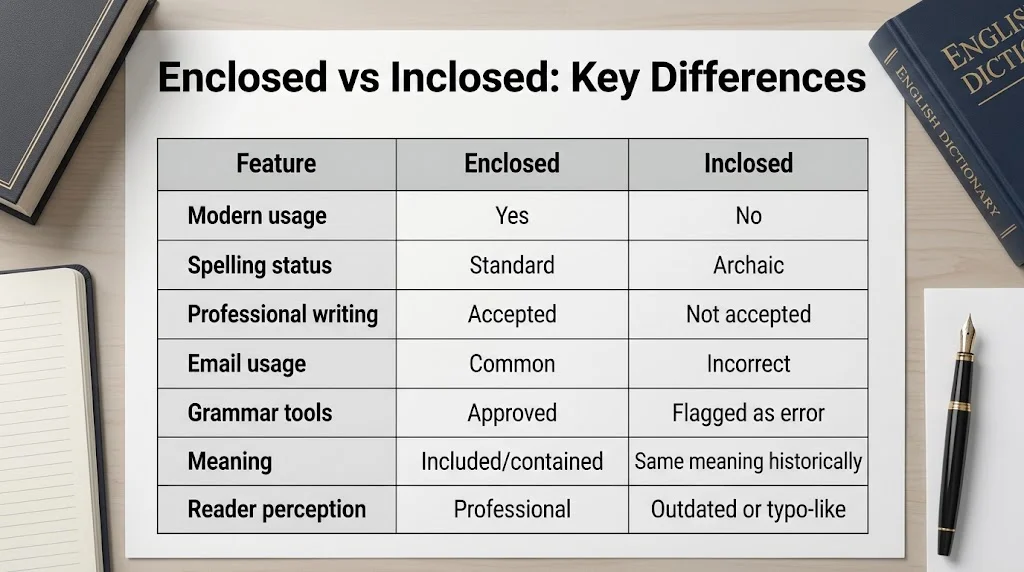
Key Differences Explained Clearly
Even though both words share meaning, their usage context is completely different.
| Feature | Enclosed | Inclosed |
| Modern usage | Yes | No |
| Spelling status | Standard | Archaic |
| Professional writing | Accepted | Not accepted |
| Email usage | Common | Incorrect |
| Grammar tools | Approved | Flagged as error |
| Meaning | Included/contained | Same meaning historically |
| Reader perception | Professional | Outdated or typo-like |
This table is the simplest way to lock the difference in memory.
Historical Evolution of Inclosed vs Enclosed
To understand why both words exist, we need to step back in time.
English spelling was not always fixed. Before dictionaries became standard, spelling often depended on how words sounded or how writers personally chose to spell them.
Early English Flexibility
In Middle and Early Modern English:
- Spelling was inconsistent
- Regional dialects influenced writing
- Writers often used multiple spellings for the same word
“Inclosed” and “enclosed” coexisted during this time.
The Printing Press Effect
The invention of the printing press changed everything.
Printed books required:
- Consistency
- Standard spelling rules
- Repeatable language forms
This pushed English toward standardization.
Dictionary Standardization
By the 18th century:
- Dictionaries began defining correct spelling
- Samuel Johnson’s dictionary helped formalize usage
- “Enclosed” became the preferred form
“Inclosed” slowly faded from professional writing.
Final Outcome
Over time:
- “Enclosed” became standard English
- “Inclosed” became obsolete
Today, only one survives in active usage.
Modern Usage Rules
Let’s make this practical.
Always Use “Enclosed” In:
- Business emails
- Academic papers
- Legal documents
- Customer communication
- Professional letters
Never Use “Inclosed” Unless:
- You are quoting historical text
- You are reproducing old documents
- You are writing stylistic historical fiction
Grammar Tools Behavior
Modern tools like:
- Grammarly
- Microsoft Word
- Google Docs
They consistently:
- Accept “enclosed”
- Flag “inclosed” as incorrect
This alone tells you how modern English treats it.
Where “Enclosed” Is Commonly Used Today
The word “enclosed” is extremely active in professional writing.
Email Communication
Example:
- Please find the presentation enclosed for your review.
Used when attaching files or documents.
Formal Letters
Example:
- Enclosed please find the requested documents.
This remains common in corporate communication.
Shipping and Packaging
Example:
- All accessories are enclosed in the box.
Used for clarity in physical products.
Legal Context
Example:
- The evidence enclosed herein supports the claim.
Used for precision in legal language.
Where “Inclosed” Still Appears
Even though outdated, it still exists in niche contexts.
Historical Archives
Old letters and manuscripts preserve original spelling.
Reprints of Old Texts
Publishers keep original wording for authenticity.
Literary Style Use
Some writers use it for historical tone.
Archival Legal Documents
Older contracts and records still contain it.
However, outside these areas, it is rarely seen.
Common Mistakes People Make With Inclosed vs Enclosed
This confusion creates predictable writing mistakes.
Mistake: Using “Inclosed” in Emails
Often happens when copying old templates.
Mistake: Thinking Both Are Interchangeable
They are not interchangeable in modern English.
Mistake: Confusing With “Closed”
These are different words:
- enclosed = included inside
- closed = shut or not open
Mistake: Over-Editing Old Texts
Some people accidentally “modernize” historical documents incorrectly.
Real Usage Examples (Correct vs Incorrect)
Let’s make it crystal clear.
Incorrect Usage
- The files are inclosed in this message.
Correct Usage
- The files are enclosed in this message.
Another Example
Incorrect:
- Please find the inclosed documents.
Correct:
- Please find the enclosed documents.
Historical Example
- The letter was inclosed with the petition.
Modern rewrite:
- The letter was enclosed with the petition.
Read More: Skull or Scull: Meaning, Difference, and Correct Usage
Case Study: Business Email Correction Impact
A small but real-world example shows why this matters.
Scenario
A junior employee sends a formal email using “inclosed” instead of “enclosed.”
Outcome
- Recipient notices outdated spelling
- Email feels less professional
- Internal correction is issued
Fixed Version Result
After correction:
- Email reads more professional
- Communication becomes clearer
- No distraction from content
Key Insight
A single outdated spelling can subtly affect perceived credibility in professional communication.
Grammar Authority Consensus
Modern English references consistently agree:
- “Enclosed” is the only correct modern spelling
- “Inclosed” is marked as archaic
- It is not used in professional writing standards
This consensus is universal across:
- American English
- British English
- International business English
There is no split opinion here.
Simple Memory Trick to Never Confuse Again
Here is an easy mental shortcut:
- E in Enclosed = Email era (modern writing)
- I in Inclosed = Inside history (old writing only)
Once you associate it this way, the confusion disappears.
Key Insights
- Enclosed is the preferred spelling in modern English.
- Inclosed is an archaic variant mainly found in historical writing.
- Use enclosed in emails, letters, academic work, and professional documents.
- Both forms have the same basic meaning, but their usage and style differ.
- Historical texts may preserve inclosed for authenticity.
- Choosing enclosed helps maintain clear, current, and professional word-choice.
- Understanding language origins makes unusual spelling variants easier to recognize.
- When unsure, check reliable dictionaries and consider the writing context.
My Personal Experience
As an English language specialist, I have often come across Inclosed vs Enclosed while reviewing emails, letters, academic papers, and other forms of professional writing. I have noticed that inclosed can cause hesitation because it appears in older books, documents, and historical contexts. When helping writers make the right word-choice, I usually consider the purpose and audience first. For present-day communication, I recommend enclosed because it fits current modern usage and keeps the writing clear and professional.
My experience has shown me that learning the meaning, origins, and development of words makes these spelling decisions much easier. When someone asks me about Inclosed vs Enclosed, I explain that recognizing older variants can prevent confusion, especially when reading historical material. I also encourage writers to consult reliable dictionaries and pay attention to real contexts. This habit strengthens grammar, writing skills, and semantic precision, while helping writers feel more confident when choosing the appropriate form.
Practice:
Choose the Correct Word
Fill in each blank with enclosed or inclosed.
- Please find the requested documents ______ with this letter.
- The package contained an ______ instruction sheet.
- The old manuscript used the spelling ______.
- I have ______ the receipt for your reference.
- The historical letter stated that the papers were ______ with the application.
Correct the Mistake
Rewrite each sentence using the appropriate modern spelling.
- Please find the inclosed report.
- The documents are inclosed with this email.
- I have inclosed the requested form.
Answer Key
- enclosed
- enclosed
- inclosed
- enclosed
- inclosed
Remember: Use enclosed for modern writing. Keep inclosed mainly when reproducing or discussing historical text.
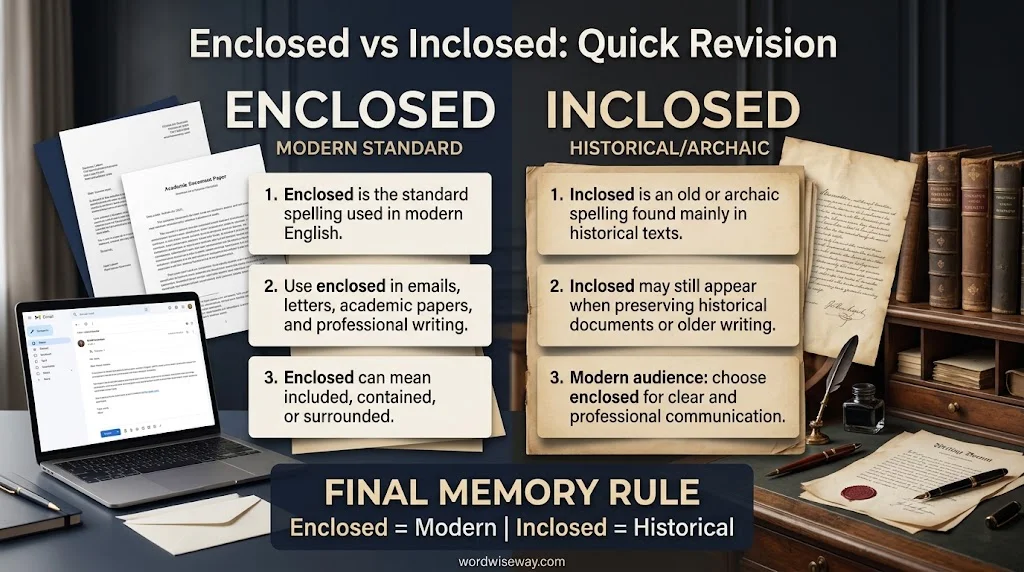
Quick Revision
- Enclosed is the standard spelling used in modern English.
- Inclosed is an old or archaic spelling found mainly in historical texts.
- Use enclosed in emails, letters, academic papers, and professional writing.
- Enclosed can mean included, contained, or surrounded.
- Inclosed may still appear when preserving historical documents or older writing.
- When writing for a modern audience, choose enclosed for clear and professional communication.
- Remember: Enclosed = modern; Inclosed = historical.
FAQs
1. What is the main difference between inclosed and enclosed?
Ans: The main difference is usage over time. Enclosed is the modern standard, while inclosed is outdated and mostly found in older texts.
2. Is “inclosed” still correct English?
Ans: Yes, but only in historical or archaic usage. In modern English, enclosed is preferred in all formal writing.
3. When should I use “enclosed”?
Ans: You should use enclosed in letters, emails, business correspondence, and academic papers for clarity and correctness.
4. Why did “inclosed” disappear from modern usage?
Ans: Because language trends in English-language books, published essays, and ngram graphs (1800–2000) show a steady shift toward enclosed.
5. Is there any grammar rule banning “inclosed”?
Ans: No strict grammar rule bans it, but modern dictionaries and usage guides strongly recommend enclosed.
6. Can I use “inclosed” in academic writing?
Ans: It is not recommended. Enclosed is the accepted standard in academic-writing and professional-writing.
7. What does “enclosed” mean?
Ans: It means something is inserted, shut in, or surrounded, often referring to documents in an envelope or mailed package.
8. Why do writers get confused between these words?
Ans: Because of historical origins, similar meanings, and exposure to older texts where inclosed was once used.
9. Is “inclosed” a spelling mistake?
Ans: In modern usage, yes. It is generally treated as a misspelling of enclosed.
10. Which word should I always use today?
Ans: You should always use enclosed, as it ensures clarity, correctness, and modern writing standards.
Conclusion
The comparison of Inclosed vs Enclosed shows a clear evolution in English usage, where enclosed has become the dominant and preferred form in modern communication. In contrast, inclosed now appears mainly in historical or outdated contexts.
For today’s writing letters, business correspondence, and academic papers, using enclosed ensures better clarity, correctness, and professional tone. Understanding this difference helps writers avoid confusion, improve grammar usage, and maintain strong writing standards in all forms of communication.